In one line: variation of g: JEE/NEET Physics · Gravitation series · Part 7 of 8 · All parts →✪ Key points — the 30-second versionHeight: g' ≈ g(1 − 2h/R) — exact: gR²/.
JEE/NEET Physics · Gravitation series · Part 7 of 9 · All parts →
- One recipe: your gravity = (mass beneath you) ÷ (distance from centre)²
- Up a mountain: g falls a little · Deep in a mine: g falls to zero at the centre
- Spinning Earth makes the equator’s g slightly weaker than the poles’
- g runs from 9.780 (equator) to 9.832 (poles) — ‘9.8’ is an average in disguise
- Exact formula for height; the shortcut only works for small heights
Stand on a spring balance at the equator, then at the North Pole — the same you weighs about 350 grams more at the Pole. Not an instrument trick: g itself genuinely changes with height, depth, and latitude. NEET asks all three as direct formula questions. Part 7 of the Gravitation series — with one recipe behind all three.
- The one recipe behind everything
- Going up: the mountain case
- Going down: the mine case
- Spinning: the equator case
- What each letter means
- Solved examples
- Common mistakes
- This physics in your daily life
- Practice set
- Recap
The One Recipe Behind Everything
Your gravity depends on only two things: how much planet is beneath you, and how far you are from its centre. Climb: mass same, distance bigger → g falls. Dig: distance smaller BUT mass beneath you shrinks too → g still falls. Spin: some gravity gets ‘spent’ holding you on the circle → felt g falls. Three variations, one recipe.
Going Up: The Mountain Case
Climbing to height h moves you farther from the centre: divide by (R+h)² instead of R². Calibration: at Everest’s top, g drops only 0.03 m/s² — tiny, because 8.8 km is truly tiny next to 6,400 km. But at h = R (one full radius up), the exact formula gives g/4 — while the shortcut would absurdly give −g. If h isn’t tiny, use the exact form. A wrong-sign answer is your alarm bell.
Going Down: The Mine Case
Descend to depth d and something lovely happens: all the rock ABOVE your head cancels its own pull (a shell of uniform rock pulls you equally in all directions from inside — net zero). Only the ball of rock beneath you counts — and that ball shrinks as you descend. At the centre of the Earth: nothing beneath, pulls from every side cancel — g = 0. You would float at the centre of the Earth.
Spinning: The Equator Case
The spinning Earth carries you around a circle (biggest circle at the equator, shrinking to nothing at the poles). Going in a circle needs some inward pull — part of gravity is ‘spent’ as that inward pull, so the balance you stand on reads less. The discount is small (0.34% at the equator) but permanent — and combined with Earth’s slight equatorial bulge, real g runs 9.780 (equator) to 9.832 (poles).
What Each Letter Means
| Letter | What it means (plain words) | Value / unit |
|---|---|---|
| g | gravity strength at the surface (the starting value) | Earth: 9.8 m/s² |
| h / d | height climbed / depth dug | in metres |
| ω | spin rate of Earth in radians per second (2π ÷ 24 hours) | 7.29 × 10⁻⁵ |
| λ (lambda) | latitude — 0° at the equator, 90° at the poles | degrees |
Solved Examples
One substitution: g’ = 9.8 × (1 − ½) = 4.9 m/s².
Check: halfway down, half the ‘effective planet’ beneath you — linear, clean. ✔
Answer: 4.9 m/s² (= g/2)
Exact: g’ = g·R²/(2R)² = g/4 = 2.45 m/s².
Shortcut would say: g(1 − 2) = −g — nonsense! That’s the alarm: big h demands the exact formula. JEE tests exactly this discrimination.
Answer: g/4 = 2.45 m/s²
Step 1 — spin rate: ω = 2π/86,400 = 7.27×10⁻⁵ per second.
Step 2 — the spent part: ω²R = (7.27×10⁻⁵)² × 6.4×10⁶ ≈ 0.034 m/s².
Step 3 — fraction: 0.034/9.8 ≈ 0.34%.
Fun limit: if Earth spun ~17× faster (a day of 1.4 hours), the spent part would equal g itself — objects at the equator would float! ✔
Answer: ≈ 0.34% reduction at the equator
- Using the small-h shortcut for big h. It quietly returns nonsense (like −g). If h is a serious fraction of R, use gR²/(R+h)² exactly.
- ‘g = 0 at the centre, so energy = 0 there too.’ No! At the centre, gravity’s pull is zero but the trap is at its DEEPEST (energy −1.5GMm/R). Zero pull ≠ zero debt.
- Degrees instead of radians for ω. The spin formula needs radians per second (2π per rotation). A degree slips in and every number is silently wrong.
- Digging past the centre. The depth formula only applies inside the planet — d cannot exceed R.
This Physics in Your Daily Life
- The gold-trader margin: a 70 kg person reads ~350 g lighter at the equator than at the poles on a spring balance — precision traders and calibration labs genuinely account for latitude.
- Mineral and oil hunting: dense ore buried underground makes g slightly stronger above it. Companies map tiny g-variations to find oil and minerals — a whole industry built on this card.
- ESA’s GOCE satellite mapped Earth’s gravity variations so precisely that ocean currents and melting ice show up in the data.
- Deep gold mines (like South Africa’s 3.8-km ones) can measure the depth-effect with a simple pendulum — this card, tested underground.
Practice set (answers hidden — try first)
(NEET-level) g at the bottom of a mine d = R/1000:
(JEE Main-level) g at height h = R:
(Concept) Where do you weigh most — equator, pole, or Everest’s summit?
(NEET-level) The depth where g becomes g/4:
(Concept) At the centre of the Earth, your weight and the gravity trap are:
- 🧠 One recipe chant: ‘mass beneath ÷ distance²’ — all three variations are edits of this.
- 🧠 Height hits twice as hard: height uses 2h/R, depth uses just d/R.
- 🧠 Centre of Earth: zero pull, deepest trap — ‘no slope at the bottom of the well’.
- 🏠 Daily: you weigh ~350 g less at the equator than at the poles — gold traders account for it.
- 🏠 Daily: oil companies map tiny g-changes to find hidden deposits — an entire industry on this card.
- one recipe: g = (mass beneath) ÷ (distance from centre)²
- height: g’ = gR²/(R+h)² ≈ g(1 − 2h/R) — shortcut only for tiny h
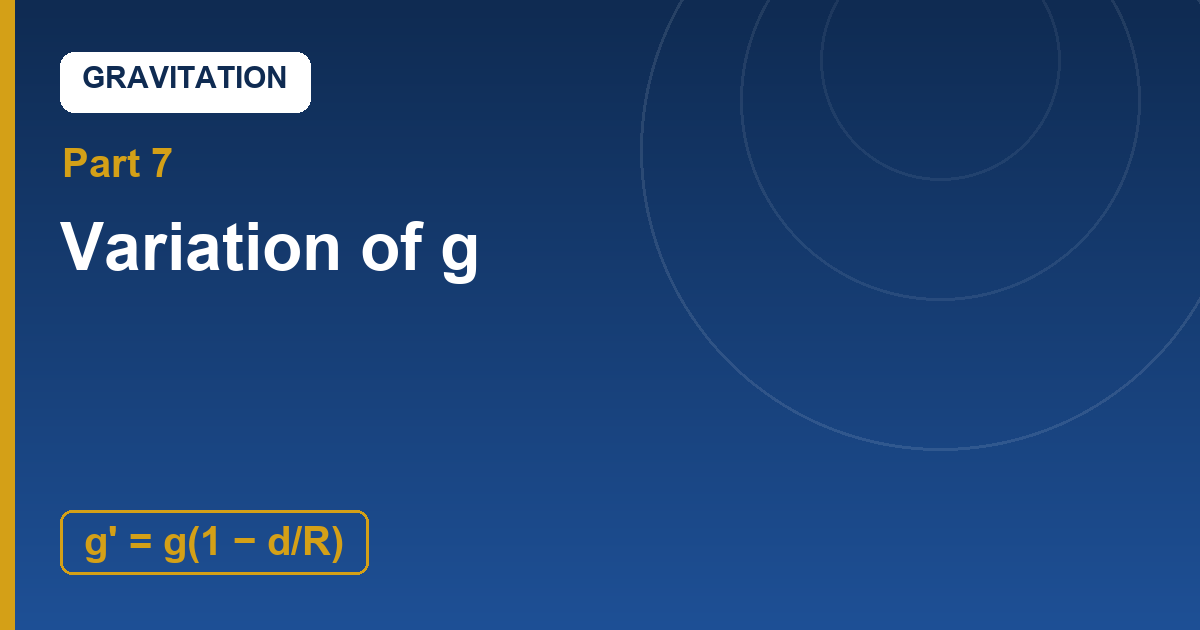
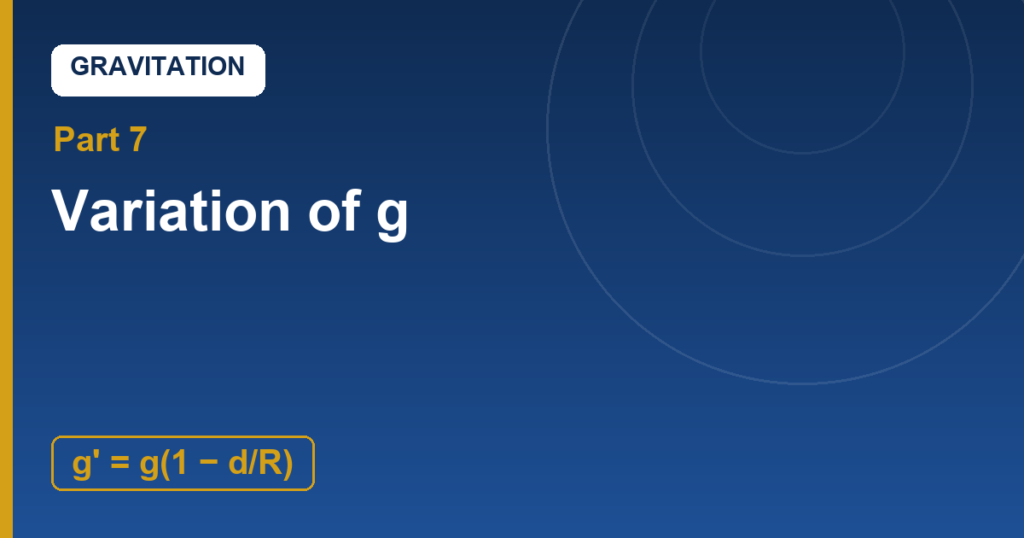
- depth: g’ = g(1 − d/R) — rock above cancels itself; g = 0 at the centre
- spin: g’ = g − ω²R cos²λ — biggest discount at the equator (~0.34%)
- real g: 9.780 (equator) to 9.832 (poles)
Quick revision
- One recipe: your gravity = (mass beneath you) ÷ (distance from centre)²
- Up a mountain: g falls a little · Deep in a mine: g falls to zero at the centre
- Spinning Earth makes the equator’s g slightly weaker than the poles’
- g runs from 9.780 (equator) to 9.832 (poles) — ‘9.8’ is an average in disguise
- Exact formula for height; the shortcut only works for small heights
- The one recipe behind everything
- 1Escape Velocity: The Speed That Ends Gravity’s Grip
- 2Orbital Velocity: Why the ISS Never Falls
- 3Kepler’s Laws: The 1609 Prediction Machine NASA Still Uses
- 4Angular Momentum: Gravity Can Pull, It Cannot Twist
- 5Gravitational Potential Energy: Why the Minus Sign Matters
- 6Satellite Energy: Why Total Energy Is Negative KE Over Two
- 7Variation of g: Why You Weigh Less at the Equator
- 8Black Holes, LIGO and Lagrange Points: Gravitation’s Research Frontier
- 9Gravitation Bonus: Field Intensity, Shell Theorem, Weightlessness and GEO Satellites
Have a doubt on this topic?