

Beats in Music: When Two Notes Almost Agree
In one line: Beats — exam-ready notes in one glance.
- The Simple Idea: Alternating Reinforcement and Cancellation
- The Formula: Beat Frequency Is the Difference of Frequencies
- Why Beats Happen: The Phase-Drift Picture
- The Amplitude Equation — A Quick JEE-Level Derivation
- Tuning by Beats to Zero
- Solved Examples
- This Physics in Your Daily Life
- Practice Set (answers hidden — try first)
- Frequently Asked Questions
- Exam Checklist
- FAQ
- How much of this page is exam-relevant?
- When should I revisit?
- The Thirty-Second Recap
- Explain It Simply
- Abbreviations That Recur Here
- Key Takeaways
- The Framework Line to Memorise
JEE/NEET Physics · Oscillations & Waves series · Part 7 of 8 · All parts →
- Two close frequencies trade loudness: loud-quiet-loud-quiet = beats
- Beat frequency = the DIFFERENCE of the two frequencies: f_beat = |f₁ − f₂|
- In addition, beats are interference in time (standing waves were interference in space)
- Zero beats = perfect tuning — how musicians tune by ear
- 1 beat/second = frequencies 1 Hz apart
Two flutists play nearly the same note — the sound swells and dips, ‘waa-waa-waa’, a few times a second. That throbbing is beats — and it’s so precise that musicians, piano tuners and Doppler radars use it as a measuring instrument. Part 7 of the Oscillations & Waves series.
- Therefore, the simple idea: constructive/destructive alternation
- The formula: difference of frequencies
- What each letter means
- In addition, why beats happen: the phase-drift picture
- The amplitude equation (JEE derivation)
- Tuning by beats to zero
- Therefore, solved examples
- Common mistakes
- This physics in your daily life
- In addition, practice set
- Recap
- Frequently asked questions
The Simple Idea: Alternating Reinforcement and Cancellation
Two waves at almost the same frequency drift in and out of step. When they are in step (crest on crest), they add constructively → loud. When they fall out of step (crest on trough), they cancel destructively → quiet. Because the frequencies are slightly different, this alignment keeps changing: as one wave slowly gains a cycle on the other, loud and quiet alternate rhythmically — the beat is interference in time, exactly as standing-wave patterns are interference in space.
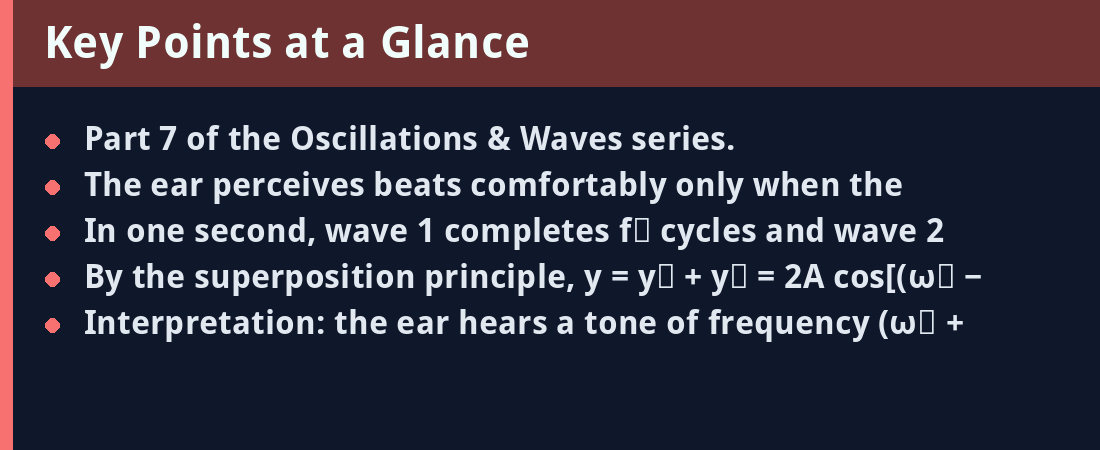
Here is the crucial condition: the two frequencies must be close. If they are far apart (say 300 Hz and 500 Hz), the phase relationship changes so rapidly that your ear cannot follow the loudness swings — you simply hear two separate tones. The ear perceives beats comfortably only when the difference is small, roughly within ~10 Hz. That is why beats are a phenomenon of almost-identical notes — hence the title of this card.
The Formula: Beat Frequency Is the Difference of Frequencies
LOUD (in step)
quiet (out of step)
LOUD
1 beat period = 1/|f₁ − f₂|
| Letter | What it means (plain words) | Value / unit |
|---|---|---|
| f₁, f₂ | the two close frequencies | Hz |
| f_beat | throbs per second = their difference | Hz — always positive |
| T_beat = 1/f_beat | time between successive loud moments (the beat period) | s |
Why the difference? In one second, wave 1 completes f₁ cycles and wave 2 completes f₂ cycles. So the faster wave gains exactly (f₁ − f₂) whole cycles on the slower one. Each gained cycle means the phase relationship has swept through a full in-step → out-of-step → in-step round trip — one complete loud-quiet-loud throb. Gained cycles per second = beats per second. Simple arithmetic, deep reason.
Why Beats Happen: The Phase-Drift Picture
Think of the two waves as two clocks whose hands move at slightly different speeds. The hands coincide (alignment → loud), then one pulls ahead, and after a while they point in opposite directions (opposition → quiet), then coincide again. The number of times per second one hand laps the other is precisely |f₁ − f₂|. The beat is the sound of two clocks’ hands lapping each other.
This also explains the amplitude requirement: the deepest silences between throbs occur only when the two waves have equal amplitudes, so crest can fully cancel trough. If one wave is much louder, the sum never dips to silence — you hear a weaker wobble instead. Exam questions sometimes ask exactly this: when are beats most distinct? Answer: equal amplitudes.
The Amplitude Equation — A Quick JEE-Level Derivation
Let two waves of equal amplitude A and close frequencies ω₁ and ω₂ arrive at your ear:
y₁ = A sin ω₁t, y₂ = A sin ω₂t.
By the superposition principle, y = y₁ + y₂ = 2A cos[(ω₁ − ω₂)t/2] · sin[(ω₁ + ω₂)t/2].
Interpretation: the ear hears a tone of frequency (ω₁ + ω₂)/2 — essentially the average, indistinguishable from f₁ ≈ f₂ — whose amplitude envelope is |2A cos[(ω₁ − ω₂)t/2]|. The envelope peaks twice for every full cosine cycle, so the loudness throb rate is |f₁ − f₂| — the beat frequency. Note the subtlety: the envelope itself has frequency |f₁ − f₂|/2, but the loudness (which depends on the envelope’s magnitude) repeats at |f₁ − f₂|. This is a favourite JEE trap.
Tuning by Beats to Zero
Adjust one instrument until the throbbing slows… slows… vanishes: zero beats = identical frequencies. The ear hears ‘zero’ exquisitely well — far better than it can judge “is this 440 or 441 Hz?” directly. This is how orchestras tune to the oboe’s reference A and how piano tuners work, counting beats against a standard and chasing the count down to zero, string by string.
Practical procedure in three steps: (1) sound both sources, (2) count beats per second to know how far apart the frequencies are, (3) make a deliberate change (tighten a string, add wax to a fork) and see whether the beat count rises or falls — the direction tells you whether you are moving closer to or further from the reference. When the beats vanish, you are in unison.
Solved Examples
Difference: |259 − 256| = 3 Hz → 3 loud-quiet cycles per second. ✔
Answer: 3 beats/s
Step 1 — two candidates from 2 beats: the unknown is either 254 or 258 Hz. Beats alone cannot tell you which — beats give only the difference.
Step 2 — the wax test decides: wax loading a fork prong slows its vibration frequency slightly.
• If the unknown were 258 Hz: slowing moves it toward 256 → beats should fall (2 → 1 → 0). ✘
• If the unknown were 254 Hz: slowing moves it away from 256 (254 → 253) → beats should rise (2 → 3). ✔ — which is exactly what was observed.
Answer: 254 Hz
Step 1 — candidates: 436 or 444 Hz (4 beats against 440).
Step 2 — direction test: tightening raises string tension, which raises the pitch.
• If it started at 444: raising the pitch moves it further above 440 → beats would rise. ✘
• If it started at 436: raising the pitch brings it up toward 440 → beats fall 4 → 2 → 0. ✔
Final state: zero beats = perfectly tuned at 440 Hz.
Answer: originally 436 Hz; tuned to 440 Hz
- Forgetting the two-candidate ambiguity. ‘4 beats against 440’ means 436 OR 444 — without a change-test (wax, tightening), the answer is not unique. Always check whether the question supplies the deciding test; if it does, apply the direction logic explicitly.
- Adding instead of subtracting. Beats are the DIFFERENCE, never the sum (the sum is a related but different phenomenon).
- Expecting to hear beats from distant frequencies. A 300 Hz and 500 Hz pair doesn’t beat audibly — beats need CLOSE frequencies (roughly within ~10 Hz for the ear).
- Confusing beat frequency with the perceived pitch. You hear a tone near f₁ ≈ f₂ that THROBS at |f₁ − f₂| — the throb and the note are different numbers.
- Sign errors in the direction test. Write both candidates down, state clearly which way the change moves each one, and compare with the observed rise/fall. Skipping this step on paper is where marks are lost.
This Physics in Your Daily Life
- Every orchestra tuning — strings adjusting to the oboe’s A while beats slow to silence — is this card performed publicly.
- Piano tuners count beats between a string and a standard; the craft is zeroing beats string by string.
- Doppler radars and speed guns measure beats between the emitted wave and the reflection from a moving vehicle — the beat frequency IS your speed reading.
- Aircraft and machine monitoring: two engines at slightly different RPM produce a throbbing drone; mechanics diagnose mis-tuning by ear — beats as a maintenance tool.
- Binaural beats in headphones (e.g. 350 Hz in the left ear, 357 Hz in the right) create a perceived 7 Hz throb — marketed relaxation tech built directly on the difference rule.
- Hum detection: an appliance humming slightly off from the mains frequency beats against it — an audible warning that something is drifting out of spec.
Practice Set (answers hidden — try first)
(NEET-level) Forks at 512 and 508 Hz. Beats/s:
(JEE Main-level) 440 Hz standard, 4 beats/s; tightening reduces it to 2. The string was:
(NEET-level) Beats are heard most distinctly when the two forks have:
(JEE Main-level) Beats of 5/s disappear when one fork is waxed to reduce f slightly. Original pair:
(Concept) Zero beats means:
(JEE Advanced-style) A sonometer wire beats 3/s with a 256 Hz fork; loading the wire with a small mass raises its pitch and the beats fall to 1/s. Original wire frequency?
- 🧠 Chant: ‘the throb is the difference’.
- 🧠 Tuning rule: ‘chase the beats to zero’.
- 🧠 Ambiguity check: ‘two candidates — demand the change-test’.
- 🏠 Daily: orchestras and piano tuners zero beats for a living.
- 🏠 Daily: a speed gun’s readout is a beat frequency converted to km/h.
- Therefore, 🔁 f_beat = |f₁ − f₂|
- 🔁 beats need close frequencies (a few Hz apart)
- 🔁 zero beats = matched frequencies
Two tuning forks at 256 Hz and 258 Hz: separately, pure tones. Together: a note that swells and fades twice a second. The tones take turns reinforcing and cancelling — constructive, destructive, constructive — and your ear hears the handshake as a throb.
f_beat = |f₁ − f₂| = 2 Hz. Musicians tune by driving this to zero: as two strings approach agreement, the beat slows — 4 Hz, 2 Hz, 0.5 Hz… silence between throbs — until the throb disappears entirely. Beats ARE the tuner’s stethoscope.
Draw two sine waves of slightly different spacing, then their sum: a wave whose envelope rises and falls in slow hills. Crest-on-crest (in phase): tall sum. Crest-on-trough (out of phase): flat. The sum’s envelope is the beat.
Frequently Asked Questions
Q. Can beats occur with light waves?
Yes — interference in time works for any wave. In optics, beating between two close light frequencies is the basis of heterodyne detection, though the beat frequencies are far too fast to see directly and are detected electronically.
Q. Why must the amplitudes be equal for best beats?
Complete destructive interference needs crest exactly matching trough. With unequal amplitudes, the sum never reaches zero — the throbbing becomes shallower but the beat frequency is unchanged, since it depends only on |f₁ − f₂|.
Q. What happens if the frequencies are very close, like 0.1 Hz apart?
Beats still occur, just very slowly — one throb every 10 seconds. Zero difference means no beats at all: steady, unchanging loudness.
Q. Is the beat frequency ever negative?
No. That is why the formula uses the absolute value |f₁ − f₂|. Physically, a throb rate can’t be negative; mathematically, the absolute value encodes that it doesn’t matter which source is faster.
- In addition, beats = loudness throbbing from two close frequencies
- f_beat = |f₁ − f₂| — always the difference, always positive
- perceived pitch ≈ the average (f₁ + f₂)/2; the throb rate is the difference — don’t mix them up
- Therefore, deepest beats need equal amplitudes
- zero beats = perfect unison (tuning target)
- ambiguous cases resolved by a change-test (wax/tighten)
- In addition, beats are interference in time; standing waves are interference in space
Contents: this page covers Beats: When Two Notes Almost Agree with worked notes, tables, a checklist and a rapid recap.
Exam Checklist
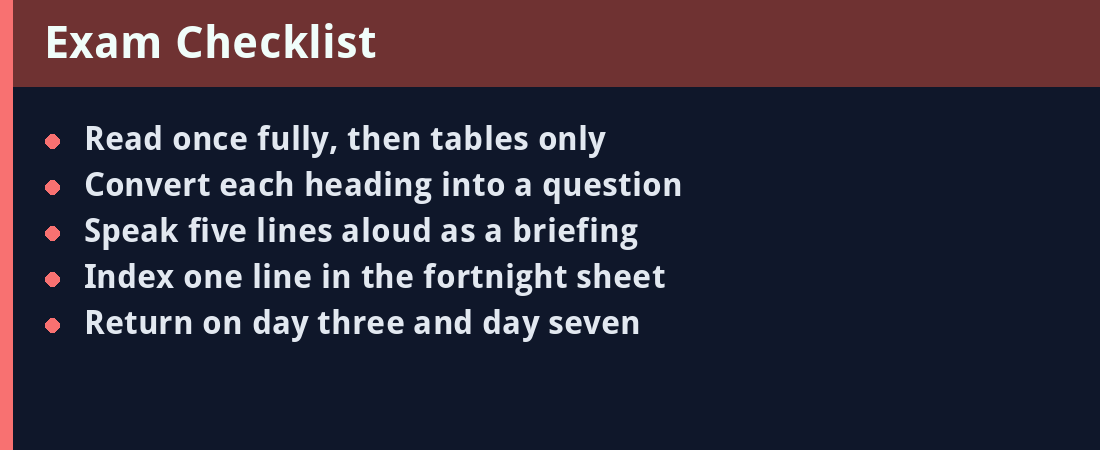
- Read once fully, then tables only
- Convert each heading into a question
- Therefore, speak five lines aloud as a briefing
- Index one line in the fortnight sheet
- Return on day three and day seven
FAQ
How much of this page is exam-relevant?
Nearly all of it, because the tables and worked items follow the standard question register for this subject.
When should I revisit?
Day three and day seven after the first read, with the drill spoken aloud once.
The Thirty-Second Recap
One page. One topic. Therefore, read the tables twice. Speak the recap once. Moreover, the numbers carry the marks. The names carry the traps. However, revisits beat rereads. Finally, day three and day seven. That is all.
Explain It Simply
Think of this page as a map of one neighbourhood. The big streets are the tables. The landmarks are the numbers. The street names are the terms in bold. However big the city feels, this one neighbourhood fits in a pocket, and a pocket map is what exam week needs. Therefore, walk it once fully, then walk only the streets you forget, and by the second walk the neighbourhood feels like home.
Pocket the map, not the whole city: exams reward the walkable version of every topic.
Abbreviations That Recur Here
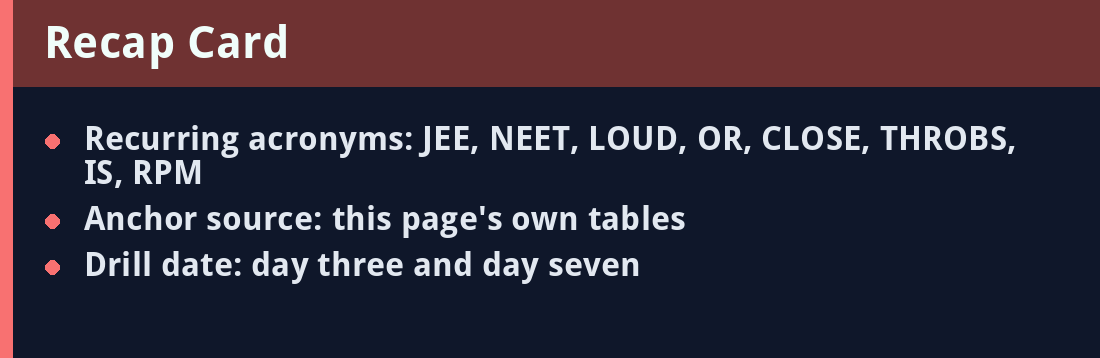
- NEET.
- LOUD.
- CLOSE.
- THROBS.
- RPM.
Key Takeaways
In conclusion, Beats: When Two Notes Almost Agree compresses into its tables, its numbers and its checklist above. To summarize, revise twice this week, speak the recap once, and let the acronyms carry the recall. Therefore, this page banks itself in ten honest minutes.
The Framework Line to Memorise
The interference pattern runs like an algorithm nature executes without a protocol: every wave validates against every other inside a framework older than instruments, and no configuration of the room is exempt.
Two notes walk into a room; the beat they leave behind is the physics the ear performs.
Moreover, the exam frames this chapter through configuration: change one frequency parameter and the entire interference algorithm reprints the pattern, a framework every solved example validates in three lines.
Quick revision
- Two close frequencies trade loudness: loud-quiet-loud-quiet = beats
- Beat frequency = the DIFFERENCE of the two frequencies: f_beat = |f₁ − f₂|
- In addition, beats are interference in time (standing waves were interference in space)
- Zero beats = perfect tuning — how musicians tune by ear
- 1 beat/second = frequencies 1 Hz apart
- Therefore, the simple idea: constructive/destructive alternation
Have a doubt on this topic?
Sources & official references
External references for fact-checking and further reading.