
Doppler Effect Explained: Master the Grand Finale Formula Card
In one line: Doppler Effect and the Grand Finale Formula Card — exam-ready notes in one glance.
- Why Motion Changes Pitch: The Moving-Crest Picture
- The Rule of Thumb: Closer = Higher
- What Each Letter Means
- Light: Red and Blue Shifts
- Solved Examples
- This Physics in Your Daily Life
- Recap + Grand Finale Formula Card
- Practice Set (Answers Hidden — Try First)
- Exam Checklist
- FAQ
- How much of this page is exam-relevant?
- When should I revisit?
- The Thirty-Second Recap
- Explain It Simply
- Abbreviations That Recur Here
- Key Takeaways
One-page formula card (PDF) — print it, pin it, revise from it. Free, no signup.
JEE/NEET Physics · Oscillations & Waves series · Part 8 of 8 · All parts →
- Doppler: relative motion changes the heard frequency — closer = higher, receding = lower
- The size of the shift grows with (speed ÷ wave speed)
- Light version: redshift/blueshift — the universe’s speedometer
- Applications: sirens pass by, radar speed guns, medical ultrasound, exoplanets, expanding universe
- Complete chapter formula card at the end
An ambulance siren screams toward you, passes, and the pitch drops — yet the driver hears no change at all. That pitch shift, the Doppler effect, is how police catch speeders, doctors image blood flow, meteorologists warn of tornadoes, and astronomers discovered the universe is expanding. This is the grand finale of the Oscillations & Waves series — and it closes the loop beautifully, because Doppler ties together waves, frequency, and motion in a single, elegant idea.
- Therefore, why motion changes pitch
- The rule of thumb: closer = higher
- What each letter means
- In addition, light: red and blue shifts
- Solved examples
- Common mistakes
- Therefore, this physics in your daily life
- Practice set
- Recap + formula card
Why Motion Changes Pitch: The Moving-Crest Picture
The siren emits wave crests at a fixed rate — that rate (the true frequency f₀) never changes. What changes is where each crest begins its journey. Rushing toward you, each new crest is emitted from a position closer than the previous one, so each crest has less distance to cover. The crests arrive squeezed together (shorter λ, higher f). Moving away, each crest starts from farther out, so they arrive stretched apart (longer λ, lower f).
The crucial insight: the source never changed; the journey did. The Doppler effect is not a change in the emitted wave — it is a change in the arrival rate of crests at your ear. That’s why the driver of the ambulance hears a perfectly steady tone while everyone on the pavement hears the dramatic slide.
The Rule of Thumb: Closer = Higher
source →
ahead: squeezed → HIGHER pitch
behind: stretched → LOWER
Before touching any formula, decide the direction of the shift. Then estimate its size. The shift is roughly proportional to the source’s speed as a fraction of the wave speed — a source moving at one-tenth the wave speed produces roughly a ten percent shift.
What Each Letter Means
| Letter | What it means (plain words) | Value / unit |
|---|---|---|
| f | heard frequency (what changes) | Hz |
| f₀ | true emitted frequency (fixed by source) | Hz |
| v | wave speed in the medium (sound: ~343 m/s in air at 20 °C) | m/s |
| v_s, v_o | source’s and observer’s speeds toward each other | m/s |
Full quantitative formulas fill a page; for exams, the honest shortcut is the ratio scale: a source at 10% of the sound speed shifts pitch by ~10% — roughly 1.7 musical semitones. Memorise direction + rough size; derive exactly when the question demands it.
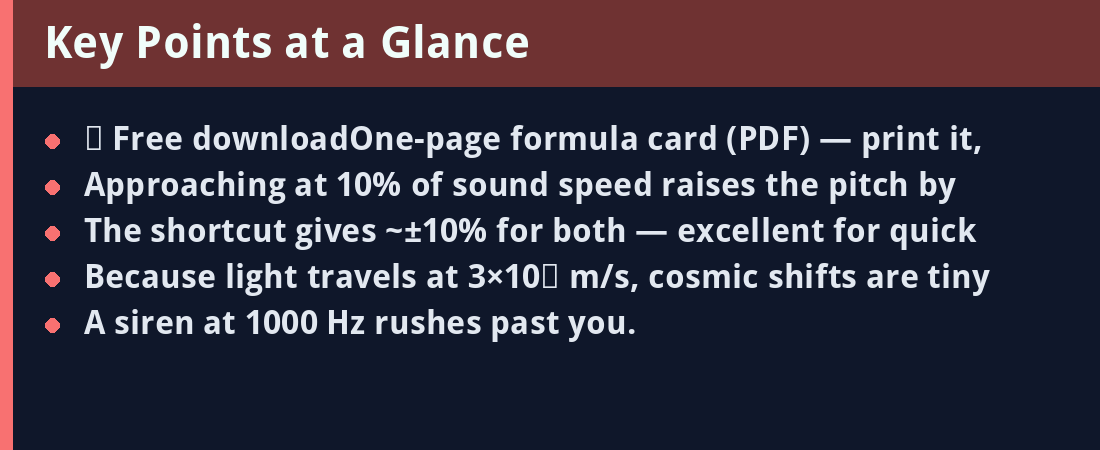
One subtlety worth knowing for JEE: the shift is asymmetric. Approaching at 10% of sound speed raises the pitch by about 11% (v/(v − v_s) = 340/306 ≈ 1.11), while receding at the same speed lowers it by about 9% (v/(v + v_s) ≈ 0.91). The shortcut gives ~±10% for both — excellent for quick elimination of options, exact only when the speeds are small.
Light: Red and Blue Shifts
Light does exactly the same thing, but we read the shift in colour. Light from an approaching star is squeezed to shorter wavelengths — a blueshift; light from a receding one is stretched to longer wavelengths — a redshift. Because light travels at 3×10⁸ m/s, cosmic shifts are tiny fractions — but astronomy’s instruments measure them superbly.
Edwin Hubble observed that light from virtually every distant galaxy is redshifted, and that the farther the galaxy, the bigger the shift. That observation is the expanding universe — and, run backwards, it is the evidence base for the Big Bang. The same siren physics, stretched across billions of light-years.
Solved Examples
Direction rule: approaching — heard above 1000 Hz; the instant it passes, a drop to below 1000 Hz. The drop at the pass is the Doppler signature — it is the question’s real test, not the exact numbers. ✔
Answer: higher → drops to lower at the pass
Double shift: the car, acting as a moving observer, sees a raised frequency; it then reflects (re-radiates) that raised frequency as a moving source — a second shift of the same size. Total shift ≈ 2 × f₀ × (v/c) = 2 × 24×10⁹ × (30/3×10⁸).
= 4,800 Hz beat — the gun counts 4.8 kHz of beats, converts via v = (beat/2f₀)·c, and prints ‘108 km/h’. ✔
Answer: beat ≈ 4.8 kHz → 108 km/h
10% approach → ~10% up: ≈ 660 Hz.
Exact: f = 600 × 340/(340 − 34) = 600 × 340/306 ≈ 667 Hz — the shortcut’s 660 lands within 1%. Direction + ratio first, exact when the options are close together. ✔
Answer: ≈ 667 Hz (exact); ~660 by the 10% rule
- Reversing the direction. Approach = higher, ALWAYS — for both moving source and moving observer. Write the direction rule before any formula.
- Using wave speed vs relative speed loosely. The shift scale is source speed ÷ WAVE speed (343 m/s for sound, 3×10⁸ m/s for light) — mixing them gives absurd answers.
- Thinking the siren itself changes. f₀ never changes; only the arrival rate does. The driver hears the true pitch throughout.
- Forgetting the along-the-line component. Only the speed along the line joining source and observer counts. A car roaring past sideways sounds momentarily unshifted at the instant of closest approach.
- Redshift = ‘redder colour’ only. Astronomically it means ‘stretched wavelengths’ — light could start ultraviolet and still be called redshifted, ending merely blue.
This Physics in Your Daily Life
- Every siren, horn and racing car that drops pitch as it passes is a public Doppler demonstration.
- Speed guns (and speed traps) read a double-Doppler beat — your speed ticket is literally a frequency count.
- Doppler ultrasound in hospitals measures blood-flow speed through the skin — no incision, pure echo physics. It also flags heart-valve problems by revealing abnormal flow patterns.
- Weather Doppler radar maps wind inside storms from the shift of reflected microwaves — tornado warnings run on this card.
- Exoplanet hunting: a star tugged by an orbiting planet wobbles toward and away from us, its light alternately blue- and redshifting — the “radial velocity” method found hundreds of planets.
- The expanding universe: Hubble’s redshifts, the Big Bang’s evidence base, is the ambulance siren stretched across billions of light-years.
Recap + Grand Finale Formula Card
| What | Formula | Remember |
|---|---|---|
| SHM definition | a = −ω²x | pull-back ∝ displacement |
| SHM motion | x = A sin(ωt); v_max = Aω; a_max = ω²A | fastest at centre, strongest pull at ends |
| Clocks | pendulum: 2π√(L/g); spring: 2π√(m/k) | mass-free pendulum; gravity-free spring |
| SHM energy | ½kA² total; avg KE = avg PE | amplitude-squared |
| Springs combined | series k/2, parallel 2k (equal) | period ∝ 1/√k |
| Resonance | driver = natural frequency | amplitude maximum; damping barely shifts f |
| Wave link | v = fλ | f by source, v by medium |
| String waves | v = √(T/μ) | tighter/lighter = faster |
| Standing waves | f_n = n·v/2L (string, open pipe); odd only for closed (v/4L) | nodes λ/2 apart; ends are nodes |
| Beats | f_beat = |f₁ − f₂| | zero beats = tuned |
| Doppler | approach → higher; recede → lower | shift ∝ speed ÷ wave speed; light: red/blue |
Practice Set (Answers Hidden — Try First)
(NEET-level) A source approaches. The observer hears:
(NEET-level) A galaxy’s light is redshifted. It is:
(JEE Main-level) A car approaches a radar at 25 m/s; f₀ = 24 GHz. Beat ≈
(Concept) The siren driver hears:
(JEE Main-level) Source at 10% of sound speed, approaching. Heard pitch changes by about:
- 🧠 Chant: ‘closer means higher — passing means dropping’.
- 🧠 Scale rule: ‘10% of wave speed ≈ 10% pitch shift’.
- 🧠 Radar guns double it: two shifts (car-as-observer, car-as-source) → beat = 2f₀v/c.
- 🏠 Daily: every passing siren is a Doppler demonstration you can’t unhear.
- 🏠 Daily: speed tickets, blood-flow scans, tornado warnings, and the Big Bang — one effect, every scale.
- In addition, 🔁 Doppler shifts the heard frequency, not the source’s emission
- 🔁 approach higher / recede lower — always
- 🔁 shift ∝ v_source/v_wave
A passing ambulance doesn’t change its own sound — the driver hears one steady tone the whole time. YOU hear the drop, because the wave-crests bunch together while it approaches (each crest emitted from closer than the last) and stretch apart while it leaves.
Source at rest: 1000 Hz arrives as 1000 Hz. Approaching at 34 m/s (10% of sound speed): crests compress → ≈1100 Hz. Receding: stretched → ≈909 Hz. The formula only cares about the ALONG-THE-LINE speed; a car passing sideways sounds unshifted at the moment of closest approach.
Picture the siren emitting crest-rings like ripples from a moving duck: ahead of the duck the rings bunch tight, behind they spread wide. A listener ahead sits where rings arrive frequently (high pitch); behind, rarely (low pitch).
- Therefore, doppler: relative motion shifts heard frequency, not the emitted one
- approach = higher pitch; recede = lower — always
- shift size ∝ source speed ÷ wave speed
- In addition, light version: blueshift (approach), redshift (recede)
- radar guns = double Doppler; the beat is the speed
Contents: this page covers Doppler Effect and the Grand Finale Formula Card with worked notes, tables, a checklist and a rapid recap.
Exam Checklist
- Read once fully, then tables only
- Therefore, convert each heading into a question
- Speak five lines aloud as a briefing
- Index one line in the fortnight sheet
- In addition, return on day three and day seven

FAQ
How much of this page is exam-relevant?
Nearly all of it, because the tables and worked items follow the standard question register for this subject.
When should I revisit?
Day three and day seven after the first read, with the drill spoken aloud once.
The Thirty-Second Recap
One page. One topic. Therefore, read the tables twice. Speak the recap once. Moreover, the numbers carry the marks. The names carry the traps. However, revisits beat rereads. Finally, day three and day seven. That is all.
Explain It Simply
Think of this page as a map of one neighbourhood. The big streets are the tables. The landmarks are the numbers. The street names are the terms in bold. However big the city feels, this one neighbourhood fits in a pocket, and a pocket map is what exam week needs. Therefore, walk it once fully, then walk only the streets you forget, and by the second walk the neighbourhood feels like home.
Pocket the map, not the whole city: exams reward the walkable version of every topic.

Abbreviations That Recur Here
- PDF.
- JEE.
- HIGHER.
- LOWER.
- ALWAYS.
- WAVE.
Key Takeaways
In conclusion, Doppler Effect and the Grand Finale Formula Card compresses into its tables, its numbers and its checklist above. To summarize, revise twice this week, speak the recap once, and let the acronyms carry the recall. Therefore, this page banks itself in ten honest minutes.
Quick revision
- Doppler: relative motion changes the heard frequency — closer = higher, receding = lower
- The size of the shift grows with (speed ÷ wave speed)
- Light version: redshift/blueshift — the universe’s speedometer
- Applications: sirens pass by, radar speed guns, medical ultrasound, exoplanets, expanding universe
- Complete chapter formula card at the end
- Therefore, why motion changes pitch
Have a doubt on this topic?
Sources & official references
External references for fact-checking and further reading.