Satellite Energy: Why Total Orbital Energy Is Negative
Quick answer: The −2 : +1 : −1 ratio (PE : KE : E) that solves every satellite-energy question, the halve-the-radius pattern, and why a satellite that loses energy speeds…
- The 2:1:1 Pattern (Memorise This, Not Three Formulas).
- The Drag Paradox, Explained.
- Solved Examples.
- This Physics in Your Daily Life.
- Practice set (answers hidden — try first).
- Frequently Asked Questions
- What should you know about The 2:1:1 Pattern (Memorise This, Not Three Formulas)?
- What should you know about The Drag Paradox, Explained?
- What should you know about Solved Examples?
- What should you know about This Physics in Your Daily Life?
- What should you know about Practice set (answers hidden — try first)?
- About the Author
- References & authoritative sources
In one line: satellite energy: JEE/NEET Physics · Gravitation series · Part 6 of 8 · All parts →✪ Key points — the 30-second versionThe ratio that solves everything: PE.
In fact, JEE/NEET Physics · Gravitation series · Part 6 of 9 · All parts →
- Moreover, one ratio solves everything: debt : speed-energy : total = 2 : 1 : 1 (with debt negative)
- Total = −GMm/2r — negative means trapped; zero means free
- Meanwhile, closer orbit = faster AND deeper in debt (needs energy removed)
- As a result, the drag paradox: losing energy makes a satellite SPEED UP
- In other words, for oval orbits, use the average distance (semi-major axis)
Notably, every satellite in orbit is in debt — and the size of that debt follows one fixed pattern that solves nearly every exam question on this topic. If Part 5 was the bank account, this card is the repayment schedule. In fact, part 6 of the Gravitation series .
- Indeed, the 2:1:1 pattern (memorise this, not three formulas).
- What each letter means.
- The drag paradox, explained.
- Solved examples.
- Common mistakes.
- Specifically, this physics in your daily life.
- Practice set.
- Recap.
The 2:1:1 Pattern (Memorise This, Not Three Formulas).
Similarly, a satellite in a circular orbit has two energies: speed-energy (positive — it’s moving) and gravity-debt (negative — it’s trapped). Meanwhile, using the orbit speed from Part 2 , the maths gives a fixed pattern:
| Letter. | What it means (plain words). | Value / unit. |
|---|---|---|
| G. | gravity’s fixed strength number. | 6.67 × 10⁻¹¹. |
| M, m. | planet’s mass, satellite’s mass. | kg. |
| r. | Overall, distance from the planet’s centre to the orbit. | m. |
| total (E). | Consequently, the whole account: negative = trapped, zero = just barely free. | −GMm/2r. |
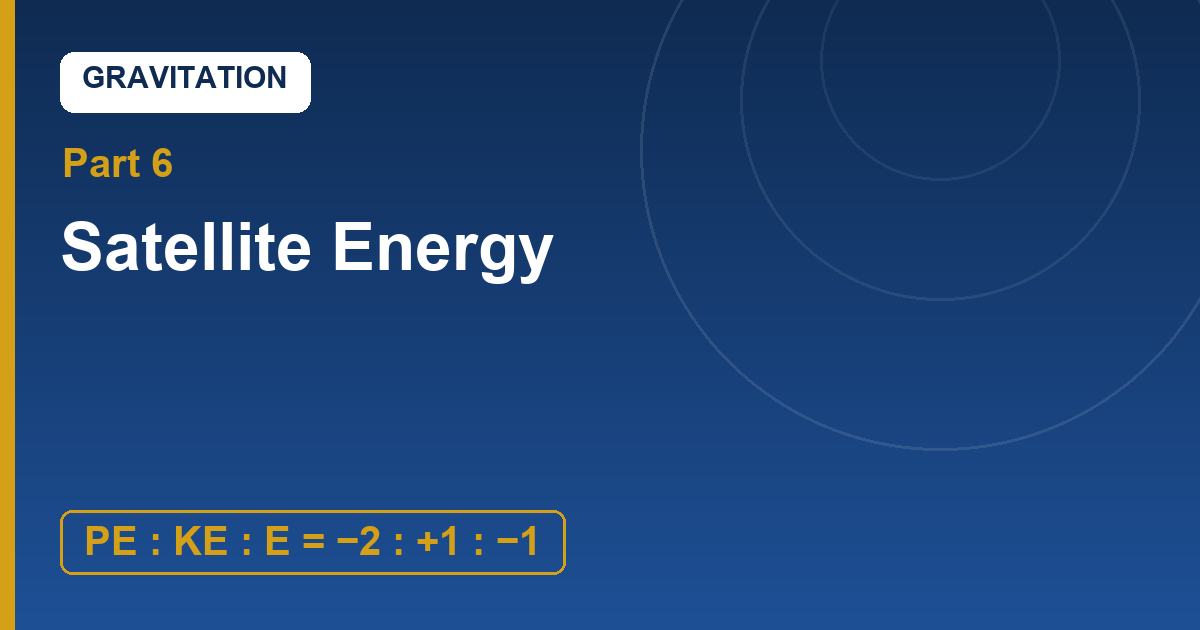
Furthermore, read the pattern as a sentence: ‘the debt is always exactly twice the speed-energy. Meanwhile, the account is negative by exactly the amount of the speed-energy.’ Escape means paying off exactly the speed-energy you have. That single sentence answers most questions.
The Drag Paradox, Explained.
Likewise, here’s the strangest fact in this chapter: when a satellite loses energy (to air drag), it speeds up. Indeed, losing energy deepens the debt → deeper debt = smaller orbit r → smaller orbit = faster orbit speed (Part 2’s rule). So the satellite descends and speeds up while its account gets worse. As a result, space stations fight this constantly — drag bleeds them downward, and re-supply craft re-pay the debt.
Solved Examples.
In short, apply 2:1:1: debt = −2E₀, total = −E₀.
Check: total is negative (trapped) and equals the speed-energy in size.
Answer: debt = −2E₀; total = −E₀
Subsequently, all three scale as 1/r: every one doubles in size.
But think: moving closer needs energy removed (a retro-burn or drag) — the account worsens — and the satellite ends up faster . Yes: that’s the drag paradox.
Answer: all double in size; total more negative; satellite faster
In fact, use totals, never pieces: new total − old total = (−GMm/4r) − (−GMm/2r) = +GMm/4r.
Moreover, why totals: the move changes both speed-energy (down) and debt (up) — only the net is what the thrusters pay. Meanwhile, students who compute only one piece get the wrong options.
Therefore, common-sense check: positive (climbing costs energy). Meanwhile, less than the full debt change — the satellite gives back some speed-energy as it settles.
Answer: +GMm/4r
- Meanwhile, ‘Closer = lazier.’ The opposite: closer orbits are faster (Part 2) with MORE speed-energy. Indeed, the mistake comes from everyday ‘nearer the ground = slower’ feelings.
- As a result, computing only the speed-energy or only the debt for orbit shifts. Meanwhile, thruster budgets = change in TOTAL. Every wrong MCQ option is a partial answer.
- Similarly, ‘Total zero in orbit.’ Zero total = just barely escaping. All circling/oval orbits have negative totals.
- Using r for oval orbits. Overall, for ellipses, put the average distance (semi-major axis) in place of r — the total depends only on that average.
This Physics in Your Daily Life.
- Consequently, the ISS loses ~2 km of height per month to drag and gets re-boosted by visiting spacecraft — a monthly subscription payment against this exact debt schedule.
- Furthermore, retired TV satellites are pushed UP to a ‘graveyard orbit’, not down — the debt maths makes burial-in-space cheaper than a controlled fall.
- Likewise, LIGO’s famous ‘chirp’ is this card, heard: two orbiting black holes radiated energy. Their account deepened, the orbit shrank, they orbited faster — rising pitch = deepening debt. 1.3 billion light-years away, your syllabus played out audibly (Part 8).
- Mars aerobraking: missions dip into the thin atmosphere to let drag pay the debt of slowing down — free deceleration worth tonnes of fuel.
Practice set (answers hidden — try first).
(NEET-level) Speed-energy = +E₀. Debt and total are:.
(JEE Main-level) Energy to move a satellite from orbit r to orbit 2r:.
(Concept) A satellite fires backward thrusters and loses energy. Its speed:.
(NEET-level) A satellite’s total is −E. To escape it must receive:.
(Concept) Why is the total always negative for orbiting satellites?
- 🧠 The 2:1:1 chant: ‘debt twice the speed-energy, total negative by exactly the speed-energy’ — one pattern, every question.
- 🧠 Paradox line: ‘lose energy, speed up’ — the drag paradox in four words.
- 🏠 Daily: the ISS falls ~2 km per month and gets re-boosted — a monthly debt payment you can watch on launch schedules.
- 🏠 Daily: retired TV satellites are pushed UP, not down — the debt maths makes space burial cheaper.
- 🏠 Daily: LIGO’s rising chirp IS this card heard through a detector — deepening debt, shrinking orbit, faster circling.
Orbiting is a strange bargain: to climb higher, you must SLOW DOWN. Gain potential energy and you lose twice as much kinetic — so the total sinks. Falling toward the Sun, the reverse: you speed up, but the total energy climbs less than your speed suggests.
Low orbit: KE = +3.2 MJ/kg, PE = −6.4 MJ/kg, total = −3.2 MJ/kg (exactly −KE/2). Geostationary orbit: KE smaller, total −0.5 MJ/kg. Check the pattern: E = −KE/2 at every radius — the two energies are locked in a 2:1 marriage by the mathematics of circular orbits.
Draw a bar chart at two orbit heights: at low orbit the KE bar is tall, the PE bar twice as tall downward, total bar a short stub below zero. At high orbit all three bars shrink together, same 2:1 shape. The chart is self-similar at every altitude.
- the pattern: debt : speed-energy : total = 2 : 1 : 1 (debt negative)
- total = −GMm/2r; negative = trapped, zero = escape
- escape costs exactly your current speed-energy
- drag paradox: losing energy → lower orbit → FASTER
- oval orbits: r → average distance (semi-major axis)
Frequently Asked Questions
What should you know about The 2:1:1 Pattern (Memorise This, Not Three Formulas)?
A satellite in a circular orbit has two energies: speed-energy (positive — it’s moving) and gravity-debt (negative — it’s trapped). Using the orbit speed from Part 2, the maths gives a fixed pattern:
What should you know about The Drag Paradox, Explained?
What should you know about Solved Examples?
Apply 2:1:1: debt = −2E₀, total = −E₀. Check: total is negative (trapped) and equals the speed-energy in size. ✔ ‘Closer = lazier.’ The opposite: closer orbits are faster (Part 2) with MORE speed-energy. The mistake comes from everyday ‘nearer the ground = slower’ feelings. Computing only the speed-energy or only the debt for orbit shifts. Thruster budgets = change in TOTAL. Every wrong MCQ option is a partial answer.
What should you know about This Physics in Your Daily Life?
The ISS loses ~2 km of height per month to drag and gets re-boosted by visiting spacecraft — a monthly subscription payment against this exact debt schedule. Retired TV satellites are pushed UP to a ‘graveyard orbit’, not down — the debt maths makes burial-in-space cheaper than a controlled fall.
What should you know about Practice set (answers hidden — try first)?
🧠 The 2:1:1 chant: ‘debt twice the speed-energy, total negative by exactly the speed-energy’ — one pattern, every question. 🧠 Paradox line: ‘lose energy, speed up’ — the drag paradox in four words. 🏠 Daily: the ISS falls ~2 km per month and gets re-boosted — a monthly debt payment you can watch on launch schedules.
References & authoritative sources
- Britannica — concept background
- United Nations — official documents
- NTA — official
- NCERT Physics textbooks
- JEE Main — official
Source: compiled from official notifications, standard textbooks and our own mock-test analytics; last reviewed September 2026.
Quick revision
- Moreover, one ratio solves everything: debt : speed-energy : total = 2 : 1 : 1 (with debt negative)
- Total = −GMm/2r — negative means trapped; zero means free
- Meanwhile, closer orbit = faster AND deeper in debt (needs energy removed)
- As a result, the drag paradox: losing energy makes a satellite SPEED UP
- In other words, for oval orbits, use the average distance (semi-major axis)
- Indeed, the 2:1:1 pattern (memorise this, not three formulas).
- 1Escape Velocity: The Speed That Ends Gravity’s Grip
- 2Orbital Velocity: Why the ISS Never Falls
- 3Kepler’s Laws: The 1609 Prediction Machine NASA Still Uses
- 4Angular Momentum: Gravity Can Pull, It Cannot Twist
- 5Gravitational Potential Energy: Why the Minus Sign Matters
- 6Satellite Energy: Why Total Energy Is Negative KE Over Two
- 7Variation of g: Why You Weigh Less at the Equator
- 8Black Holes, LIGO and Lagrange Points
- 9Gravitation Bonus: Shell Theorem to GEO Satellites
Have a doubt on this topic?
Sources & official references
External references for fact-checking and further reading.