Charge and Coulomb’s Law Explained: How Electric Forces Work
In one line: Charge and Coulomb’s Law — exam-ready notes in one glance.
- Two Kinds of Charge, One Simple Rule
- Coulomb’s Law: Gravity’s Twin
- The k Surprise: Why Electricity Rules
- Quantisation and Conservation
- Solved Examples
- This Physics in Your Daily Life
- Practice set (answers hidden – try first)
- Frequently Asked Questions
- What should you know about Two Kinds of Charge, One Simple Rule?
- What should you know about Coulomb’s Law: Gravity’s Twin?
- What should you know about The k Surprise: Why Electricity Rules?
- What should you know about Quantisation and Conservation?
- What should you know about Solved Examples?
- Exam Checklist
- FAQ
- How much of this page is exam-relevant?
- When should I revisit?
- The Thirty-Second Recap
- Explain It Simply
- Abbreviations That Recur Here
- Key Takeaways
- The Framework Line to Memorise
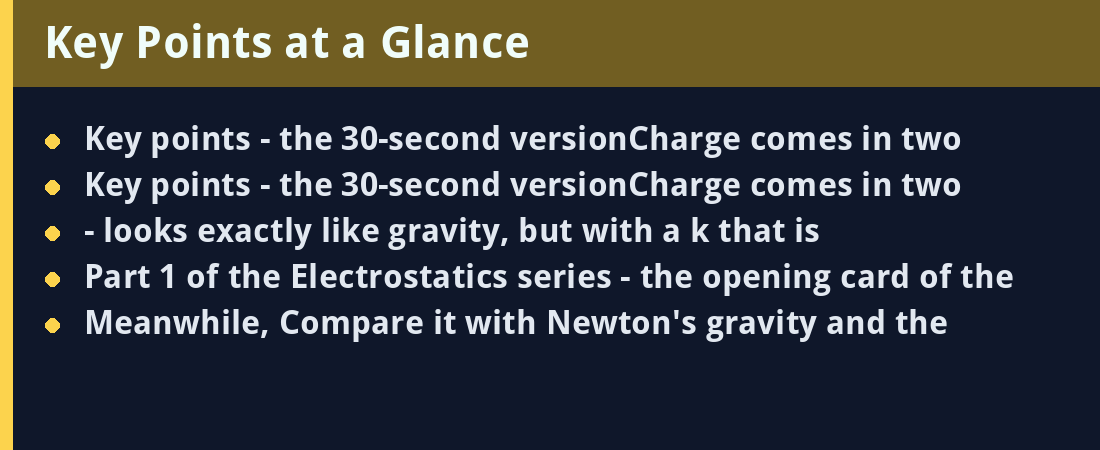
In one line: JEE/NEET Physics ? Electrostatics series ? Part 1 of 8 ? All parts ? Key points – the 30-second versionCharge comes in two kinds: positive and negative -.
JEE/NEET Physics ? Electrostatics series ? Part 1 of 8 ? All parts
- Charge comes in two kinds: positive and negative – like charges push apart, unlike charges pull together
- Coulomb’s law: F = kq1q2/r? – looks exactly like gravity, but with a k that is ENORMOUS
- K = 9×10? – electric force is ~1036 times stronger than gravity between two protons
- Charge is quantised (comes in whole electrons) and conserved (never created or destroyed)
- Quantising the charge: q = ne (n whole electrons, e = 1.6×10?1? C)
Rub a balloon on your hair and it sticks to a wall. Meanwhile, Lightning tears the sky apart. Both are the same thing: charge – one of the universe’s two great forces, cousin of gravity but a million-trillion-trillion times stronger. Part 1 of the Electrostatics series – the opening card of the Class 12 high-weightage block.
- Therefore, two kinds of charge, one simple rule
- Coulomb’s law: gravity’s twin
- What each letter means
- In addition, the k surprise: why electricity rules
- Quantisation and conservation
- Solved examples
- Therefore, common mistakes
- This physics in your daily life
- Practice set
- In addition, recap
Two Kinds of Charge, One Simple Rule
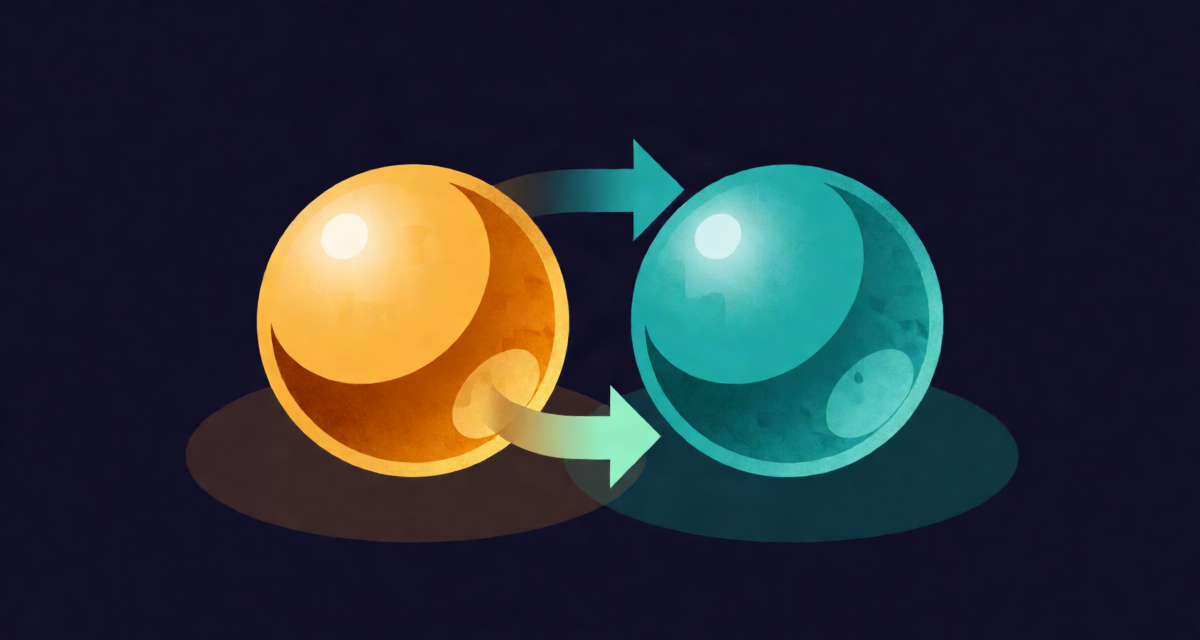
Charge comes in exactly two flavours: positive (+) and negative (-). Therefore, The behaviour rule is one line: like charges repel (push apart), unlike charges attract (pull together). Protons carry +e, electrons carry -e, and almost everything around you is neutral only because the two precisely cancel.
Coulomb’s Law: Gravity’s Twin
Place two charges a distance apart – they push or pull with a force given by Coulomb’s law. Meanwhile, Compare it with Newton’s gravity and the family resemblance is unmistakable:
+q
+q
F = kq1q2/r?
gravity: F = Gm1m2/r? – same shape
k = 9×10? vs G = 6.7×10?11
electric force wins by ~1036 between two protons
| Letter | What it means (plain words) | Value / unit |
|---|---|---|
| F | the push/pull force between the two charges | newtons (N) |
| k | Coulomb’s constant – electricity’s strength number | 9 x 10? N?m?/C? |
| q1, q2 | the two charges | coulombs (C); e = 1.6×10?1? C |
| r | distance between the charge CENTRES | metres – always squared |
The k Surprise: Why Electricity Rules
Gravity’s G is 6.67×10?11; electricity’s k is 9×10?. Consequently, Between two protons, the electric repulsion beats gravitational attraction by a factor of about 1036 – a billion trillion trillion. Meanwhile, Why doesn’t electricity crush the universe then? In fact, Because ordinary matter is neutral: the positives and negatives cancel almost perfectly, leaving gravity (which never cancels) to run the cosmos at large scales.
Quantisation and Conservation
Quantised: charge comes in whole-electron packets. Notably, You can have 1e, 2e, 100e – never half an electron. q = ne. Conserved: the total charge of an isolated system never changes; rubbing a balloon doesn’t create charge, it TRANSFERS electrons (hair balloon, leaving hair + and balloon -).
Solved Examples
Direct: F = 9×10? x (2×10?6)? / (0.1)? = 9×10? x 4×10?1? / 0.01.
= 3.6 N – a tangible push between two specks. Furthermore, That’s k’s enormity at work.
Same charges a metre apart would be: 0.036 N (100x distance 10?4x force, the inverse square). ?
Answer: 3.6 N (repulsive, both positive)
Work in ratios: numerator x2 (charge), denominator ?4 (distance halved r? quartered).
New F = 2 x 4 = 8F.
Check each factor separately – the multiplicative bookkeeping of 1/r? laws. ?
Answer: 8F
q = ne: n = q/e = 1 / 1.6×10?1?.
n = 6.25×10¹⁸ electrons – six billion billion in a single coulomb. Specifically, Now feel why ‘charging’ objects barely dents their electron count: a rubbed balloon shifts maybe a billionth of them.
?
Answer: n ? 6.25 x 10¹⁸ electrons
- Forgetting to square r. The eternal inverse-square trap – square the distance before dividing.
- Using cm with k. k demands metres and coulombs; a ?C is 10?6 C, a cm is 10?? m. Convert everything first.
- Sign errors with force direction. The formula gives magnitude; LIKE repels, UNLIKE attracts – set directions by inspection, not by plugging signs blindly.
- ‘Rubbing creates charge.’ No – it transfers electrons. Specifically, In other words, Total charge is conserved; the balloon gains exactly what the hair loses.
This Physics in Your Daily Life
- The balloon-and-hair trick is this entire card: rubbing transfers electrons, the charged balloon polarises the wall’s molecules, and unlike-charge attraction sticks it there.
- Lightning is charge separation gone extreme – clouds rub against air (essentially), build kilomillion-volt charge differences, and the 1036-strong force discharges in a flash.
- Laundry static and crackling sweaters in dry winter air: electron transfer between fabrics, with no humid air to leak it away.
- Photocopiers and laser printers guide toner powder with charged drums – Coulomb’s law, printing your documents.
- Fuel trucks drag earth-chains because transferred charge during fuelling could spark – safety engineering built on charge conservation.
Practice set (answers hidden – try first)
(NEET-level) Two 3 ?C charges, 30 cm apart. Force:
(JEE Main-level) One charge doubled, distance doubled. Force becomes:
(NEET-level) Charge on 5×10¹⁴ electrons:
(Concept) A glass rod rubbed with silk becomes positive because:
(JEE Main-level) Two charges attract at F. Meanwhile, Both are doubled, distance unchanged:
- F = kq1q2/r?; k = 9×10? N?m?/C?
- inverse square: distance x10 force ?100
- Therefore, quantised q = ne, e = 1.6×10?1? C
- ?? like repels, unlike attracts – set direction by inspection
- ?? Furthermore, F = kq1q2/r?, k = 9×10? (vs gravity’s 10?11 G)
- In addition, ?? electric force is ~1036 x gravity between protons
- ?? charge quantised: q = ne; conserved: rubbing transfers, never creates
- ?? ratio method for combined changes (charge x2, distance ?2 8F)
- Therefore, ?? like repel, unlike attract
- ?? However, F = kq1q2/r?, k = 9×10?
- ?? charge quantised (q = ne) and conserved
Rub a balloon on your hair and it clings to a wall. Nothing was created: electrons — tiny, movable — were scraped from hair to rubber. Now the balloon has extra minus, the hair extra plus, and opposite charges pull. Static electricity is bookkeeping of scraped electrons.
Coulomb: F = kq₁q₂/r². Two 1 C charges 1 m apart: 9 billion newtons — a monstrous force (k = 9×10⁹). Two balloons rubbed: microcoulombs, centimetres apart → milli-newtons: gentle clinging. Same law, six orders of magnitude apart in charge.
Draw the two objects with + and − signs, arrows between them: unlike arrows pointing AT each other (pull), like arrows pointing APART (push). Longer distance, shorter arrows — the 1/r² collapse drawn to scale.
- ?? Chant: ‘like flees, unlike clings’.
- ?? k vs G: ‘electricity is 1036 times the bully’.
- ?? One coulomb: ‘six billion billion electrons’.
- ?? Daily: balloon-on-wall, winter crackle, lightning – all Part 1.
- ?? Daily: photocopiers print with Coulomb’s law.
Frequently Asked Questions
What should you know about Two Kinds of Charge, One Simple Rule?
Charge comes in exactly two flavours: positive (+) and negative (-). Moreover, The behaviour rule is one line: like charges repel (push apart), unlike charges attract (pull together). Protons carry +e, electrons carry -e, and almost everything around you is neutral only because the two precisely cancel.
What should you know about Coulomb’s Law: Gravity’s Twin?
Place two charges a distance apart – they push or pull with a force given by Coulomb’s law. In fact, As a result, Compare it with Newton’s gravity and the family resemblance is unmistakable:
What should you know about The k Surprise: Why Electricity Rules?
Gravity’s G is 6.67×10?11; electricity’s k is 9×10?. Notably, In short, Between two protons, the electric repulsion beats gravitational attraction by a factor of about 1036 – a billion trillion trillion. Meanwhile, Indeed, Why doesn’t electricity crush the universe then? Meanwhile, Because ordinary matter is neutral: the positives and negatives cancel almost perfectly, leaving gravity (which never cancels) to run the cosmos at large scales.
What should you know about Quantisation and Conservation?
Quantised: charge comes in whole-electron packets. Meanwhile, You can have 1e, 2e, 100e – never half an electron. q = ne. Conserved: the total charge of an isolated system never changes; rubbing a balloon doesn’t create charge, it TRANSFERS electrons (hair balloon, leaving hair + and balloon -).
What should you know about Solved Examples?
Direct: F = 9×10? x (2×10?6)? / (0.1)? = 9×10? x 4×10?1? / 0.01. = 3.6 N – a tangible push between two specks. Therefore, That’s k’s enormity at work. Forgetting to square r. The eternal inverse-square trap – square the distance before dividing. Using cm with k. k demands metres and coulombs; a ?C is 10?6 C, a cm is 10?? m. Convert everything first.
Contents: this page covers Charge and Coulomb’s Law: The Push and Pull of Electricity with worked notes, tables, a checklist and a rapid recap.
Exam Checklist
- In addition, read once fully, then tables only
- Convert each heading into a question
- Speak five lines aloud as a briefing
- Therefore, index one line in the fortnight sheet
- Return on day three and day seven

FAQ
How much of this page is exam-relevant?
Nearly all of it, because the tables and worked items follow the standard question register for this subject.
When should I revisit?
Day three and day seven after the first read, with the drill spoken aloud once.
The Thirty-Second Recap
One page. One topic. Therefore, read the tables twice. Speak the recap once. Moreover, the numbers carry the marks. The names carry the traps. However, revisits beat rereads. Finally, day three and day seven. That is all.
Explain It Simply
Think of this page as a map of one neighbourhood. The big streets are the tables. The landmarks are the numbers. The street names are the terms in bold. However big the city feels, this one neighbourhood fits in a pocket, and a pocket map is what exam week needs. Therefore, walk it once fully, then walk only the streets you forget, and by the second walk the neighbourhood feels like home.
Pocket the map, not the whole city: exams reward the walkable version of every topic.
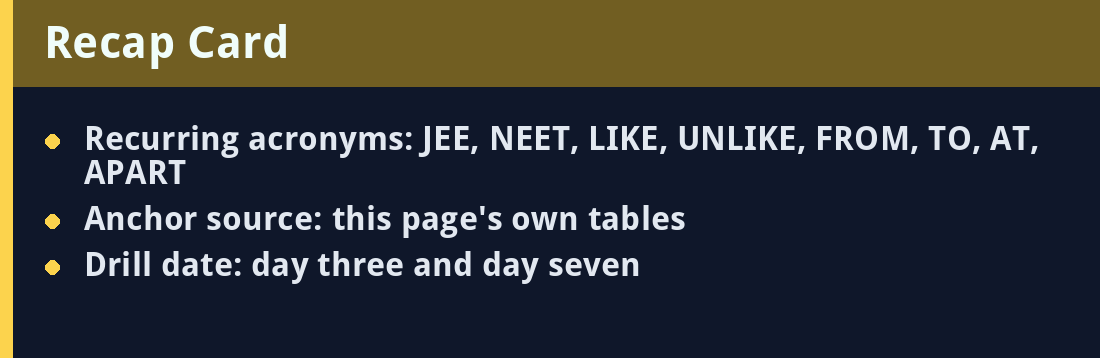
Abbreviations That Recur Here
- JEE.
- LIKE.
- UNLIKE.
- TO.
- AT.
Key Takeaways
In conclusion, Charge and Coulomb’s Law: The Push and Pull of Electricity compresses into its tables, its numbers and its checklist above. To summarize, revise twice this week, speak the recap once, and let the acronyms carry the recall. Therefore, this page banks itself in ten honest minutes.
The Framework Line to Memorise
Coulomb’s law is a validated framework: an inverse-square protocol between charges, with symmetric authorization – each force validated as exactly the other’s opposite.
Quick revision
- Charge comes in two kinds: positive and negative – like charges push apart, unlike charges pull together
- Coulomb’s law: F = kq1q2/r? – looks exactly like gravity, but with a k that is ENORMOUS
- K = 9×10? – electric force is ~1036 times stronger than gravity between two protons
- Charge is quantised (comes in whole electrons) and conserved (never created or destroyed)
- Quantising the charge: q = ne (n whole electrons, e = 1.6×10?1? C)
- Therefore, two kinds of charge, one simple rule
Have a doubt on this topic?
Sources & official references
External references for fact-checking and further reading.