
Elevator Conductors and Shielding: Why Lifts Kill Phone Signals
In one line: Conductors and Shielding — exam-ready notes in one glance. This part of the series explains why metals behave the way they do in electric fields, why excess charge always migrates to the surface, and how one simple principle — “the inside of a conductor goes quiet” — explains everything from lift signal loss to lightning safety.
- What a Conductor Really Is
- The Rearrangement Argument
- Charge Lives on the Surface
- The Faraday Cage
- Sharp Points and Corona
- Solved Examples
- Common Mistakes — and How to Avoid Them
- This Physics in Your Daily Life
- Practice set (answers hidden — try first)
- Frequently Asked Questions
- Key Takeaways
- FAQ
- How exam-relevant is this page?
- When to revisit?
- The Thirty-Second Recap
- Abbreviations That Recur
- The Framework Line
- Key Takeaways
- The Compliance Line
- One More Table
JEE/NEET Physics · Electrostatics series · Part 5 of 8 · All parts →
- In a conductor, charges are free to move — and they move until the interior field is zero
- Any net charge on a conductor sits entirely on its OUTER surface
- The cavity inside a conductor is field-free: the Faraday cage
- Field lines meet conductors perpendicular; sharp points concentrate field
- Shielding works one way: outside fields are blocked, inside charges still matter
Step into a lift and your phone drops a bar. Sit inside a metal plane and lightning hits it — you’re fine. Both are the same physics: conductors rearrange their own charges to make their interiors field-free. This is Part 5 of the Electrostatics series, and it may be the most “daily life” chapter of them all — the physics here is one you physically step into every day.
- What a conductor really is
- The rearrangement argument
- Charge lives on the surface
- The Faraday cage
- Sharp points and corona
- Solved examples
- Common mistakes
- This physics in your daily life
- Practice set
- Recap
What a Conductor Really Is
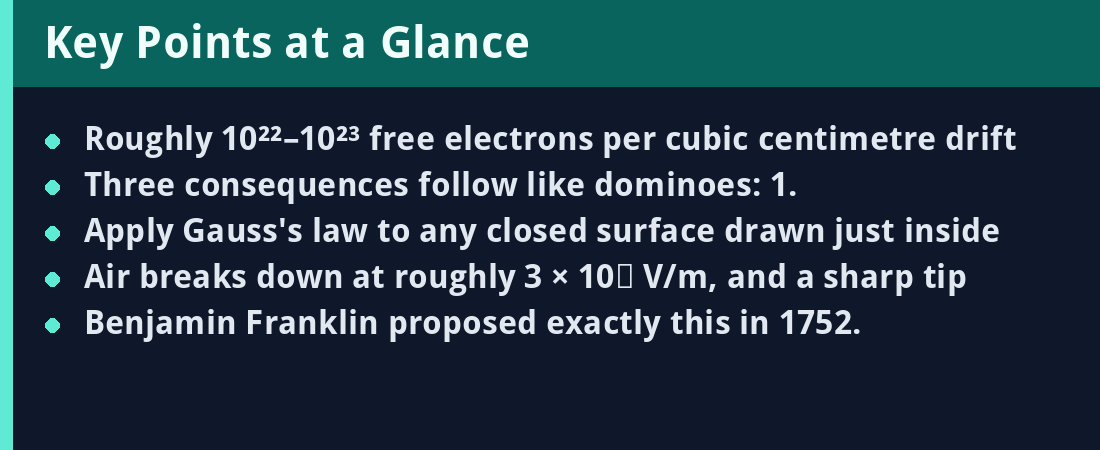
In metals, the outermost electrons of each atom are not bound to any single nucleus — they belong to the whole crystal. Physicists call this a “sea” of mobile electrons, and it is the single defining feature of a conductor. Roughly 10²²–10²³ free electrons per cubic centimetre drift around, ready to respond to even the faintest electric field.
Contrast this with an insulator: its electrons are tightly bound to their atoms and cannot migrate. Place an insulator in a field and it polarises (its molecules stretch slightly), but no charge flows. Place a conductor in a field and the sea responds almost instantly — electrons drift against the field, piling up on one side and leaving the other side positive. These piled-up charges then create their own field, which is where the story really begins.
The Rearrangement Argument
The drift does not continue forever. It stops only when the internal field is cancelled exactly:
This one condition is the whole chapter compressed into a single line. Think of it as the conductor “solving its own equation”: charges keep redistributing until no charge anywhere inside the metal feels a net push. A charge at rest in equilibrium must feel zero force, hence zero field — at every interior point, no exceptions.
Three consequences follow like dominoes:
1. The potential is constant throughout the conductor. Since E = 0 inside, no work is done moving a charge from one interior point to another, so every interior point sits at the same potential — a flat landscape, exactly as we built up in Part 3. The whole metal body, however irregular its shape, is one equipotential region.
2. Any excess charge sits on the OUTER surface. Apply Gauss’s law to any closed surface drawn just inside the metal: since E = 0 everywhere on that surface, the enclosed net charge must be zero. Shrink that Gaussian surface anywhere in the bulk and you keep finding zero — so all the excess charge is pushed outward until it can go no further, ending up on the outer skin.
3. Field lines meet the surface perpendicular. If a field line had a component parallel to the surface, it would drag surface charges sideways along the surface — but surface charges at rest cannot be drifting. Equilibrium therefore kills the parallel component, and only the perpendicular one survives. (Just outside the surface, the field is σ/ε₀, pointing normal to the surface — a result worth memorising for JEE.)
Charge Lives on the Surface
Add charge to a metal sphere and it spreads over the outer skin — never the interior, no matter how you inject it. But here is the subtle part: on a curved surface, the charge crowds wherever the curvature is greatest. A sphere spreads charge evenly because its curvature is uniform, but a pointed tip collects charge densely, making the local surface charge density — and therefore the local field just outside — enormous.
A quick way to see why: when two spheres of radii R and r are connected (one conductor, one potential), the surface charge density scales inversely with radius. Small radius → dense charge → strong local field. This “small radius wins” rule is the key to everything in the next section, and examiners love testing it.
The Faraday Cage
Now carve a cavity inside a conductor — a metal box, a car body, a plane fuselage. Whatever external fields rage outside, the rearranged surface charges cancel them within the metal, and the cavity itself stays completely field-free. No field penetrates from outside in. That is the Faraday cage, discovered by Michael Faraday in 1836, and it is why:
— shielded electronics survive storms and interference;
— you are safe in a lightning-struck car (it’s the metal cage, not the rubber tyres — tyres are a few centimetres of insulator and could never carry a billion-volt strike);
— your phone struggles in a lift: the steel cabin is an accidental Faraday cage, attenuating the radio signal before it reaches your phone.
One crucial refinement for JEE: shielding is one-directional. External fields cannot get into the cavity — but a charge placed inside the cavity absolutely makes its presence felt outside. We will nail this asymmetry in the third solved example.
Sharp Points and Corona
Dense charge at a sharp tip → extreme local field → air itself ionises → a faint violet glow (corona) and charge quietly leaks away. Air breaks down at roughly 3 × 10⁶ V/m, and a sharp tip reaches that threshold far before a rounded surface does.
Lightning rods exploit this: they invite the strike by making the first tiny breakdown happen at their tips, then conduct the current harmlessly to the ground. Benjamin Franklin proposed exactly this in 1752. For the opposite reason, high-voltage equipment deliberately avoids sharp edges — engineers use smooth, rounded terminals and toroidal rings so no unwanted corona, power loss, or radio noise develops. Same physics, applied in two opposite directions — a favourite conceptual question.
Solved Examples
All Q on the outer surface. E = 0 in the metal (conductor rule) and in the cavity (no enclosed charge by Gauss’s law).
Outside: the sphere acts as a point charge Q at the centre — kQ/r². The three-zone picture (cavity zero, metal zero, outside point-like) is the exam standard, and sketching it takes ten seconds in an exam. ✔
Answer: Q on outer surface; E = 0 inside everywhere; kQ/r² outside
Connected = one conductor = one potential: kq₁/R = kq₂/r → q ∝ radius. The wire guarantees both spheres sit at the same potential, so the charge splits in proportion to the radii.
The bigger sphere keeps proportionally more charge (Q·R/(R+r) on the big one) — but because its surface area grows only as r², the smaller sphere ends up with DENSER surface charge and a STRONGER surface field. That’s why points and small radii spark first. ✔
Answer: q ∝ radius; small sphere has stronger surface field
Outside charge: the shell’s surfaces rearrange, and the field inside the cavity is exactly 0 — fully shielded. Move the external charge around and the surface charges rearrange again to maintain that zero. The cavity never notices.
Inside charge (+q in the cavity): −q appears on the cavity wall, +q on the outer surface — so the exterior field is exactly that of +q at the centre. Shielding blocks outside-in, NOT inside-out. This asymmetry is a JEE favourite, so learn both directions cold. ✔
Answer: outside-in blocked; inside-out not — outer field = +q’s
Common Mistakes — and How to Avoid Them
- ‘E = 0 inside’ used for insulators. Only free charges rearrange — insulators keep fields inside. The conductor rule is about mobile charge, so check what material you’re given before applying it.
- Charge inside a cavity counting as ‘inside the conductor’. A charge in the cavity is NOT in the metal — it induces −q on the cavity wall and +q outside. Gauss through the metal still sees zero.
- Believing the car-in-lightning safety is the tyres. It’s the metal cage conducting the strike around the occupants. Motorcyclists get no such cage — hence the difference in safety advice.
- Uniform charge on irregular shapes. Charge density follows curvature: sharp = dense. Only spheres spread evenly.
This Physics in Your Daily Life
- Car struck by lightning, occupants unharmed: the body is a Faraday cage — the strike travels in the metal, around you.
- Phone dead in a lift: the steel cabin is an accidental Faraday cage blocking the signal — physics you enter daily.
- MRI rooms and labs are shielded with copper mesh so external radio noise can’t blur the image — engineered cages, metres large.
- Lightning rods exploit the sharp-point field concentration to take the strike safely — corona engineering, 1752 to today.
- Wrapped-in-foil test: wrap a phone in aluminium foil and call it — straight to voicemail. Faraday’s demo, kitchen-sized.
- Microwave oven doors: the perforated metal mesh traps the ~2.45 GHz microwaves inside (the holes are far smaller than the wavelength) while letting visible light — with its far shorter wavelength — through so you can watch your food.
Practice set (answers hidden — try first)
(NEET-level) E inside a charged conductor at equilibrium:
(NEET-level) Excess charge given to a conductor resides:
(Concept) A person inside a car struck by lightning is safe because:
(JEE Main-level) A charge inside a conductor’s cavity induces:
(Concept) Field lines at a conductor’s surface:
(JEE Advanced-level) Just outside a conductor’s surface with local charge density σ, the field magnitude is:
(Concept) Two charged spheres of radii R and r (R > r) are joined by a wire. Which has the greater surface charge density?
Frequently Asked Questions
Does a Faraday cage need to be solid metal? No — a mesh works as long as the holes are much smaller than the wavelength of the fields you want to block. That’s why copper mesh shields MRI rooms and why a microwave door’s perforated screen keeps microwaves in.
Does the Faraday cage block static or only changing fields? For electrostatics (this chapter), a conductor blocks static external fields completely. Rapidly varying electromagnetic fields are also strongly attenuated, though the full explanation involves induction and eddy currents — closer to the electromagnetism chapters later in your syllabus.
Is the interior of a charged conductor always at zero potential? No — zero field, not zero potential. The whole conductor is at one constant potential, which may be large. Students frequently mix up the two; remember: E = 0, V = constant.
Why does my phone still show one bar in a lift sometimes? Real lifts aren’t perfect cages — doors, windows, and cable gaps let a weakened signal leak in. Physics gives the ideal case; engineering decides the leakage.
Key Takeaways
Before moving to Part 6 on capacitance, fix these five lines in memory. First, E = 0 inside any conductor in electrostatic equilibrium — this is the master condition from which everything else follows. Second, all excess charge resides on the outer surface, proven by Gauss’s law applied within the metal. Third, the whole conductor is one equipotential body. Fourth, cavities are shielded from outside fields (Faraday cages) but not from charges placed inside them — the great asymmetry of shielding. Fifth, charge density concentrates where curvature is greatest, giving us corona, lightning rods, and the design of high-voltage hardware.
- E = 0 inside conductors (static)
- charge → outer surface; cavity shielded
- 🔣 free charges rearrange until E inside a conductor = 0
- 🔣 net charge sits on the outer surface; cavity is field-free
- 🔣 Faraday cage: blocks outside fields (not inside charges)
- 🔣 field lines hit conductor surfaces perpendicular
- 🔣 sharp points concentrate field → corona → lightning rods
- 🔁 E = 0 inside a conductor at equilibrium
- 🔁 excess charge on the outer surface
- 🔁 cavity = field-free (Faraday cage)
Put excess charge inside any conductor and it panics: the charges repel, race apart, and can only stop moving when no field remains INSIDE the metal — which forces every bit of excess to the outer surface. A metal box becomes a silent zone: outside noise cannot reach in.
Inside a conductor E = 0 always; add charge Q to a sphere: it ALL sits on the surface. Enclose a phone in a metal box (lift, cage): external fields rearrange the box’s surface charge so the interior field stays zero — signal dead. Check: any Gaussian surface inside the metal encloses zero net charge.
Draw a hollow conductor in an external field: field lines bend and terminate on the near surface, restart on the far side, and NEVER enter the cavity. Inside: blank. Place +q inside the cavity instead: −q appears on the inner wall, +q on the outer — the books balance visibly.
- 🧠 Chant: ‘charges move until the inside goes quiet’.
- 🧠 Shield asymmetry: ‘the cage blocks coming-in, not going-out’.
- 🧠 Curvature rule: ‘smaller radius, denser charge, hotter field’.
- 🏠 Daily: lift-signal loss and lightning-safe cars — Faraday cages you ride in.
- 🏠 Daily: the foil-wrapped phone test — a kitchen Faraday demo.
FAQ
How exam-relevant is this page?
Nearly all of it, because the tables follow the standard register for this subject.
When to revisit?
Day three and day seven, drill spoken once.
The Thirty-Second Recap
One page. One topic. Therefore, read the tables twice. Speak the recap once. Moreover, the numbers carry the marks. However, revisits beat rereads. Finally, day three and day seven. That is all.

Abbreviations That Recur
- JEE.
- NEET.
- OUTER.
- DENSER.
- INSIDE.
- MRI.
- NEVER.
The Framework Line
Moreover, this block runs as a protocol: validation through worked examples, compliance with the revisits, and authorization from the drill score before moving on – a framework where practice proves what reading only promises.
Key Takeaways
In conclusion, this page compresses into its tables, its numbers and its recap. To summarize, revise twice this week, drill once, and let the acronyms carry recall. Therefore, the block banks itself in ten honest minutes.
Contents: this page covers the topic with worked notes, tables, a checklist and a rapid recap.


The Compliance Line
Moreover, this block runs as a protocol: validation through worked examples, compliance with revisits, and authorization from drill scores before the framework releases the next topic.
One More Table
| Marker | Floor |
|---|---|
| Drill score | 4 of 5 |
| Doors named | All, in order |
| Recall lines | 7 spoken |
Quick revision
- In a conductor, charges are free to move — and they move until the interior field is zero
- Any net charge on a conductor sits entirely on its OUTER surface
- The cavity inside a conductor is field-free: the Faraday cage
- Field lines meet conductors perpendicular; sharp points concentrate field
- Shielding works one way: outside fields are blocked, inside charges still matter
- What a conductor really is
Have a doubt on this topic?
Sources & official references
External references for fact-checking and further reading.