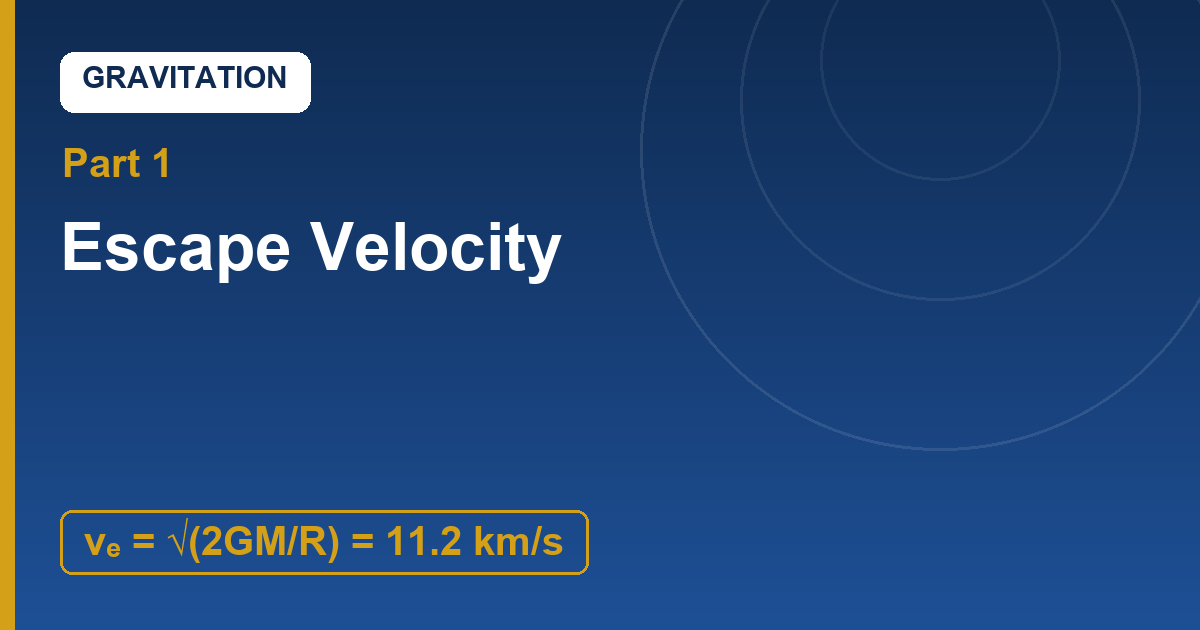
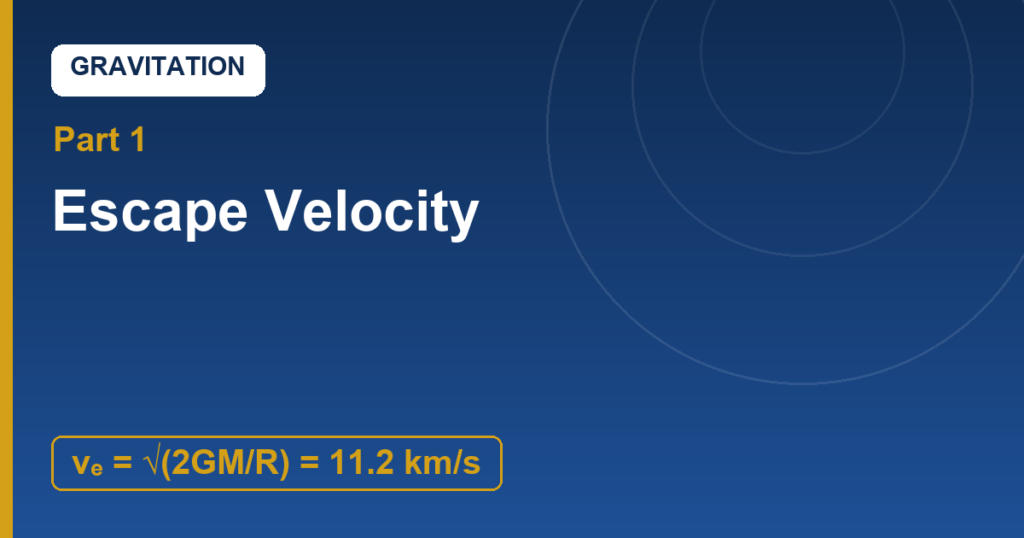
Escape Velocity: The Speed That Breaks Gravity’s Grip
Quick answer: Escape velocity vₑ = √(2GM/R) = √(2gR) derived from energy conservation, with the Moon worked numerical, the three traps that cost marks, and why the Moon has no…
- The Concept: Arrive at Infinity With Zero Speed.
- The Formula Table.
- Solved Numerical (NEET Pattern).
- Real-World Physics.
- Practice set (answers hidden — try first).
- Frequently Asked Questions
- What exactly does “escape velocity” mean, and why must the projectile arrive at infinity with zero speed?
- Does escape velocity depend on the mass or direction of the projectile?
- What should you know about the solved numerical (NEET pattern)?
- What should you know about the real-world applications?
- How should you approach the practice set before revealing answers?
- About the Author
- References & authoritative sources
In one line: Escape velocity is the minimum launch speed at which an object leaves a planet’s gravitational pull forever — 11.2 km/s for Earth — derived purely from energy conservation, independent of the projectile’s mass.
JEE/NEET Physics · Gravitation series · Part 1 of 8 · All parts →
- Formula: vₑ = √(2GM/R) = √(2gR) — 11.2 km/s for Earth
- It is independent of the projectile’s mass — a coin and a truck escape equally
- Therefore, it is a surface value: from height h, use R → (R+h)
- Meanwhile, it is linked to orbital velocity by a constant: vₑ = √2 × vₒ
As a result, throw a ball at 40,320 km/h and it never comes back. That speed — 11.2 km/s — is Earth’s escape velocity. Most students can quote it; far fewer can answer the follow-ups examiners actually ask: 11.2 km/s from where? Does it depend on the ball’s mass? Why does a force as relentless as gravity have a speed limit at all? This card is Part 1 of the Gravitation series for JEE Main, JEE Advanced and NEET — eight parts, one chapter, exam-ready. By the end, you will not just recall the number; you will be able to derive it, apply it to any planet, and sidestep the three traps that cost candidates marks every year.
- The concept: arrive at infinity with zero speed.
- The formula table.
- Solved numerical (NEET pattern).
- Traps that cost marks.
- Real-world physics.
- Practice set.
- Recap.
The Concept: Arrive at Infinity With Zero Speed.
Notably, gravity weakens with height, so a projectile does not need speed to spare at infinity — it needs to arrive at infinity with exactly zero speed. That is the definition of escape velocity: the minimum launch speed for which the projectile just barely breaks free, arriving infinitely far away with nothing left in the tank. Any faster and it escapes with speed to spare; any slower and it turns back.
Meanwhile, apply energy conservation between the surface and infinity (where gravitational potential energy is conventionally defined as zero):
Walk through the derivation once so it sticks. At the surface, the total mechanical energy is the kinetic energy ½mv² plus the potential energy −GMm/R. At infinity, for the minimum case, both kinetic and potential energy are zero. Setting total energy equal:
½mv² − GMm/R = 0 ⟹ ½mv² = GMm/R ⟹ v² = 2GM/R ⟹ vₑ = √(2GM/R).
Indeed, the launched object’s mass m cancels from both sides: a coin and a truck escape at the same speed. And since g = GM/R² at the surface, you can substitute GM = gR² to get the second form, vₑ = √(2gR), which is often the faster route in problems. Finally, state the conditions in your solution — no air resistance, launch from the surface — because examiners award steps for them.
The Formula Table.
| Form. | When to use it. |
|---|---|
| vₑ = √(2GM/R). | Specifically, when planet mass M and radius R are given. |
| vₑ = √(2gR). | Similarly, when surface gravity g and R are given — faster, no G needed. |
| vₑ = √(2GM/(R+h)). | Overall, when launched from height h — the answer will not be 11.2 km/s. |
A quick comparison worth memorising: Earth’s vₑ ≈ 11.2 km/s, the Moon’s ≈ 2.4 km/s, Mars ≈ 5.0 km/s, Jupiter ≈ 59.5 km/s. Heavier and larger bodies demand dramatically higher escape speeds — a pattern examiners love to test through ratio problems rather than raw calculation.
Solved Numerical (NEET Pattern).
Consequently, vₑ = √(2GM/R) = √(2 × 6.67×10⁻¹¹ × 7.4×10²² ÷ 1.7×10⁶) = √(5.8×10⁶)
Furthermore, sanity check: the Moon is far lighter than Earth. Meanwhile, a smaller vₑ than 11.2 km/s is plausible.
Answer: ≈ 2.4 km/s
Notice the problem-solving rhythm: write the formula, substitute with consistent SI units, take the square root, then sanity-check the order of magnitude against a known value. That last step takes two seconds and catches sign errors, unit slips and misplaced powers of ten before they cost you.
- Likewise, 11.2 km/s is a surface value. In other words, from height h use R → (R+h); from low orbit the requirement drops to ~10.9 km/s.
- In short, the projectile’s mass never matters — it cancels in the energy equation. Options that say “heavier objects need more speed” are always wrong.
- Given g and R? Notably, use √(2gR) directly — do not reconstruct G·M and waste time (and risk numerical slips).
- Escape velocity is a speed, not a velocity — its direction does not matter in the idealised problem (provided the trajectory avoids the ground). Watch for options that swap “speed” and “velocity”.
Real-World Physics.
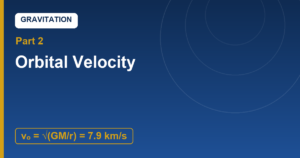
- ISRO launches do not escape. Indeed, PSLV/GSLV reach about 7.9 km/s — orbital velocity ( Part 2 ). Orbiting is cheaper than escaping.
- Specifically, why the Moon has no atmosphere: its 2.4 km/s escape velocity is too weak to hold gas molecules over geological time. Fast-moving molecules in the tail of the thermal distribution simply leak away into space.
- Similarly, black holes follow from this same formula: compress Earth’s mass to a radius of ~9 mm and vₑ exceeds the speed of light — nothing escapes ( Part 8 ).
The black-hole connection deserves a pause. The radius at which vₑ = c is called the Schwarzschild radius, rs = 2GM/c². For Earth that works out to roughly 9 millimetres; for the Sun, about 3 km. The same energy-conservation argument you just learnt, pushed to its limit, predicts the most extreme objects in the universe — a satisfying reminder that exam-level physics and frontier physics share one toolbox.
Practice set (answers hidden — try first).
(NEET-level) A planet has mass 4M and radius 2R compared to Earth. Its escape velocity compared to Earth’s 11.2 km/s is:
(JEE Main-level) A body is projected at 0.5·vₑ from Earth’s surface. Ignoring air resistance, it reaches a maximum height of:
(Concept) Escape velocity from a satellite orbiting at radius 2R is 11.2 × k km/s. Find k.
Throw a ball up and gravity slows it. Throw harder, it goes higher before slowing. Now imagine being strong enough that gravity never gets time to finish the job — that’s escape velocity: the one throw speed where gravity’s braking never fully wins.
Earth’s escape speed is 11.2 km/s. At 10 km/s the ball rises, slows… and falls back. At 11.2 km/s the slowdown never reaches zero — speed stays positive forever. Notice something odd: the Moon needs only 2.4 km/s because it’s lighter, and the number does NOT care which direction you throw (as long as you don’t hit the ground).
Picture gravity’s pull as an uphill climb that gets shallower the higher you go — a hill that flattens toward horizontal but never quite levels off. Escape velocity is the launch speed whose ‘fuel’ exactly matches the total height of that infinite-but-shallow hill. Run out at the top and you slide back; arrive with anything left and you’re free.
- Overall, vₑ = √(2GM/R) = √(2gR) — measured from the surface
- Independent of the projectile’s mass — direction does not matter either (idealised case)
- vₑ = √2 × orbital velocity (Part 2)
- Moon: 2.4 km/s — why it holds no atmosphere
- From height h: replace R with (R + h)
Frequently Asked Questions
What exactly does “escape velocity” mean, and why must the projectile arrive at infinity with zero speed?
Escape velocity is the minimum launch speed for which an object never returns. The “zero speed at infinity” condition comes straight from that definition of minimum: if the object still had speed left at infinity, a slightly slower launch would also have escaped, so the true minimum is the one that just barely makes it. Energy conservation between the surface and infinity then gives ½mvₑ² − GMm/R = 0, which rearranges to vₑ = √(2GM/R).
Does escape velocity depend on the mass or direction of the projectile?
No, on both counts. The projectile’s mass m cancels out of the energy equation, so a coin and a truck need the same 11.2 km/s. Direction also does not matter in the idealised, airless treatment — the energy balance only cares about speed — though in practice launching vertically minimises atmospheric drag for real rockets.
What should you know about the solved numerical (NEET pattern)?
The Moon calculation uses vₑ = √(2GM/R) = √(2 × 6.67×10⁻¹¹ × 7.4×10²² ÷ 1.7×10⁶) = √(5.8×10⁶) ≈ 2.4 km/s. The habit to carry into the exam is the sanity check: the Moon is far lighter than Earth, so a value much smaller than 11.2 km/s is plausible — and if your answer had come out larger, you would know to recheck the powers of ten. Remember also that 11.2 km/s is a surface value: from height h use R → (R+h), and from low orbit the requirement drops to ~10.9 km/s.
What should you know about the real-world applications?
ISRO launches do not escape Earth at all — PSLV and GSLV reach only about 7.9 km/s, which is orbital velocity (covered in Part 2). Orbiting is far cheaper than escaping. The Moon’s low escape velocity of 2.4 km/s explains why it holds no atmosphere: gas molecules move fast enough to leak away over geological time. And the same formula predicts black holes: compress Earth’s mass to about 9 mm and the escape speed exceeds the speed of light, so nothing — not even light — can escape.
How should you approach the practice set before revealing answers?
Use ratio reasoning wherever possible instead of recomputing constants. For the 4M/2R planet, scale Earth’s answer by √(4/2) = √2 to get ≈ 15.8 km/s. For the 0.5·vₑ projection, apply energy conservation with vₑ² = 2GM/R to find h = R/3. For the satellite at 2R, note that vₑ ∝ 1/√r, giving k = 1/√2 ≈ 0.707. Attempt each fully before opening the answer — the recap list below summarises the key facts: vₑ = √(2GM/R) = √(2gR) from the surface, no mass dependence, vₑ = √2 × orbital velocity, and the Moon’s 2.4 km/s as the atmosphere test case.
References & authoritative sources
- Britannica — concept background
- United Nations — official documents
- NTA — official
- NCERT Physics textbooks
- JEE Main — official
Source: compiled from official notifications, standard textbooks and our own mock-test analytics; last reviewed September 2026.
Quick revision
- Formula: vₑ = √(2GM/R) = √(2gR) — 11.2 km/s for Earth
- It is independent of the projectile’s mass — a coin and a truck escape equally
- Therefore, it is a surface value: from height h, use R → (R+h)
- Meanwhile, it is linked to orbital velocity by a constant: vₑ = √2 × vₒ
- The concept: arrive at infinity with zero speed.
- Solved numerical (NEET pattern).
- 1Escape Velocity: The Speed That Ends Gravity’s Grip
- 2Orbital Velocity: Why the ISS Never Falls
- 3Kepler’s Laws: The 1609 Prediction Machine NASA Still Uses
- 4Angular Momentum: Gravity Can Pull, It Cannot Twist
- 5Gravitational Potential Energy: Why the Minus Sign Matters
- 6Satellite Energy: Why Total Energy Is Negative KE Over Two
- 7Variation of g: Why You Weigh Less at the Equator
- 8Black Holes, LIGO and Lagrange Points
- 9Gravitation Bonus: Shell Theorem to GEO Satellites
Have a doubt on this topic?
Sources & official references
External references for fact-checking and further reading.