Angular Momentum Explained: Why Gravity Pulls But Cannot Twist
Quick answer: Why central forces conserve angular momentum (τ = 0), the L = mvr shortcut for elliptical-orbit speed problems, and how pulsars, satellites and ice skaters all obey the…
- The Simple Idea: You Can’t Beat the Rule
- What Each Letter Means
- The Skater, Step by Step
- The Comet: The Same Trick in Space
- Solved Examples
- This Physics in Your Daily Life
- Practice set (answers hidden — try first)
- Frequently Asked Questions
- What should you know about The Simple Idea: You Can't Beat the Rule?
- What should you know about What Each Letter Means?
- What should you know about The Skater, Step by Step?
- What should you know about The Comet: The Same Trick in Space?
- What should you know about Solved Examples?
- About the Author
- References & authoritative sources
In one line: angular momentum: JEE/NEET Physics · Gravitation series · Part 4 of 8 · All parts →✪ Key points — the 30-second versionCentral force ⟹ zero torque ⟹ L = mv.
In fact, JEE/NEET Physics · Gravitation series · Part 4 of 9 · All parts →
- Angular momentum (L) = mass × speed × distance from the centre — the ‘quantity of turning’
- If nothing twists the system, L stays fixed forever — no exceptions
- Therefore, arms in → spin faster (skater). Arms out → spin slower
- Meanwhile, closer to the Sun → planet speeds up — that’s Kepler’s Rule 2 explained
- As a result, l = mvr is conserved even when energy is not
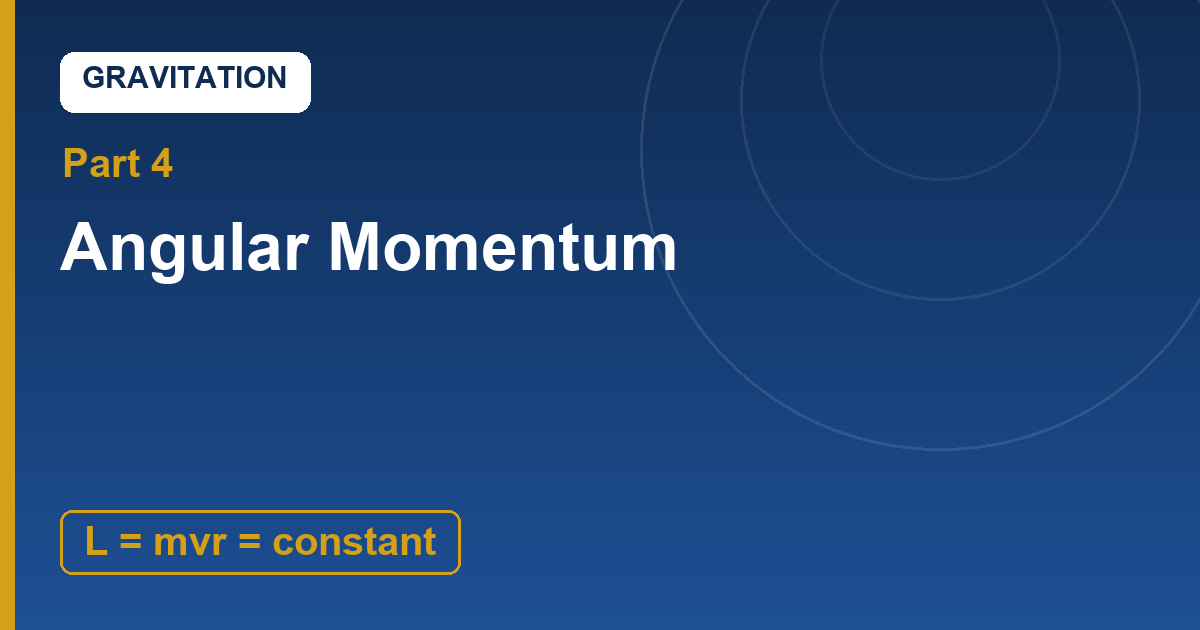
In other words, watch an ice skater spin: arms stretched out — slow. Meanwhile, arms pulled in — suddenly whirling fast. No push, no engine. In fact, where did the extra spin come from? That’s the secret — a rule so strict the whole universe obeys it. Part 4 of the Gravitation series , the rule behind planets, skaters and pulsars.
- Notably, the simple idea: you can’t beat the rule
- What each letter means
- The skater, step by step
- Indeed, the comet: the same trick in space
- Solved examples
- Common mistakes
- Specifically, this physics in your daily life
- Practice set
- Recap
The Simple Idea: You Can’t Beat the Rule
Similarly, some things in physics can be changed by pushing harder. But a few are locked. Moreover, one locked thing: if no outside ‘twist’ (torque) acts on a spinning system, its turning quantity — angular momentum — cannot change. Meanwhile, not by pulling arms in, not by exploding, not by any internal trick.
Overall, why can’t gravity change it for a planet? Meanwhile, because gravity pulls the planet straight toward the Sun — along the string connecting them. Therefore, a pull aimed straight at the centre can speed you up or slow you down, but it can never twist you around. In one line: gravity can pull, but it cannot twist. So a planet’s turning quantity is locked for eternity.
What Each Letter Means
| Letter | What it means (plain words) | Value / unit |
|---|---|---|
| L | Consequently, angular momentum — the ‘amount of turning’ the system has | unit: kg·m²/s |
| m | Furthermore, mass of the moving object (planet, skater’s arm, satellite) | kg |
| v | Likewise, the object’s sideways speed (the part that goes around, not toward or away) | m/s |
| r | In short, distance from the centre of the motion (planet to Sun, skater’s arm to body centre) | m |
Subsequently, read it as a see-saw: v × r must stay constant (m doesn’t change). Indeed, shrink r, and v must grow to pay for it. Grow r, and v must drop. That’s the entire rule.
The Skater, Step by Step
In fact, arms out: her hands are far from the spin axis (big r), moving at modest speed (v). Meanwhile, she pulls her arms in: r shrinks — and since v × r is locked, v rises automatically. She spins faster without doing any rotational work. Her muscles worked to pull the arms in, but the spin-up is pure rule, not push.
The Comet: The Same Trick in Space
Moreover, a comet on its long oval orbit is a skater with invisible arms. Meanwhile, far from the Sun: big r, slow crawl. Falling closer: r shrinks — v must rise. The comet whips around the Sun at maximum speed at closest approach, then slows again on the way out. This IS Kepler’s Rule 2 from Part 3 — ‘faster near the Sun’ was this locked quantity all along. Kepler saw the pattern; this rule explains it.
Solved Examples
Therefore, apply the see-saw: v × r constant → 2 × 24,000 = v × 8,000.
Solve: v = 6 km/s. Meanwhile, closer = faster, exactly like the comet.
Answer: 6 km/s
As a result, the locked thing: turning resistance × spin rate = constant. Meanwhile, half the resistance → double the spin rate.
Answer: 4 rounds/s.
In other words, bonus truth: her spinning energy DOUBLED — paid for by her muscles pulling the arms in. Meanwhile, the turning rule and the energy rule are separate books; both must balance.
Answer: 4 rounds/s (and her muscles paid the extra energy)
Notably, the string pulls through the centre — it can’t twist. Meanwhile, v × r is locked: half the radius → double the speed .
Similarly, energy: speed energy = ½mv² → quadruples. Your hand did that work pulling the string — you can feel the ball yank back.
Answer: speed ×2; energy ×4 — your pulling hand pays
- Overall, ‘Angular momentum is always conserved.’ Only when no outside twist acts. Add friction (a twist) and it drains away — a spinning top slows and stops.
- Counting wrong-speed parts. Consequently, only the sideways speed counts in mvr. Motion straight toward or away from the centre carries no turning.
- Assuming energy is also conserved. Furthermore, in the skater and string problems, energy changes while turning stays locked. Two separate rules — check both.
- Forgetting which point. Likewise, the rule holds about the centre you measure r from — for planets, the Sun; for the ball-on-string, the hole.
This Physics in Your Daily Life
- In short, every figure skater, diver, and aerial skier you’ve watched: tuck = fast spin (small r), stretch = slow spin (big r). They’re not styling — they’re operating this rule with their bodies.
- A cat always lands on its feet by twisting body halves against each other — total turning stays ~zero while each half rotates.
- Helicopters need tail rotors: the engine twists the big blades one way. The rule twists the body the other way. The tail rotor exists to cancel it.
- Pulsars — the skater gone wild: a dying star collapses from Earth-size to 10 km. Shrinking r a million-fold — so spin rate explodes to hundreds of rounds per second. The fastest known use of this rule in nature.
- Chandrayaan-type spacecraft turn in space with reaction wheels: spin a small wheel inside one way, the whole craft turns the other — zero fuel burned.
Practice set (answers hidden — try first)
(NEET-level) A planet at 3r from the Sun moves at speed v. At distance r, its speed is:
(Concept) A skater halves her turning resistance. Her spin rate:
(Concept) Why can’t the Sun change a planet’s turning quantity?
(JEE Main-level) The string-pull ball’s radius is halved. Speed and energy change by:
(Concept) A spinning top slows and stops on a table. Which rule leaked?
- 🧠 One sentence rule: ‘gravity can pull but can’t twist’ — no twist, no change to turning quantity.
- 🧠 See-saw chant: v × r = constant. That’s the skater, the comet, the whole card.
- 🏠 Daily: every figure skater’s tuck-spin, every diver’s pike, every wrestler’s sprawl — athletes run this rule with their bodies.
- 🏠 Daily: helicopters need tail rotors BECAUSE of this rule — the body spins opposite the blades; the tail rotor cancels it.
- 🏠 Daily: pulsars — collapsed stars spinning hundreds of times a second — are the skater’s trick at cosmic scale.
Open a door by pushing near the hinge: nothing. The same push at the handle: the door swings. What matters is not force alone but force × leverage — the twist. Gravity always pulls through the centre, so its leverage is zero: gravity is a push at the hinge.
Compare: a rocket thrusting sideways gives angular momentum L = mvr; change any factor and the orbit twists into a new shape. Gravity gives ΔL = 0 every second of the orbit — pull it as hard as you like, the twisting effect is exactly zero because the lever arm (perpendicular distance to the line of pull) is zero.
Draw the planet with two arrows: the velocity arrow (long near the Sun, short far away) and the gravity arrow (pointing dead at the Sun’s centre). The gravity arrow only tilts the velocity arrow — it can rotate it, never lengthen or shorten the sweep the path makes around the Sun.
- L = mvr — the locked ‘quantity of turning’
- no outside twist → L never changes, no matter what happens inside
- v × r see-saw: closer = faster, farther = slower
- explains Kepler’s Rule 2, skaters, comets, pulsars
- L conserved does NOT mean energy conserved — two separate books
Frequently Asked Questions
What should you know about The Simple Idea: You Can't Beat the Rule?
Some things in physics can be changed by pushing harder. But a few are locked. One locked thing: if no outside ‘twist’ (torque) acts on a spinning system, its turning quantity — angular momentum — cannot change. Not by pulling arms in, not by exploding, not by any internal trick.
What should you know about What Each Letter Means?
Read it as a see-saw: v × r must stay constant (m doesn’t change). Shrink r, and v must grow to pay for it. Grow r, and v must drop. That’s the entire rule.
What should you know about The Skater, Step by Step?
Arms out: her hands are far from the spin axis (big r), moving at modest speed (v). She pulls her arms in: r shrinks — and since v × r is locked, v rises automatically. She spins faster without doing any rotational work. Her muscles worked to pull the arms in, but the spin-up is pure rule, not push.
What should you know about The Comet: The Same Trick in Space?
A comet on its long oval orbit is a skater with invisible arms. Far from the Sun: big r, slow crawl. Falling closer: r shrinks — v must rise. The comet whips around the Sun at maximum speed at closest approach, then slows again on the way out. This IS Kepler’s Rule 2 from Part 3 — ‘faster near the Sun’ was this locked quantity all along. Kepler saw the pattern; this rule explains it.
What should you know about Solved Examples?
Apply the see-saw: v × r constant → 2 × 24,000 = v × 8,000. Solve: v = 6 km/s. Closer = faster, exactly like the comet. ✔ ‘Angular momentum is always conserved.’ Only when no outside twist acts. Add friction (a twist) and it drains away — a spinning top slows and stops.
References & authoritative sources
- Britannica — concept background
- United Nations — official documents
- NTA — official
- NCERT Physics textbooks
- JEE Main — official
Source: compiled from official notifications, standard textbooks and our own mock-test analytics; last reviewed September 2026.
Quick revision
- Angular momentum (L) = mass × speed × distance from the centre — the ‘quantity of turning’
- If nothing twists the system, L stays fixed forever — no exceptions
- Therefore, arms in → spin faster (skater). Arms out → spin slower
- Meanwhile, closer to the Sun → planet speeds up — that’s Kepler’s Rule 2 explained
- As a result, l = mvr is conserved even when energy is not
- Notably, the simple idea: you can’t beat the rule
- 1Escape Velocity: The Speed That Ends Gravity’s Grip
- 2Orbital Velocity: Why the ISS Never Falls
- 3Kepler’s Laws: The 1609 Prediction Machine NASA Still Uses
- 4Angular Momentum: Gravity Can Pull, It Cannot Twist
- 5Gravitational Potential Energy: Why the Minus Sign Matters
- 6Satellite Energy: Why Total Energy Is Negative KE Over Two
- 7Variation of g: Why You Weigh Less at the Equator
- 8Black Holes, LIGO and Lagrange Points
- 9Gravitation Bonus: Shell Theorem to GEO Satellites
Have a doubt on this topic?
Sources & official references
External references for fact-checking and further reading.