Black Holes, LIGO and Lagrange Points Explained
Quick answer: The series finale: how the Class 11 formulas run today's biggest experiments — the 9 mm Schwarzschild radius of Earth, LIGO's proton-width measurement, Aditya-L1 at Lagrange point L1,…
- Black Holes From Your Syllabus.
- LIGO: Energy Conservation at 22 Decimal Places.
- Lagrange Points: Parking Spots in Space.
- Weighing the Invisible.
- The Complete Gravitation Formula Card.
- Where the Series Goes Next.
- Practice set (answers hidden — try first).
- Frequently Asked Questions
- What should you know about Black Holes From Your Syllabus?
- What should you know about LIGO: Energy Conservation at 22 Decimal Places?
- What should you know about Lagrange Points: Parking Spots in Space?
- What should you know about Weighing the Invisible?
- What should you know about Where the Series Goes Next?
- About the Author
- References & authoritative sources
In one line: Black Holes, LIGO and Lagrange Points — exam-ready notes in one glance.
One-page formula card (PDF) — print it, pin it, revise from it. Free, no signup.
In one line: Black holes, LIGO and Lagrange points — the finale of the JEE/NEET Physics · Gravitation series · Part 8 of 8 · All parts →
JEE/NEET Physics · Gravitation series · Part 8 of 8 · All parts →
- A black hole forms when escape velocity crosses light speed: R_s = 2GM/c²
- Compress Earth to a black hole and its radius would be just 9 mm
- LIGO measures spacetime ripples smaller than a proton’s width
- The complete 8-part Gravitation formula card — your revision sheet — is below
In 2015, humanity “heard” two black holes collide — 1.3 billion years after the event actually happened. Every formula used in that detection is over a century old at most, and the core mathematics traces straight back to the gravitation you have revised across this series. This finale of the Gravitation series shows exactly how the syllabus connects to modern astrophysics — and then hands you the complete revision card.
- Black holes from your syllabus.
- LIGO: energy conservation at 22 decimal places.
- Lagrange points: parking spots in space.
- Weighing the invisible.
- The complete formula card.
- Where the series goes next.
Black Holes From Your Syllabus.
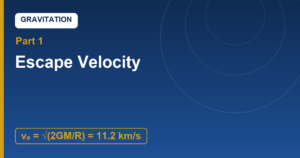
Start with escape velocity from Part 1: vₑ = √(2GM/R). Now imagine shrinking R while keeping M fixed. As the radius decreases, the escape velocity climbs. At some critical radius, vₑ equals c — the speed of light. Beyond that boundary, nothing escapes, not even light itself:
R_s = 2 × 6.67×10⁻¹¹ × 6×10²⁴ ÷ (3×10⁸)² = 8×10¹⁴ ÷ 9×10¹⁶
Answer: ≈ 9 mm — all of Earth, squeezed into a marble.
Try it yourself: repeat the calculation for the Sun (M = 2×10³⁰ kg). You should get about 3 km — the entire Sun compressed to the size of a small town. This is a classic one-mark exam question.
Here is the exam-relevant correction most students miss: at a distance, a black hole’s gravity is identical to that of any object of equal mass. If you swapped the Sun for a Sun-mass black hole tomorrow, Earth’s orbit would not change by a metre. Black holes do not “suck things in” — they simply have gravity, and their horror lies only in how close you can get to the mass.
LIGO: Energy Conservation at 22 Decimal Places.
In September 2015, two black holes — 36 and 29 solar masses — spiralled into each other and merged. In the final moments, three entire solar masses converted directly into pure energy as gravitational waves: E = mc², Part 5’s bookkeeping applied at cosmic scale. For a few hundredths of a second, that merger out-radiated all the stars in the observable universe combined.
LIGO — the Laser Interferometer Gravitational-Wave Observatory — caught the signal. Its two 4-km detector arms measured a length change of roughly one ten-thousandth of a proton’s width, a precision so extreme that engineers must account for quantum noise, thermal vibration of the mirrors, and even the rumble of trucks hundreds of kilometres away. This is energy and momentum conservation verified at 22 decimal places.
And the story is coming home: LIGO-India is under development as India’s flagship gravitational observatory, which will sharpen the sky-localisation of every future detection dramatically. Expect this in the “current science” flavour of exam questions.
Lagrange Points: Parking Spots in Space.
There are five special points in the Sun–Earth system where the Sun’s gravity, the Earth’s gravity and the orbital motion balance out. A satellite parked there holds station with almost no fuel — these are the Lagrange points.
- L1 (1.5 million km sunward of Earth) gives an uninterrupted view of the Sun. It hosts Aditya-L1, ISRO’s solar observatory — India’s first dedicated solar mission.
- L2, on the far side of Earth from the Sun, gives telescopes a permanently dark, cold sky. It hosts the James Webb Space Telescope.
- L3 sits behind the Sun — useful only for fiction, since we can never see what’s there.
- L4 and L5 lead and trail Earth by 60° in its orbit; naturally captured asteroids (“Trojans”) collect at such points in other planetary systems.
The placement math is Parts 2, 3 and 5 working together: gravitational force balance plus centripetal orbital conditions plus energy bookkeeping. If a question gives you the Sun–Earth distance and asks for the L1 distance, you are equating the net force toward the Sun with the required centripetal force for a 1-year orbital period — a beautiful synthesis problem.
Weighing the Invisible.
How do we know the black hole at our galaxy’s centre, Sgr A*, weighs about four million Suns? We watch a star orbit it. The star S2 completes a full 16-year loop around a point where nothing visible sits. Measure the orbital period T and the semi-major radius r, then apply Kepler’s third law from Part 3: M = 4π²r³/GT².
That is the astonishing part: a law published in 1619, derived from planetary observations by naked-eye-era astronomy, weighs a four-million-solar-mass monster. Kepler’s third law works equally for Mars and for black holes because gravity is gravity — the same inverse-square force everywhere in the universe. This technique, watching things orbit invisible masses, is also how astronomers first inferred dark matter in galaxies.
The Complete Gravitation Formula Card.
| Quantity. | Formula. | Note. |
|---|---|---|
| Escape velocity. | vₑ = √(2GM/R) = √(2gR). | surface launch; mass-independent. |
| Orbital velocity. | vₒ = √(GM/r) = √(gR). | Furthermore, r = R + h; vₑ = √2·vₒ. |
| Kepler’s third law. | T² = 4π²r³/GM. | same central body only. |
| Angular momentum. | L = mvr = constant. | central force ⟹ τ = 0. |
| Gravitational PE. | U = −GMm/r. | U = 0 at infinity. |
| Orbit energies. | KE = GMm/2r, E = −GMm/2r. | |PE| = 2|KE|. |
| g with depth. | g’ = g(1 − d/R). | g = 0 at centre. |
| g with height. | g’ ≈ g(1 − 2h/R). | exact: gR²/(R+h)². |
| g with latitude. | Likewise, g’ = g − ω²R cos²λ. | max reduction at equator. |
Revision tip: memorise the escape and orbital velocity pair together — the relation vₑ = √2·vₒ is tested far more often than either formula alone. The energy relations are the second-highest-yield row: remember that for a circular orbit, the total energy is negative and equal to half the potential energy in magnitude.
Where the Series Goes Next.
In short, the angular momentum conservation from Part 4 becomes the most powerful problem-solving tool in the next chapter — Rotational Motion: torque, moment of inertia and rolling bodies. The central-force argument (τ = 0 ⟹ L = constant) reappears everywhere in rotation, so the mental machinery you built here transfers directly. Gravitation, it turns out, was rotation’s rehearsal.
Practice set (answers hidden — try first).
(Concept) If the Sun were replaced by a Sun-mass black hole, Earth’s orbit would:.
(JEE Advanced-flavoured) A planet has R_s equal to its actual radius. The surface escape velocity is:.
(Concept) Why park Aditya-L1 at L1 rather than in Earth orbit?
(Numerical) A star orbits Sgr A* with a 16-year period at an average orbital radius of about 10³ AU. Estimate the central mass (take Earth’s orbit: 1 year at 1 AU).
- GPS on your phone corrects for gravity: clocks on satellites tick faster than clocks on Earth (weaker gravity up there, ~38 microseconds a day). Without Einstein’s gravity maths, your map would drift by ~10 km every day.
- Lagrange points guard our weather satellites: the James Webb and several weather observatories sit at these gravitationally balanced parking spots — no fuel burned to hold position, so they watch Earth and stars for years, cheaply.
- LIGO-style precision in your gadgets: the same laser-interference idea that detected gravitational waves (measuring a shift 10,000× smaller than a proton) is the ancestor of the optical sensors in your mouse and fibre-internet equipment.
- Black-hole maths runs the maps of the sky: satellite TV dishes and star-tracker navigation correct their signals for the way mass bends light — light bending around the Sun, first measured in 1919, is now a routine engineering correction.
Imagine the well of gravity dug so deep that even light — the fastest thing there is — lacks the launch speed to climb out. That’s a black hole: not a vacuum cleaner, just a pit with walls steeper than light can climb. And when two such pits crash together, the well itself shakes — space quivers like a struck drumskin.
Light escapes at 300,000 km/s; Earth would trap it only if compressed to 9 mm across (its ‘photon sphere’ logic). LIGO measured two black holes of 36 and 29 solar masses merging 1.3 billion light-years away — the wobble it detected in a 4-km laser arm was 10,000× smaller than a proton.
Picture spacetime as a stretched rubber sheet: masses make dents, a black hole a bottomless poke. Two pokes spiralling together launch waves across the sheet — and a detector is just two rulers at right angles, each stretching and squeezing a hair’s breadth as the wave passes.
- black hole = vₑ crossing c: R_s = 2GM/c²
- LIGO measures spacetime ripples smaller than a proton
- L1 hosts Aditya-L1; L2 hosts James Webb
- Kepler’s third law weighs invisible masses
Frequently Asked Questions
What should you know about Black Holes From Your Syllabus?
A black hole is nothing more exotic than escape velocity taken to its limit. Start from Part 1: vₑ = √(2GM/R). Shrink R while keeping M fixed, and at some radius vₑ = c. That radius is the Schwarzschild radius, R_s = 2GM/c². Worked example for Earth: R_s = 2 × 6.67×10⁻¹¹ × 6×10²⁴ ÷ (3×10⁸)² = 8×10¹⁴ ÷ 9×10¹⁶ ≈ 9 mm. Remember also that at a distance, a black hole’s gravity equals that of any equal mass — orbiting bodies notice nothing special until they venture close.
What should you know about LIGO: Energy Conservation at 22 Decimal Places?
Two black holes of 36 and 29 solar masses merged in 2015, converting three solar masses directly into gravitational-wave energy — E = mc² from Part 5 at cosmic scale. LIGO’s 4-km detector arms measured a length change of one ten-thousandth of a proton’s width, confirming energy conservation to extraordinary precision. LIGO-India is under development and will become India’s flagship gravitational observatory, dramatically improving source localisation on the sky.
What should you know about Lagrange Points: Parking Spots in Space?
There are five Lagrange points in the Sun–Earth system where gravitational pulls and orbital motion balance, letting satellites hold station with almost no fuel. L1 (1.5 million km sunward) hosts Aditya-L1, ISRO’s solar observatory, because it enjoys a continuous, eclipse-free view of the Sun. L2 hosts the James Webb Space Telescope, which needs a permanently dark, cold sky. L4 and L5 sit 60° ahead of and behind Earth’s orbit. The placement math combines Parts 2, 3 and 5 — force balance plus centripetal conditions.
What should you know about Weighing the Invisible?
How do we know the black hole Sgr A* weighs about four million Suns? Watch a star orbit it: the star S2 completes a 16-year loop around an invisible point. Measure T and r, then apply Part 3: M = 4π²r³/GT². It is remarkable that Kepler’s 1619 law — derived from naked-eye planetary data — weighs million-solar-mass monsters today, but gravity’s inverse-square nature makes it universal.
What should you know about Where the Series Goes Next?
The angular momentum conservation from Part 4 becomes the most powerful problem-solving tool in the next chapter — Rotational Motion: torque, moment of inertia and rolling bodies. The central-force argument (zero torque ⟹ constant angular momentum) transfers directly, so the intuition built across Gravitation becomes rotation’s foundation.
References & authoritative sources
- Britannica — concept background
- United Nations — official documents
- ISRO — official
- NASA
- PIB — S&T releases
Source: compiled from official notifications, standard textbooks and our own mock-test analytics; last reviewed September 2026.
Quick revision
- A black hole forms when escape velocity crosses light speed: R_s = 2GM/c²
- Compress Earth to a black hole and its radius would be just 9 mm
- LIGO measures spacetime ripples smaller than a proton’s width
- The complete 8-part Gravitation formula card — your revision sheet — is below
- Black holes from your syllabus.
- LIGO: energy conservation at 22 decimal places.
- 1Escape Velocity: The Speed That Ends Gravity’s Grip
- 2Orbital Velocity: Why the ISS Never Falls
- 3Kepler’s Laws: The 1609 Prediction Machine NASA Still Uses
- 4Angular Momentum: Gravity Can Pull, It Cannot Twist
- 5Gravitational Potential Energy: Why the Minus Sign Matters
- 6Satellite Energy: Why Total Energy Is Negative KE Over Two
- 7Variation of g: Why You Weigh Less at the Equator
- 8Black Holes, LIGO and Lagrange Points
- 9Gravitation Bonus: Shell Theorem to GEO Satellites
Have a doubt on this topic?
Sources & official references
External references for fact-checking and further reading.