Potential Energy Explained: Stored Work Ready to Strike
Quick answer: Potential energy explained as stored work: gravitational and spring energy, the reference-level choice and JEE/NEET worked examples in exam-ready notes.
- Height Energy: mgh
- Spring Energy: ½kx²
- Conservative: Path Never Matters
- The PE ↔ KE Trade
- Solved Examples
- This Physics in Your Daily Life
- Practice set (answers hidden — try first)
- Frequently Asked Questions
- What should you know about Height Energy: mgh?
- What should you know about Spring Energy: ½kx²?
- What should you know about Conservative: Path Never Matters?
- What should you know about The PE ↔ KE Trade?
- What should you know about Solved Examples?
- About the Author
- References & authoritative sources
In one line: Potential Energy — exam-ready notes in one glance.
In one line: JEE/NEET Physics · Work, Energy & Power series · Part 3 of 8 · All parts →✪ Key points — the 30-second versionStored energy from position: lifted = height.
JEE/NEET Physics · Work, Energy & Power series · Part 3 of 8 · All parts →
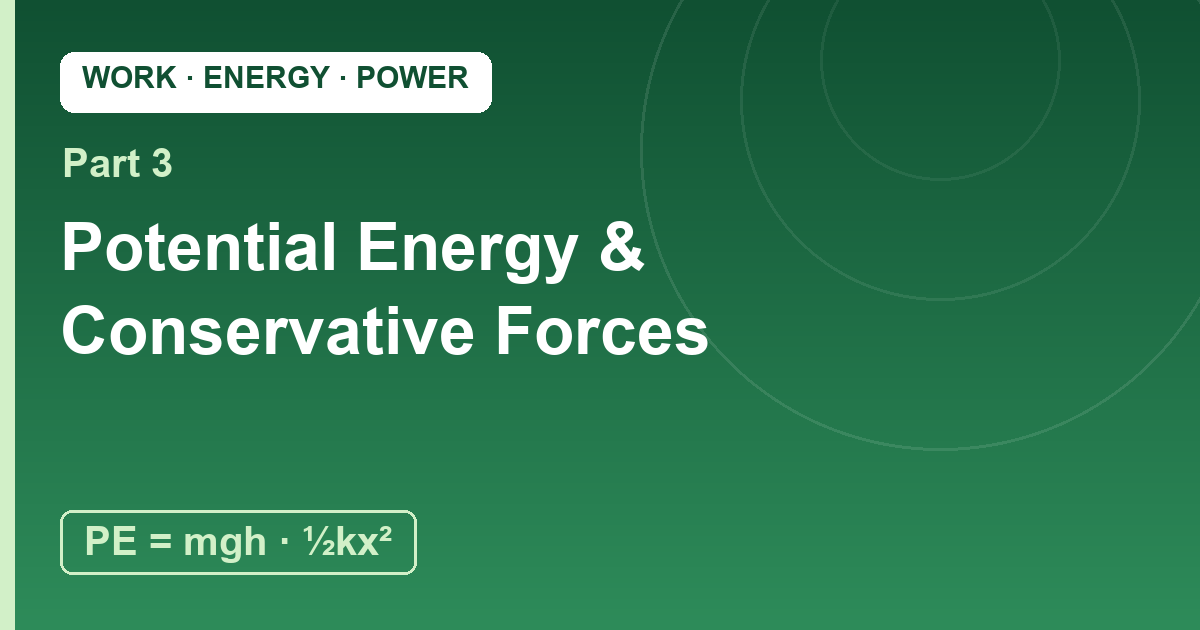
- Stored energy from position: lifted = height energy (mgh), stretched = spring energy (½kx²)
- Gravity is ‘conservative’: path doesn’t matter, only height change
- PE is a debt/credit between states — changes matter, not absolutes
- PE → KE freely: the pendulum, the rollercoaster, the hydro dam
- Spring energy grows with stretch SQUARED: double the pull, ×4 stored
Lift a brick to a rooftop — it quietly stores the work you did. Therefore, Let it go — the stored energy returns as motion. Dams, rollercoasters, archer’s bows: all run on this stored energy. Meanwhile, Potential energy (PE) is work banked by changing a position — height or stretch. Part 3 of the Work, Energy & Power series.
- Height energy: mgh
- Spring energy: ½kx²
- What each letter means
- Conservative: path never matters
- The PE ↔ KE trade
- Solved examples
- Common mistakes
- This physics in your daily life
- Practice set
- Recap
Height Energy: mgh
| Letter | What it means (plain words) | Value / unit |
|---|---|---|
| m | mass being lifted | kg |
| g | gravity strength at the surface | ≈ 10 m/s² (9.8 precise) |
| h | height ABOVE YOUR CHOSEN ZERO LEVEL | metres — you choose the zero! |
Lifting a 1 kg brick up 1 m costs ~10 J — banked as PE, returnable on release. Note h is measured from a zero level you choose (the ground, a table, a roof) — only PE changes are physical, so pick the most convenient zero and stay consistent.
Spring Energy: ½kx²
| Letter | What it means (plain words) | Value / unit |
|---|---|---|
| k | stiffness — how many newtons per metre of stretch | N/m (a stiff spring has big k) |
| x | stretch or squeeze from natural length | metres — always squared |
Stretch a spring double: four times the stored energy. Compress triple: nine times. Consequently, The square makes spring energy grow brutally — why a fully compressed loaded spring is genuinely dangerous.
Conservative: Path Never Matters
Gravity has a beautiful property: the work it does depends ONLY on height change — not the route. Furthermore, Lift a brick straight up 2 m or carry it up a spiral ramp 2 m: gravity’s PE change is identical (mgh both ways). Forces like this are called conservative; they allow the free PE↔KE trading of Part 4. However, Friction is the opposite: its work depends on path length — energy leaks away and never returns.
The PE ↔ KE Trade
Drop the brick: PE (mgh) converts to KE (½mv²). Moreover, Swing a pendulum: height energy ↔ motion energy, back and forth. Stretch a bow: your work → spring PE → arrow KE. In fact, All day, the universe trades between stored and moving energy — Part 4 makes the ledger exact.
Solved Examples
Direct: mgh = 2 × 10 × 5 = 100 J.
Check: 100 J banked = the KE it will have falling back — 100 = ½(2)v² → v = 10 m/s. ✔
Answer: 100 J
At 10 cm: ½(200)(0.1²) = 1 J. At 20 cm: ½(200)(0.2²) = 4 J.
Double stretch = ×4 energy — the square again. ✔
Answer: 1 J → 4 J (double stretch, ×4)
Energy ledger: spring PE → height PE. ½(500)(0.2²) = 10 J = mgh → 10 = 0.5 × 10 × h.
h = 2 m.
Check: spring gives back everything it stored (ideal spring) — 10 J lifts 0.5 kg by 2 m. ✔
Answer: rises 2 m
- Forgetting to square the stretch in ½kx². The #1 spring error — always square x first (in metres!).
- Mixing cm and m. 10 cm must be 0.10 m before any formula. Notably, Half the wrong answers in this chapter start as centimetres.
- Changing the zero level mid-problem. Choose one zero for h and never move it.
- Assuming friction trades like gravity. Only conservative forces (gravity, ideal springs) bank energy returnably — friction’s losses are one-way.
This Physics in Your Daily Life
- Hydroelectric dams are PE banks: rain lifts water (Sun’s work), dams hold the height, turbines cash mgh back as electricity — most of the world’s renewable power is literally stored height.
- A ball-point pen’s click, a car’s suspension, a trampoline, your mattress springs: ½kx² giving you comfort or function every day.
- Archery and slingshots: muscle work banked in a bent bow / stretched rubber, returned as arrow speed in a millisecond.
- Rollercoasters lift you once (the clacking chain lift = charging mgh) then trade PE↔KE for the whole ride — no engine needed after the first hill.
- Pumped-storage power stations buy cheap night electricity to pump water uphill, then sell it back as mgh at peak hours — a battery made of a lake.
Practice set (answers hidden — try first)
(NEET-level) A 5 kg bag on a 3 m table (zero at floor). PE:
(JEE Main-level) Spring k = 800 N/m compressed 5 cm. Energy:
(Concept) Lifting a stone 2 m straight vs along a 5 m ramp (no friction): gravity’s PE gain is:
(NEET-level) Doubling a spring’s stretch multiplies stored energy by:
(JEE Main-level) A 1 kg ball dropped from 20 m: KE at the ground (no air):
- 🧠 Chant: ‘height banks, springs bank — squares and products, then thank’.
- 🧠 Two squares rule: KE has v², spring PE has x² — the chapter’s two squares.
- 🧠 Path-free: straight up or spiral up — gravity only counts the height.
- 🏠 Daily: every dam is a battery made of a lake — mgh as national infrastructure.
- 🏠 Daily: your mattress and car suspension cash ½kx² for you all night and every bump.
- 🔁 PE_gravity = mgh (choose one zero)
- 🔁 PE_spring = ½kx² — square first, metres only
- 🔁 conservative = path-independent (gravity, springs)
A stretched spring, a lifted brick, a held-breath dam: all are frozen accidents waiting to happen. Potential energy is work you already did, parked in shape or position, retrievable on demand. Nothing visible moves — the energy hides in geometry.
Lift 5 kg by 2 m: you paid mgh = 98 J. Let go: gravity repays all 98 J as kinetic energy (v = 6.3 m/s). Compress a spring 0.1 m with k = 200 N/m: ½kx² = 1 J parked. Same currency, different vaults.
Draw a landscape of hills and valleys with a ball resting partway up a slope. Height above the valley floor = stored energy. Nudge the ball: it rolls down, trading height for speed, the total constant. The map IS the energy budget.
- height energy: mgh — work banked by lifting
- spring energy: ½kx² — stretch SQUARED (metres!)
- conservative forces: path irrelevant, only height/stretch change matters
- choose one zero level and keep it
- friction is non-conservative: energy leaks one-way
Frequently Asked Questions
What should you know about Height Energy: mgh?
Lifting a 1 kg brick up 1 m costs ~10 J — banked as PE, returnable on release. Note h is measured from a zero level you choose (the ground, a table, a roof) — only PE changes are physical, so pick the most convenient zero and stay consistent.
What should you know about Spring Energy: ½kx²?
Stretch a spring double: four times the stored energy. Compress triple: nine times. In other words, The square makes spring energy grow brutally — why a fully compressed loaded spring is genuinely dangerous.
What should you know about Conservative: Path Never Matters?
Gravity has a beautiful property: the work it does depends ONLY on height change — not the route. Specifically, Lift a brick straight up 2 m or carry it up a spiral ramp 2 m: gravity’s PE change is identical (mgh both ways). Forces like this are called conservative; they allow the free PE↔KE trading of Part 4. Indeed, Friction is the opposite: its work depends on path length — energy leaks away and never returns.
What should you know about The PE ↔ KE Trade?
Drop the brick: PE (mgh) converts to KE (½mv²). In short, Swing a pendulum: height energy ↔ motion energy, back and forth. Stretch a bow: your work → spring PE → arrow KE. Similarly, All day, the universe trades between stored and moving energy — Part 4 makes the ledger exact.
What should you know about Solved Examples?
Direct: mgh = 2 × 10 × 5 = 100 J. Check: 100 J banked = the KE it will have falling back — 100 = ½(2)v² → v = 10 m/s. ✔ Forgetting to square the stretch in ½kx². Therefore, The #1 spring error — always square x first (in metres!). Mixing cm and m. 10 cm must be 0.10 m before any formula. Meanwhile, Half the wrong answers in this chapter start as centimetres.
References & authoritative sources
- Britannica — concept background
- United Nations — official documents
- NTA — official
- NCERT Physics textbooks
- JEE Main — official
Source: compiled from official notifications, standard textbooks and our own mock-test analytics; last reviewed September 2026.
Quick revision
- Stored energy from position: lifted = height energy (mgh), stretched = spring energy (½kx²)
- Gravity is ‘conservative’: path doesn’t matter, only height change
- PE is a debt/credit between states — changes matter, not absolutes
- PE → KE freely: the pendulum, the rollercoaster, the hydro dam
- Spring energy grows with stretch SQUARED: double the pull, ×4 stored
- Conservative: path never matters
- 1Work Done: When a Force Actually Achieves Something
- 2Kinetic Energy and the Work-Energy Theorem
- 3Potential Energy: Stored Work, Ready to Strike
- 4Conservation of Energy: The Universe’s Perfect Bookkeeping
- 5Power and Efficiency: How FAST You Can Do the Work
- 6Collisions: The Great Sorting — What Survives, What Dies
- 7Springs and Vertical Circles: Energy in Two Classic Stages
- 8Energy in the Real World: The Formula Card
Have a doubt on this topic?
Sources & official references
External references for fact-checking and further reading.