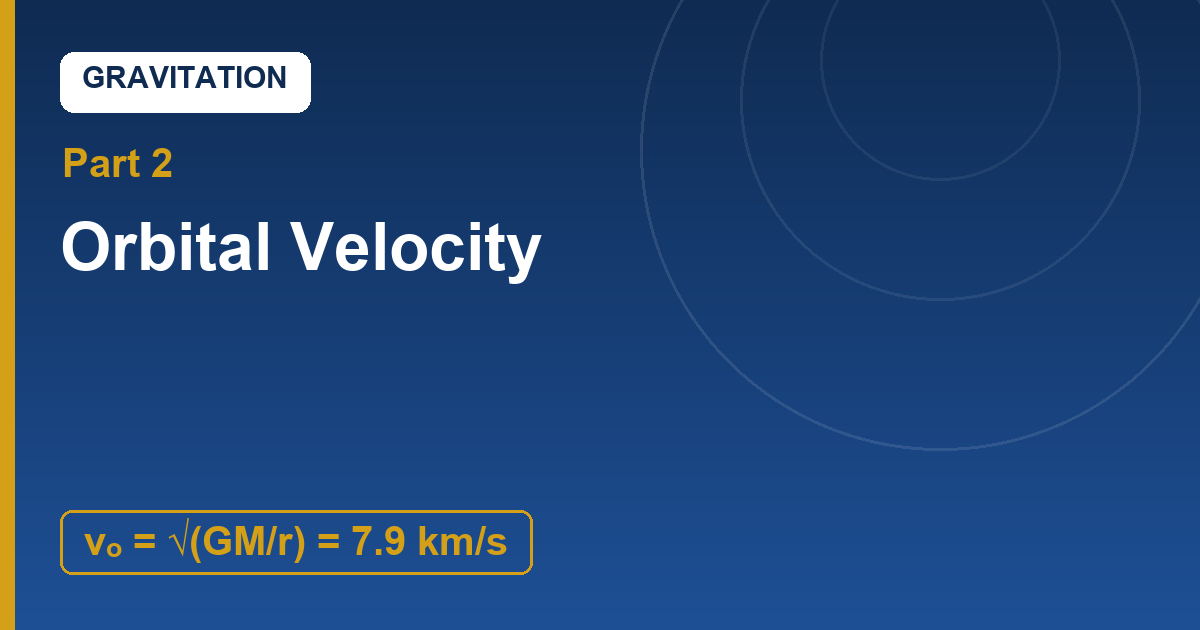
Orbital Velocity Explained: Why the ISS Never Falls
Quick answer: Orbital velocity vₒ = √(GM/r) = √(gR) from centripetal-force balance, the r = R+h trap, and why higher satellites move slower — with the √2 link to escape…
- The Simple Idea: Newton’s Cannonball
- What Each Letter Means
- Why Higher Satellites Move SLOWER
- The √2 Memory Trick
- Solved Examples
- This Physics in Your Daily Life
- Practice set (answers hidden — try first)
- Frequently Asked Questions
- What should you know about The Simple Idea: Newton's Cannonball?
- What should you know about Why Higher Satellites Move SLOWER?
- What should you know about The √2 Memory Trick?
- What should you know about Solved Examples?
- What should you know about This Physics in Your Daily Life?
- About the Author
- References & authoritative sources
In one line: orbital velocity: JEE/NEET Physics · Gravitation series · Part 2 of 8 · All parts →✪ Key points — the 30-second versionFormula: vₒ = √(GM/r) = √(gR) — 7.9.
In fact, JEE/NEET Physics · Gravitation series · Part 2 of 9 · All parts →
- Moreover, orbiting = falling and missing the ground, forever
- Vₒ = √(GM/r) — 7.9 km/s near Earth (G: gravity’s number, M: planet’s mass, r: distance from planet’s centre)
- Meanwhile, r = R + h — from the planet’s CENTRE, not from its surface
- As a result, higher orbit = SLOWER speed (surprise!)
- In other words, escape velocity = √2 × orbit velocity — remember the pair 11.2 and 7.9
Notably, the International Space Station has been falling for 25 years — and it has never hit the ground. not because gravity is missing up there (it’s still 89% as strong). it’s because the ISS moves sideways so fast that as it falls, the curved Earth keeps dropping away beneath it. Part 2 of the Gravitation series — and this one you can understand with a thrown ball.
- The simple idea: Newton’s cannonball
- What each letter means
- Why higher satellites move SLOWER
- The √2 memory trick
- Solved examples
- Common mistakes
- Indeed, this physics in your daily life
- Practice set
- Recap
The Simple Idea: Newton’s Cannonball
Specifically, throw a ball sideways — it lands a few metres away. Meanwhile, throw harder — it lands farther. now imagine throwing extremely hard, from a very high mountain.
Similarly, here’s the key: the Earth is round, so its surface curves downward. Meanwhile, as the ball flies farther, the ground beneath it drops away. If the ball flies fast enough, its falling matches the Earth’s curving — the ball falls forever and never touches ground. That’s an orbit.
So an astronaut isn’t floating because there’s no gravity. Overall, the astronaut and the whole station are falling together — like being in a lift whose cable snapped. Indeed, everything falls together = everything floats together.
What Each Letter Means
Earth
ISS — falls 24/7
gravity (89% of surface!)
7.7 km/s sideways
ground curves away
→ falls forever, never lands
| Letter | What it means (plain words) | Value / unit |
|---|---|---|
| vₒ | Consequently, orbit velocity — the sideways speed needed to keep falling around the planet forever | answer in m/s or km/s |
| G | Furthermore, gravity’s fixed strength number (same everywhere in the universe) | 6.67 × 10⁻¹¹ |
| M | Likewise, mass of the planet you’re orbiting — how much stuff it has | Earth: 6 × 10²⁴ kg |
| r | In short, distance from the planet’s CENTRE to the satellite — this is R + h, the #1 trap in this topic | Subsequently, earth’s surface orbit: 6.4 × 10⁶ m |
Why Higher Satellites Move SLOWER
Feels wrong, right? In fact, higher = farther from Earth = fighting more gravity? No — it’s the opposite. As a result, farther from Earth, gravity is weaker. Meanwhile, the satellite needs less speed to keep circling. vₒ shrinks as r grows: doubling the orbit distance cuts the speed by √2.
Moreover, real numbers: ISS at 400 km flies at 7.7 km/s. TV satellites at 36,000 km crawl at 3.1 km/s. In other words, the Moon at 384,000 km strolls at 1 km/s. Indeed, low orbits are the fast lane; high orbits are the slow lane.
The √2 Memory Trick
Therefore, from Part 1 : escape velocity 11.2 km/s, orbit velocity 7.9 km/s. Notably, the ratio is always √2, for any planet, at any height. Meanwhile, memorise the pair, and any question about either one hands you the other.
Solved Examples
Meanwhile, shortcut form (when the question gives g instead of M): vₒ = √(gR).
Plug in: √(10 × 6.4×10⁶) = √(64×10⁶) = 8×10³.
As a result, common-sense check: the famous answer is 7.9 km/s (with g = 9.8) — ours says 8.
Answer: 8 km/s
In other words, step 1 — convert height to distance from centre: r = R + h = 2R. Meanwhile, this one line is the entire question!
Specifically, step 2 — apply ‘higher = slower’: v = 7.9/√2.
Similarly, common-sense check: higher orbit, slower speed — matches the rule.
Answer: ≈ 5.6 km/s
Overall, step 1 — speed: vₒ = √(GM/2R) ≈ 5.6 km/s.
Consequently, step 2 — time = distance ÷ speed: circle distance = 2πr = 2π × 1.28×10⁷ m.
Furthermore, common-sense check: about 4 hours — higher orbits are slower AND longer. Meanwhile, much more time than the ~90-minute ISS.
Answer: T ≈ 4 hours
- Likewise, using R instead of R + h. The question says ‘height 400 km’ — students plug in Earth’s radius alone. Fix it forever: r = R + h, distance from the CENTRE. This is the most-lost mark in satellites.
- ‘Higher = faster’ feeling. It comes from everyday climbing. But higher orbit means weaker gravity, so LESS speed is needed. Trust the formula.
- Mixing up 7.9 and 11.2. 7.9 km/s = going around (orbit). 11.2 km/s = leaving forever (escape).
- Thinking satellites are weightless because g = 0. At ISS height g is still 8.7 m/s². They float because everything falls together.
This Physics in Your Daily Life
- Your Google Maps pin: GPS satellites fly at 20,200 km at 3.9 km/s. Circling exactly twice a day — that orbit was chosen with this formula. Your phone is talking to objects obeying it right now.
- Starlink internet: thousands of satellites in the low fast lane (550 km, ~95 minutes per lap) — low = fast = low signal delay.
- TV dish pointing: your dish points at one fixed spot in the sky — a satellite parked 36. 000 km up, moving at just the right slow speed to circle once per day, matching Earth’s spin. That’s why it never ‘moves’.
- Chandrayaan circling the Moon slowly: the Moon is light. Orbit speed there is only ~1.7 km/s — same formula, smaller M.
Practice set (answers hidden — try first)
(NEET-level) A satellite at height h = R. Its speed vs the near-surface 8 km/s:
(Concept) Two satellites, 100 kg and 5,000 kg, at the same height. Speed comparison:
(NEET-level) Moving a satellite from surface-orbit to orbit radius 9R changes its speed by:
(Concept) Why do astronauts float inside the ISS?
(JEE Main-level) A satellite’s orbit radius is 4× another’s. Its period (time per lap) is:
- 🧠 √2 pair: orbit 7.9, escape 11.2 — one memory, two answers.
- 🧠 ‘Higher = slower’ — the fast lane is LOW. Remember: ISS laps in 90 min; the Moon takes a month.
- 🧠 r = R + h chant: ‘distance from the CENTRE’ — say it before every satellite problem.
- 🏠 Daily: your TV dish points at one fixed spot — a satellite parked 36. 000 km up moving at exactly the slow speed that matches Earth’s day.
- 🏠 Daily: Google Maps works because GPS satellites keep a 12-hour lap at 20,200 km — this formula chose that height.
Newton’s own thought experiment: fire a cannonball from a mountain. Faster and faster shots land farther away — until one shot is so fast the ground curves away beneath it as fast as it falls. It never lands. That’s an orbit: falling and missing.
The ISS falls toward Earth at the same rate as anything dropped — about 8 m of drop in the first second. But it moves 7.7 km sideways each second, and Earth’s surface curves 4.9 m downward per 7.7 km. Fall 8 m, ground drops ~5 m: it stays up. Match the two numbers and you orbit.
Draw Earth as a circle and the orbit as a ring around it. The satellite is ALWAYS on the ring, always falling (arrow pointing to Earth’s centre), always moving sideways (arrow along the ring). The two arrows never cancel — they cooperate to make the path curve exactly as much as Earth curves.
- vₒ = √(GM/r); near surface: vₒ = √(gR) = 7.9 km/s
- r = R + h — always measure from the planet’s centre
- higher orbit = slower speed (weaker gravity needs less speed)
- orbit = falling around the planet forever, not ‘no gravity’
- vₑ = √2 × vₒ: the pair 11.2 and 7.9 km/s
Frequently Asked Questions
What should you know about The Simple Idea: Newton's Cannonball?
Throw a ball sideways — it lands a few metres away. Throw harder — it lands farther. Now imagine throwing extremely hard, from a very high mountain. Here’s the key: the Earth is round, so its surface curves downward. As the ball flies farther, the ground beneath it drops away. If the ball flies fast enough, its falling matches the Earth’s curving — the ball falls forever and never touches ground. That’s an orbit.
What should you know about Why Higher Satellites Move SLOWER?
Feels wrong, right? Higher = farther from Earth = fighting more gravity? No — it’s the opposite. Farther from Earth, gravity is weaker , so the satellite needs less speed to keep circling. vₒ shrinks as r grows: doubling the orbit distance cuts the speed by √2.
What should you know about The √2 Memory Trick?
From Part 1: escape velocity 11.2 km/s, orbit velocity 7.9 km/s. The ratio is always √2, for any planet, at any height. Memorise the pair, and any question about either one hands you the other.
What should you know about Solved Examples?
Shortcut form (when the question gives g instead of M): vₒ = √(gR). Using R instead of R + h. The question says ‘height 400 km’ — students plug in Earth’s radius alone. Fix it forever: r = R + h, distance from the CENTRE. This is the most-lost mark in satellites.
What should you know about This Physics in Your Daily Life?
Moreover, your Google Maps pin: GPS satellites fly at 20,200 km at 3.9 km/s. Circling exactly twice a day — that orbit was chosen with this formula. Your phone is talking to objects obeying it right now. Starlink internet: thousands of satellites in the low fast lane (550 km, ~95 minutes per lap) — low = fast = low signal delay.
References & authoritative sources
- Britannica — concept background
- United Nations — official documents
- NTA — official
- NCERT Physics textbooks
- JEE Main — official
Source: compiled from official notifications, standard textbooks and our own mock-test analytics; last reviewed September 2026.
Quick revision
- Moreover, orbiting = falling and missing the ground, forever
- Vₒ = √(GM/r) — 7.9 km/s near Earth (G: gravity’s number, M: planet’s mass, r: distance from planet’s centre)
- Meanwhile, r = R + h — from the planet’s CENTRE, not from its surface
- As a result, higher orbit = SLOWER speed (surprise!)
- In other words, escape velocity = √2 × orbit velocity — remember the pair 11.2 and 7.9
- The simple idea: Newton’s cannonball
- 1Escape Velocity: The Speed That Ends Gravity’s Grip
- 2Orbital Velocity: Why the ISS Never Falls
- 3Kepler’s Laws: The 1609 Prediction Machine NASA Still Uses
- 4Angular Momentum: Gravity Can Pull, It Cannot Twist
- 5Gravitational Potential Energy: Why the Minus Sign Matters
- 6Satellite Energy: Why Total Energy Is Negative KE Over Two
- 7Variation of g: Why You Weigh Less at the Equator
- 8Black Holes, LIGO and Lagrange Points
- 9Gravitation Bonus: Shell Theorem to GEO Satellites
Have a doubt on this topic?
Sources & official references
External references for fact-checking and further reading.