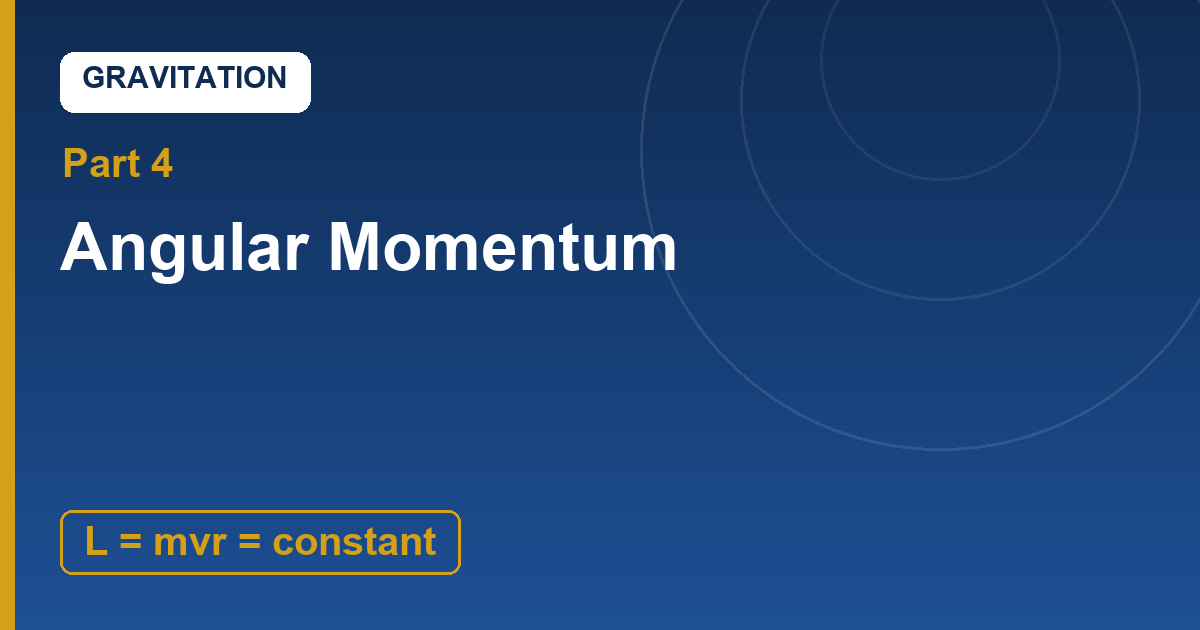
In one line: angular momentum: JEE/NEET Physics · Gravitation series · Part 4 of 8 · All parts →✪ Key points — the 30-second versionCentral force ⟹ zero torque ⟹ L = mv.
JEE/NEET Physics · Gravitation series · Part 4 of 9 · All parts →
- Angular momentum (L) = mass × speed × distance from the centre — the ‘quantity of turning’
- If nothing twists the system, L stays fixed forever — no exceptions
- Arms in → spin faster (skater). Arms out → spin slower
- Closer to the Sun → planet speeds up — that’s Kepler’s Rule 2 explained
- L = mvr is conserved even when energy is not
Watch an ice skater spin: arms stretched out — slow. Arms pulled in — suddenly whirling fast. No push, no engine. Where did the extra spin come from? Nowhere. That’s the secret — a rule so strict the whole universe obeys it. Part 4 of the Gravitation series, the rule behind planets, skaters and pulsars.
- The simple idea: you can’t beat the rule
- What each letter means
- The skater, step by step
- The comet: the same trick in space
- Solved examples
- Common mistakes
- This physics in your daily life
- Practice set
- Recap
The Simple Idea: You Can’t Beat the Rule
Some things in physics can be changed by pushing harder. But a few are locked. One locked thing: if no outside ‘twist’ (torque) acts on a spinning system, its turning quantity — angular momentum — cannot change. Not by pulling arms in, not by exploding, not by any internal trick.
Why can’t gravity change it for a planet? Because gravity pulls the planet straight toward the Sun — along the string connecting them. A pull aimed straight at the centre can speed you up or slow you down, but it can never twist you around. In one line: gravity can pull, but it cannot twist. So a planet’s turning quantity is locked for eternity.
What Each Letter Means
| Letter | What it means (plain words) | Value / unit |
|---|---|---|
| L | angular momentum — the ‘amount of turning’ the system has | unit: kg·m²/s |
| m | mass of the moving object (planet, skater’s arm, satellite) | kg |
| v | the object’s sideways speed (the part that goes around, not toward or away) | m/s |
| r | distance from the centre of the motion (planet to Sun, skater’s arm to body centre) | m |
Read it as a see-saw: v × r must stay constant (m doesn’t change). Shrink r, and v must grow to pay for it. Grow r, and v must drop. That’s the entire rule.
The Skater, Step by Step
Arms out: her hands are far from the spin axis (big r), moving at modest speed (v). She pulls her arms in: r shrinks — and since v × r is locked, v rises automatically. She spins faster without doing any rotational work. Her muscles worked to pull the arms in, but the spin-up is pure rule, not push.
The Comet: The Same Trick in Space
A comet on its long oval orbit is a skater with invisible arms. Far from the Sun: big r, slow crawl. Falling closer: r shrinks — v must rise. The comet whips around the Sun at maximum speed at closest approach, then slows again on the way out. This IS Kepler’s Rule 2 from Part 3 — ‘faster near the Sun’ was this locked quantity all along. Kepler saw the pattern; this rule explains it.
Solved Examples
Apply the see-saw: v × r constant → 2 × 24,000 = v × 8,000.
Solve: v = 6 km/s. Closer = faster, exactly like the comet. ✔
Answer: 6 km/s
The locked thing: turning resistance × spin rate = constant. Half the resistance → double the spin rate.
Answer: 4 rounds/s.
Bonus truth: her spinning energy DOUBLED — paid for by her muscles pulling the arms in. The turning rule and the energy rule are separate books; both must balance. ✔
Answer: 4 rounds/s (and her muscles paid the extra energy)
The string pulls through the centre — it can’t twist, so v × r is locked: half the radius → double the speed.
Energy: speed energy = ½mv² → quadruples. Your hand did that work pulling the string — you can feel the ball yank back. ✔
Answer: speed ×2; energy ×4 — your pulling hand pays
- ‘Angular momentum is always conserved.’ Only when no outside twist acts. Add friction (a twist) and it drains away — a spinning top slows and stops.
- Counting wrong-speed parts. Only the sideways speed counts in mvr. Motion straight toward or away from the centre carries no turning.
- Assuming energy is also conserved. In the skater and string problems, energy changes while turning stays locked. Two separate rules — check both.
- Forgetting which point. The rule holds about the centre you measure r from — for planets, the Sun; for the ball-on-string, the hole.
This Physics in Your Daily Life
- Every figure skater, diver, and aerial skier you’ve watched: tuck = fast spin (small r), stretch = slow spin (big r). They’re not styling — they’re operating this rule with their bodies.
- A cat always lands on its feet by twisting body halves against each other — total turning stays ~zero while each half rotates.
- Helicopters need tail rotors: the engine twists the big blades one way; the rule twists the body the other way. The tail rotor exists to cancel it.
- Pulsars — the skater gone wild: a dying star collapses from Earth-size to 10 km, shrinking r a million-fold — so spin rate explodes to hundreds of rounds per second. The fastest known use of this rule in nature.
- Chandrayaan-type spacecraft turn in space with reaction wheels: spin a small wheel inside one way, the whole craft turns the other — zero fuel burned.
Practice set (answers hidden — try first)
(NEET-level) A planet at 3r from the Sun moves at speed v. At distance r, its speed is:
(Concept) A skater halves her turning resistance. Her spin rate:
(Concept) Why can’t the Sun change a planet’s turning quantity?
(JEE Main-level) The string-pull ball’s radius is halved. Speed and energy change by:
(Concept) A spinning top slows and stops on a table. Which rule leaked?
- 🧠 One sentence rule: ‘gravity can pull but can’t twist’ — no twist, no change to turning quantity.
- 🧠 See-saw chant: v × r = constant. Closer = faster. That’s the skater, the comet, the whole card.
- 🏠 Daily: every figure skater’s tuck-spin, every diver’s pike, every wrestler’s sprawl — athletes run this rule with their bodies.
- 🏠 Daily: helicopters need tail rotors BECAUSE of this rule — the body spins opposite the blades; the tail rotor cancels it.
- 🏠 Daily: pulsars — collapsed stars spinning hundreds of times a second — are the skater’s trick at cosmic scale.
- L = mvr — the locked ‘quantity of turning’
- no outside twist → L never changes, no matter what happens inside
- v × r see-saw: closer = faster, farther = slower
- explains Kepler’s Rule 2, skaters, comets, pulsars
- L conserved does NOT mean energy conserved — two separate books
Quick revision
- Angular momentum (L) = mass × speed × distance from the centre — the ‘quantity of turning’
- If nothing twists the system, L stays fixed forever — no exceptions
- Arms in → spin faster (skater). Arms out → spin slower
- Closer to the Sun → planet speeds up — that’s Kepler’s Rule 2 explained
- L = mvr is conserved even when energy is not
- The simple idea: you can’t beat the rule
- 1Escape Velocity: The Speed That Ends Gravity’s Grip
- 2Orbital Velocity: Why the ISS Never Falls
- 3Kepler’s Laws: The 1609 Prediction Machine NASA Still Uses
- 4Angular Momentum: Gravity Can Pull, It Cannot Twist
- 5Gravitational Potential Energy: Why the Minus Sign Matters
- 6Satellite Energy: Why Total Energy Is Negative KE Over Two
- 7Variation of g: Why You Weigh Less at the Equator
- 8Black Holes, LIGO and Lagrange Points: Gravitation’s Research Frontier
- 9Gravitation Bonus: Field Intensity, Shell Theorem, Weightlessness and GEO Satellites
Have a doubt on this topic?