JEE/NEET Physics · Work, Energy & Power series · Part 7 of 8 · All parts →
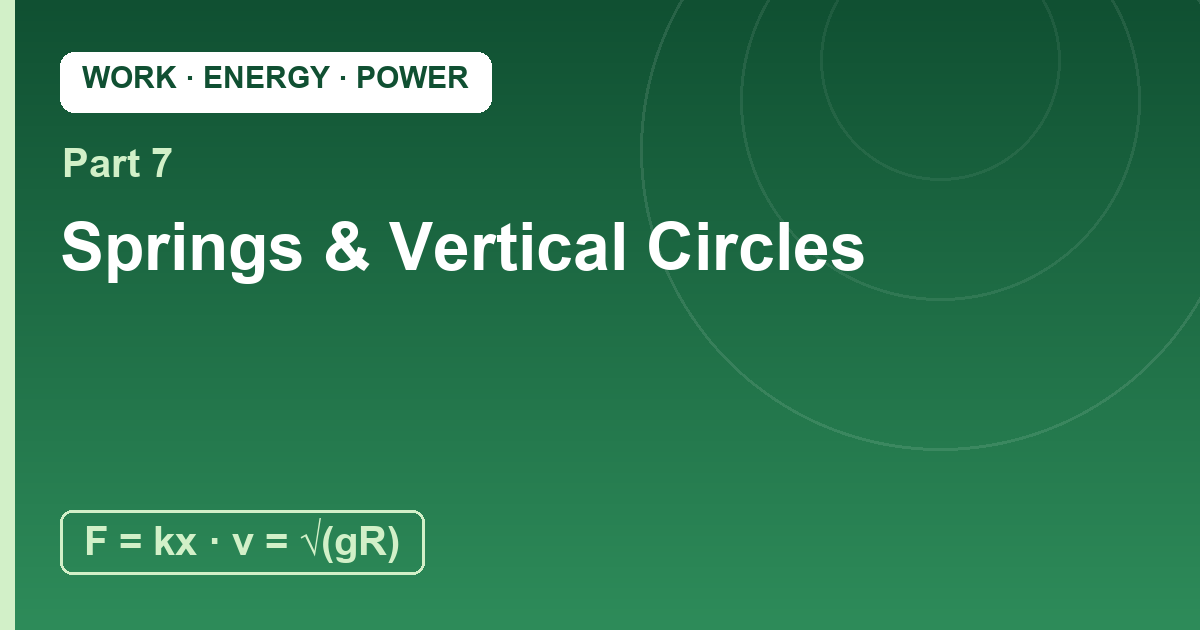
- Springs obey Hooke’s law: pull force = stiffness × stretch (F = kx)
- Vertical circles: minimum top speed = √(gR) (gravity supplies the whole inward push)
- Energy solves both: ½kx² ↔ KE ↔ mgh trades
- Water in a rotating bucket doesn’t fall — the circle’s demand holds it
- A pail, a plane looping, a satellite: one rule, √(gR)
Swing a bucket of water over your head — the water stays in. Loop a plane — passengers are pushed into seats, not belts. Both are one rule about the minimum speed at the top of a vertical circle. Part 7 of the Work, Energy & Power series: two classic energy stages every exam loves.
- Hooke’s law, simply
- The vertical circle’s top point: the weak link
- The √(gR) rule, derived
- Energy connects the levels
- Solved examples
- Common mistakes
- This physics in your daily life
- Practice set
- Recap
Hooke’s Law, Simply
| Letter | What it means (plain words) | Value / unit |
|---|---|---|
| F | the force the spring pulls back with | N |
| k | stiffness — newtons per metre of stretch | N/m |
| x | stretch (or squeeze) from natural length | m |
Combined with energy: stretch stores ½kx², and releasing converts it to KE. This pairing (F = kx to find forces; ½kx² to find energy) solves every spring question.
The Vertical Circle’s Top Point: The Weak Link
In a vertical circle, the top is the danger point — gravity pulls you toward the centre (helping the circle) and speed is lowest there (energy spent on climbing). The question: how slow can you go at the top and still keep the circle?
The √(gR) Rule, Derived
At the top, gravity pulls down — straight toward the centre. In the most desperate case, gravity alone supplies the entire inward push the circle demands:
Below √(gR), gravity wants more inward pull than the circle’s path can provide — the object leaves the circle (water leaves the bucket). At or above it, the track/rotation holds. One number, universal: bucket, plane, rollercoaster, satellite (whose ‘circle never fails’ because it’s always in free fall).
Energy Connects the Levels
To find the minimum launch speed at the BOTTOM for a full loop: bottom speed must be enough to climb 2R and still have √(gR) at top. Energy: ½mv_b² = ½m(gR) + mg(2R) → v_b = √(5gR) — the famous √5, sibling of Part 4’s 2.5R height rule (they’re the same statement, one in speeds, one in heights).
Solved Examples
Force: 400 × 0.05 = 20 N. Energy: ½(400)(0.05²) = 0.5 J.
Note: force linear (20 N), energy quadratic — different books. ✔
Answer: F = 20 N; E = 0.5 J
√(gR): √(10 × 1) ≈ 3.16 m/s.
Feel it: one full turn per ~2 seconds — that’s why you swing a bucket briskly, not lazily. ✔
Answer: ≈ 3.16 m/s
Energy route: ½v_b² = ½(gR) + 2gR → v_b = √(5gR) = √(5×10×0.8) = √40.
v_b ≈ 6.32 m/s.
Cross-check with Part 4: release height needed = 2.5R = 2 m → v from 2 m drop = √(2×10×2) = √40 ✔ — speeds and heights tell the same story.
Answer: v_b = √(5gR) ≈ 6.32 m/s
- Using √(gR) as the BOTTOM speed. It’s the TOP minimum. Bottom needs √(5gR).
- Forgetting gravity helps at the top. At the circle’s top, gravity points toward the centre — it’s an ally; at the bottom, it’s opposition (the track must push extra).
- Centimetres in ½kx². 5 cm = 0.05 m, always — the eternal spring trap.
- Keeling the tension wrong at the top. At minimum speed the track/string pushes (or pulls) with ZERO extra force — gravity does it all. That’s the meaning of √(gR).
This Physics in Your Daily Life
- The bucket trick works exactly when your hand-side speed beats √(gR) — feel it fail as you slow: water falls from the top.
- Rollercoaster loops are engineered above √(5gR) with safety margin — the screams at the top are physics holding you in.
- Washing machine spin cycles: the drum spins clothes at speeds where water ‘can’t stay’ in the fabric — it leaves through the holes tangentially. √(gR) logic, laundry edition.
- Pilots looping aircraft feel ‘g-force’ at the loop’s BOTTOM (extra push needed) and lightness at the top — the vertical circle’s asymmetry, worn as body weight.
- Every trampoline bounce is F = kx catching you and ½kx² returning you — this card’s two halves in one mattress.
Practice set (answers hidden — try first)
(NEET-level) Spring k = 200 N/m, x = 10 cm. Force:
(JEE Main-level) Minimum top speed in a 0.4 m vertical circle (g = 10):
(JEE Main-level) Minimum bottom speed for the same loop:
(Concept) At the top at minimum speed, the string’s tension is:
(NEET-level) Doubling a spring’s stretch multiplies its stored energy by:
- 🧠 Chant: ‘top is √gR, bottom is √5gR, height is 2-and-a-half R’.
- 🧠 Gravity flips roles: helper at the top, opponent at the bottom of a vertical circle.
- 🏠 Daily: swing a bucket briskly — you’re personally verifying √(gR).
- 🏠 Daily: the washing machine’s spin cycle is water failing to keep the circle.
- 🔁 F = kx (linear) vs ½kx² (squared)
- 🔁 v_top(min) = √(gR): gravity alone supplies the push
- 🔁 v_bottom(min) = √(5gR)
- Hooke: F = kx (force linear); energy: ½kx² (squared)
- top of vertical circle: minimum v = √(gR)
- bottom launch for a full loop: √(5gR)
- height equivalent: 2.5R (same rule, in heights)
- at minimum top speed, gravity supplies the whole inward push
Quick revision
- Springs obey Hooke’s law: pull force = stiffness × stretch (F = kx)
- Vertical circles: minimum top speed = √(gR) (gravity supplies the whole inward push)
- Energy solves both: ½kx² ↔ KE ↔ mgh trades
- Water in a rotating bucket doesn’t fall — the circle’s demand holds it
- A pail, a plane looping, a satellite: one rule, √(gR)
- Hooke’s law, simply
- 1Work Done: When a Force Actually Achieves Something
- 2Kinetic Energy and the Work-Energy Theorem: The Great Shortcut
- 3Potential Energy: Stored Work, Ready to Strike
- 4Conservation of Energy: The Universe’s Perfect Bookkeeping
- 5Power and Efficiency: How FAST You Can Do the Work
- 6Collisions: The Great Sorting — What Survives, What Dies
- 7Springs and Vertical Circles: Energy in Two Classic Stages
- 8The Finale: Energy in the Real World, and the Complete Formula Card
Have a doubt on this topic?