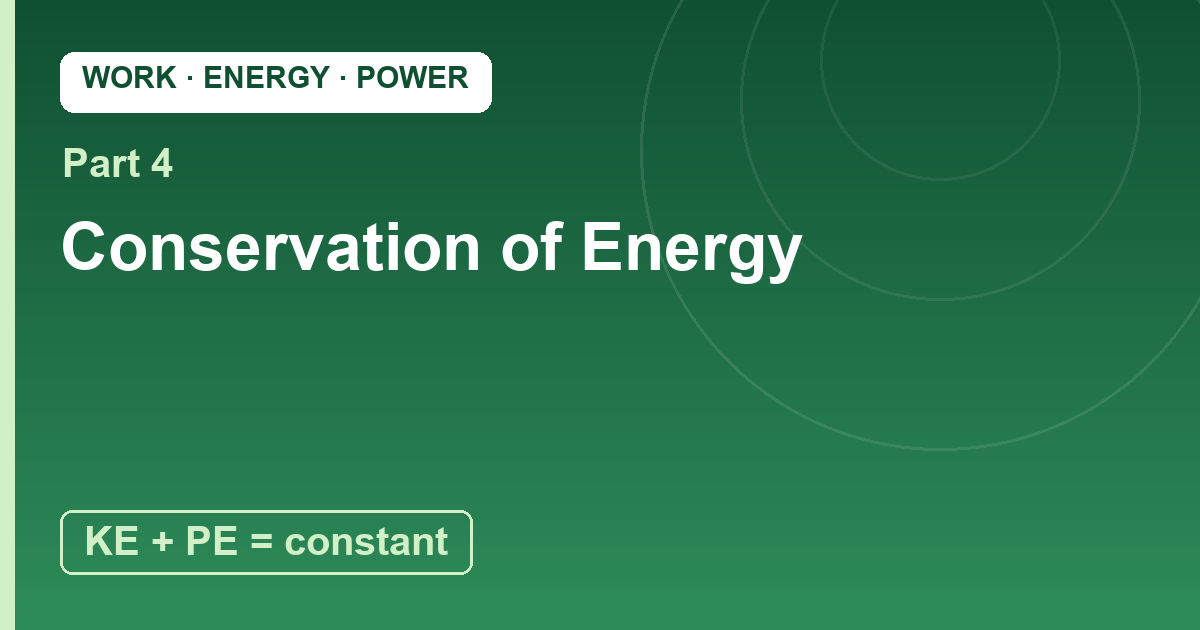
Conservation of Energy: How the Universe Keeps Perfect Books
Quick answer: The law of conservation of energy explained as perfect bookkeeping: worked JEE/NEET examples, common traps, and a revision card you can recall in the exam hall.
- The One Rule
- The Famous Result: v = √(2gh), No Mass Anywhere
- When Friction Leaks the Ledger
- The Pendulum’s Endless Trade
- Solved Examples
- This Physics in Your Daily Life
- Practice set (answers hidden — try first)
- Frequently Asked Questions
- What should you know about The One Rule?
- What should you know about The Famous Result: v = √(2gh), No Mass Anywhere?
- What should you know about When Friction Leaks the Ledger?
- What should you know about The Pendulum's Endless Trade?
- What should you know about Solved Examples?
- About the Author
- References & authoritative sources
In one line: Conservation of Energy — exam-ready notes in one glance.
In one line: JEE/NEET Physics · Work, Energy & Power series · Part 4 of 8 · All parts →✪ Key points — the 30-second versionTotal energy (KE + PE) stays constant when.
In fact, JEE/NEET Physics · Work, Energy & Power series · Part 4 of 8 · All parts →
- Moreover, total energy (KE + PE) stays constant when only conservative forces act
- Falling: mgh converts exactly to ½mv² — v = √(2gh), mass cancels!
- Meanwhile, with friction: ME_lost = friction force × distance (the leak is measurable)
- As a result, pendulum and rollercoaster: endless PE↔KE trading
- In other words, energy is never destroyed — only moved or downgraded
Notably, drop anything — a feather (in vacuum) or an elephant — from the same height. Meanwhile, both hit the ground at the same speed. In fact, mass doesn’t even enter the answer. That’s energy conservation at work: the universe’s most reliable bookkeeping. Part 4 of the Work, Energy & Power series .
- The one rule
- What each letter means
- Indeed, the famous result: v = √(2gh), no mass anywhere
- When friction leaks the ledger
- The pendulum’s endless trade
- Solved examples
- Common mistakes
- Specifically, this physics in your daily life
- Practice set
- Recap
The One Rule
total = KE + PE (constant)
KEmax
PE 0
bottom of swing — all motion
KE 0
PEmax
top of swing — all stored
| Letter | What it means (plain words) | Value / unit |
|---|---|---|
| KE | motion energy ½mv² | J |
| PE | Similarly, stored energy: mgh (height) and/or ½kx² (spring) | J |
| friction (if present) | Overall, the leak: total drops by friction × distance | the only common spoiler |
Consequently, read it as a see-saw: what KE loses, PE gains, exactly. Meanwhile, total never changes (with only gravity/springs). Moreover, with friction, the total still doesn’t vanish — it leaks out as heat : mechanical energy lost = friction force × distance slid.
The Famous Result: v = √(2gh), No Mass Anywhere
Furthermore, drop from height h: mgh = ½mv² → divide both sides by m — mass cancels completely → v = √(2gh). Meanwhile, heavy or light, same landing speed (in vacuum). Therefore, from 20 m: v = √400 = 20 m/s. From 45 m (with g = 10): 30 m/s. One line, no mass, no time — the most useful result in the chapter.
When Friction Leaks the Ledger
Likewise, real slides and roads have friction. Indeed, the bookkeeping then reads: (KE + PE)_start = (KE + PE)_end + friction × distance. Meanwhile, the leak isn’t lost — it’s heat (why brake discs glow, why rubbing warms hands). Questions love this: ‘how far does it slide before stopping?’ — the leak formula answers in one line.
The Pendulum’s Endless Trade
In short, a pendulum swings because energy endlessly converts: maximum height (all PE. Meanwhile, still) → bottom (all KE, fastest) → the other side’s height (all PE again). With zero friction it would swing forever. Real pendulums leak tiny heat each swing — that’s why clocks needed winding.
Solved Examples
In other words, famous result: v = √(2gh) = √(2 × 10 × 45) = √900.
Notably, v = 30 m/s — no mass needed, ever.
Answer: 30 m/s
Indeed, ledger: start PE = 2 × 10 × 1.5 = 30 J. Leak = friction × distance = 4 × 3 = 12 J. Remaining for KE = 18 J.
Specifically, ½(2)v² = 18 → v = √18 ≈ 4.24 m/s.
Check: without friction it’d be √30 ≈ 5.48 — friction slowed it, as it must.
Answer: v ≈ 4.24 m/s
Two conditions meet: at the loop’s top, gravity supplies the needed centripetal push: mg = mv²/R → v²_top = gR. Energy: mg·h = mg·(2R) + ½m·gR → h = 2R + R/2.
h = 2.5R.
This is the classic rollercoaster design number — five-halves the loop radius (in practice more, for friction).
Answer: h = 2.5R (the rollercoaster rule)
- Putting mass in the drop formula. v = √(2gh) has no mass — inserting one means the algebra was never finished.
- Forgetting the friction leak term. ‘Energy is conserved’ is FALSE with friction present; mechanical energy falls by friction × distance.
- Height measured inconsistently. Keep one zero level for the whole problem (Part 3’s rule).
- Believing energy conservation means nothing is lost ever. Energy is never destroyed — but it DOWNGRADES to heat, which is usually unusable. The ledger always balances; usefulness doesn’t.
This Physics in Your Daily Life
- Every rollercoaster’s first hill is its battery — the rest of the ride spends that mgh. Engineers add margin above 2.5R for friction.
- Hydro dams again, quantitatively: 1,000 tonnes falling 100 m delivers ~1 billion joules — v = √(2gh) for the water, then turbines take over.
- Regenerative braking: EVs intercept the KE you’d normally burn in brakes and bank it into the battery — conservation, monetised.
- A swing in the park: you pump by leaning at the right moments (adding small energy each cycle). Friction and air take tiny tolls — the trade is visible physics.
- Meteors burn up because v is enormous: ½mv² at 30 km/s converts to heat on air contact — conservation you can watch as a shooting star.
Practice set (answers hidden — try first)
(NEET-level) Speed after a 20 m free fall (g = 10):
(JEE Main-level) A 1 kg block slides 5 m on flat ground against friction 6 N, starting at 8 m/s. It stops after:
(Concept) A pendulum’s speed is maximum at:
(JEE Main-level) Loop-the-loop minimum release height (loop radius R, frictionless):
(Concept) With friction present, ‘energy is conserved’ — true or false?
- 🧠 Chant: ‘what motion loses, height gains — the total never changes’.
- 🧠 The mass-free line: ‘drop questions don’t need mass — √2gh and done’.
- 🧠 2.5R: the rollercoaster rule — say it like a phone number.
- 🏠 Daily: every coaster’s first hill is the ride’s battery; everything after is spending.
- 🏠 Daily: a shooting star is ½mv² turned to heat in front of your eyes.
- 🔁 KE + PE constant under gravity/springs
- 🔁 v = √(2gh): no mass, no time needed
- 🔁 friction leak = friction × distance → heat
A ball bounces lower each time and stops — energy ‘lost’? No: it became heat in the floor, sound in the air, wobble in the ball. Energy never disappears; it only changes costume. Conservation isn’t a rule physics follows — it’s a rule geometry forces.
Drop 1 kg from 10 m: PE = 98 J. Just before impact: KE = 98 J. After a messy inelastic bounce: 30 J motion + 60 J heat + 8 J sound. The costumes changed; the total never left 98 J.
Picture a set of water tanks connected by pipes labelled ‘kinetic’, ‘potential’, ‘heat’, ‘sound’, ‘light’. Water flows between tanks in every direction, but the pipes never leak outside the system. Read any moment: total level constant.
- KE + PE = constant (gravity/springs only)
- v = √(2gh) — the mass-free drop formula
- with friction: ME drops by friction × distance (it becomes heat)
- pendulum/rollercoaster: endless PE↔KE trade
- loop-the-loop minimum: start at 2.5R
Frequently Asked Questions
What should you know about The One Rule?
Read it as a see-saw: what KE loses, PE gains, exactly. Total never changes (with only gravity/springs). With friction, the total still doesn’t vanish — it leaks out as heat : mechanical energy lost = friction force × distance slid.
What should you know about The Famous Result: v = √(2gh), No Mass Anywhere?
Drop from height h: mgh = ½mv² → divide both sides by m — mass cancels completely → v = √(2gh). Heavy or light, same landing speed (in vacuum). From 20 m: v = √400 = 20 m/s. From 45 m (with g = 10): 30 m/s. One line, no mass, no time — the most useful result in the chapter.
What should you know about When Friction Leaks the Ledger?
Real slides and roads have friction. The bookkeeping then reads: (KE + PE)_start = (KE + PE)_end + friction × distance. The leak isn’t lost — it’s heat (why brake discs glow, why rubbing warms hands). Questions love this: ‘how far does it slide before stopping?’ — the leak formula answers in one line.
What should you know about The Pendulum's Endless Trade?
A pendulum swings because energy endlessly converts: maximum height (all PE, still) → bottom (all KE, fastest) → the other side’s height (all PE again). With zero friction it would swing forever. Real pendulums leak tiny heat each swing — that’s why clocks needed winding.
What should you know about Solved Examples?
Famous result: v = √(2gh) = √(2 × 10 × 45) = √900. v = 30 m/s — no mass needed, ever. ✔ Putting mass in the drop formula. v = √(2gh) has no mass — inserting one means the algebra was never finished. Forgetting the friction leak term. ‘Energy is conserved’ is FALSE with friction present; mechanical energy falls by friction × distance.
References & authoritative sources
- Britannica — concept background
- United Nations — official documents
- NTA — official
- NCERT Physics textbooks
- JEE Main — official
Source: compiled from official notifications, standard textbooks and our own mock-test analytics; last reviewed September 2026.
Quick revision
- Moreover, total energy (KE + PE) stays constant when only conservative forces act
- Falling: mgh converts exactly to ½mv² — v = √(2gh), mass cancels!
- Meanwhile, with friction: ME_lost = friction force × distance (the leak is measurable)
- As a result, pendulum and rollercoaster: endless PE↔KE trading
- In other words, energy is never destroyed — only moved or downgraded
- Indeed, the famous result: v = √(2gh), no mass anywhere
- 1Work Done: When a Force Actually Achieves Something
- 2Kinetic Energy and the Work-Energy Theorem
- 3Potential Energy: Stored Work, Ready to Strike
- 4Conservation of Energy: The Universe’s Perfect Bookkeeping
- 5Power and Efficiency: How FAST You Can Do the Work
- 6Collisions: The Great Sorting — What Survives, What Dies
- 7Springs and Vertical Circles: Energy in Two Classic Stages
- 8Energy in the Real World: The Formula Card
Have a doubt on this topic?
Sources & official references
External references for fact-checking and further reading.