Centre of Mass Explained: The Point That Behaves Like a Particle
Quick answer: In one line: Centre of Mass — exam-ready notes in one glance. In one line: JEE/NEET Physics · Rotational Motion series · Part 1 of 8 · All…
- The Simple Idea: The Balance Point.
- What Each Symbol Means.
- The Unbreakable Rule.
- Finding Balance Points Easily.
- Solved Examples.
- This Physics in Your Daily Life.
- Practice set (answers hidden — try first).
- Frequently Asked Questions
- What should you know about The Simple Idea: The Balance Point?
- What should you know about What Each Symbol Means?
- What should you know about The Unbreakable Rule?
- What should you know about Finding Balance Points Easily?
- What should you know about Solved Examples?
- About the Author
- References & authoritative sources
In one line: Centre of Mass — exam-ready notes in one glance.
In one line: JEE/NEET Physics · Rotational Motion series · Part 1 of 8 · All parts →✪ Key points — the 30-second versionCOM = mass-weighted average position: x_com =.
In fact, JEE/NEET Physics · Rotational Motion series · Part 1 of 8 · All parts →
- Moreover, the centre of mass = the average position of all the mass (‘the balance point’)
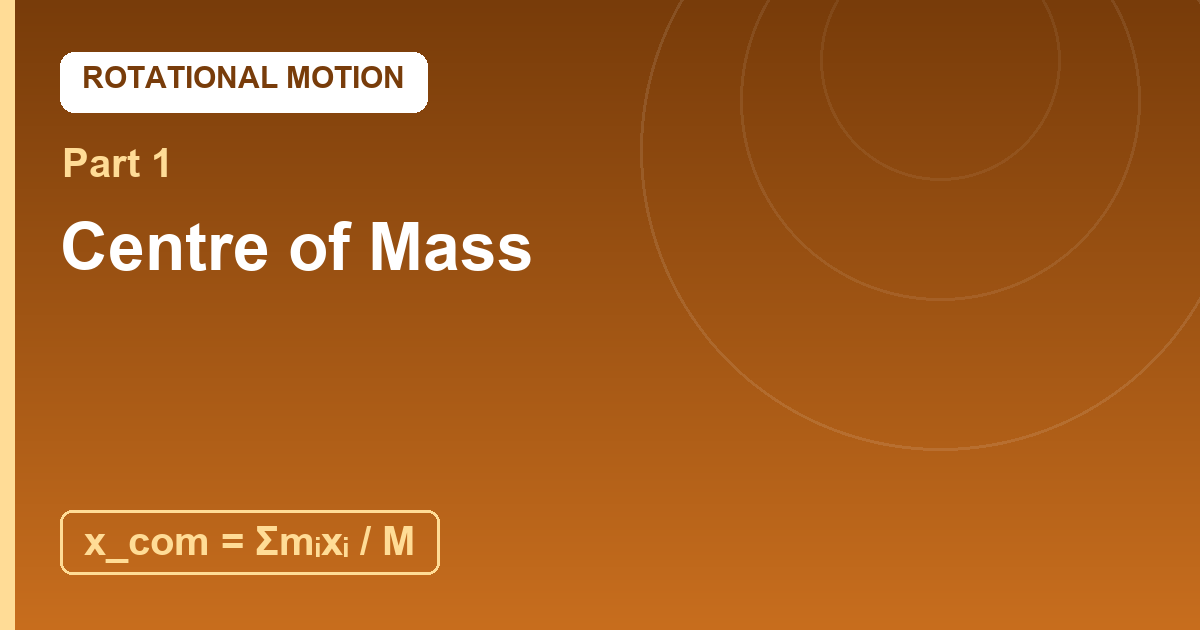
- X_com = Σmᵢxᵢ / M — mass × position, added up, divided by total mass
- Meanwhile, the balance point moves as if ALL mass and ALL outside forces were concentrated there
- As a result, inside forces (explosions, walking, springs) can NEVER move the balance point
- In other words, the balance point can even lie outside the body (a ring’s centre is empty!)
Notably, fireworks explode — fragments fly everywhere. But one invisible point among them keeps sailing along the same smooth arc as if nothing had exploded at all. In fact, that point is the centre of mass — and it’s the foundation for everything in this chapter. Part 1 of the Rotational Motion series .
- Indeed, the simple idea: the balance point.
- What each symbol means.
- The unbreakable rule.
- Finding balance points easily.
- Solved examples.
- Common mistakes.
- Specifically, this physics in your daily life.
- Practice set.
- Recap.
The Simple Idea: The Balance Point.
Similarly, put a ruler on your finger and find where it balances — that spot is the centre of mass (COM): the average position of all the mass . Meanwhile, for the see-saw: a heavier child sits closer to the middle. A lighter child farther — that’s the COM rule in the playground: m₁ × d₁ = m₂ × d₂ .
Overall, one surprise: the COM doesn’t have to be on the material. Meanwhile, a ring’s balance point is in the empty hole. A boomerang’s is in the air beside it. Meanwhile, it’s a calculated point, not a physical spot.
What Each Symbol Means.
| Letter. | What it means (plain words). | Value / unit. |
|---|---|---|
| x_com. | the balance point’s position. | metres, from your chosen zero. |
| m₁, m₂, …. | each object’s mass. | kg. |
| x₁, x₂, …. | Consequently, each object’s position, all measured from the SAME zero. | metres. |
| M (total). | all masses added. | kg. |
Furthermore, read it as a weighted average — like your exam percentage: internal marks × weight + external marks × weight, divided by total weight. Meanwhile, more mass on the right → the balance point shifts right.
The Unbreakable Rule.
Likewise, here’s the magic: inside forces can never move the balance point. Meanwhile, inside forces come in pairs (Newton’s third law) — push-pull pairs cancel each other in the total. So: a firework’s fragments fly, but their balance point follows the original arc (only gravity, an outside force, acts). Notably, a man walks right on a boat — the boat drifts left so the shared balance point stays put (in still water).
Finding Balance Points Easily.
In short, symmetry first: a disc’s COM is its centre, a rod’s is its middle — always on any line of symmetry. Meanwhile, two standard results: a half-ring’s COM sits 2R/π from the centre; a half-disc’s at 4R/3π. Cut-out shapes: treat the missing piece as negative mass — full square minus the cut-out, two lines of algebra.
Solved Examples.
Playground rule: heavier mass closer. Subsequently, 6 kg is 3× heavier → its distance is 3× smaller. Meanwhile, split 40 cm in ratio 3:1.
In fact, check with the formula: (2×0 + 6×40) ÷ 8 = 30 cm from the 2 kg mass.
Answer: 30 cm from the 2 kg mass
Moreover, think first: walking is an INSIDE force — the balance point cannot move. So if he moves forward, the boat must drift backward.
Therefore, set up: boat moves back x → man’s real movement = 4 − x. Meanwhile, balance-point stays fixed: 60(4 − x) = 120x.
Meanwhile, solve: 240 = 180x → x = 4/3 m → man moves 4 − 4/3 ≈ 2.67 m .
Overall, common-sense check: the boat is heavier, so it moves less — ✔
Answer: man moves 8/3 ≈ 2.67 m; boat drifts back 4/3 m
The trick — negative mass: full square (4 units of mass, centre at (a, a)) minus the quarter (1 unit, centre at (a/2, a/2)).
Apply the formula: x = (4×a − 1×a/2) ÷ 3 = 7a/6. Same for y by symmetry.
Check: removing the lower-left corner pushes the balance point beyond the geometric centre (a, a) — up and right.
Answer: (7a/6, 7a/6) from the cut corner
- Every position must be measured from the SAME starting point. Draw first, put your zero at one object, then compute.
- Forgetting the COM can be outside the body (rings, L-shapes) — and ‘fixing’ correct answers because they look wrong.
- ‘Inside forces can move the COM if they’re strong.’ No — push-pull pairs always cancel in the total. Explosions, springs, muscles: all useless for moving the balance point.
- Confusing centre of mass with centre of gravity. Same thing in normal gravity (all exam cases) — different only in exotic non-uniform fields.
This Physics in Your Daily Life.
- High-jumpers clear bars their body’s balance point never reaches: the Fosbury flop bends the body over the bar so the COM passes UNDER it. Genius cheating of geometry.
- Car safety ratings measure COM height vs wheel width — that ratio decides rollover risk. Racing cars keep it low and central; that’s why they corner like they’re on rails.
- When you carry two heavy bags, you lean — your body is re-centring the combined balance point over your feet.
- Airline cargo loading: cargo must keep the plane’s COM inside a narrow range near the wings — outside it, no elevator can save the flight.
- Walk on a paddle boat / ice: each step you take. Something else shifts — the balance point of you-plus-boat stays put over your original spot.
Practice set (answers hidden — try first).
(NEET-level) Masses 1 kg and 3 kg, 60 cm apart. COM from the 1 kg mass:.
(JEE Main-level) A 50 kg girl walks 3 m on a frictionless 100 kg raft. Her movement relative to water:.
(Concept) A firework explodes mid-air. The fragments’ balance point:.
(NEET-level) A half-ring’s COM from its centre (radius R):.
(Concept) Can the COM lie outside the material?
- 🧠 See-saw rule: heavier sits closer — m₁d₁ = m₂d₂, the whole formula in playground form.
- 🧠 Golden sentence: ‘inside forces never move the balance point’ — fireworks, boats, walking, all one rule.
- 🧠 Cut-outs are negative mass: full shape minus the hole, two lines of algebra.
- 🏠 Daily: carrying two heavy bags, you lean — your body re-centres the balance point over your feet.
- 🏠 Daily: high-jumpers arch over the bar so their balance point passes UNDER it — geometric genius.
Balance a ruler on one finger: it tips unless your finger sits under one magic spot. That spot — where the ruler’s mass ‘averages out’ — is the centre of mass. Every object behaves as if all its weight lives in that single point.
Two kids on a see-saw: 30 kg and 60 kg. The balance point sits 2 m from the small kid and 1 m from the big one — 30×2 = 60×1. The COM is the mass-weighted average position: closer to the heavy side, always.
Silhouette any object on paper and try to balance the cutout on a pin: it balances at the COM. Toss a wrench in the air — it tumbles madly, but ONE point inside it travels in a clean parabola: the COM flies like a simple ball, no matter how ugly the tumbling.
- COM = mass-weighted average position = the balance point
- see-saw rule: m₁d₁ = m₂d₂ — heavier sits closer
- outside force = total mass × COM’s acceleration — always
- inside forces (walking, explosions) never move the COM
- COM can lie outside the body; cut-outs = negative mass trick
Frequently Asked Questions
What should you know about The Simple Idea: The Balance Point?
What should you know about What Each Symbol Means?
What should you know about The Unbreakable Rule?
What should you know about Finding Balance Points Easily?
What should you know about Solved Examples?
Playground rule: heavier mass closer. 6 kg is 3× heavier → its distance is 3× smaller. Split 40 cm in ratio 3:1. Check with the formula: (2×0 + 6×40) ÷ 8 = 30 cm from the 2 kg mass.
References & authoritative sources
- Britannica — concept background
- United Nations — official documents
- NTA — official
- NCERT Physics textbooks
- JEE Main — official
Source: compiled from official notifications, standard textbooks and our own mock-test analytics; last reviewed September 2026.
Quick revision
- Moreover, the centre of mass = the average position of all the mass (‘the balance point’)
- X_com = Σmᵢxᵢ / M — mass × position, added up, divided by total mass
- Meanwhile, the balance point moves as if ALL mass and ALL outside forces were concentrated there
- As a result, inside forces (explosions, walking, springs) can NEVER move the balance point
- In other words, the balance point can even lie outside the body (a ring’s centre is empty!)
- Indeed, the simple idea: the balance point.
- 1Centre of Mass: The Point That Behaves Like a Particle
- 2Torque: Why Doorknobs Live Far From Hinges
- 3Moment of Inertia: Why Distribution Beats Size
- 4Torque Equals I-Alpha: Newton’s Second Law, Spun
- 5Angular Momentum in Rotation: Conservation Unleashed
- 6Rolling Motion: Translation and Rotation in One Body
- 7Rotational Energy and Flywheels: Spin as a Battery
- 8Equilibrium and Toppling: Why Cranes Don’t Fall Over
Have a doubt on this topic?
Sources & official references
External references for fact-checking and further reading.