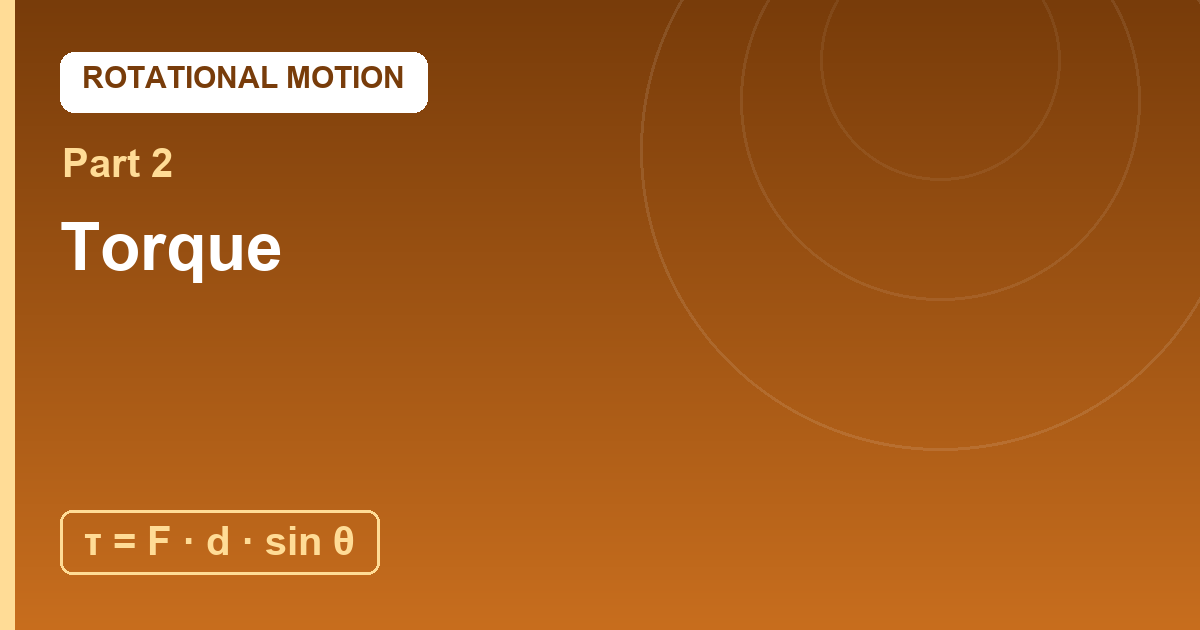
In one line: JEE/NEET Physics · Rotational Motion series · Part 2 of 8 · All parts →✪ Key points — the 30-second versionTorque = r × F = rF·sinθ — the turning effect.
JEE/NEET Physics · Rotational Motion series · Part 2 of 8 · All parts →
- Torque = turning power of a force = force × perpendicular distance
- Push far from the hinge = more turning. Push toward the hinge = zero turning
- A force whose line passes through the pivot NEVER turns anything
- Choose your pivot where unknown forces act — they vanish from the equation
- Same turning power: double the distance, half the force (the lever idea)
Push a door near its hinge — barely moves. Same push at the handle — swings wide open. Same force, different result. What’s different is the turning power — the torque. Master this one idea and half of mechanics’ ‘difficult’ problems become two-line problems. Part 2 of the Rotational Motion series.
- The simple idea: turning power
- What each letter means
- The golden rule: through the pivot = zero
- Choosing the pivot wisely
- Solved examples
- Common mistakes
- This physics in your daily life
- Practice set
- Recap
The Simple Idea: Turning Power
Turning a thing depends on two things only: how hard you push and how far from the pivot you push — plus the angle (perpendicular pushes turn best; pushes along the door do nothing). Torque bundles all three:
| Letter | What it means (plain words) | Value / unit |
|---|---|---|
| τ (tau) | torque — the turning power of the force | unit: N·m (newton-metre) |
| force | how hard you push | newtons (N) |
| distance | from the pivot to where you push | metres |
| angle | between the push direction and the door/rod direction | 90° is best |
Read it as a trade: double the distance, halve the force. That’s why spanners are long, door handles are far from hinges, and pedals are wider than your shoe.
The Golden Rule: Through the Pivot = Zero
A force whose line of action passes through the pivot produces zero turning — any size force. Like pushing a door exactly at the hinge: it can’t swing. Simple, and incredibly useful (next section).
Choosing the Pivot Wisely
Here’s the exam-solver’s secret. A torque equation can be written about ANY point — so choose the point where the annoying unknown force acts, and it vanishes from your equation (golden rule). Hinge forces, axle forces, ground contacts: pick them as your pivot and they disappear. This one trick solves hinged rods, beams, and ladders in three lines.
Solved Examples
Direct: τ = 10 × 0.9 = 9 N·m. Same push at 0.1 m from the hinge: 1 N·m — nine times weaker. Door-handle placement is pure torque engineering. ✔
Answer: 9 N·m
Use the angle: only the perpendicular part of the push turns: 20 × sin30° = 10 N effective.
τ = 0.5 × 10 = 5 N·m.
Check the other road: perpendicular distance = 0.5 × sin30° = 0.25 m; 20 × 0.25 = 5 N·m. Same answer, two roads. ✔
Answer: 5 N·m
Step 1 — torques about the HINGE (so the unknown hinge force vanishes): only weight acts, at L/2: turning = Mg × L/2.
Step 2 — spinning law (Part 4): turning = I × spin-up, with I = ML²/3 → spin-up = 3g/2L.
Step 3 — Newton on the balance point: its downward acceleration = spin-up × L/2 = 3g/4. So hinge push + weight = M × 3g/4 → hinge push = Mg/4 upward.
Check: the hinge carries only a QUARTER of the weight at release — the far end is falling away beneath the rod. ✔ This 3-step pattern cracks every hinged-body problem.
Answer: Hinge pushes up with Mg/4
- Measuring distance from the wrong point. It’s always from the chosen pivot to where the force acts — and every torque in one equation must use the SAME pivot.
- Forgetting the angle. If the push isn’t perpendicular, multiply by sin(angle) — or find the perpendicular distance instead. Draw the situation first.
- Mixing turning directions. Pick clockwise = positive (or anticlockwise) and stay consistent through the whole solution.
- Calling N·m ‘joules’. Same units on paper, different quantities — never mix or convert them.
This Physics in Your Daily Life
- Every tool in a toolbox is a torque machine: spanners (long = easy), scissors (double lever), bottle openers, bicycle pedals, steering wheels (big circle = gentle turning).
- Your own body: the biceps attaches just 5 cm from the elbow — holding a 10 kg dumbbell at 35 cm needs ~7× your body weight of muscle force. Tendon injuries are torque-accounting failures.
- Trucks are rated in torque (N·m) — the number that says how massive a load they can get moving. ‘Torque curves’ decide how a car feels to drive.
- Gearboxes are torque traders: first gear exchanges speed for turning power — that’s the entire point of gears.
- Doorknobs, tap heads, and jar-lid grippers all just increase the perpendicular distance — turning power without extra muscle.
Practice set (answers hidden — try first)
(NEET-level) 40 N perpendicular, 25 cm from pivot:
(JEE Main-level) 10√2 N at 45° on a 20 cm rod’s end, about the other end:
(Concept) A force pointing exactly at the pivot:
(NEET-level) To double turning power with the same perpendicular force:
(Concept) Why solve hinged-rod problems by taking torques about the hinge?
- 🧠 Turning = push × distance: ‘double the arm, half the push’ — every tool ever made.
- 🧠 Golden rule: ‘through the pivot = zero turning’ — any force size. Use it to erase unknowns.
- 🧠 Solver’s rule: take turning about where the unknown force acts — it vanishes.
- 🏠 Daily: door handles far from hinges, long spanners, wide steering wheels, jar-lid grippers — all just bigger distance.
- 🏠 Daily: your biceps attaches 5 cm from the elbow — holding a 10 kg dumbbell at 35 cm costs your muscle ~7× that force.
- τ = force × distance × sin(angle) — turning power, unit N·m
- perpendicular pushes turn best; along the hinge line = zero
- through the pivot = zero torque (any force size)
- pick pivots where unknown forces act → they vanish
- lever trade: double distance = half force needed
Quick revision
- Torque = turning power of a force = force × perpendicular distance
- Push far from the hinge = more turning. Push toward the hinge = zero turning
- A force whose line passes through the pivot NEVER turns anything
- Choose your pivot where unknown forces act — they vanish from the equation
- Same turning power: double the distance, half the force (the lever idea)
- The simple idea: turning power
- 1Centre of Mass: The Point That Behaves Like a Particle
- 2Torque: Why Doorknobs Live Far From Hinges
- 3Moment of Inertia: Rotational Mass, and Why Distribution Beats Size
- 4Torque Equals I-Alpha: Newton’s Second Law, Spun
- 5Angular Momentum in Rotation: Conservation Unleashed
- 6Rolling Motion: Translation and Rotation in One Body
- 7Rotational Energy and Flywheels: Spin as a Battery
- 8Equilibrium and Toppling: Why Cranes Don’t Fall Over
Have a doubt on this topic?