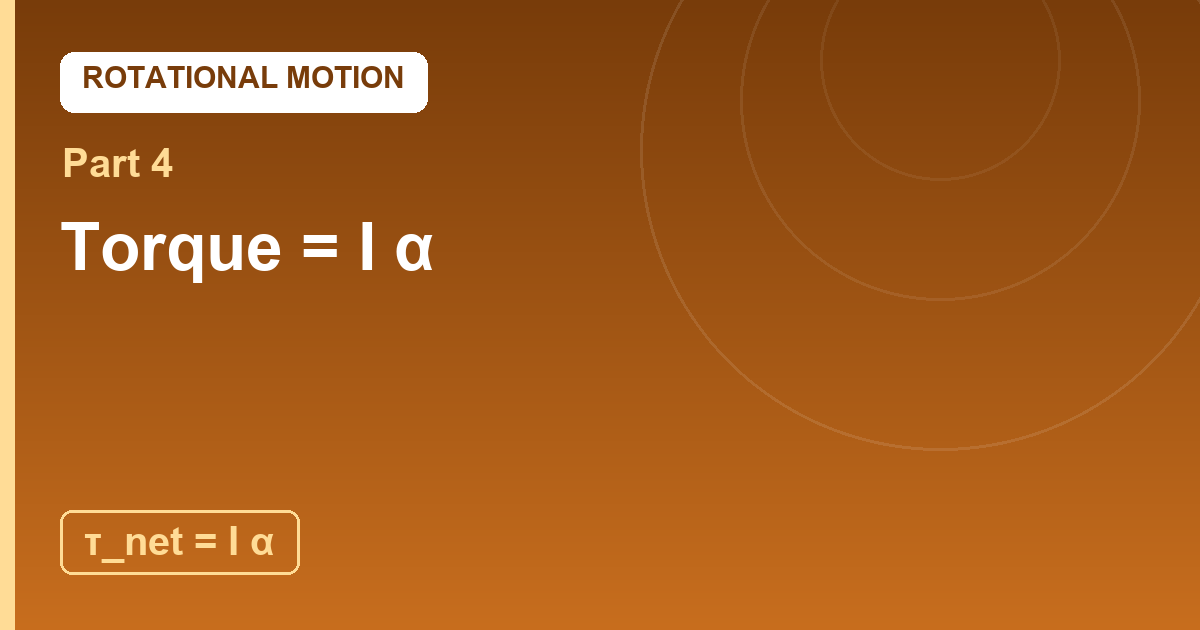
Torque Equals I Alpha: Newton’s Second Law for Rotation
Quick answer: Torque equals I alpha: Newton's second law spun for rotation with solved JEE/NEET examples and the rotational dynamics toolkit.
- The Dictionary: Push → Spin.
- What Each Letter Means.
- The Bridge: Connecting String Speed to Spin.
- The Master Pattern: Massive Pulleys.
- Solved Examples.
- This Physics in Your Daily Life.
- Practice set (answers hidden — try first).
- Frequently Asked Questions
- What should you know about The Dictionary: Push → Spin?
- What should you know about The Bridge: Connecting String Speed to Spin?
- What should you know about The Master Pattern: Massive Pulleys?
- What should you know about Solved Examples?
- What should you know about This Physics in Your Daily Life?
- About the Author
- References & authoritative sources
In one line: Torque Equals I-Alpha — exam-ready notes in one glance.
In one line: JEE/NEET Physics · Rotational Motion series · Part 4 of 8 · All parts →✪ Key points — the 30-second versionτ_net = I·α — the rotational twin of F = maThe.
In fact, JEE/NEET Physics · Rotational Motion series · Part 4 of 8 · All parts →
- Moreover, newton’s law has a spinning twin: turning power = laziness × spin-up (τ = Iα)
- Therefore, the full dictionary: force↔torque, mass↔laziness, acceleration↔spin-up
- Meanwhile, string problems: two equations + one bridge (a = Rα)
- As a result, a pulley with mass makes the two string tensions DIFFERENT
- In other words, the pulley’s laziness acts like extra hanging mass (I/R²)
Notably, everything you learned about pushing objects has an exact spinning twin — learn the dictionary once. Meanwhile, ‘rotational dynamics’ becomes ordinary Newton physics wearing a moustache. In fact, part 4 of the Rotational Motion series — the card that unlocks every pulley problem you’ll ever meet.
- The dictionary: push → spin.
- What each letter means.
- Indeed, the bridge: connecting string speed to spin.
- The master pattern: massive pulleys.
- Solved examples.
- Common mistakes.
- Specifically, this physics in your daily life.
- Practice set.
- Recap.
The Dictionary: Push → Spin.
| Pushing world (you know). | Spinning world (this card). | Connection. |
|---|---|---|
| Force (N). | Torque — turning power (N·m). | τ = force × distance. |
| Mass — push-laziness (kg). | Similarly, moment of inertia — spin-laziness (kg·m²). | I = Σmr² (Part 3). |
| Force = mass × acceleration. | Turning = laziness × spin-up. | τ = Iα. |
| Speed v, acceleration a. | Spin ω, spin-up α. | bridges below. |
So τ = Iα says exactly what F = ma says: lazier bodies (bigger I) spin up more slowly for the same turning power.
What Each Letter Means.
| Letter. | What it means (plain words). | Value / unit. |
|---|---|---|
| τ (tau). | Overall, total outside turning power about the axis. | N·m. |
| I. | spin-laziness about that axis. | kg·m². |
| α (alpha). | Consequently, spin-up — how fast the spin rate increases. | radians/second² (always radians!). |
| ω (omega). | spin rate. | radians/second (rpm × 2π/60). |
The Bridge: Connecting String Speed to Spin.
When a string unwinds from a pulley of radius R without slipping, the mass’s speed equals R×spin. Furthermore, this bridge is the third equation that solves the classic problems.
The Master Pattern: Massive Pulleys.
Likewise, real pulleys have mass and laziness — and that changes everything: the string tension becomes different on the two sides. Meanwhile, the difference is precisely what spins the pulley:
In short, every ‘massive pulley’ problem is three equations: (1) Newton on hanging mass 1. Meanwhile, (2) Newton on hanging mass 2 (or one mass + gravity), (3) turning = laziness × spin-up on the pulley, plus the bridge. Moreover, three unknowns (a, α, T), done.
Solved Examples.
Subsequently, dictionary: α = τ/I = 3 per second². Indeed, from rest, spin rate after 4 s = 12 rad/s.
Answer: α = 3 rad/s²
In fact, equation 1 (mass): 2g − T = 2a → 20 − T = 2a.
Moreover, equation 2 (disc): T × 0.5 = 0.5 × α.
Therefore, bridge: a = 0.5α → α = 2a → from eq 2: T = 2a.
Meanwhile, solve: 20 − 2a = 2a → a = 5 m/s², T = 10 N.
As a result, the insight: T = 10 N is only HALF the weight (20 N) — the string is ‘lightened’ because it must also spin the disc. Meanwhile, in the massless-pulley limit, T → full weight.
Answer: a = 5 m/s²; T = 10 N
In other words, three equations: 50 − T₁ = 5a; T₂ − 30 = 3a; (T₁ − T₂)(0.2) = 0.2 × (a/0.2).
Notably, clean up the third: T₁ − T₂ = 5a.
Indeed, add all three: 20 = 13a → a ≈ 1.54 m/s².
Specifically, the shortcut insight: the pulley acts like an EXTRA HANGING MASS of I/R² = 5 kg. Meanwhile, total ‘mass’ = 3 + 5 + 5 = 13 kg pulled by net force 20 N.
Answer: a = 20/13 ≈ 1.54 m/s² (pulley = extra 5 kg of ‘mass’)
- Similarly, equal tensions on a massive pulley’s two sides. Indeed, never — the difference IS what spins it. Overall, equal tensions exist only in the massless-pulley ideal.
- Consequently, forgetting the bridge a = Rα. Meanwhile, string problems cannot be solved without it — it’s the no-slip condition.
- Degrees instead of radians. Every spinning formula assumes radians. In other words, one degree slips in → every number silently wrong.
- Skipping the free-body diagram ‘to save time’. The 3-equation pattern takes 30 s with a diagram, 10 min without.
- Using τ = Iα about a random accelerating point. Legal axes: a fixed axis or through the balance point.
This Physics in Your Daily Life.
- Rowing machines and gym pulleys with heavy flywheels feel ‘smooth and heavy’ because of the flywheel’s laziness — the resistance you feel is Iα engineering.
- Every electric motor is sized by its load’s laziness: washing-machine drums. Hard-drive spindles, EV motors — spin-up time = torque ÷ I, and designers balance the two.
- Cement kilns and grinding mills are enormous spinning masses — their start-up currents and clutch designs are this card at megawatt scale.
- Crane winches and lifts compute drum torque exactly like our examples: tension difference × radius = drum laziness × spin-up — safety factors live in that equation.
- Your ceiling fan’s slow, majestic start is τ = Iα: modest torque, sizeable laziness, gentle spin-up to cruise.
Practice set (answers hidden — try first).
(NEET-level) Torque 10 N·m on I = 5 kg·m²:.
(JEE Main-level) Disc (I = 0.5 kg·m², R = 0.5 m), string, 2 kg mass (g = 10):.
(Concept) The two tensions in a string over a massive pulley:.
(NEET-level) A flywheel spins up from rest to 20 rad/s in 5 s. α and angle:.
(Concept) A pulley’s laziness acts on the system like:.
- 🧠 The dictionary chant: ‘force↔turning, mass↔laziness, acceleration↔spin-up’ — Newton, spun.
- 🧠 Bridge chant: ‘string speed = R × spin’ — the no-slip line solves pulley problems.
- 🧠 Massive pulley: tensions differ; the pulley acts like extra hanging mass I/R².
- 🏠 Daily: your ceiling fan’s slow majestic start-up is τ = Iα — modest motor, sizeable laziness.
- 🏠 Daily: gym machines with heavy flywheels feel ‘smooth-heavy’ — the flywheel’s laziness IS the resistance.
Push a shopping trolley: F = ma. Push a merry-go-round: τ = Iα. Identical logic, rotated vocabulary — force becomes twist, mass becomes rotational stubbornness, acceleration becomes spin-up. Every rotational law is a translation of Newton’s familiar one.
Same 10 N·m twist on three objects: a light ring (I = MR²) gets α = 10/MR²; a disc (½MR²) gets double that spin-up; the same mass concentrated at the axle gets a huge α. Numbers in, spin-rate out, scaled by one property: I.
Draw two identical arrows of torque hitting three different wheels — hoop, disc, point-mass axle. Below each, an arrow for resulting spin-up: short for the hoop, medium for the disc, enormous for the axle-centred one. One cause, three effects, ranked by I.
- τ = Iα — the spinning twin of F = ma
- the dictionary: force↔torque, mass↔laziness, a↔α, speed↔spin
- bridge: string speed = R × spin (no slipping)
- massive pulley: tensions differ — (T₁ − T₂)R = Iα
- pulley laziness acts like extra mass I/R² hanging on the string
Frequently Asked Questions
What should you know about The Dictionary: Push → Spin?
What should you know about The Bridge: Connecting String Speed to Spin?
What should you know about The Master Pattern: Massive Pulleys?
Real pulleys have mass and laziness — and that changes everything: the string tension becomes different on the two sides. The difference is precisely what spins the pulley: Every ‘massive pulley’ problem is three equations: (1) Newton on hanging mass 1. (2) Newton on hanging mass 2 (or one mass + gravity), (3) turning = laziness × spin-up on the pulley, plus the bridge. Three unknowns (a, α, T), done.
What should you know about Solved Examples?
Dictionary: α = τ/I = 3 per second². From rest, spin rate after 4 s = 12 rad/s. ✔ Answer: α = 3 rad/s² Equal tensions on a massive pulley’s two sides. Never — the difference IS what spins it. Equal tensions exist only in the massless-pulley ideal. Forgetting the bridge a = Rα. String problems cannot be solved without it — it’s the no-slip condition.
What should you know about This Physics in Your Daily Life?
Rowing machines and gym pulleys with heavy flywheels feel ‘smooth and heavy’ because of the flywheel’s laziness — the resistance you feel is Iα engineering. Every electric motor is sized by its load’s laziness: washing-machine drums. Hard-drive spindles, EV motors — spin-up time = torque ÷ I, and designers balance the two.
References & authoritative sources
- Britannica — concept background
- United Nations — official documents
- NTA — official
- NCERT Physics textbooks
- JEE Main — official
Source: compiled from official notifications, standard textbooks and our own mock-test analytics; last reviewed September 2026.
Quick revision
- Moreover, newton’s law has a spinning twin: turning power = laziness × spin-up (τ = Iα)
- Therefore, the full dictionary: force↔torque, mass↔laziness, acceleration↔spin-up
- Meanwhile, string problems: two equations + one bridge (a = Rα)
- As a result, a pulley with mass makes the two string tensions DIFFERENT
- In other words, the pulley’s laziness acts like extra hanging mass (I/R²)
- The dictionary: push → spin.
- 1Centre of Mass: The Point That Behaves Like a Particle
- 2Torque: Why Doorknobs Live Far From Hinges
- 3Moment of Inertia: Why Distribution Beats Size
- 4Torque Equals I-Alpha: Newton’s Second Law, Spun
- 5Angular Momentum in Rotation: Conservation Unleashed
- 6Rolling Motion: Translation and Rotation in One Body
- 7Rotational Energy and Flywheels: Spin as a Battery
- 8Equilibrium and Toppling: Why Cranes Don’t Fall Over
Have a doubt on this topic?
Sources & official references
External references for fact-checking and further reading.