Moment of Inertia: Why Mass Distribution Beats Size
Quick answer: In one line: Moment of Inertia — exam-ready notes in one glance. In one line: JEE/NEET Physics · Rotational Motion series · Part 3 of 8 · All…
- The Simple Idea: Spinning Laziness
- What Each Symbol Means
- The r² Law: Where Beats How Much
- The Numbers You Must Own
- Moving the Axis: the +Md² Trick
- Solved Examples
- This Physics in Your Daily Life
- Practice set (answers hidden — try first)
- Frequently Asked Questions
- What should you know about The Simple Idea: Spinning Laziness?
- What should you know about What Each Symbol Means?
- What should you know about The r² Law: Where Beats How Much?
- What should you know about Moving the Axis: the +Md² Trick?
- What should you know about Solved Examples?
- About the Author
- References & authoritative sources
In one line: Moment of Inertia — exam-ready notes in one glance.
In one line: JEE/NEET Physics · Rotational Motion series · Part 3 of 8 · All parts →✪ Key points — the 30-second versionI = Σmᵢrᵢ² — resistance to angular.
In fact, JEE/NEET Physics · Rotational Motion series · Part 3 of 8 · All parts →
- Moment of inertia (I) = spinning laziness — how much a body resists being spun up
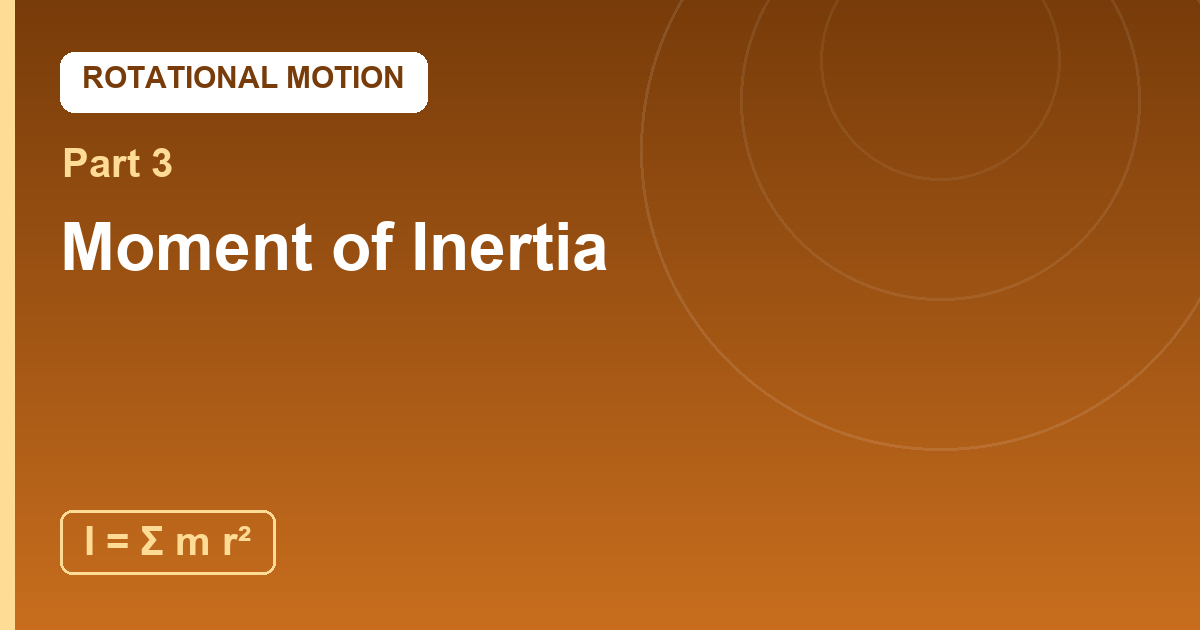
- I = Σmr² — mass × (distance from the spin axis)²
- WHERE the mass sits matters more than HOW MUCH: mass far from the axis = huge laziness
- Meanwhile, own these: ring MR², disc ½MR², rod ML²/12 (middle), sphere ⅖MR²
- As a result, moving the axis: I_new = I_balancepoint + Md² (the parallel-axis trick)
In other words, two wheels: same weight, same size. Meanwhile, one is a bicycle wheel (mass at the rim), one is a solid disc. In fact, spin both — the bicycle wheel fights much harder. Same mass, same size, completely different spinning laziness. The difference is WHERE the mass sits — and that’s the moment of inertia. Part 3 of the Rotational Motion series .
- The simple idea: spinning laziness
- What each symbol means
- Notably, the r² law: where beats how much
- The numbers you must own
- Indeed, moving the axis: the +Md² trick
- Solved examples
- Common mistakes
- Specifically, this physics in your daily life
- Practice set
- Recap
The Simple Idea: Spinning Laziness
Similarly, mass tells you how hard it is to push something (linear laziness). Meanwhile, moment of inertia tells you how hard it is to spin it (spinning laziness). But spinning adds a twist: it matters where the mass is. Moreover, mass near the spin axis is easy to spin. Mass far from the axis is lazy — very lazy.
What Each Symbol Means
| Letter | What it means (plain words) | Value / unit |
|---|---|---|
| I | Overall, moment of inertia — the spinning laziness | unit: kg·m² |
| m | Consequently, each little piece of the body’s mass | kg |
| r | Furthermore, distance of that piece from the SPIN AXIS (a line!) | metres |
Likewise, the square is the whole personality: move mass twice as far out and it becomes 4× lazier. Note: r is measured from the axis (the imaginary rod it spins around), not from a point. Therefore, ‘The moment of inertia of a disc’ is an incomplete sentence until you say which axis.
The r² Law: Where Beats How Much
Meanwhile, our two wheels (2 kg each, 30 cm radius): the bicycle wheel has all mass at 30 cm → I = 2 × 0.09 = 0.18 kg·m². Therefore, the solid disc spreads mass from centre to rim → I = ½MR² = 0.09 — exactly half, same mass, same size. This is why flywheels are rims, cricket bats are massed at the striking end. Tightrope walkers carry LONG poles (huge laziness = slow tipping).
The Numbers You Must Own
| Body (mass M, size R or L) | Axis | I | Compared to ring |
|---|---|---|---|
| Ring / hoop | through centre, ⊥ | MR² | As a result, 1.00 — all mass at max distance |
| Disc / solid cylinder | through centre, ⊥ | ½MR² | In other words, 0.50 — half: mass spread inward |
| Rod | through middle, ⊥ | ML²/12 | — |
| Rod | through end, ⊥ | ML²/3 | — |
| Solid sphere | through centre | ⅖MR² | 0.40 — mass deepest inside |
| Hollow sphere (shell) | through centre | ⅔MR² | 0.67 |
Moving the Axis: the +Md² Trick
Notably, check it on the rod: middle-axis laziness ML²/12. Indeed, shift to the end (d = L/2): ML²/12 + M(L/2)² = ML²/12 + ML²/4 = ML²/3 ✔. Bonus truth: an axis through the balance point always gives the smallest laziness — every other parallel axis adds Md².
Solved Examples
Indeed, think, don’t compute: ring (all mass far out) > disc (mass spread inward) > sphere (mass deep inside). Meanwhile, ranking questions test the where-beats-how-much idea.
Answer: ring > disc > sphere
Specifically, apply: ML²/12 + M(L/4)² = ML²/12 + ML²/16 = 7ML²/48.
Check: between the middle value (ML²/12) and the end value (ML²/3), nearer the middle — as the small shift demands.
Answer: 7ML²/48
Similarly, step 1 — need the in-plane (diameter) value first: the disc’s two in-plane lazinesses add to its through-centre value: ¼MR² + ¼MR² = ½MR² ✔, so each diameter = ¼MR².
Overall, step 2 — shift to the tangent (d = R): ¼MR² + MR² = 5MR²/4 .
In other words, the pattern: shift the axis inside the plane, then shift it outward — two-step chains are the JEE standard here.
Answer: 5MR²/4
- Quoting I without naming the axis. A rod’s laziness is ML²/12 about its middle and 4× that about its end — the axis IS the answer.
- Using R for rods and L for discs — cross-wired under time pressure. Write the body’s shape before writing the formula.
- +Md² with the wrong d. d is axis-to-parallel-axis distance — sketch the two parallel lines and measure between them.
- The in-plane trick on 3-D bodies. It only works for flat (plate-like) bodies — no ‘in-plane axes’ exist for a sphere.
This Physics in Your Daily Life
- Flywheel energy stores are designed as rims on frictionless bearings — laziness per kilogram maximised by putting mass far out.
- Sports gear is laziness design: cricket bats massed at the blade (quicker wrists. Punch where you want it), golf driver heads big and far from the hands, tightrope poles long.
- Engine flywheels smooth the jerks between cylinder firings — laziness resists sudden speed changes, delivering steady rotation.
- I-beams in buildings use the same r² idea with area instead of mass — flanges far from the centre line give enormous bending resistance per kilogram of steel.
- Satellites ‘despin’ by yo-yo weights: masses unwind far from the axis, laziness jumps, spin collapses ( Part 5 ) — fuel-free braking.
Practice set (answers hidden — try first)
(NEET-level) Ring vs disc (same M, R) — laziness ratio:
(JEE Main-level) Solid sphere about a tangent line:
(Concept) Of all parallel axes, laziness is least about the axis through:
(NEET-level) A disc’s laziness about a diameter (through-centre value I₀):
(JEE Main-level) Two point masses m at distance r plus one 2m at r/2, same axis:
- 🧠 Laziness table chant: ring 1, disc ½, sphere ⅖ — ‘all-out, spread, deep-in’ (MR² units).
- 🧠 r² law: twice as far out = 4× lazier. WHERE beats HOW MUCH.
- 🧠 +Md² chant: ‘middle is minimum’ — every other parallel axis adds Md².
- 🏠 Daily: cricket bats massed at the blade, tightrope walkers with long poles, spoked cycle wheels — laziness design all around you.
- 🏠 Daily: I-beams in buildings put steel far from the centre line — same r² idea with area instead of mass.
Two skaters, same weight. One holds dumbbells at her chest, one holds them at arm’s length. Same mass, wildly different spin difficulty. In rotation, WHERE the mass sits matters more than HOW MUCH there is — spread-out mass is stubborn.
A point mass 1 m from the axis contributes m×(1)² = m. Move it to 2 m: m×(2)² = 4m. Distance DOUBLED, resistance QUADRUPLED. That squared is the whole secret — a ring of mass M and radius R resists twice as much as a disc of the same M and R (MR² vs ½MR²).
Picture a bar chart of ‘rotational stubbornness’ versus radius: it doesn’t grow linearly, it curves upward as the square. Mass near the axis barely registers; the same kilogram at the rim dominates the chart.
- I = Σmr² — spinning laziness; r from the AXIS; unit kg·m²
- the r² law: where the mass sits beats how much there is
- own the table: ring MR², disc ½MR², rod ML²/12 & ML²/3, sphere ⅖MR², shell ⅔MR²
- parallel-axis: I_new = I_balancepoint + Md²; balance-point axis is always smallest
- flat bodies: in-plane lazinesses add to the through-centre value
Frequently Asked Questions
What should you know about The Simple Idea: Spinning Laziness?
Mass tells you how hard it is to push something (linear laziness). Moment of inertia tells you how hard it is to spin it (spinning laziness). But spinning adds a twist: it matters where the mass is. Mass near the spin axis is easy to spin. Mass far from the axis is lazy — very lazy.
What should you know about What Each Symbol Means?
The square is the whole personality: move mass twice as far out and it becomes 4× lazier. Note: r is measured from the axis (the imaginary rod it spins around), not from a point. ‘The moment of inertia of a disc’ is an incomplete sentence until you say which axis.
What should you know about The r² Law: Where Beats How Much?
Our two wheels (2 kg each, 30 cm radius): the bicycle wheel has all mass at 30 cm → I = 2 × 0.09 = 0.18 kg·m². The solid disc spreads mass from centre to rim → I = ½MR² = 0.09 — exactly half, same mass, same size. This is why flywheels are rims, cricket bats are massed at the striking end. Tightrope walkers carry LONG poles (huge laziness = slow tipping).
What should you know about Moving the Axis: the +Md² Trick?
Check it on the rod: middle-axis laziness ML²/12. Shift to the end (d = L/2): ML²/12 + M(L/2)² = ML²/12 + ML²/4 = ML²/3 ✔. Bonus truth: an axis through the balance point always gives the smallest laziness — every other parallel axis adds Md².
What should you know about Solved Examples?
Think, don’t compute: ring (all mass far out) > disc (mass spread inward) > sphere (mass deep inside). Ranking questions test the where-beats-how-much idea. ✔ Answer: ring > disc > sphere
References & authoritative sources
- Britannica — concept background
- United Nations — official documents
- NTA — official
- NCERT Physics textbooks
- JEE Main — official
Source: compiled from official notifications, standard textbooks and our own mock-test analytics; last reviewed September 2026.
Quick revision
- Moment of inertia (I) = spinning laziness — how much a body resists being spun up
- I = Σmr² — mass × (distance from the spin axis)²
- WHERE the mass sits matters more than HOW MUCH: mass far from the axis = huge laziness
- Meanwhile, own these: ring MR², disc ½MR², rod ML²/12 (middle), sphere ⅖MR²
- As a result, moving the axis: I_new = I_balancepoint + Md² (the parallel-axis trick)
- The simple idea: spinning laziness
- 1Centre of Mass: The Point That Behaves Like a Particle
- 2Torque: Why Doorknobs Live Far From Hinges
- 3Moment of Inertia: Why Distribution Beats Size
- 4Torque Equals I-Alpha: Newton’s Second Law, Spun
- 5Angular Momentum in Rotation: Conservation Unleashed
- 6Rolling Motion: Translation and Rotation in One Body
- 7Rotational Energy and Flywheels: Spin as a Battery
- 8Equilibrium and Toppling: Why Cranes Don’t Fall Over
Have a doubt on this topic?
Sources & official references
External references for fact-checking and further reading.