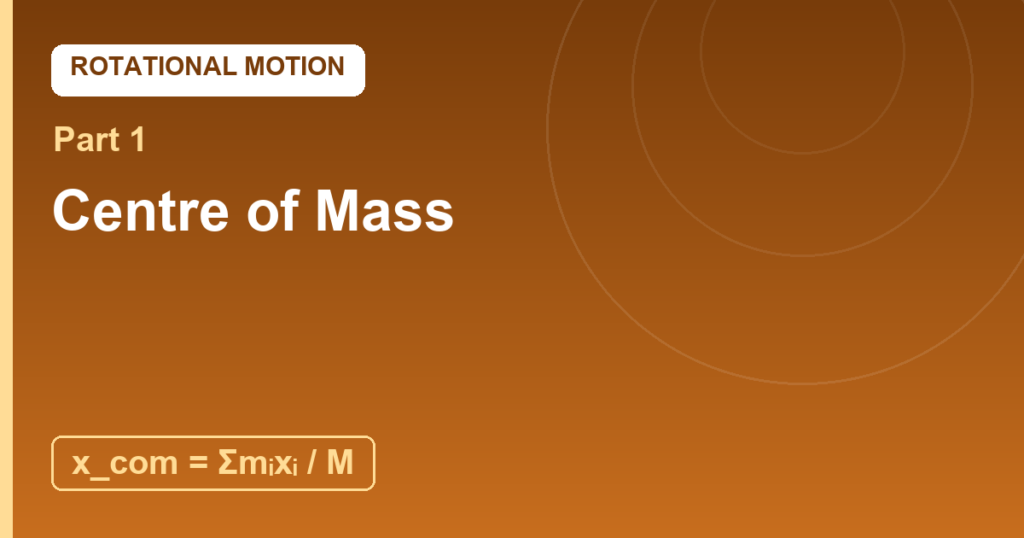
In one line: JEE/NEET Physics · Rotational Motion series · Part 1 of 8 · All parts →✪ Key points — the 30-second versionCOM = mass-weighted average position: x_com =.
JEE/NEET Physics · Rotational Motion series · Part 1 of 8 · All parts →
- The centre of mass = the average position of all the mass (‘the balance point’)
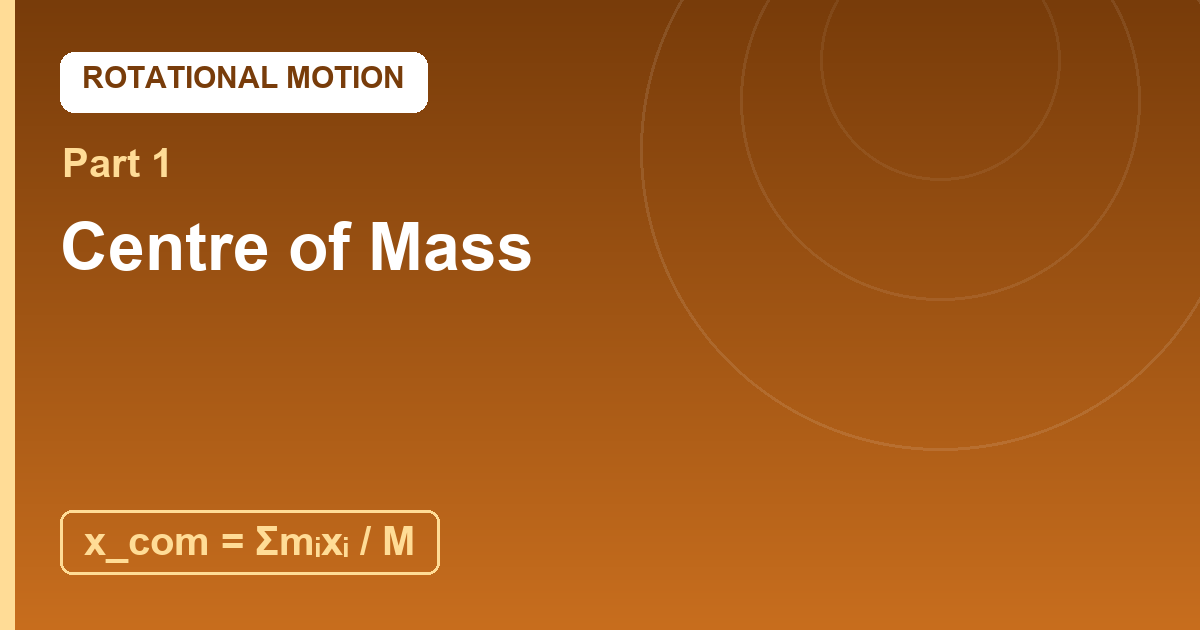
- x_com = Σmᵢxᵢ / M — mass × position, added up, divided by total mass
- The balance point moves as if ALL mass and ALL outside forces were concentrated there
- Inside forces (explosions, walking, springs) can NEVER move the balance point
- The balance point can even lie outside the body (a ring’s centre is empty!)
Fireworks explode — fragments fly everywhere. But one invisible point among them keeps sailing along the same smooth arc as if nothing had exploded at all. That point is the centre of mass — and it’s the foundation for everything in this chapter. Part 1 of the Rotational Motion series.
- The simple idea: the balance point
- What each symbol means
- The unbreakable rule
- Finding balance points easily
- Solved examples
- Common mistakes
- This physics in your daily life
- Practice set
- Recap
The Simple Idea: The Balance Point
Put a ruler on your finger and find where it balances — that spot is the centre of mass (COM): the average position of all the mass. For the see-saw: a heavier child sits closer to the middle, a lighter child farther — that’s the COM rule in the playground: m₁ × d₁ = m₂ × d₂.
One surprise: the COM doesn’t have to be on the material. A ring’s balance point is in the empty hole. A boomerang’s is in the air beside it. It’s a calculated point, not a physical spot.
What Each Symbol Means
| Letter | What it means (plain words) | Value / unit |
|---|---|---|
| x_com | the balance point’s position | metres, from your chosen zero |
| m₁, m₂, … | each object’s mass | kg |
| x₁, x₂, … | each object’s position, all measured from the SAME zero | metres |
| M (total) | all masses added | kg |
Read it as a weighted average — like your exam percentage: internal marks × weight + external marks × weight, divided by total weight. More mass on the right → the balance point shifts right.
The Unbreakable Rule
Here’s the magic: inside forces can never move the balance point. Why? Inside forces come in pairs (Newton’s third law) — push-pull pairs cancel each other in the total. So: a firework’s fragments fly, but their balance point follows the original arc (only gravity, an outside force, acts). A man walks right on a boat — the boat drifts left so the shared balance point stays put (in still water).
Finding Balance Points Easily
Symmetry first: a disc’s COM is its centre, a rod’s is its middle — always on any line of symmetry. Two standard results: a half-ring’s COM sits 2R/π from the centre; a half-disc’s at 4R/3π. Cut-out shapes: treat the missing piece as negative mass — full square minus the cut-out, two lines of algebra.
Solved Examples
Playground rule: heavier mass closer. 6 kg is 3× heavier → its distance is 3× smaller. Split 40 cm in ratio 3:1.
Check with the formula: (2×0 + 6×40) ÷ 8 = 30 cm from the 2 kg mass. ✔
Answer: 30 cm from the 2 kg mass
Think first: walking is an INSIDE force — the balance point cannot move. So if he moves forward, the boat must drift backward.
Set up: boat moves back x → man’s real movement = 4 − x. Balance-point stays fixed: 60(4 − x) = 120x.
Solve: 240 = 180x → x = 4/3 m → man moves 4 − 4/3 ≈ 2.67 m.
Common-sense check: the boat is heavier, so it moves less — ✔
Answer: man moves 8/3 ≈ 2.67 m; boat drifts back 4/3 m
The trick — negative mass: full square (4 units of mass, centre at (a, a)) minus the quarter (1 unit, centre at (a/2, a/2)).
Apply the formula: x = (4×a − 1×a/2) ÷ 3 = 7a/6. Same for y by symmetry.
Check: removing the lower-left corner pushes the balance point beyond the geometric centre (a, a) — up and right. ✔
Answer: (7a/6, 7a/6) from the cut corner
- Mixing zeros. Every position must be measured from the SAME starting point. Draw first, put your zero at one object, then compute.
- Forgetting the COM can be outside the body (rings, L-shapes) — and ‘fixing’ correct answers because they look wrong.
- ‘Inside forces can move the COM if they’re strong.’ No — push-pull pairs always cancel in the total. Explosions, springs, muscles: all useless for moving the balance point.
- Confusing centre of mass with centre of gravity. Same thing in normal gravity (all exam cases) — different only in exotic non-uniform fields.
This Physics in Your Daily Life
- High-jumpers clear bars their body’s balance point never reaches: the Fosbury flop bends the body over the bar so the COM passes UNDER it. Genius cheating of geometry.
- Car safety ratings measure COM height vs wheel width — that ratio decides rollover risk. Racing cars keep it low and central; that’s why they corner like they’re on rails.
- When you carry two heavy bags, you lean — your body is re-centring the combined balance point over your feet.
- Airline cargo loading: cargo must keep the plane’s COM inside a narrow range near the wings — outside it, no elevator can save the flight.
- Walk on a paddle boat / ice: each step you take, something else shifts — the balance point of you-plus-boat stays put over your original spot.
Practice set (answers hidden — try first)
(NEET-level) Masses 1 kg and 3 kg, 60 cm apart. COM from the 1 kg mass:
(JEE Main-level) A 50 kg girl walks 3 m on a frictionless 100 kg raft. Her movement relative to water:
(Concept) A firework explodes mid-air. The fragments’ balance point:
(NEET-level) A half-ring’s COM from its centre (radius R):
(Concept) Can the COM lie outside the material?
- 🧠 See-saw rule: heavier sits closer — m₁d₁ = m₂d₂, the whole formula in playground form.
- 🧠 Golden sentence: ‘inside forces never move the balance point’ — fireworks, boats, walking, all one rule.
- 🧠 Cut-outs are negative mass: full shape minus the hole, two lines of algebra.
- 🏠 Daily: carrying two heavy bags, you lean — your body re-centres the balance point over your feet.
- 🏠 Daily: high-jumpers arch over the bar so their balance point passes UNDER it — geometric genius.
- COM = mass-weighted average position = the balance point
- see-saw rule: m₁d₁ = m₂d₂ — heavier sits closer
- outside force = total mass × COM’s acceleration — always
- inside forces (walking, explosions) never move the COM
- COM can lie outside the body; cut-outs = negative mass trick
Quick revision
- The centre of mass = the average position of all the mass (‘the balance point’)
- x_com = Σmᵢxᵢ / M — mass × position, added up, divided by total mass
- The balance point moves as if ALL mass and ALL outside forces were concentrated there
- Inside forces (explosions, walking, springs) can NEVER move the balance point
- The balance point can even lie outside the body (a ring’s centre is empty!)
- The simple idea: the balance point
- 1Centre of Mass: The Point That Behaves Like a Particle
- 2Torque: Why Doorknobs Live Far From Hinges
- 3Moment of Inertia: Rotational Mass, and Why Distribution Beats Size
- 4Torque Equals I-Alpha: Newton’s Second Law, Spun
- 5Angular Momentum in Rotation: Conservation Unleashed
- 6Rolling Motion: Translation and Rotation in One Body
- 7Rotational Energy and Flywheels: Spin as a Battery
- 8Equilibrium and Toppling: Why Cranes Don’t Fall Over
Have a doubt on this topic?