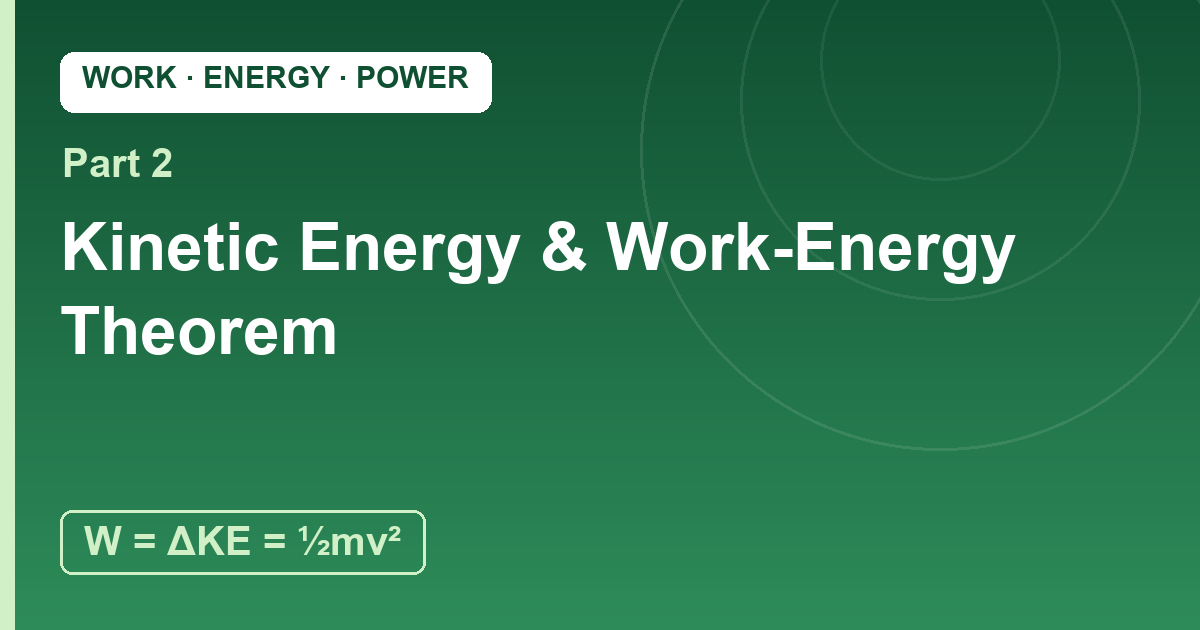
In one line: JEE/NEET Physics · Work, Energy & Power series · Part 2 of 8 · All parts →✪ Key points — the 30-second versionMoving energy: KE = ½mv² — double the speed,.
JEE/NEET Physics · Work, Energy & Power series · Part 2 of 8 · All parts →
- Moving energy: KE = ½mv² — double the speed, QUADRUPLE the energy
- The theorem: total work on a body = change in its moving energy
- Why it’s a shortcut: no forces over time needed — just before and after
- Stopping distance grows as speed SQUARED — the road-safety physics
- Same speed, different mass: KE scales with mass; same mass: KE scales with speed²
A car at 60 km/h needs four times the distance to stop as at 30 km/h. Not twice — four times. That single fact kills accidents, and it comes from one formula: moving energy grows with the SQUARE of speed. Part 2 of the Work, Energy & Power series.
- Moving energy, simply
- What each letter means
- The work-energy theorem: the great shortcut
- The v² law and road safety
- Solved examples
- Common mistakes
- This physics in your daily life
- Practice set
- Recap
Moving Energy, Simply
Anything moving carries energy of motion — kinetic energy (KE). It depends on mass and speed, but NOT equally: mass counts once, speed counts twice (squared):
| Letter | What it means (plain words) | Value / unit |
|---|---|---|
| KE | kinetic energy — energy of motion | joules (J) |
| m | mass of the moving thing | kg |
| v | its SPEED | m/s — always squared here |
Feel the square: a 50 kg cyclist at 10 m/s has 2,500 J; at 20 m/s (only double) — 10,000 J, four times. Triple the speed, nine times the energy.
The Work-Energy Theorem: The Great Shortcut
Why this is gold: Newton’s method needs force at every instant. The theorem doesn’t — it only needs before and after speeds, whatever complicated path connected them. A curved water slide, a bumpy road, a rollercoaster: total work is the same, and the theorem skips every detail in between.
The v² Law and Road Safety
Stopping means removing all the KE, and brakes remove energy roughly at a steady rate over distance. KE ∝ v², so stopping distance ∝ speed². 30→60 km/h: energy ×4, distance ×4. This one line of physics explains speed limits, school-zone signs, and why ‘he was only a bit faster’ is never true.
Solved Examples
At 10: ½ × 50 × 100 = 2,500 J. At 20: ½ × 50 × 400 = 10,000 J.
Double speed, ×4 energy — the square, felt. ✔
Answer: 2,500 J → 10,000 J
KE change: 0 − ½(1000)(400) = −200,000 J.
Theorem: work by brakes = −200 kJ — the brakes REMOVED 200 kJ (as heat; brake discs glow on F1 cars for exactly this reason).
Follow-up: at 40 m/s the same car needs −800 kJ — and four times the stopping distance. ✔
Answer: W = −200 kJ (removed)
Theorem route (no forces needed): gravity’s work = mgh = 30×10×4 = 1,200 J (the normal push does zero work — perpendicular). KE goes 0 → 1,200 J.
½(30)v² = 1,200 → v² = 80 → v ≈ 8.9 m/s.
Notice: the slide’s shape never entered — curved, straight, wavy: same answer. That’s the theorem’s power. ✔
Answer: v ≈ 8.9 m/s, whatever the slide’s shape
- Using speed without squaring ‘just for this once’. Every KE question punishes it. Write ½mv² and square first.
- Confusing momentum (mv) with energy (½mv²). Doubling speed doubles momentum but quadruples energy — different quantities, different questions.
- Forgetting negative work in the theorem. Friction’s work enters with a minus; total means total.
- Believing heavier needs more stopping distance. At the same speed, a truck has more KE AND more braking force (roughly proportional) — stopping distance is nearly mass-independent; SPEED decides it.
This Physics in Your Daily Life
- Speed limits are energy laws: hitting a wall at 60 vs 30 km/h delivers four times the energy to your body — the entire case for slower zones.
- F1 brake discs glow red-hot: they absorb a race car’s KE as heat, ~1 MJ per hard stop — a kettle’s worth of boiling energy, in a second.
- <Cyclists and pedestrians survive at 30, not 60: crash-energy quadruples with doubling speed — the physics behind every city speed limit debate.
- A hammer drives nails: swing energy ½mv² concentrated into the nail’s tiny stopping distance — enormous force from modest energy.
- Water dams and kettle elements, wind turbines and your leg muscles: all trade work for KE and back — this card is the exchange rate.
Practice set (answers hidden — try first)
(NEET-level) A 2 kg ball at 3 m/s. KE:
(JEE Main-level) Speed tripled. KE becomes:
(NEET-level) A 500 kg bike at 20 m/s brakes to rest. Work by brakes:
(Concept) A box slides down a frictionless curved slide of height h. Bottom speed depends on:
(JEE Main-level) Equal KE, masses 1 kg and 4 kg. Speed ratio:
- 🧠 Chant: ‘double the speed, four times the trouble’.
- 🧠 Theorem shortcut: ‘forget the path, compare the speeds’.
- 🧠 Perpendicular = free: slides, orbits, carrying bags — no work, no KE change from those forces.
- 🏠 Daily: every speed-limit sign is ½mv² wearing a red circle.
- 🏠 Daily: glowing F1 brakes — a car’s KE converted visibly to heat.
- 🔁 KE = ½mv², joules
- 🔁 W_total = ΔKE — the before/after shortcut
- 🔁 stopping distance ∝ v²
- KE = ½mv² — speed squared: double speed, ×4 energy
- work-energy theorem: total work = KE change — before/after only
- normal force and other perpendicular forces do zero work
- stopping distance ∝ speed² — the road-safety law
- momentum ∝ v; energy ∝ v² — different books
Quick revision
- Moving energy: KE = ½mv² — double the speed, QUADRUPLE the energy
- The theorem: total work on a body = change in its moving energy
- Why it’s a shortcut: no forces over time needed — just before and after
- Stopping distance grows as speed SQUARED — the road-safety physics
- Same speed, different mass: KE scales with mass; same mass: KE scales with speed²
- The work-energy theorem: the great shortcut
- 1Work Done: When a Force Actually Achieves Something
- 2Kinetic Energy and the Work-Energy Theorem: The Great Shortcut
- 3Potential Energy: Stored Work, Ready to Strike
- 4Conservation of Energy: The Universe’s Perfect Bookkeeping
- 5Power and Efficiency: How FAST You Can Do the Work
- 6Collisions: The Great Sorting — What Survives, What Dies
- 7Springs and Vertical Circles: Energy in Two Classic Stages
- 8The Finale: Energy in the Real World, and the Complete Formula Card
Have a doubt on this topic?