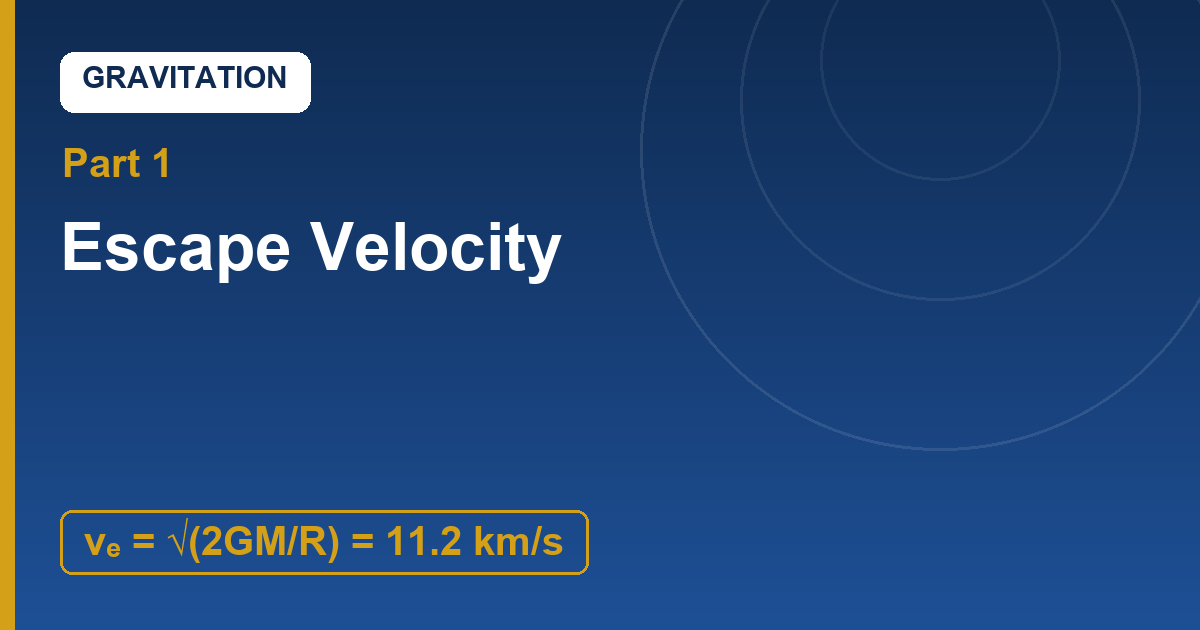
In one line: escape velocity: JEE/NEET Physics · Gravitation series · Part 1 of 8 · All parts →✪ Key points — the 30-second versionFormula: vₑ = √(2GM/R) = √(2gR) — 11.
JEE/NEET Physics · Gravitation series · Part 1 of 9 · All parts →
- Escape velocity = the minimum throw speed so a ball never falls back (11.2 km/s for Earth)
- vₑ = √(2GM/R) — G: gravity’s fixed strength number, M: planet’s mass, R: planet’s radius
- The ball’s weight doesn’t matter — a coin and a truck escape at the same speed
- 11.2 km/s is from Earth’s surface; from a height, you need less
- Escape velocity = √2 × orbit velocity (next card: 7.9 km/s)
Throw a cricket ball as hard as you can — it comes back. Now imagine throwing it at 40,000 km/h. It never comes back. That magic speed is called escape velocity. For Earth, it is 11.2 km/s. In this card — Part 1 of the Gravitation series — you will understand why this speed exists, using nothing more than everyday ideas. No memorising. By the end, the formula will feel obvious.
- The simple idea (read this first)
- What each letter in the formula means
- Why the ball’s weight does NOT matter
- Step-by-step: how the formula is born
- The formula in three forms
- Solved examples — from easy to exam
- Common mistakes (and how to avoid them)
- This physics in your daily life
- Practice set
- Recap
The Simple Idea (Read This First)
Think of gravity as a hill. You are at the bottom (Earth’s surface). You want to roll a ball so far up the hill that it never rolls back.
Here is the trick: this hill gets flatter as you go up. Near the bottom it is steep. Higher up, less steep. Very high up, almost flat. That is exactly how gravity works — it becomes weaker and weaker as you go farther from Earth.
So you don’t need unlimited power to escape. You need just enough speed so that when the ball has climbed the whole hill, its speed becomes exactly zero — it barely, gently, reaches the top. Any slower, it rolls back. Any faster, it still has speed left over at the top.
That minimum speed is escape velocity. That’s the whole concept. The formula below is just bookkeeping for this hill idea.
What Each Letter in the Formula Means
| Letter | What it is | In plain words | Value / unit |
|---|---|---|---|
| vₑ | escape velocity | the minimum throwing speed to leave the planet forever | answer in m/s (or km/s) |
| G | gravitational constant | a fixed tiny number that says how strong gravity is between any two things. Same everywhere in the universe. | 6.67 × 10⁻¹¹ |
| M | mass of the planet | how much ‘stuff’ the planet has. Bigger planet = harder to escape. | Earth: 6 × 10²⁴ kg |
| R | radius of the planet | how big the planet is, centre to surface. You throw from the surface, so this is your starting distance from the centre. | Earth: 6.4 × 10⁶ m |
Read the formula as a sentence: “escape speed grows with the planet’s mass (M on top = harder to escape) and shrinks with the planet’s size (R at the bottom = you start higher up the hill).” Heavy small planets are the hardest to escape. Light big planets are the easiest.
Why the Ball’s Weight Does NOT Matter
Surprise: a coin, a cricket ball, and a 100-tonne rocket all need exactly the same 11.2 km/s to escape Earth. Why?
A heavier ball is harder to throw (gravity pulls it more) — true. But a heavier ball thrown at the same speed also carries more energy. The two effects cancel each other perfectly. When you do the maths, the ball’s mass (m) cancels out of the equation completely.
So escape velocity is a property of the planet only — not of the thing you throw. Exam questions test this idea again and again.
Step-by-Step: How the Formula Is Born
Two energies are involved. That’s all.
Energy 1 — the ball’s throwing energy (kinetic energy): ½mv². This is what you give the ball at launch.
Energy 2 — the depth of the gravity hill (the energy needed to climb out): GMm/R. This is what the climb takes away.
Set them equal — throw energy exactly pays the climb:
Three short steps. If you can balance a see-saw, you can follow this.
The Formula in Three Forms
| Form | Use it when… | Plain-language tip |
|---|---|---|
| vₑ = √(2GM/R) | the question gives the planet’s mass M and radius R | the direct form — plug in and take square root |
| vₑ = √(2gR) | the question gives g (gravity strength at surface) and R | faster — no need for G at all |
| vₑ = √(2GM/(R+h)) | launched from a height h above the surface | remember: 11.2 km/s is only from the surface |
Solved Examples — From Easy to Exam
Step 1: write vₑ = √(2GM/R).
Step 2: top of the fraction: 2 × 6.67×10⁻¹¹ × 7.4×10²² = 98.7×10¹¹.
Step 3: divide by R: 98.7×10¹¹ ÷ 1.7×10⁶ = 5.8×10⁶.
Step 4: square root: √(5.8×10⁶) ≈ 2.4 × 10³.
Common-sense check: the Moon is much lighter than Earth, so escaping should be much easier than 11.2 km/s. 2.4 km/s — feels right. ✔
Answer: ≈ 2.4 km/s
The smart way — don’t plug numbers, compare: vₑ depends on √(M/R).
New M/R = 4M/2R = 2 × (Earth’s M/R) → escape velocity is √2 times bigger.
Answer: 11.2 × 1.414 ≈ 15.8 km/s.
Why this trick wins: G and all the big numbers cancel out. Ratio questions take 15 seconds this way. ✔
Answer: √2 × 11.2 ≈ 15.8 km/s
Think: too slow to escape — so it stops at some height h and falls back. Energy given = energy needed to reach that height.
Set up: the throwing energy ½m(vₑ/2)² must equal the climb from R to R+h. Using the shortcut vₑ² = 2GM/R, the left side becomes ¼ × GMm/R — the ball could only climb a quarter of the way out of the hill.
Result: h = R/3 — about 2,100 km above the ground for Earth.
Common-sense check: half the speed means quarter the energy (v is squared!) — a modest height. ✔
Answer: height = R/3 above the surface
- Thinking 11.2 km/s works everywhere. It is Earth’s number, from Earth’s surface. For the Moon use the Moon’s M and R. From a height, use R+h — the requirement is a little lower.
- Thinking heavier objects need more speed. They don’t — the ball’s mass cancels. A coin and a truck escape at the same speed. This is the #1 exam trap.
- Using g = 9.8 on other planets. g is Earth’s surface gravity. Other planets have their own g. If not given, use the M-and-R form.
- Forgetting the √2 link. Orbit speed (next card) is 7.9 km/s; escape is 11.2. 11.2 = √2 × 7.9 — always, for any planet. Memorise the pair, get both free.
This Physics in Your Daily Life
- Every cricket ball you’ve seen thrown is the slow version of this card. Even the fastest bowler (~150 km/h) is 270× too slow to escape. Now you know exactly how far a human throw is from space.
- Why fireworks always come down: they reach maybe 300 m/s — far too slow. Gravity’s hill barely notices them.
- Why the Moon has no air: air molecules jump around at about 1–2 km/s. The Moon’s escape speed is only 2.4 km/s — over billions of years, the fastest molecules leaked away. Earth’s 11.2 km/s is too high a hill for air to escape — that’s why we still breathe.
- ISRO launches you watch on TV don’t reach 11.2 km/s — they aim for about 7.9 km/s (orbit speed, next card). Going around Earth is cheaper than leaving it forever.
- A black hole, in one sentence: squeeze Earth’s whole mass into a marble of ~9 mm, and even light cannot reach escape speed — so nothing comes out. Your Class 11 formula, taken to its extreme (Part 8 tells the full story).
Practice set (answers hidden — try first)
(NEET-level) A planet has mass 4M and radius 2R compared to Earth. Its escape velocity compared to Earth’s 11.2 km/s is:
(JEE Main-level) A body is thrown up at half the escape velocity. It reaches a height of:
(Concept) Does a heavier rocket need a higher speed to escape Earth?
(NEET-level) If Earth shrank to half its radius (same mass), escape velocity would:
(Concept) Escape velocity from a height h: is it more or less than 11.2 km/s?
- 🧠 Remember the pair: 7.9 goes around, 11.2 goes out. 11.2 = 7.9 × √2 — ‘escape needs a √2 kick’.
- 🧠 The pair of 2s: Earth numbers are 6×1024 kg and 6.4×10⁶ m — mass has 24, radius has 6.
- 🧠 Hill picture: gravity is a hill that flattens — ‘throw just hard enough to reach the top with zero left’.
- 🏠 Daily: a cricket bowler’s 150 km/h vs the needed 40,320 km/h — that’s how far a human throw is from space.
- 🏠 Daily: fireworks peak at ~300 m/s; the Moon’s weak 2.4 km/s is why it lost its air.
- vₑ = √(2GM/R) = √(2gR) — the planet’s property, measured from its surface
- G = 6.67×10⁻¹¹ (gravity’s strength number), M = planet’s mass, R = planet’s radius
- the thrown object’s mass cancels — weight never matters
- the hill picture: gravity gets weaker with height, so a minimum speed escapes
- Moon: 2.4 km/s — that’s why it has no atmosphere
Quick revision
- Escape velocity = the minimum throw speed so a ball never falls back (11.2 km/s for Earth)
- vₑ = √(2GM/R) — G: gravity’s fixed strength number, M: planet’s mass, R: planet’s radius
- The ball’s weight doesn’t matter — a coin and a truck escape at the same speed
- 11.2 km/s is from Earth’s surface; from a height, you need less
- Escape velocity = √2 × orbit velocity (next card: 7.9 km/s)
- The simple idea (read this first)
- 1Escape Velocity: The Speed That Ends Gravity’s Grip
- 2Orbital Velocity: Why the ISS Never Falls
- 3Kepler’s Laws: The 1609 Prediction Machine NASA Still Uses
- 4Angular Momentum: Gravity Can Pull, It Cannot Twist
- 5Gravitational Potential Energy: Why the Minus Sign Matters
- 6Satellite Energy: Why Total Energy Is Negative KE Over Two
- 7Variation of g: Why You Weigh Less at the Equator
- 8Black Holes, LIGO and Lagrange Points: Gravitation’s Research Frontier
- 9Gravitation Bonus: Field Intensity, Shell Theorem, Weightlessness and GEO Satellites
Have a doubt on this topic?
Sources & official references
External references for fact-checking and further reading.