JEE/NEET Physics · Mechanical Properties of Fluids series · Part 5 of 7 · All parts →
- Viscosity = internal friction of a fluid — treacle high, water low, gases lower
- Newton’s law of viscosity: F = −ηA(dv/dx) — force from speed differences between layers
- Stokes’ law: a small sphere moving slowly through fluid feels F = 6πηrv
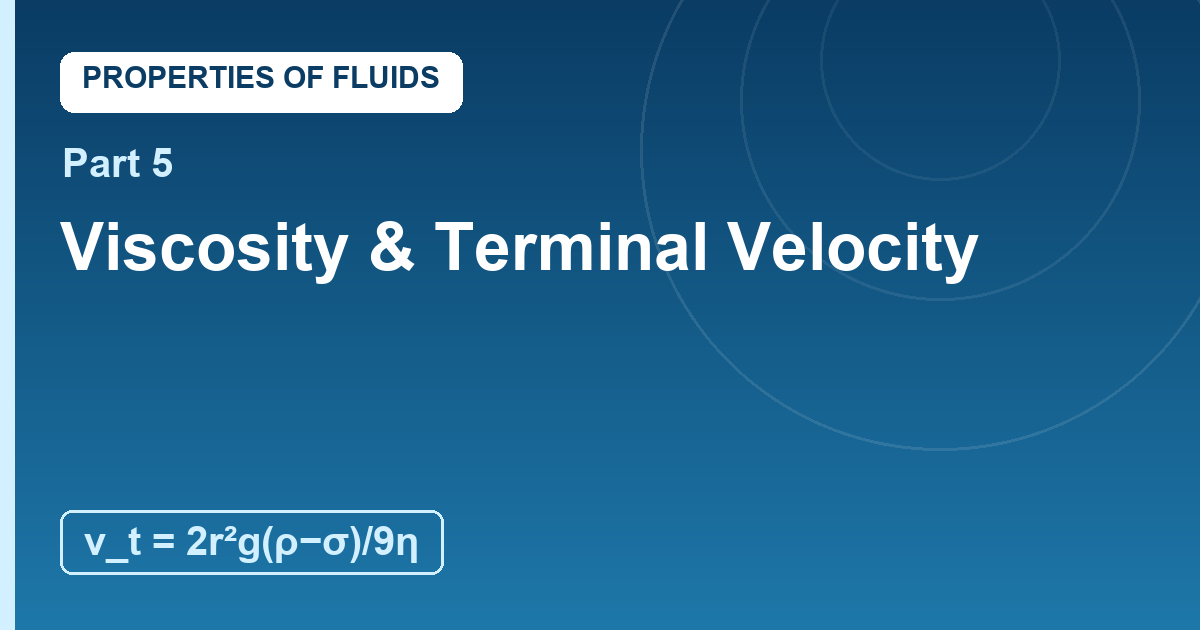
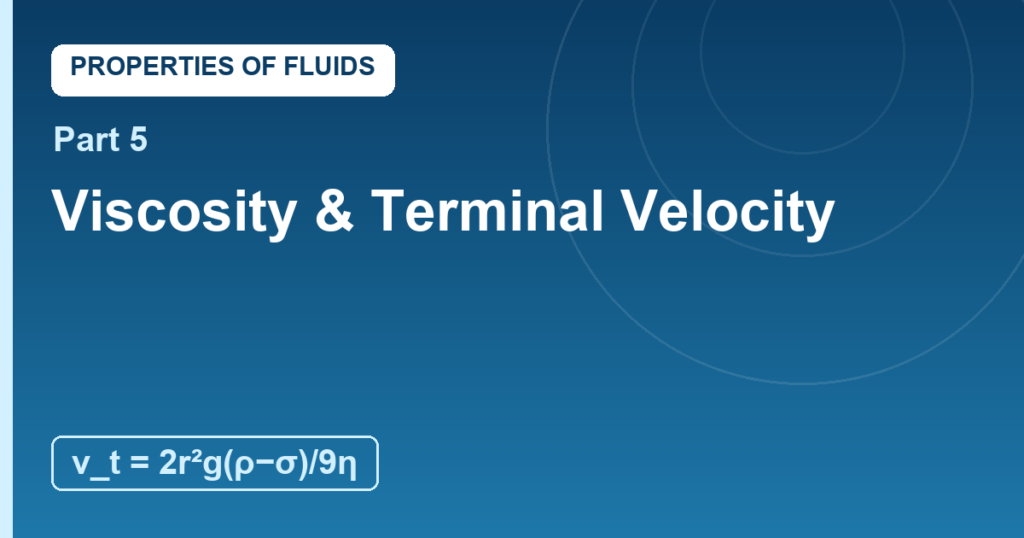
- Terminal velocity: weight = buoyancy + drag → v_t = 2r²g(ρ − σ)/(9η)
- Bigger raindrops fall faster (r²!); parachutes drop terminal velocity by raising area
Pour water and pour honey: one races, one oozes. The difference — viscosity — is friction INSIDE the fluid, and it’s why raindrops survive the fall and parachutes save lives. Part 5 of the Mechanical Properties of Fluids series.
- Viscosity: the internal brake
- Newton’s viscosity law
- Stokes’ law for spheres
- Terminal velocity
- Solved examples
- Common mistakes
- This physics in your daily life
- Practice set
- Recap
Viscosity: The Internal Brake
Fluids flow in layers, and neighbouring layers rub. The rubbing force — viscosity — resists differences in speed between layers. Honey’s layers cling hard (η ≈ 10 Pa·s); water’s barely (10⁻³); air’s less still (2×10⁻⁵). Viscosity falls with temperature in liquids (warm honey pours) and rises in gases.
Newton’s Law of Viscosity
| Letter | What it means (plain words) | Value / unit |
|---|---|---|
| η (eta) | coefficient of viscosity | Pa·s (or poise: 1 P = 0.1 Pa·s) |
| dv/dx | how quickly speed changes between layers | per metre |
| A | contact area of the layers | m² |
Stokes’ Law for Spheres
A small sphere moving slowly (gentle flow, no turbulence) through fluid feels drag F = 6πηrv — proportional to radius and speed. This simple law is the workhorse of falling-ball experiments.
Terminal Velocity
A falling sphere accelerates until drag + buoyancy exactly cancel weight — then it cruises at constant speed:
The r² is dramatic: a 2× fatter raindrop falls 4× faster. Too big, and drops break apart — nature’s speed limit keeps rain gentle.
Solved Examples
F = ηA(v/d) = 0.5 × 0.2 × (0.5/0.001) = 50 N.
✔
Answer: 50 N
v_t = 2(0.002)²(10)(7200)/(9×1) = 2×4×10⁻⁶×72000/9.
= 576×10⁻⁴… = 0.064 m/s — a slow, watchable sink (that’s how η is measured!). ✔
Answer: ≈0.064 m/s
A 1 mm drop: v_t ≈ 4 m/s (walk-jog pace); a 5 mm would need ~100 m/s but shatters first.
Viscosity + breakup cap rain at gentle speeds — terminal velocity is a survival mechanism for the uncovered world. ✔
Answer: Terminal velocity caps raindrop speed
- Using Stokes’ law for big or fast objects. F = 6πηrv holds only for small spheres in gentle (laminar) flow — turbulence changes the game.
- Density mix-up in v_t. The formula carries (ρ − σ): the DIFFERENCE between sphere and fluid densities (buoyancy’s fingerprint).
- Temperature forgetting. Liquid viscosity falls when heated; gas viscosity rises — opposite directions, classic concept question.
- Terminal velocity ≠ zero acceleration at once. It’s approached asymptotically after a brief acceleration phase.
This Physics in Your Daily Life
- Engine oils are graded by viscosity (20W-40…) — chosen to keep engine drag low cold AND protection high hot: viscosity-temperature engineering in every service station.
- Parachutes — trade the skydiver’s ~200 km/h terminal velocity for ~20 km/h by multiplying drag area: terminal velocity as a life-or-death dial.
- Paint, ketchup and shampoo formulation — thickeners tune η so paint sticks but levels and ketchup rests but pours: rheology industries.
- Blood’s viscosity matters medically — too thick stresses the heart, too thin bruises: blood thinners are viscosity prescriptions.
- Honey, syrup, and tea brewing — hot water extracts faster because warm fluids’ lower viscosity speeds diffusion and flow.
Drop a stone from a plane: gravity pulls steadily, but air drag grows with speed — every km/h costs a little more push-back. The tug-of-war must end when drag’s bill exactly equals gravity’s allowance: from then on, income equals outgo and speed freezes. The sky has a price list, and every object settles at its own quoted rate.
Skydiver spread-eagle: ~55 m/s terminal. Same diver head-down (less area): ~90 m/s. With parachute: ~5 m/s. Same gravity, same mass — only the drag area changed, and the terminal speed moved tenfold.
Graph velocity against time for a drop: starts rising as a curve, then flattens onto a ceiling — the terminal velocity asymptote. Change the radius (r² in the formula) and the ceiling moves; change the fluid and it moves again.
Practice set (answers hidden — try first)
(NEET-level) Terminal velocity is where acceleration =
(JEE Main-level) Radius doubles (Stokes regime): v_t becomes
(NEET-level) Heating honey makes it:
(Concept) Stokes’ law applies to:
(JEE Main-level) F = 6πηrv with η=0.8, r=1 mm, v=0.5: F =
- viscosity = layers’ internal friction
- F = ηA·dv/dx (Newton)
- Stokes: F = 6πηrv (small, slow spheres)
- v_t = 2r²g(ρ−σ)/9η
- liquids thin out when heated; gases thicken
- 🔁 viscosity meaning and units
- 🔁 Newton + Stokes formulas
- 🔁 terminal velocity derivation idea
- 🧠 Chant: ‘r-squared rules the fall’.
- 🧠 Stokes: ‘six-pi-eta-r-v’.
- 🏠 Daily: engine oil grades = viscosity choices.
- 🏠 Daily: parachutes dial terminal velocity down.
Quick revision
- Viscosity = internal friction of a fluid — treacle high, water low, gases lower
- Newton’s law of viscosity: F = −ηA(dv/dx) — force from speed differences between layers
- Stokes’ law: a small sphere moving slowly through fluid feels F = 6πηrv
- Terminal velocity: weight = buoyancy + drag → v_t = 2r²g(ρ − σ)/(9η)
- Bigger raindrops fall faster (r²!); parachutes drop terminal velocity by raising area
- Viscosity: the internal brake
Have a doubt on this topic?