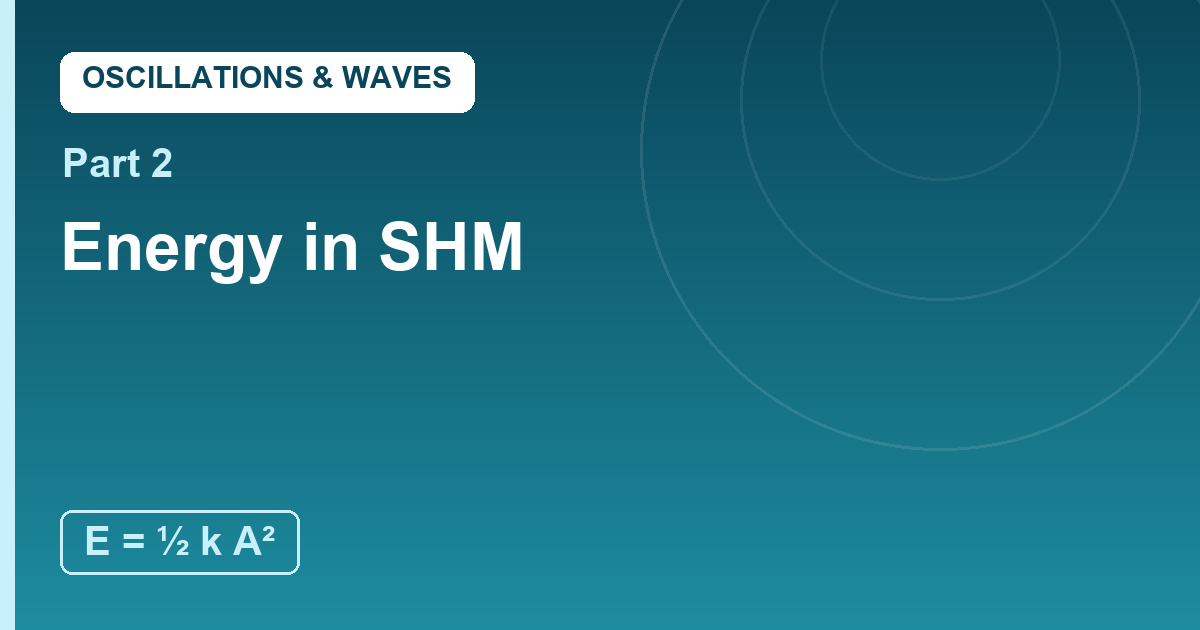
Energy in SHM: How Kinetic and Potential Energy Trade Places Endlessly
Quick answer: Energy in simple harmonic motion quantified: the kinetic-potential trade, the total-energy rule and JEE/NEET worked examples in exam-ready notes.
- The Two Energies, Traded
- The Total: Fixed by Amplitude
- The Average Surprise: Half and Half
- Solved Examples
- This Physics in Your Daily Life
- Practice set (answers hidden — try first)
- Frequently Asked Questions
- What should you know about The Two Energies, Traded?
- What should you know about The Total: Fixed by Amplitude?
- What should you know about The Average Surprise: Half and Half?
- What should you know about Solved Examples?
- What should you know about This Physics in Your Daily Life?
- Does the total energy ever change during SHM?
- Why doesn’t more energy make the oscillator faster?
- About the Author
- References & authoritative sources
In one line: Energy in SHM — exam-ready notes in one glance.
In one line: JEE/NEET Physics · Oscillations & Waves series · Part 2 of 8 · All parts →✪ Key points — the 30-second versionTotal SHM energy = ½kA² (or ½mω²A²) — fixed.
JEE/NEET Physics · Oscillations & Waves series · Part 2 of 8 · All parts →
- Total SHM energy = ½kA² (or ½mω²A²) — fixed by amplitude alone
- Energy endlessly trades: all-kinetic at the centre ↔ all-potential at the extremes
- Average KE = average PE = half the total each
- Doubling the amplitude QUADRUPLES the energy
- Energy rides the square of amplitude — just as KE rides v², and spring PE rides x²
A guitar string at maximum loudness, a swing at its highest point, a trampoline at full stretch — all three have banked their energy as stored (potential) energy. A moment later, it is all motion. This card puts numbers on the endless trade you first met in WEP Part 4 — now in oscillation form. Indeed, this is Part 2 of the Oscillations & Waves series.
- The two energies, traded.
- What each letter means.
- The total: fixed by amplitude.
- The average surprise: half and half.
- Solved examples.
- Common mistakes.
- This physics in your daily life.
- Practice set.
- Recap.
The Two Energies, Traded
Simple harmonic motion is a continuous exchange between two forms of energy. At the extremes (x = ±A): displacement is maximum → spring/height PE is maximum, and motion is momentarily zero. At the centre (x = 0): displacement is zero → PE is minimum, and speed is maximum (v = Aω). In between, a smooth handover occurs at every instant:
x = +A (end)
x = A/2
centre (x=0)
total = ½kA² (never changes)
KE
PE
Notice what this means physically: the oscillator never “spends” its energy anywhere. It merely shuttles the same fixed amount between storage (PE) and motion (KE), once per quarter-cycle, forever — as long as no friction or damping drains it away.
| Letter | What it means (plain words) | Value / unit |
|---|---|---|
| A | amplitude — the swing size | m |
| k | stiffness of the spring (k = mω² for SHM) | N/m |
| PE | stored energy at displacement x: ½kx² | J — max at ±A |
| KE | motion energy: ½mv² | J — max at centre |
The Total: Fixed by Amplitude
Read ½kA² closely: the square of amplitude rules the energy. Double the swing → 4× the energy; triple it → 9×. This is why loud strumming carries much more energy than gentle playing — and why a trampoline at full stretch bites harder than a gentle bob.
Two useful sanity checks follow from the formula. First, the total energy does not depend on where the mass currently is — x never appears in ½kA², only the maximum displacement A. Second, for a spring–mass system you can rewrite k as mω², giving ½mω²A²: a heavier mass or a faster clock rate (larger ω) both raise the energy at the same amplitude.
The Average Surprise: Half and Half
Over a full cycle, the energy spends equal time near both forms: average KE = average PE = ¼kA² — exactly half the total each. NEET loves this line: “in SHM, the average kinetic energy equals the average potential energy.”
This is a genuinely remarkable result. Instantaneous KE and PE swing wildly between zero and the full total, yet averaged over one complete oscillation they sit perfectly level at 50–50. No other common oscillating system splits so neatly — it happens because SHM’s sinusoidal motion divides each cycle symmetrically between “near the ends” and “near the centre.”
Solved Examples
Direct substitution: ½kA² = ½ × 200 × (0.05)² = 0.25 J.
Double the amplitude: ½ × 200 × (0.1)² = 1.0 J — ×4, the square.
Answer: 0.25 J (1.0 J if A doubles)
Energy ledger: total = ½(200)(0.1²) = 1 J. PE at 5 cm = ½(200)(0.05²) = 0.25 J → KE = 0.75 J.
½(0.5)v² = 0.75 → v = √3 ≈ 1.73 m/s.
Check: v_max = Aω = 0.1 × √(400) = 2 m/s — at half-displacement we’re slower, 1.73 < 2 ✔
Answer: v = √3 ≈ 1.73 m/s
The half-and-half surprise: ¼kA² : ¼kA² : ½kA² → 1 : 1 : 2.
Instantaneous values swing wildly; the averages sit perfectly level.
Answer: 1 : 1 : 2
- Using x instead of A in the total. ½kx² is the PE at displacement x; the TOTAL is ½kA² — only the maximum displacement enters.
- Forgetting cm→m before squaring. 5 cm must be 0.05 m; one slip = 10,000× error.
- Assuming energy oscillates asymmetrically. It does not — the 1:1:2 average rule holds; don’t confuse instantaneous values with averages.
- Expecting amplitude to change the period via energy. More energy does NOT mean faster oscillation — the period stays amplitude-free (Part 1).
This Physics in Your Daily Life
- Loudness of any instrument tracks energy ∝ A² — strum 41% harder for double loudness (×1.41 amplitude). “Twice as loud” is far more work than it sounds.
- Earthquake design: buildings store and trade SHM energy as they sway — engineers compute ½kA² equivalents to size dampers (Part 4).
- Waves at the beach: wave energy goes as height-squared — a 2× taller breaker hits with 4× the energy. Surfers and sea-walls both respect the square.
- Microwave ovens pump oscillating energy into water molecules — the molecular SHM becomes heat in your food.
- The death of loudness: as a bell rings down, energy drains ∝ A² — loudness fades fast first, then slowly: amplitude-squared, heard in every decaying note.
Practice set (answers hidden — try first)
(NEET-level) k = 100 N/m, A = 10 cm. Total energy?
(NEET-level) Amplitude doubled. Total energy becomes:
(JEE Main-level) In SHM, average KE : average PE:
(JEE Main-level) Total 2 J; at x = A/2, KE is:
(Concept) Where is PE minimum in SHM?
- 🧠 Chant: “energy rides the square — of amplitude, of speed, of stretch”.
- 🧠 The 1:1:2 rule: average KE : average PE : total.
- 🏠 Daily: twice-as-loud music needs ~4× the energy — amplitude-squared at the party.
- 🏠 Daily: a double-height wave breaks with 4× the punch — the square, at the beach.
- 🔁 Total SHM energy = ½kA² (J)
- 🔁 Energy trades: KE-max at centre, PE-max at ends
- 🔁 Avg KE = avg PE = half each of total
A swing at its highest point: perfectly still, fully “charged”. At the lowest point: fastest, all motion. Energy doesn’t vanish between the two — it sloshes between the tank of position (PE) and the tank of motion (KE), like water poured between two glasses, the total never changing.
Total energy = ½kA². At x = A/2: PE = ¼ of total, KE = ¾. At x = 0: KE = everything, v = v_max. At x = A: KE = 0. Check any point: PE + KE = ½kA², always the same number.
Draw two mirrored curves: KE is an upside-down arch (max at centre, zero at ends), PE a right-side-up arch (zero at centre, max at ends). Slide along the axis and watch the two curves trade height exactly — one falls as much as the other rises.
- Total = ½kA² = ½mω²A² — amplitude-squared
- All-motion at centre (v = Aω); all-stored at extremes (a = ω²A)
- Average KE = average PE = ¼kA² (1:1:2)
- Doubling amplitude quadruples energy
- The trade is WEP Part 4’s see-saw in oscillation form
Frequently Asked Questions
What should you know about The Two Energies, Traded?
In SHM, kinetic and potential energy exchange continuously. At the extremes (x = ±A), all the energy is potential and the particle is momentarily at rest; at the centre (x = 0), all the energy is kinetic and speed peaks at v = Aω. The two forms trade back and forth every quarter-cycle, but their sum — ½kA² — never changes. If you remember one picture, remember the bar chart: as the PE bar falls, the KE bar rises by exactly the same amount.
What should you know about The Total: Fixed by Amplitude?
The total energy of a simple harmonic oscillator is E = ½kA² = ½mω²A². It depends only on the stiffness (or mass and angular frequency) and the amplitude — never on the instantaneous position or speed. Because amplitude enters as a square, small changes in swing size produce large changes in energy: doubling A gives 4× the energy, tripling gives 9×.
What should you know about The Average Surprise: Half and Half?
Averaged over a complete cycle, kinetic and potential energy each contribute exactly half the total: ⟨KE⟩ = ⟨PE⟩ = ¼kA² = E/2. This gives the classic exam ratio ⟨KE⟩ : ⟨PE⟩ : E = 1 : 1 : 2. Remember this is about averages — the instantaneous values still swing from zero to the full total.
What should you know about Solved Examples?
The worked examples above cover the three most common exam patterns. (1) Direct total: ½kA² = ½ × 200 × (0.05)² = 0.25 J; doubling the amplitude gives 1.0 J — ×4, the square. (2) Speed at a given displacement: subtract ½kx² from ½kA² to get KE, then solve ½mv² = KE. (3) The average split: 1 : 1 : 2. Common pitfalls to avoid: using x instead of A in the total (½kx² is the PE at displacement x; only the maximum displacement enters the total), and forgetting cm→m conversion before squaring — 5 cm must be 0.05 m, or your answer is off by 10,000×.
What should you know about This Physics in Your Daily Life?
Amplitude-squared energy shows up everywhere. Loudness of any instrument tracks energy ∝ A² — strumming 41% harder (×1.41 amplitude) doubles the energy. In earthquake engineering, buildings store and trade SHM energy as they sway, and engineers compute ½kA² equivalents to size dampers. Ocean waves carry energy proportional to height squared, so a 2× taller breaker hits with 4× the punch. Even a microwave oven works by pumping oscillating energy into water molecules, turning their molecular SHM into heat in your food.
Does the total energy ever change during SHM?
Not in ideal SHM. Without friction, air drag, or damping, the sum KE + PE is conserved at ½kA² forever. In real systems, damping slowly drains the total — which is why a struck bell or plucked string fades — but at every instant the KE + PE balance still holds at the (now shrinking) current energy level.
Why doesn’t more energy make the oscillator faster?
More energy at the same k means a larger amplitude, not a shorter period. The period T = 2π√(m/k) depends only on mass and stiffness — never on amplitude. A bigger swing covers more distance, but it also moves faster at the centre; the two effects cancel exactly. This amplitude-independence of the period is the defining property of simple harmonic motion (Part 1).
References & authoritative sources
- Britannica — concept background
- United Nations — official documents
- NTA — official
- NCERT Physics textbooks
- JEE Main — official
Source: compiled from official notifications, standard textbooks and our own mock-test analytics; last reviewed September 2026.
Quick revision
- Total SHM energy = ½kA² (or ½mω²A²) — fixed by amplitude alone
- Energy endlessly trades: all-kinetic at the centre ↔ all-potential at the extremes
- Average KE = average PE = half the total each
- Doubling the amplitude QUADRUPLES the energy
- Energy rides the square of amplitude — just as KE rides v², and spring PE rides x²
- The two energies, traded.
Have a doubt on this topic?
Sources & official references
External references for fact-checking and further reading.