JEE/NEET Physics · Oscillations & Waves series · Part 7 of 8 · All parts →
- Two close frequencies trade loudness: loud-quiet-loud-quiet = beats
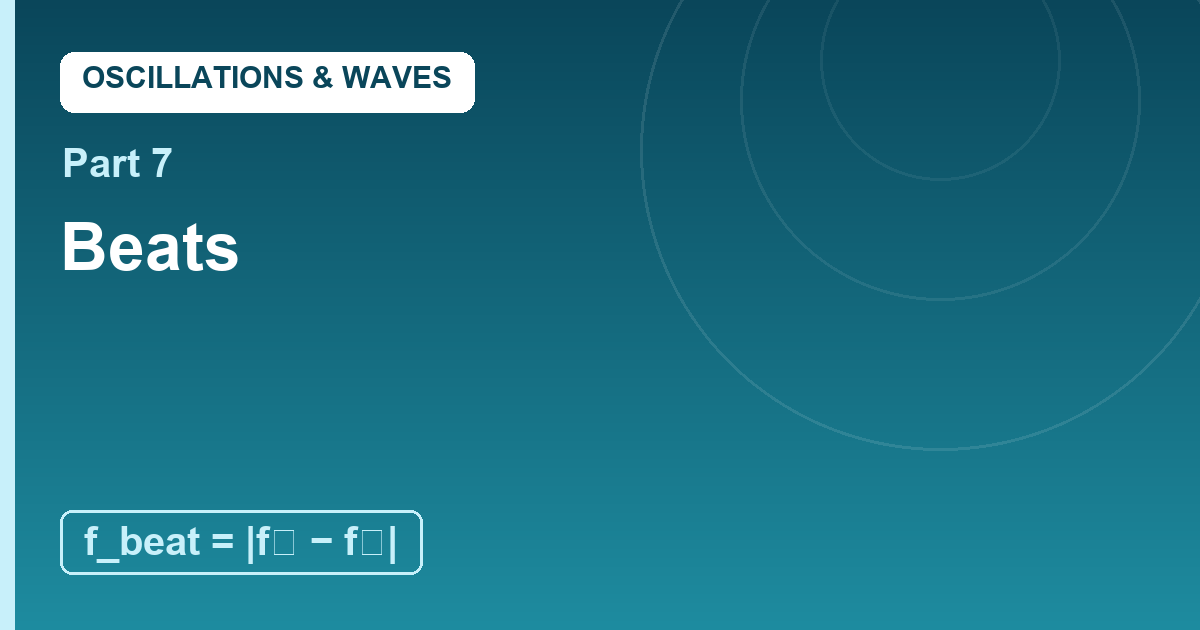
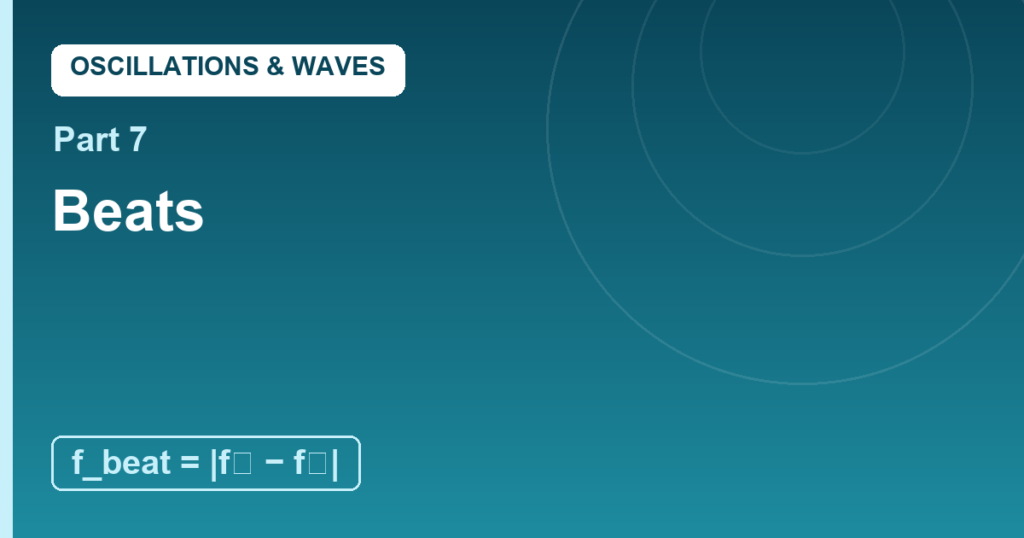
- Beat frequency = the DIFFERENCE of the two frequencies: f_beat = |f₁ − f₂|
- Beats are interference in time (standing waves were interference in space)
- Zero beats = perfect tuning — how musicians tune by ear
- 1 beat/second = frequencies 1 Hz apart
Two flutists play nearly the same note — the sound swells and dips, ‘waa-waa-waa’, a few times a second. That throbbing is beats — and it’s so precise that musicians, piano tuners and police radars use it as a measuring instrument. Part 7 of the Oscillations & Waves series.
- The simple idea: constructive/destructive alternation
- The formula: difference of frequencies
- What each letter means
- Tuning by beats to zero
- Solved examples
- Common mistakes
- This physics in your daily life
- Practice set
- Recap
The Simple Idea: Alternating Reinforcement
Two waves at almost the same frequency drift in and out of step. In step (crests on crests) → loud. Out of step (crest on trough) → silent. As one wave gains a cycle on the other, loud and quiet alternate rhythmically — the beat is interference in time, exactly like standing-wave patterns are interference in space.
The Formula: Difference of Frequencies
| Letter | What it means (plain words) | Value / unit |
|---|---|---|
| f₁, f₂ | the two close frequencies | Hz |
| f_beat | throbs per second = their difference | Hz — always positive |
Why the difference? In one second, the faster wave gains exactly (f₁−f₂) whole cycles on the slower one — each gained cycle = one loud→quiet→loud round trip. Simple arithmetic, deep reason.
Tuning by Beats to Zero
Adjust one instrument until the throbbing slows… slows… vanishes: zero beats = identical frequencies. The ear hears ‘zero’ exquisitely well — this is how orchestras tune to a reference note and how piano tuners work, counting beats against a standard.
Solved Examples
Difference: 3 Hz → 3 loud-quiet cycles per second. ✔
Answer: 3 beats/s
Two candidates from 2 beats: 254 or 258 Hz.
The wax test decides: slowing the unknown RAISED the beat count → it was moving AWAY from 256 → it must have been ABOVE: 258 Hz (slowed toward 256… wait: 258 slowed moves toward 256, beats should fall).
Re-read: slowing raised beats → the unknown was BELOW: 254 Hz, slowing further to 253 → 3 beats ✔
Answer: 254 Hz
Candidates: 436 or 444 Hz.
Tightening raises string pitch → beats falling to zero means the string rose INTO 440 → it started at 436 Hz, final state perfectly tuned at 440.
✔ (If it had started at 444, tightening would raise beats — the direction test again.)
Answer: originally 436 Hz; tuned to 440 Hz
- Forgetting the two-candidate ambiguity. ‘4 beats against 440’ means 436 OR 444 — without a change-test (wax, tightening), the answer is not unique. Always check whether the question gives the deciding test.
- Adding instead of subtracting. Beats are the DIFFERENCE, never the sum (the sum is a related but different phenomenon).
- Expecting to hear beats from distant frequencies. A 300 Hz and 500 Hz pair doesn’t beat audibly — beats need CLOSE frequencies (roughly within ~10 Hz for the ear).
- Confusing beat frequency with the perceived pitch. You hear a tone near f₁≈f₂ that THROBS at |f₁−f₂| — the throb and the note are different numbers.
This Physics in Your Daily Life
- Every orchestra tuning — strings adjusting to the oboe’s A while beats slow to silence — is this card performed publicly.
- Piano tuners count beats between a string and a standard; the craft is zeroing beats string by string.
- Doppler radars and speed guns measure beats between emitted and reflected waves — the beat frequency IS your speed reading.
- Aircraft and machine monitoring: two engines at slightly different RPM produce a throbbing drone; mechanics diagnose mis-tuning by ear — beats as maintenance tool.
- Binaural beats in headphones (350 Hz left, 357 Hz right) create a 7 Hz perceived throb — marketed relaxation tech built on the difference rule.
Practice set (answers hidden — try first)
(NEET-level) Forks at 512 and 508 Hz. Beats/s:
(JEE Main-level) 440 Hz standard, 4 beats/s, tightening reduces to 2. The string was:
(NEET-level) Maximum beats heard when the forks are:
(JEE Main-level) Beats of 5/s disappear when one fork is waxed to reduce f slightly. Original pair:
(Concept) Zero beats means:
- 🧠 Chant: ‘the throb is the difference’.
- 🧠 Tuning rule: ‘chase the beats to zero’.
- 🧠 Ambiguity check: ‘two candidates — demand the change-test’.
- 🏠 Daily: orchestra tuning and piano tuners zero beats for a living.
- 🏠 Daily: a speed gun’s readout is a beat frequency in km/h.
- 🔁 f_beat = |f₁ − f₂|
- 🔁 beats need close frequencies (few Hz apart)
- 🔁 zero beats = matched frequencies
- beats = loudness throbbing from two close frequencies
- f_beat = |f₁ − f₂| — always the difference
- zero beats = perfect unison (tuning target)
- ambiguous cases resolved by a change-test (wax/tighten)
- beats are interference in time; standing waves in space
Quick revision
- Two close frequencies trade loudness: loud-quiet-loud-quiet = beats
- Beat frequency = the DIFFERENCE of the two frequencies: f_beat = |f₁ − f₂|
- Beats are interference in time (standing waves were interference in space)
- Zero beats = perfect tuning — how musicians tune by ear
- 1 beat/second = frequencies 1 Hz apart
- The simple idea: constructive/destructive alternation
Have a doubt on this topic?