JEE/NEET Physics · Oscillations & Waves series · Part 4 of 8 · All parts →
- Damping = friction slowly stealing SHM energy — swings decay, period barely changes
- Free oscillation: the natural frequency set by the system (pendulum/spring formulas)
- Forced oscillation: an outside pusher at its own frequency
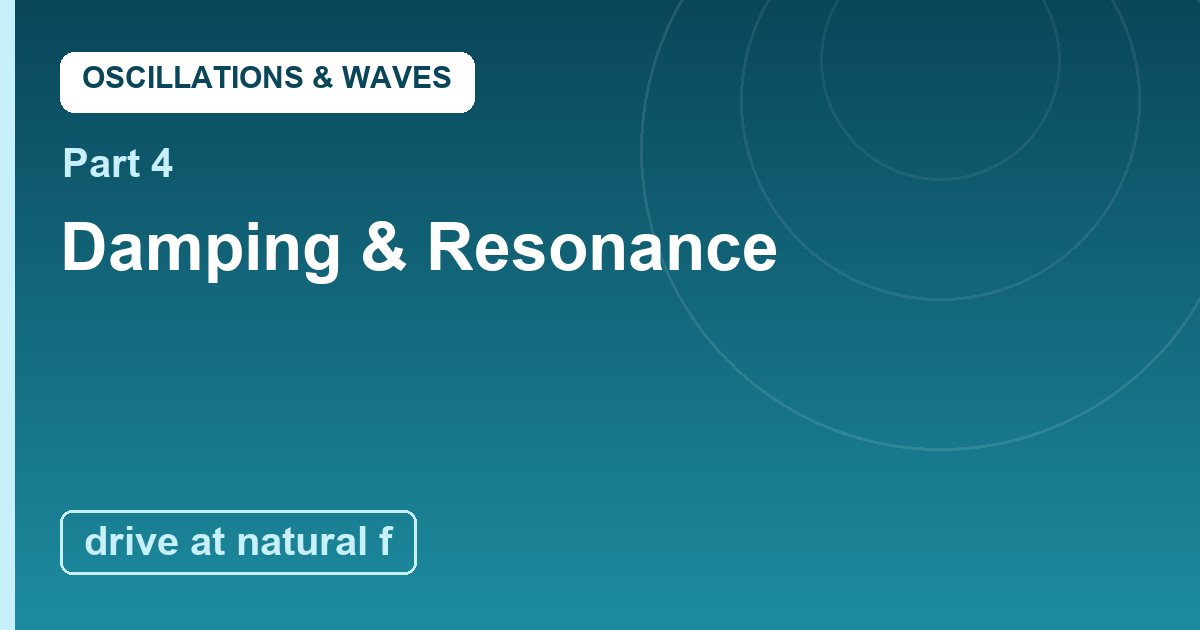
- Resonance: push at the natural frequency → amplitude EXPLODES
- Resonance is how radios, ears and MRI work — and how bridges fall
Push a child on a swing with the RIGHT timing — small pushes build a huge swing. Push with the wrong timing — nothing accumulates. That one fact, resonance, builds radios and ears, and has collapsed bridges. Part 4 of the Oscillations & Waves series.
- Damping: the honest decay
- Natural frequency: every system’s own note
- Forced oscillations and the pusher’s frequency
- Resonance: amplitude explosion
- Solved examples
- Common mistakes
- This physics in your daily life
- Practice set
- Recap
Damping: The Honest Decay
Real oscillators lose energy to friction and air — amplitude decays over time (a fading guitar note, a slowing pendulum). Crucial detail: damping mostly shrinks the amplitude; the frequency barely shifts (slightly slower). Energy drains as ½kA² drains — the note fades but holds its pitch, which is why music works at all.
Natural Frequency: Every System’s Own Note
Left alone, every oscillator vibrates at its own natural frequency (from Part 3’s formulas): a pendulum’s 1/2π√(g/L), a spring’s 1/2π√(k/m). A wineglass, a building, a car body, an eardrum — each has its note. Find the note and you hold the key to moving the system.
Forced Oscillations and the Pusher’s Frequency
Now push the system rhythmically at your own frequency f_push. The system responds with a steady oscillation at YOUR frequency — and the amplitude of that response depends dramatically on how close your push is to the natural note:
| Your push frequency vs natural | Response amplitude |
|---|---|
| far below or far above | small — pushes fight the motion half the time |
| close to natural | large — every push adds to stored energy |
| EXACTLY natural (resonance) | MAXIMUM — pushes add every cycle, energy piles up |
Resonance: Amplitude Explosion
At resonance, every push arrives exactly when it helps most — like pushing a swing at its natural moment, every time. Energy accumulates cycle after cycle until damping’s drain equals the pushing — the steady amplitude can be enormous. This is the double-edged sword: it lets a singer shatter a wineglass with bare voice, lets radios pluck one station from thousands — and let the Tacoma Narrows bridge twist itself apart (1940, wind-driven resonance) and soldiers break step on bridges (march at resonance = structural danger).
Solved Examples
Push once per cycle: T = 1/f = 2 s — a push every 2 seconds, timed to the forward swing. Any other rhythm wastes half the pushes. ✔
Answer: push every 2 s (at 0.5 Hz)
Energy ∝ A²: amplitude ×½ → energy ×¼. The energy ledger drains with the SQUARE of the amplitude — fast at first, slower as it fades. ✔
Answer: energy drops to 1/4
Natural frequency: ω = √(k/m) = 20 rad/s → f = ω/2π ≈ 3.2 Hz.
Resonance when the driver matches: ≈ 3.2 Hz. Drive a structure at this and amplitude maximises — engineering’s job is usually to keep driving frequencies AWAY from it. ✔
Answer: f ≈ 3.2 Hz
,
- Confusing free and forced frequency. Free: the system’s natural note. Forced: the response copies the DRIVER. Only when they match does resonance happen.
- Expecting damping to change pitch much. It shrinks amplitude; frequency barely moves — a fading note keeps its tune.
- Thinking resonance is always destructive (or always useful). It’s an amplitude multiplier — a tool (radio, MRI) or hazard (bridges) depending on what’s vibrating.
- Using ω where f is asked (or vice versa). Resonance questions love the 2π conversion — check which one the options carry.
This Physics in Your Daily Life
- Every radio and phone tuner is a resonance hunt: the circuit’s natural frequency is adjusted to match one broadcast — it responds massively to that station and ignores the rest.
- Your ear resonates air in the ear canal (~3 kHz) — you hear speech frequencies best because biology tuned the resonance there.
- MRI machines drive hydrogen atoms at their resonant frequency in a magnetic field — resonance, imaged, as medical scans.
- Soldiers break step crossing bridges — a marching rhythm at the bridge’s natural note could pump amplitude dangerously. Real parade-ground physics.
- The Tacoma Narrows collapse (1940) remains engineering’s most famous resonance disaster — wind drove the bridge’s natural twist until it failed. It’s on video; watch it once and never forget this card.
Practice set (answers hidden — try first)
(Concept) Resonance occurs when the driving frequency:
(NEET-level) Damping halves the amplitude. Total energy becomes:
(Concept) As a guitar note fades, its pitch:
(JEE Main-level) m = 4 kg on k = 100 N/m. Resonant driving frequency (Hz):
(Concept) Soldiers break step on a bridge to avoid:
- 🧠 Chant: ‘match the note, multiply the swing’.
- 🧠 Damping: ‘loudness fades, pitch holds’.
- 🏠 Daily: pushing a swing is resonance you operate by instinct — every 2 seconds at 0.5 Hz.
- 🏠 Daily: radio tuning, your ear, MRI, and broken bridges — one principle, four worlds.
- 🔁 damped: amplitude decays, frequency ~same
- 🔁 natural frequency from Part 3’s clock formulas
- 🔁 forced vibration copies the driver
- damping drains energy; amplitude decays, frequency nearly holds
- natural frequency: the system’s own note (Part 3 formulas)
- forced response copies the driver’s frequency
- resonance: driver = natural → amplitude maximum
- energy ∝ A²: damping halves amplitude → quarters energy
Quick revision
- Damping = friction slowly stealing SHM energy — swings decay, period barely changes
- Free oscillation: the natural frequency set by the system (pendulum/spring formulas)
- Forced oscillation: an outside pusher at its own frequency
- Resonance: push at the natural frequency → amplitude EXPLODES
- Resonance is how radios, ears and MRI work — and how bridges fall
- Damping: the honest decay
Have a doubt on this topic?