JEE/NEET Physics · Electrostatics series · Part 8 of 8 · All parts →
- The chapter’s map: charge → field → potential → Gauss → conductors → capacitors → dielectrics
- Energy methods often beat force methods — look for the ½’s
- The connected/isolated capacitor split decides every capacitor question
- Everything scales to technology: from 10³⁶-strong forces to femtofarad RAM
- Complete chapter formula card at the end
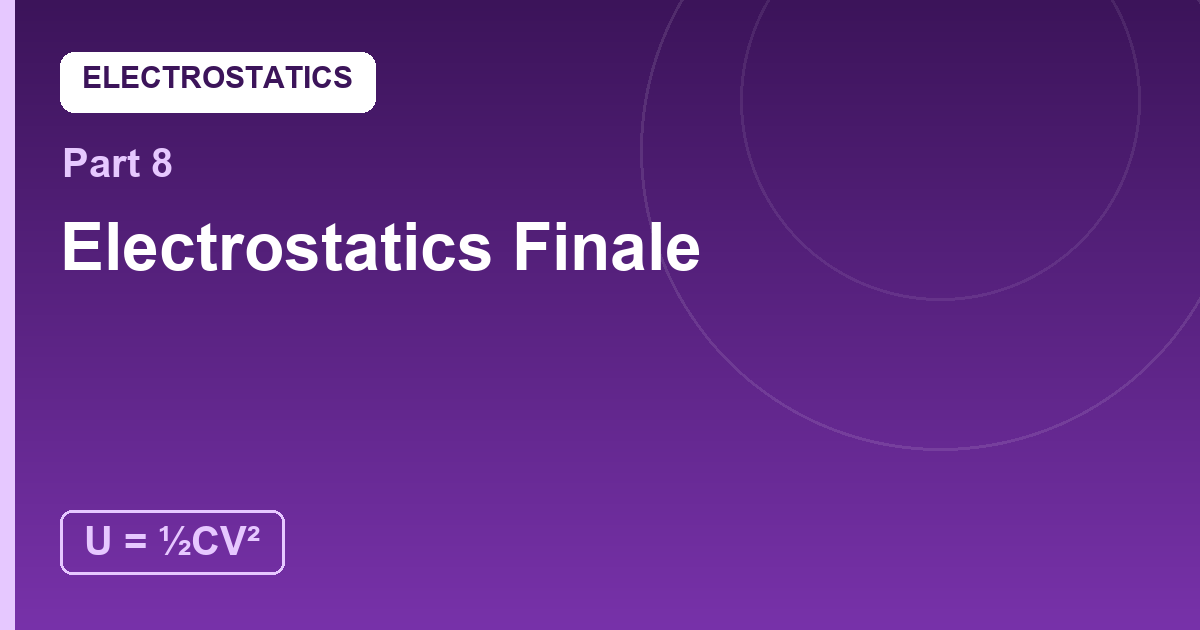
One invisible force, a billion-trillion-trillion times stronger than gravity, quietly runs your phone, your nerves, and every chemical reaction — while canceling itself so perfectly that gravity gets to run the universe. That’s electrostatics. The finale of the Electrostatics series — the map, the master patterns, and the complete formula card.
- The chapter’s one-line story
- Master pattern 1: the two landscapes
- Master pattern 2: the ½’s
- Master pattern 3: locked quantities
- Solved examples
- Common mistakes
- This physics in your daily life
- Practice set
- Recap + formula card
The Chapter’s One-Line Story
Charges create fields; fields move charges; energy bookkeeping (potentials) often beats force-tracking; Gauss turns symmetry into three-line solutions; conductors surrender their interiors; capacitors park charge pairs and their energy in the gap; dielectrics multiply the parking. Every card of this series was one beat of that sentence.
Master Pattern 1: The Two Landscapes
Force picture (vectors, arrows): F = kq₁q₂/r², E = kQ/r². Energy picture (scalars, heights): U = kq₁q₂/r, V = kQ/r. Same 1/r² vs 1/r signatures as gravity’s field and potential — the two chapters are structural twins. When a question says ‘work done’ or ‘energy’, switch landscapes; potentials add like bank balances.
Master Pattern 2: The ½’s
Three halves rule the chapter: capacitor energy ½CV², charge-through-voltage ½QV, field energy density ½ε₀E². Whenever work is done against a linearly rising opposition (voltage rising as charge arrives), only half the work stays stored — the other half is the price of the journey.
Master Pattern 3: Locked Quantities
Every capacitor puzzle hangs on one question: what is locked? Battery connected: V locked (Q, U follow C). Disconnected: Q locked (V = Q/C falls if C rises). Same physics, opposite outcomes — the exam’s favourite lever.
Solved Examples
Energy landscape: W = qV = 2×10⁻⁶ × 500 = 10⁻³ J.
No forces, no paths — the landscape answers directly. ✔
Answer: 1 mJ
U = ½CV² = ½ × 100×10⁻⁶ × 4×10⁶ = 200 J.
Real-world check: that’s the actual spec of hospital defibrillators — this chapter’s arithmetic, on a crash cart. ✔
Answer: 200 J
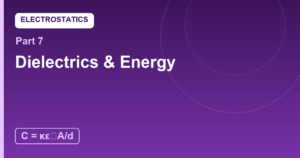
C = κε₀A/d = 6 × 8.85×10⁻¹² × 0.01/0.001 ≈ 5.3×10⁻¹⁰ F (0.53 nF).
Q = CV ≈ 6.4×10⁻⁹ C. E = V/d = 12,000 V/m → u = ½ε₀E² ≈ 6.4×10⁻⁴ J/m³.
Every card of the series in one problem — formula sheet to numbers in four lines. ✔
Answer: C ≈ 0.53 nF; Q ≈ 6.4 nC; u ≈ 6.4×10⁻⁴ J/m³
- Vector/ scalar mixing in the finale rush. Fields add as arrows, potentials as numbers — the twin landscapes have different algebras.
- The ½ dropped under time pressure. QV is the work spent; ½QV is what stayed. Check which the question asks.
- Locked-quantity amnesia. Connected → V fixed; isolated → Q fixed. Decide BEFORE computing anything else.
- Units drift in multi-step problems. mm, μC, kV — convert at the START of every step, not the end.
This Physics in Your Daily Life
- Your nervous system is electrostatics: every thought is voltage-gated ion channels flipping — ~70 mV potentials running the mind that’s reading this card.
- All chemistry is electrostatics: bonds are + nuclei and − electrons finding energy minima — the entire periodic table is this chapter’s landscape.
- Semiconductor devices (every chip) manage charge in fields at nanometre scale — field-effect transistors are literally named for this card.
- Every power adapter and radio tuner contains capacitors running the exact formulas above — the chapter, plugged into your wall.
- Static-shock door handles in winter: charge separation on you (walking on carpet), discharged through one spark — Part 1 to Part 3, personally experienced.
| What | Formula | Remember |
|---|---|---|
| Coulomb’s law | F = kq₁q₂/r² | k = 9×10⁹; like repels |
| Field (point charge) | E = kQ/r²; E = F/q | N/C; vector |
| Potential (point charge) | V = kQ/r; U = qV | SCALAR — plain addition |
| Field-potential link | E = −dV/dr | field = slope of V |
| Gauss’s law | Φ = q_enc/ε₀ | shape-free; symmetry needed to use |
| Charged shell | E = 0 inside; kQ/r² outside | point-like outside |
| Sheet / line | E = σ/2ε₀; E = λ/2πε₀r | constant; 1/r |
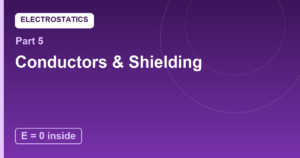
| Conductors | E = 0 inside; charge on surface | Faraday cage blocks outside-in |
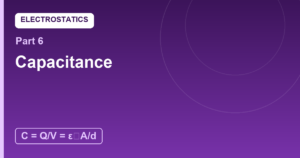
| Capacitance | C = Q/V; plates: ε₀A/d | farad = C/V |
| Dielectric | C = κε₀A/d | water ~80, glass ~7 |
| Combinations | parallel: add; series: reciprocals | swapped vs resistors |
| Capacitor energy | U = ½CV² = ½QV | the half is real |
| Energy density | u = ½ε₀E² | energy lives in the field |
| Locked quantities | connected: V fixed; isolated: Q fixed | decide first, compute after |
Practice set (answers hidden — try first)
(NEET-level) V at 0.2 m from 4 μC:
(JEE Main-level) 50 μF at 400 V. Energy:
(Concept) A charged isolated capacitor’s plates are moved apart. U:
(NEET-level) κ = 4 slab in an isolated capacitor. V:
(JEE Main-level) Three 3 μF capacitors in series:
- U = ½CV² = ½QV
- u = ½ε₀E²
- C = κε₀A/d
- 🔣 twin landscapes: forces (1/r², vectors) and potentials (1/r, scalars)
- 🔣 three ½’s: ½CV², ½QV, ½ε₀E²
- 🔣 locked quantities decide capacitor puzzles
- 🔣 conductors: E = 0 inside, charge outside
- 🔣 dielectrics multiply capacitance by κ
- 🔁 F, E go as 1/r²; U, V as 1/r
- 🔁 potentials add as scalars
- 🔁 U = ½CV²; u = ½ε₀E²
Every electrostatics fact is either a FORCE picture (vectors, pushes, field lines) or an ENERGY picture (scalars, landscapes, potential hills). Same charges, two lenses. Choosing the right lens — push-question or cost-question — is 80% of solving the problem.
Force lens: F = kq₁q₂/r², E = F/q. Energy lens: V = kQ/r, U = qV, capacitors store ½CV² = Q²/2C. A question with ‘force’, ‘field’, ‘direction’ → first lens; a question with ‘energy’, ‘work’, ‘voltage’, ‘stored’ → second.
Draw two side-by-side portraits of the same pair of charges: LEFT — arrows and field lines (who pushes whom, which way); RIGHT — a shaded potential landscape with contour lines (where energy is high, where balls would roll). One situation, two maps.
- 🧠 Chant: ‘forces square, potentials single — vectors vs scalars’.
- 🧠 Half rule: ‘work spent is QV, stored is half’.
- 🏠 Daily: your nerves run on ~70 mV — electrostatics thinking your thoughts.
- 🏠 Daily: door-handle sparks in winter: this chapter, felt.
Quick revision
- The chapter’s map: charge → field → potential → Gauss → conductors → capacitors → dielectrics
- Energy methods often beat force methods — look for the ½’s
- The connected/isolated capacitor split decides every capacitor question
- Everything scales to technology: from 10³⁶-strong forces to femtofarad RAM
- Complete chapter formula card at the end
- The chapter’s one-line story
Have a doubt on this topic?
Sources & official references
External references for fact-checking and further reading.