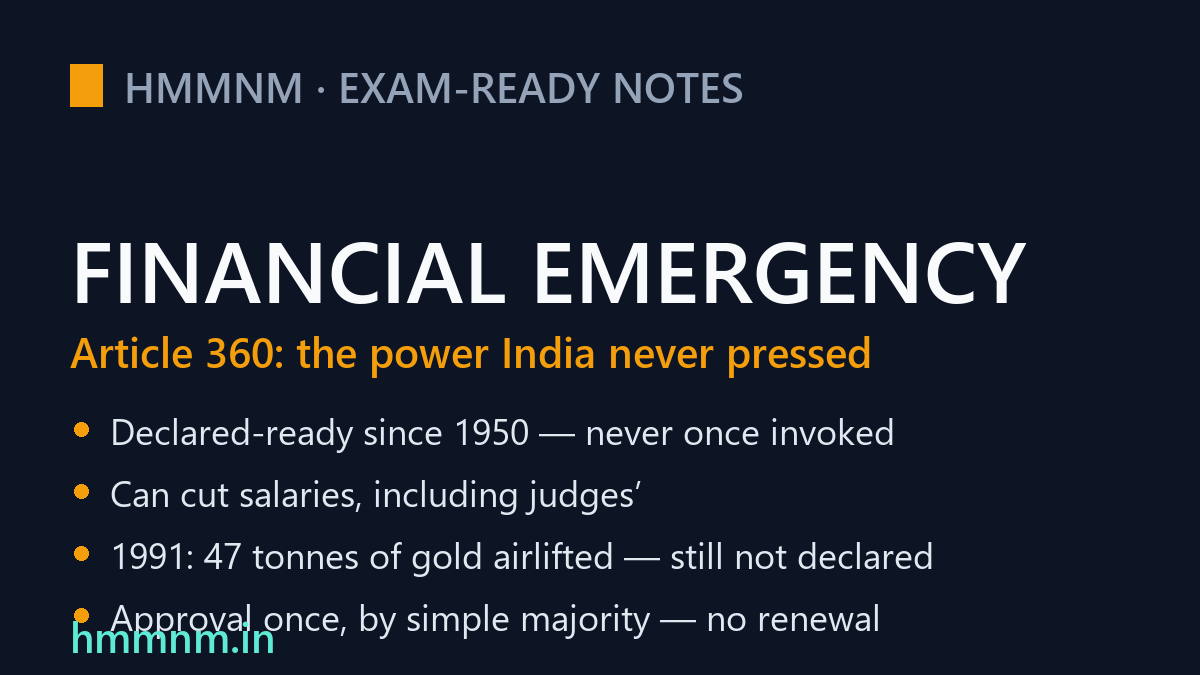
In one line: Financial Emergency under Article 360 is the Constitution’s most drastic economic power – and the only emergency provision never once used since 1950.
- 1. What Article 360 Actually Says.
- 2. The Four Powers It Grants.
- 3. The Approval Arithmetic.
- 4. Why It Has Never Been Used.
- 5. The Two Near-Misses: 1962 and 1991.
- 6. Judicial Review and the Exam Traps.
- 7. Quick Revision Card.
- Frequently Asked Questions
- What should you know about Article 360’s trigger?
- What should you know about the approval process?
- What should you know about the salary-reduction power?
- Why has Financial Emergency never been declared?
Every emergency article in the Constitution has been tested except one. In fact, National Emergencies were declared in 1962, 1971 and 1975, and President’s Rule has been invoked over 130 times. However, Article 360 has waited, armed and unused, through every crisis India has faced. Therefore, this single-concept card covers it end to end: the clause, the powers, the near-misses, and the traps examiners set.
- What Article 360 actually says.
- The four powers it grants.
- The approval arithmetic.
- Why it has never been used.
- The two near-misses: 1962 and 1991.
- Judicial review and the exam traps.
- Quick revision card.
1. What Article 360 Actually Says.
The clause is short and stark. Moreover, it has never been amended since adoption. Specifically, if the President is satisfied that the financial stability or credit of India, or of any part of its territory, is threatened, a Financial Emergency may be declared.
Three phrases carry the weight. First, “financial stability or credit” – the trigger is economic, not military or political. Second, “or of any part” – the emergency can target a single state’s finances, not just the Union’s. Third, “the President is satisfied” – like Articles 352 and 356, satisfaction is the sole gateway, though the President acts on the Council of Ministers’ advice.
2. The Four Powers It Grants.
Once declared, the emergency unlocks four specific powers. Therefore, memorise them as a set, because prelims statements mix and match them.
- Salary reductions: the President may direct reductions in the salaries and allowances of all or any class of persons serving the Union, including the judges of the Supreme Court and the High Courts.
- State money bills: Money Bills and Financial Bills reserved for the President under Article 207 go to Parliament for consideration. Effectively, the Union takes control of state financial legislation.
- Directions to states: the President may issue directions to any state to observe canons of financial propriety, including reduction of salaries and allowances of state employees.
- Duration without renewal: there is no maximum period, and no repeated parliamentary approval is required – unlike the other two emergencies.
Note the asymmetry with Article 352. Moreover, the judge-salary clause is unique. In fact, it is the only provision in the Constitution that allows a direct reduction in judicial remuneration, which is why it is debated in judicial-independence discussions.
3. The Approval Arithmetic.
Approval is the simplest of the three emergencies. Specifically, a proclamation must be laid before both Houses of Parliament. Moreover, it ceases to operate after two months unless both Houses approve it by resolution before that period ends.
Furthermore, a simple majority of members present and voting suffices. Therefore, contrast the three. Article 352 needs special majority renewal every six months. Meanwhile, Article 356 needs simple majority every six months. However, Article 360 needs simple majority once, and then continues until revoked. In addition, the Lok Sabha’s dissolution does not kill it. However, if the Rajya Sabha approves while the Lok Sabha stands dissolved, the new House must approve within thirty days of its first sitting.
4. Why It Has Never Been Used.
Seventy-six years of independence, and not one invocation. However, the reason is not that India lacked crises. Instead, the reason is that the declaration itself is an economic event.
A Financial Emergency announces to the world that India’s financial stability has collapsed. Consequently, the signal could trigger the very capital flight, credit downgrades and panic it is meant to prevent. In other words, the remedy risks becoming the disease. Therefore, every government facing a genuine crunch has reached for quieter instruments: fiscal consolidation, import compression, IMF support, or gold collateral.
5. The Two Near-Misses: 1962 and 1991.
The clause came closest to use twice, and both stories are exam-fodder as well as legend.
The 1962 war. Specifically, the China war strained the treasury badly enough that the idea of invoking Article 360 was reportedly weighed in official circles. However, the government chose war taxation and deficit financing instead, and the clause stayed sheathed.
The 1991 balance-of-payments crisis. Meanwhile, this is the definitive near-miss. Foreign exchange reserves fell to about 1.2 billion dollars – roughly two weeks of imports. In fact, the Reserve Bank airlifted 47 tonnes of gold to London as collateral for a loan, and a further 20 tonnes moved through a commercial sale. The government pledged gold, negotiated an IMF bailout, and devalued the rupee. Nevertheless, Article 360 was never declared – the strongest evidence that the provision is considered economically radioactive.
6. Judicial Review and the Exam Traps.
Like the other emergency powers, a Financial Emergency proclamation can be challenged in court. Moreover, the Bommai framework of judicial review over emergency proclamations strengthens this position, even though Bommai itself dealt with Article 356.
Now the traps. First, the classic MCQ pairing: “Financial Emergency requires renewal every six months” – false. Second: “judges’ salaries cannot be reduced during a Financial Emergency” – false, Article 360 expressly permits it. Third: “the 1991 crisis led to India’s only Financial Emergency” – false, and now you know the gold-transport story that makes it memorable. Fourth, statement-pairs about which majority approves which emergency – keep the arithmetic table from section 3 pinned.
7. Quick Revision Card.
- Trigger: threat to financial stability or credit of India or any part.
- Approval: simple majority of both Houses, within two months, once.
- No maximum duration; no renewal requirement.
- Can cut salaries – including Supreme Court and High Court judges.
- State money bills can be reserved for Parliament.
- Never invoked: not in 1962, not in 1991, not since.
Read next: Indian Polity Part 8: Emergency Provisions – Three Kinds and Their Arithmetic
Frequently Asked Questions
What should you know about Article 360’s trigger?
The President declares it when satisfied that the financial stability or credit of India, or of any part of its territory, is threatened. Therefore, the trigger is purely economic, and it can target a single state’s finances. Moreover, the President acts on the advice of the Council of Ministers.
What should you know about the approval process?
Both Houses must approve by simple majority within two months. However, unlike the other emergencies, there is no maximum duration and no renewal. Consequently, one approval sustains the emergency until revoked.
What should you know about the salary-reduction power?
The President may direct salary cuts for all Union employees, including Supreme Court and High Court judges, and for state employees through directions to states. In fact, this is the only constitutional provision permitting direct reduction of judicial remuneration.
Why has Financial Emergency never been declared?
Because declaring it would itself signal financial collapse to the world. Therefore, the announcement risk exceeds the crisis-fighting benefit. Consequently, in both 1962 and 1991, governments chose alternative tools – war finance in 1962, and gold collateral plus IMF support in 1991.
Quick revision
- What Article 360 actually says.
- The four powers it grants.
- Why it has never been used.
- The two near-misses: 1962 and 1991.
- Judicial review and the exam traps.
- Salary reductions: the President may direct reductions in the salaries and allowances of all or any class of persons serving the Union, including the…
Have a doubt on this topic?
Related explainers
State PSCs: BPSC, UPPSC and the Home-State Collector Route, Exam-Ready Notes

The Indus Waters Treaty, 1960-2026: Survival, Abeyance and the Exam Questions, Exam-Ready Notes