In one line: JEE/NEET Physics · Electrostatics series · Part 7 of 8 · All parts →✪ Key points — the 30-second versionA dielectric (insulator) in the gap MULTIPLIES.
JEE/NEET Physics · Electrostatics series · Part 7 of 8 · All parts →
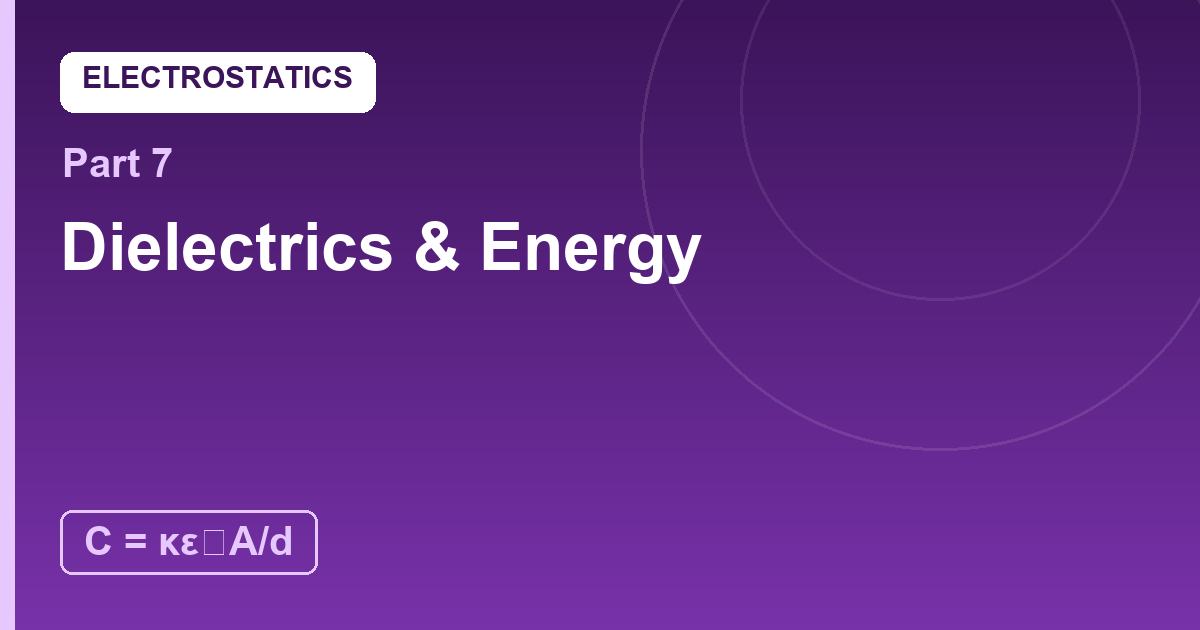
- A dielectric (insulator) in the gap MULTIPLIES capacitance: C = κε₀A/d
- κ (kappa) = the material’s multiplying factor: 1 for vacuum, ~7 for glass, thousands for special ceramics
- Polarisation: the dielectric’s molecules partially line up, weakening the internal field
- Battery connected: V fixed → Q and U grow by κ. Isolated: Q fixed → V falls, same stored energy… but density changes
- Energy density: u = ½ε₀E² — energy stored IN the field itself
Slide a sheet of glass between a capacitor’s plates and its storage leaps seven-fold — no moving parts, no extra plates. The trick is the dielectric: an insulator whose molecules lean into the field and make room for more charge. Part 7 of the Electrostatics series.
- What a dielectric does
- What each letter means
- Polarisation, seen simply
- Connected vs isolated (again the master question)
- Energy lives in the field
- Solved examples
- Common mistakes
- This physics in your daily life
- Practice set
- Recap
What a Dielectric Does
Fill a capacitor’s gap with an insulating material and its capacitance multiplies by the material’s dielectric constant κ:
| Letter | What it means (plain words) | Value / unit |
|---|---|---|
| κ (kappa) | dielectric constant — the multiplication factor | no unit; always ≥ 1 |
| ε₀ | vacuum’s electrical constant | 8.85×10⁻¹² |
| u | energy DENSITY — energy per unit volume of field | J/m³ |
Polarisation, Seen Simply
Why does an insulator help? Its molecules aren’t free to move (that’s what makes it an insulator), but they can lean: each molecule’s electron cloud shifts slightly toward the + plate, its nuclei toward the −. The material’s faces develop thin layers of bound charge that partially cancel the plates’ field inside the gap. Weaker internal field → for the same plates, more charge fits per volt → bigger C. The molecules lean; the capacitor wins.
Connected vs Isolated (Again the Master Question)
| Situation | What’s locked | Inserting dielectric → |
|---|---|---|
| Battery CONNECTED | V fixed | C ×κ; Q = CV ×κ (more charge flows in); U = ½CV² ×κ (more stored) |
| Battery DISCONNECTED | Q fixed | C ×κ; V = Q/C ÷κ (voltage drops); U = Q²/2C ÷κ (energy falls — the slab was pulled IN) |
The energy story in the isolated case is lovely: stored energy drops because the charged plates pull the slab in — the field does positive work on the dielectric. (You’d have to hold it back.) Energy accounting always balances; find who moved.
Energy Lives in the Field
This is the deepest line of the chapter: energy isn’t ‘on the plates’ — it’s in the space between them, in the field. Add up ½ε₀E² over a volume and you get the total stored energy. The concept scales straight into electromagnetism (light carries energy exactly this way).
Solved Examples
Direct: C’ = κC = 7 × 2 = 14 μF.
Battery connected at 12 V: Q = C’V = 168 μC — seven times the charge flows in. ✔
Answer: C’ = 14 μF
Q locked: V’ = V/κ = 100/5 = 20 V.
Energy: U’ = U/5 — the drop powered the slab being sucked in. Same device, opposite energy direction vs the connected case — the table decides which. ✔
Answer: V’ = 20 V
u = ½ε₀E² = ½ × 8.85×10⁻¹² × 9×10¹² ≈ 40 J/m³.
Feel it: a cubic metre of maximum-strength air field holds about the energy of a phone battery — why capacitors store less total energy than batteries but deliver it vastly faster. ✔
Answer: u ≈ 40 J/m³
- Applying the connected-case outcome to an isolated capacitor (or vice versa). First question always: is Q or V locked? The two rows of the table give OPPOSITE energy changes.
- Believing the dielectric increases the field. It WEAKENS the internal field (bound charge cancels part of it) — that’s why capacitance rises.
- κ applied twice. C = κε₀A/d — κ multiplies once. Don’t also square E or halve d by hand.
- Energy density with E in kV/cm. SI only: volts per metre before squaring.
This Physics in Your Daily Life
- Every practical capacitor has a dielectric — ceramic discs, polyester film, tantalum beads: the κ-multiplied formula printed on the component.
- Touchscreens sense your finger because flesh (mostly water, κ ≈ 80!) changes the local capacitance enormously — your hand is an excellent dielectric.
- Microwave ovens exploit water’s huge κ — the field flips water molecules back and forth 2.45 billion times a second; that leaning motion IS the heating.
- Defibrillator paddles’ gel is a dielectric matched to skin — better field coupling into the chest, less surface burn.
- Supercapacitors (bus regenerative braking, some EVs) push dielectric ideas to the extreme — millions of farads of ½CV², charged in seconds where batteries take an hour.
Practice set (answers hidden — try first)
(NEET-level) Air capacitor 3 μF; κ = 6 slab inserted. C’:
(JEE Main-level) Isolated capacitor, slab κ = 4 inserted. V changes from 40 V to:
(NEET-level) Battery connected, κ = 5 inserted. Stored energy:
(Concept) Why does capacitance rise with a dielectric?
(JEE Main-level) Doubling E multiplies energy density by:
- C = κε₀A/d
- u = ½ε₀E²
- 🔣 dielectric multiplies C: C = κε₀A/d
- 🔣 κ: vacuum 1, glass ~7, water ~80, ceramics thousands
- 🔣 polarisation: molecules lean, internal field weakens, more charge fits
- 🔣 connected: V fixed (Q, U rise ×κ); isolated: Q fixed (V, U fall ÷κ)
- 🔣 energy density u = ½ε₀E² — energy lives in the field
- 🔁 C = κε₀A/d; κ ≥ 1 always
- 🔁 connected → Q,U rise; isolated → V,U fall
- 🔁 u = ½ε₀E² (SI: V/m, J/m³)
- 🧠 Chant: ‘the slab multiplies the store’.
- 🧠 Master question: ‘connected locks V; isolated locks Q’.
- 🏠 Daily: your finger is water — κ ≈ 80 — that’s why touchscreens work.
- 🏠 Daily: microwave heating IS dielectric leaning, 2.45 billion flips a second.
Quick revision
- A dielectric (insulator) in the gap MULTIPLIES capacitance: C = κε₀A/d
- κ (kappa) = the material’s multiplying factor: 1 for vacuum, ~7 for glass, thousands for special ceramics
- Polarisation: the dielectric’s molecules partially line up, weakening the internal field
- Battery connected: V fixed → Q and U grow by κ. Isolated: Q fixed → V falls, same stored energy… but density changes
- Energy density: u = ½ε₀E² — energy stored IN the field itself
- Polarisation, seen simply
Have a doubt on this topic?