JEE/NEET Physics · Oscillations & Waves series · Part 3 of 8 · All parts →
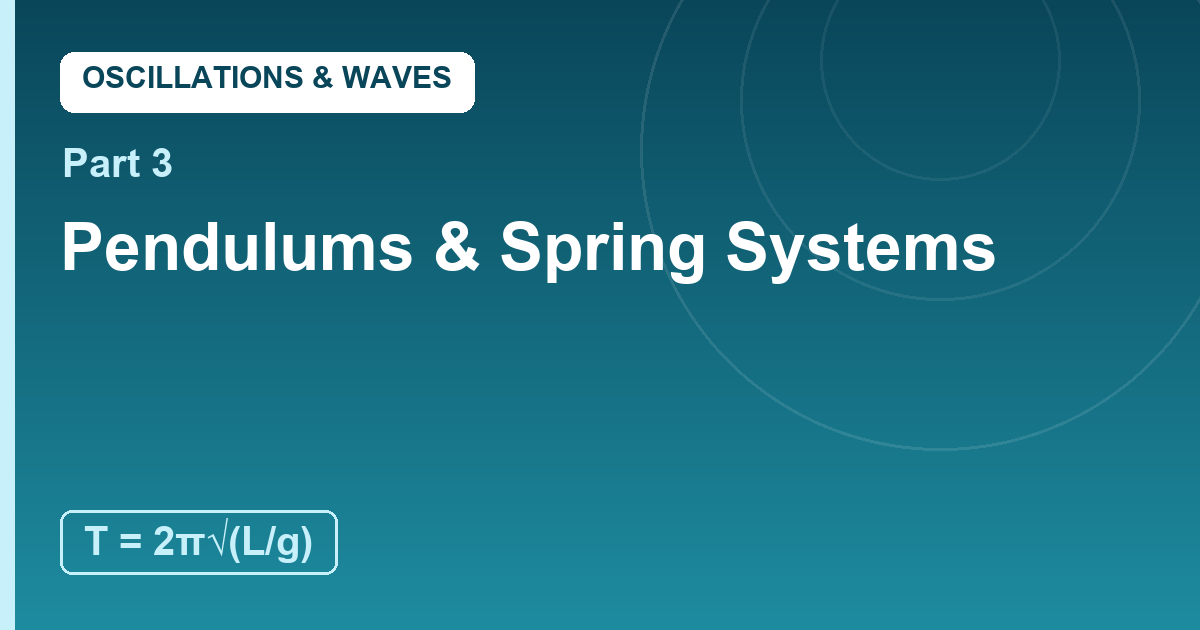
- Simple pendulum: T = 2π√(L/g) — length and gravity decide; mass NEVER
- Spring-mass: T = 2π√(m/k) — mass and stiffness decide; length NEVER
- Moon pendulums run slow (g smaller); spring clocks don’t care
- Springs in series get softer (k/2); in parallel, stiffer (2k)
- Length ×4 → period ×2 (the square root at work)
A pendulum clock carried to the Moon runs slow; a spring clock doesn’t notice. A grandfather pendulum lengthens in summer heat and loses time. All from two formulas — the two great clocks of physics. Part 3 of the Oscillations & Waves series.
- The pendulum clock
- The spring clock
- What each letter means
- Series and parallel springs
- The second pendulum: 1 metre, 2 seconds
- Solved examples
- Common mistakes
- This physics in your daily life
- Practice set
- Recap
The Pendulum Clock
Why is mass absent? A heavier bob feels more gravitational pull AND has more inertia — the two cancel exactly (a recurring hero of this series). So: longer pendulum = slower clock; stronger gravity = faster clock. On the Moon (g/6), the pendulum slows by √6 ≈ 2.45×.
The Spring Clock
That’s the deep difference: spring clocks ignore gravity entirely — they’d keep perfect time on the Moon or in free fall, where pendulums stop dead. (ISS astronauts use spring-based timekeeping, not pendulums.)
What Each Letter Means
| Letter | What it means (plain words) | Value / unit |
|---|---|---|
| L | pendulum length — pivot to bob CENTRE | m |
| g | local gravity strength | 9.8 m/s² on Earth, 1.7 on the Moon |
| m | oscillating mass (spring clock) | kg |
| k | spring stiffness | N/m — series: k/2 for two equal; parallel: 2k |
Series and Parallel Springs
| Arrangement | Effective stiffness | Why |
|---|---|---|
| Two equal springs end-to-end (series) | k/2 — softer | each stretches only half as much per force |
| Two equal springs side-by-side (parallel) | 2k — stiffer | they share the load, doubling the push |
Then plug the effective k into T = 2π√(m/k): parallel springs (2k) tick √2 faster; series springs (k/2) tick √2 slower. Square roots everywhere — halves and doubles of k never halve or double T.
The Second Pendulum: 1 Metre, 2 Seconds
A neat coincidence you can check: set L ≈ 1 m and T = 2π√(1/9.8) ≈ 2.0 s. Each one-way swing takes 1 second — this is literally how the metre was once defined, and how grandfather clocks were sized.
Solved Examples
T ∝ 1/√g: T_moon = 2 × √6 ≈ 4.9 s — the clock runs brutally slow.
Same clock as a spring version: unchanged — gravity isn’t in its formula. ✔
Answer: T ≈ 4.9 s (spring clock: unchanged)
T ∝ √L: ΔT/T = ½ × 0.1% = 0.05% longer per swing.
Per day: 86,400 s × 0.05% ≈ 43 s lost.
Grandfather clock owners really live this — hence the length-adjustment nut under the bob. ✔
Answer: ≈ 43 seconds lost per day
Parallel: k_eff = 200 → T = 2π√(1/200) ≈ 0.44 s.
Series: k_eff = 50 → T = 2π√(1/50) ≈ 0.89 s — exactly double.
Check with the ratio rule: stiffness ratio 4 → period ratio √4 = 2 ✔
Answer: series period = 2 × parallel period
- Puting mass in the pendulum formula (or gravity in the spring one). Pendulum: mass absent. Spring: gravity absent. Mixing them is the #1 error of the chapter.
- Expecting T to double when L doubles. The square root says ×√2 ≈ 1.41. Length ×4 → T ×2.
- Series/parallel springs mixed up. Series = softer (k/2); parallel = stiffer (2k) — opposite of batteries-in-series intuition from electricity.
- Measuring L to the bob’s top. L runs pivot → centre of the bob, not to where the string ends.
This Physics in Your Daily Life
- Grandfather clocks have a rating nut under the bob — seasonal timekeeping IS pendulum-length tuning, by hand.
- The metre’s origin: the ‘seconds pendulum’ (L ≈ 0.994 m) was an early definition of the metre — this card is metrology history.
- Metronomes are adjustable pendulums: slide the mass up (longer effective L) = slower tempo — T = 2π√(L/g) in musician’s clothing.
- Seismometers use spring-mass oscillators to feel earthquakes; their T = 2π√(m/k) sets which shakes they detect best.
- Diving boards and trampolines are spring clocks with human masses: heavier jumper = slower bounce (√m), stiffer board = faster (√k) — feel it at the pool.
Practice set (answers hidden — try first)
(NEET-level) Pendulum length quadrupled. Period:
(JEE Main-level) A 4 kg mass on k = 400 N/m. T:
(Concept) On the Moon, which clock keeps Earth-time?
(JEE Main-level) Two identical springs in parallel vs series (same mass). Period ratio:
(NEET-level) A heavier bob on the same pendulum. Period:
- 🧠 Chant: ‘pendulum — length and gravity; spring — mass and stiffness; nothing else’.
- 🧠 Springs: ‘series soft, parallel stiff’ (opposite of batteries).
- 🧠 Second pendulum: ‘one metre, two seconds’.
- 🏠 Daily: metronome slides and grandfather-clock nuts are this card, hand-operated.
- 🏠 Daily: heavier kid = slower trampoline bounce — √m, at the playground.
- 🔁 pendulum T = 2π√(L/g): no mass
- 🔁 spring T = 2π√(m/k): no gravity
- 🔁 k_eff: series k/2, parallel 2k (equal springs)
- pendulum: T = 2π√(L/g) — mass never matters
- spring: T = 2π√(m/k) — gravity never matters
- series springs k/2 (softer); parallel 2k (stiffer)
- square roots: L×4 → T×2; k×4 → T×2
- Moon: pendulum ×√6 slower; spring clock unchanged
Quick revision
- Simple pendulum: T = 2π√(L/g) — length and gravity decide; mass NEVER
- Spring-mass: T = 2π√(m/k) — mass and stiffness decide; length NEVER
- Moon pendulums run slow (g smaller); spring clocks don’t care
- Springs in series get softer (k/2); in parallel, stiffer (2k)
- Length ×4 → period ×2 (the square root at work)
- Series and parallel springs
Have a doubt on this topic?