In one line: JEE/NEET Physics · Work, Energy & Power series · Part 1 of 8 · All parts →✪ Key points — the 30-second versionWork = force × distance moved ALONG the.
JEE/NEET Physics · Work, Energy & Power series · Part 1 of 8 · All parts →
- Work = force × distance moved ALONG the force’s direction
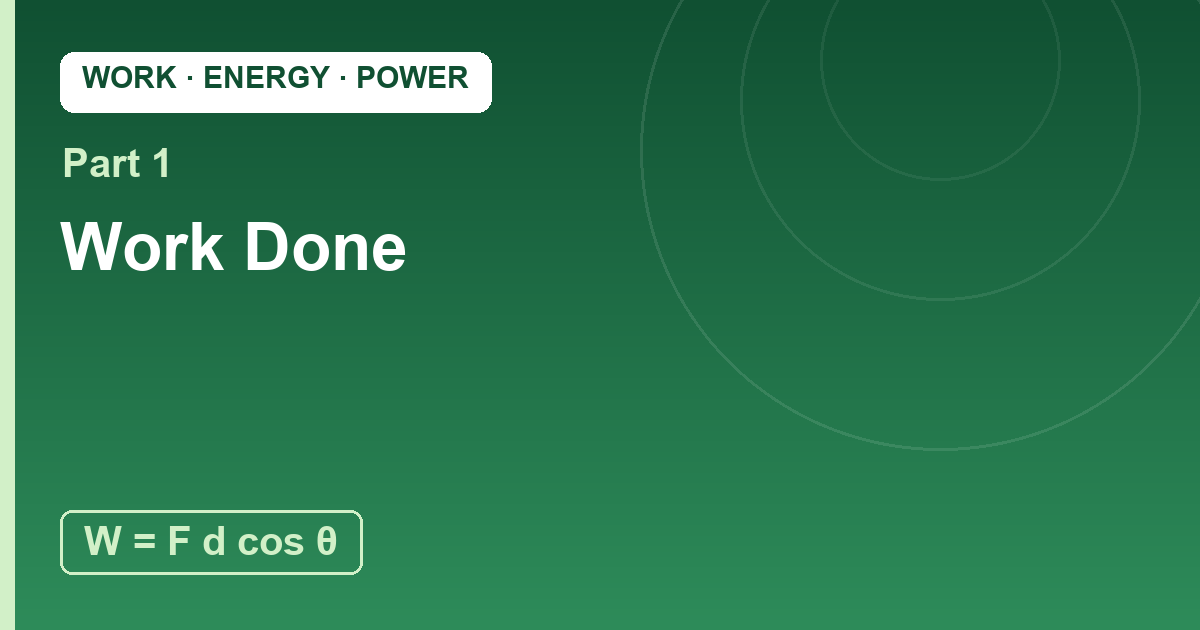
- Push at an angle? Only the part of the force along the motion counts: W = Fd·cosθ
- Carry a bag while walking on flat ground: work by you on the bag = ZERO (surprise!)
- Work can be negative — when the force fights the motion (friction)
- Unit: joule (J) = one newton pushing through one metre
Push a wall all day — exhausting, but physics says you did ZERO work. Push a trolley the same effort — physics says you did real work. The difference? In physics, ‘work’ isn’t sweat — it’s force achieving movement along its own direction. Part 1 of the Work, Energy & Power series — the card that powers the whole chapter.
- The simple idea: force × movement
- What each letter means
- The angle rule: only the matching part counts
- The zero-work surprises
- Positive and negative work
- Solved examples
- Common mistakes
- This physics in your daily life
- Practice set
- Recap
The Simple Idea: Force × Movement
Work measures transfer of energy by a force. The formula is almost embarrassingly simple — how hard you push × how far the thing moves in the direction you push. One newton of push through one metre = one joule of work. But the strictness hides two traps, and both surprise everyone.
What Each Letter Means
| Letter | What it means (plain words) | Value / unit |
|---|---|---|
| W | work done — energy transferred by the force | joules (J) |
| F | the force applied | newtons (N) |
| d | distance the object MOVES (not how hard you tried!) | metres |
| angle | between the force’s direction and the motion’s direction | 0° = full work; 90° = zero; 180° = negative |
The Angle Rule: Only the Matching Part Counts
Pull a trolley with a slanted rope: only the forward part of your pull moves the trolley forward. The upward part just lightens it (no forward movement from that). cos(angle) keeps exactly the matching part: at 0° (pulling straight along) cos = 1, full work; at 60°, half your force counts; at 90°, cos = 0, nothing counts.
The Zero-Work Surprises
Surprise 1 — pushing a wall: huge force, zero movement → d = 0 → work = 0. Your muscles burn stored energy (that’s biology), but no work is done ON the wall.
Surprise 2 — carrying a bag on flat ground: your upward hold-force is perpendicular to your forward walking → angle = 90° → cos = 0 → work by the holding force = zero. The bag moves horizontally; your force points up; they don’t match.
Surprise 3 — an orbiting satellite: gravity pulls toward Earth; motion is along the orbit. For a circular orbit they’re exactly perpendicular — gravity does zero work on a circular orbit. That’s why the ISS never slows down.
Positive and Negative Work
Force along motion (0°): positive work — energy given. Force against motion (180°, like friction on a sliding box): negative work — energy taken away. The sign is bookkeeping of energy flow, and it decides entire questions.
Solved Examples
Angle 0°, cos = 1: W = 50 × 4 = 200 J.
Feel it: 200 J ≈ the energy of a phone charger for a second — modest, sensible. ✔
Answer: 200 J
Only the forward part counts: forward force = 50 × cos60° = 25 N.
W = 25 × 4 = 100 J — exactly half. The other 25 N (upward part) did zero work. ✔
Answer: 100 J
Friction fights the motion → 180° → negative work.
Size: friction = 0.3 × 200 = 60 N. W = −60 × 5 = −300 J.
Meaning: the box handed 300 J to the floor as heat — the energy bookkeeping balances. ✔
Answer: −300 J (energy removed)
- Confusing effort with work. Pushing a wall: effort yes, work no — the wall doesn’t move. Physics asks what moved, not how tired you are.
- Forgetting the angle. The force’s full size goes into the formula only if it points along the motion. Otherwise multiply by cos(angle).
- Carrying a bag = work? On flat ground, no — hold-force is perpendicular to walking. (On stairs, yes: your force gains a lifting component.)
- Dropping minus signs. Friction on a moving box does NEGATIVE work; writing it positive breaks every later energy equation.
This Physics in Your Daily Life
- Your electricity bill is in kilowatt-HOURS — 3.6 million joules each: the power company bills you for work done by your appliances.
- Gym reality check: holding a plank does (almost) zero physics work — the burn is biology’s cost of muscle tension, not work on a load. Moving the weight is where physics work happens.
- A satellite never needs fuel to keep orbiting because gravity’s work on a circular orbit is zero — the ISS falls around Earth for free, forever.
- Cycling on flat ground is cheap; hills are expensive — on the flat your push mostly fights air; on a climb you do real lifting work (mgh every metre up, Part 3).
- Regenerative braking in EVs reverses friction’s role: the motor does negative work on the wheels and hands the energy to the battery instead of the brakes.
Practice set (answers hidden — try first)
(NEET-level) A 100 N box is lifted 2 m straight up. Work by the lifting force:
(NEET-level) A porter carries a 20 kg load 50 m on flat ground. Work by the holding force:
(JEE Main-level) A 40 N force at 60° drags a body 10 m horizontally:
(Concept) Work done by Earth’s gravity on the ISS in one circular lap:
(NEET-level) Friction of 25 N acts on a box sliding 8 m. Work by friction:
- 🧠 Chant: ‘no movement, no work — no match, no work’.
- 🧠 90° = zero: perpendicular forces never do work — carry a bag, hold a wall, circular orbit.
- 🏠 Daily: your electricity bill literally counts joules — 1 unit = 3.6 MJ of work by your appliances.
- 🏠 Daily: EV regenerative braking flips friction’s negative work into battery charge.
- 🔁 W = Fd·cosθ; joules; positive/negative by direction
- 🔁 perpendicular force → zero work, always
- 🔁 friction on a moving body does negative work
- W = Fd·cos(angle) — force × distance × matching fraction
- 0°: full work · 90°: zero · 180°: negative
- zero-work surprises: pushing a wall, carrying a bag on flat ground, circular orbits
- negative work = energy taken away (friction on a sliding box)
- joule = newton through one metre
Quick revision
- Work = force × distance moved ALONG the force’s direction
- Push at an angle? Only the part of the force along the motion counts: W = Fd·cosθ
- Carry a bag while walking on flat ground: work by you on the bag = ZERO (surprise!)
- Work can be negative — when the force fights the motion (friction)
- Unit: joule (J) = one newton pushing through one metre
- The simple idea: force × movement
- 1Work Done: When a Force Actually Achieves Something
- 2Kinetic Energy and the Work-Energy Theorem: The Great Shortcut
- 3Potential Energy: Stored Work, Ready to Strike
- 4Conservation of Energy: The Universe’s Perfect Bookkeeping
- 5Power and Efficiency: How FAST You Can Do the Work
- 6Collisions: The Great Sorting — What Survives, What Dies
- 7Springs and Vertical Circles: Energy in Two Classic Stages
- 8The Finale: Energy in the Real World, and the Complete Formula Card
Have a doubt on this topic?