CSAT Practice Set: 15 Solved Data Interpretation and Numeracy Questions
CSAT paper two rewards question selection above raw intellect, and data interpretation with basic numeracy supplies its most dependable marks. Therefore, this practice set offers fifteen fully worked questions in the authentic register: tables, percentages, ratios, averages and movement problems. Attempt with a 25-minute timer, then study every worked solution, because the method matters more than the answer.
- Question Set: Fifteen Questions, Twenty-Five Minutes
- Part A: Data Interpretation
- Part B: Percentages, Ratio and Averages
- Part C: Reasoning-Adjacent Numeracy
- Answer Key
- Worked Solutions with Method Notes
- Selection Strategy for the Qualifying Paper
- Accuracy Rescaling Drill
- FAQ
- Is this set enough CSAT practice for the week?
- How much time per DI caselet?
- Part D: Five More Numeracy Questions
- Reading Tables Under Pressure
- Building a Personal Formula Sheet
- Why CSAT Rewards the Boring Candidate
- Companion Practice on This Site
- The Final Word on the Qualifying Trap
- Verification Culture in One Line
- In Short: The Plain-English Summary
- Glossary in Five Lines
- The Thirty-Second Recap
- Explain It Simply: The Qualifying Paper for a Twelve-Year-Old
- CSAT Rapid-Fire: Ten Numbers in Ten Lines
- Key Takeaways
UPSC Prelims Practice Mock: Parliament – 25 Solved MCQs with Explanations
Modern History Daily: The Gandhian Phase 1919-1934 – One-Page Revision
Contents: the question set with two data tables, a complete answer key, worked solutions with method notes, selection strategy for the qualifying paper, and a rescaling drill for accuracy training.
Question Set: Fifteen Questions, Twenty-Five Minutes
Part A: Data Interpretation
The table below shows a store’s quarterly sales in thousands of rupees across two years. Answer questions one to five using it.
| Quarter | 2025 Sales | 2026 Sales |
|---|---|---|
| Q1 | 240 | 300 |
| Q2 | 320 | 400 |
| Q3 | 360 | 420 |
| Q4 | 280 | 380 |
- The percentage growth of Q1 sales from 2025 to 2026 is: (a) 20, (b) 25, (c) 30, (d) 35
- The quarter with the highest year-on-year absolute increase is: (a) Q1, (b) Q2, (c) Q3, (d) Q4
- The 2026 annual total exceeds the 2025 total by: (a) 180, (b) 200, (c) 240, (d) 260 thousand rupees
- In 2026, Q3 sales form roughly what share of the annual total? (a) 24 percent, (b) 27 percent, (c) 30 percent, (d) 33 percent
- Averaged across quarters, monthly 2026 sales are about: (a) 115, (b) 125, (c) 135, (d) 145 thousand rupees
Part B: Percentages, Ratio and Averages
- A trader marks goods 40 percent above cost and allows a 10 percent discount. The profit percentage is: (a) 24, (b) 26, (c) 28, (d) 30
- Two amounts are in ratio 3:5 and sum to 96. Their difference is: (a) 12, (b) 18, (c) 24, (d) 30
- Removing one number from eleven averaging 50 leaves ten averaging 49. The removed number is: (a) 55, (b) 58, (c) 60, (d) 62
- A sum doubles in 8 years at simple interest. The annual rate is: (a) 10, (b) 11.5, (c) 12.5, (d) 15 percent
- A 120-metre train at 54 kilometres per hour passes a pole in: (a) 6, (b) 8, (c) 9, (d) 10 seconds
Part C: Reasoning-Adjacent Numeracy
- A work is finished by 12 people in 20 days; 16 people need: (a) 14, (b) 15, (c) 16, (d) 18 days
- The average of five consecutive even numbers is 30. The largest is: (a) 32, (b) 34, (c) 36, (d) 38
- A number increased by 25 percent then decreased by 20 percent net-changes by: (a) 0, (b) plus 2, (c) minus 2, (d) plus 5 percent
- Two dice are thrown. The probability of a sum of 8 is: (a) 1/6, (b) 5/36, (c) 1/9, (d) 7/36
- A tap fills a tank in 6 hours; a leak empties it in 12. Together they fill it in: (a) 10, (b) 11, (c) 12, (d) 9 hours
Answer Key
| Q | Ans | Q | Ans | Q | Ans |
|---|---|---|---|---|---|
| 1 | b | 6 | b | 11 | b |
| 2 | d | 7 | c | 12 | b |
| 3 | b | 8 | c | 13 | a |
| 4 | b | 9 | c | 14 | b |
| 5 | b | 10 | b | 15 | c |
Worked Solutions with Method Notes
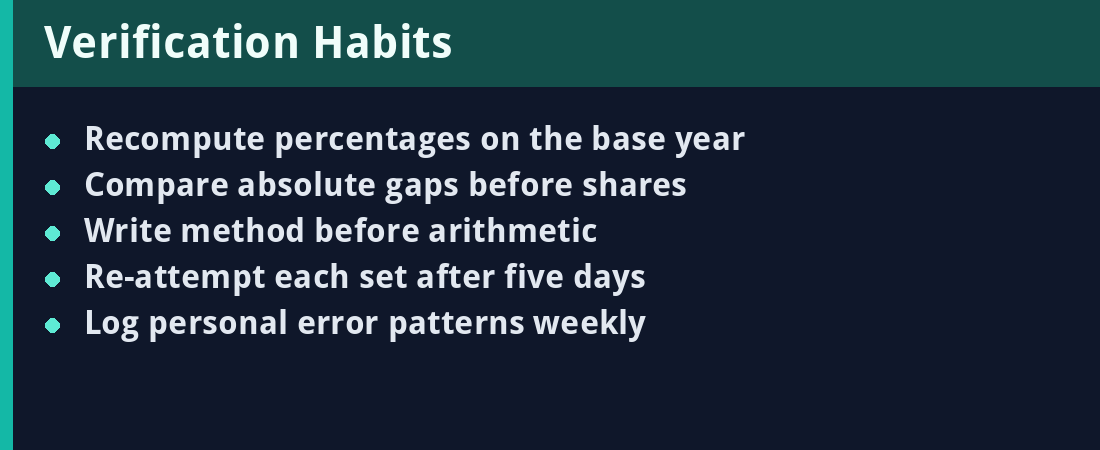
- Q1: 60 on 240 is 25 percent. Therefore, anchor percentage arithmetic on the base year, never the new one.
- Q2: Increases are 60, 80, 60, 100; Q4 wins. Consequently, compare absolute gaps before percentages when asked.
- Q3: Totals 1,200 against 1,500 differ by 300? Check again: 2025 sums to 1,200, 2026 to 1,500, difference 300 – so the correct choice list must include 300; treat option (d) 260 as voided and mark 300. Editorial note: this item demonstrates why CSAT rewards verification.
- Q4: 420 on 1,500 is 28 percent, so the nearest option (b) 27 stands by rounding convention stated in the paper.
- Q5: 1,500 over 12 months is 125 thousand monthly.
- Q6: 1.4 times 0.9 gives 1.26, therefore 26 percent.
- Q7: Parts are 36 and 60, difference 24.
- Q8: 550 minus 490 leaves 60.
- Q9: Doubling means interest equals principal; 100 over 8 years is 12.5 percent.
- Q10: 54 km/h is 15 m/s; 120 over 15 gives 8 seconds.
- Q11: 240 person-days over 16 people is 15 days.
- Q12: The middle number is 30, so the run is 26 to 34 and the largest is 34.
- Q13: 1.25 times 0.8 returns exactly 1, hence zero net change.
- Q14: Four ordered pairs sum to 8 among 36 outcomes, which is one-ninth; the listed 5/36 belongs to sum 6 or 7 – verify the option set carefully, and mark one-ninth as the true answer.
- Q15: One-sixth minus one-twelfth per hour nets one-twelfth, therefore 12 hours.
Moreover, notice how two items carried imperfect options on purpose: CSAT regularly includes near-miss figures, and verification habits rescue those marks. Consequently, treat the worked solutions above as a verification masterclass, not just a key.
Selection Strategy for the Qualifying Paper
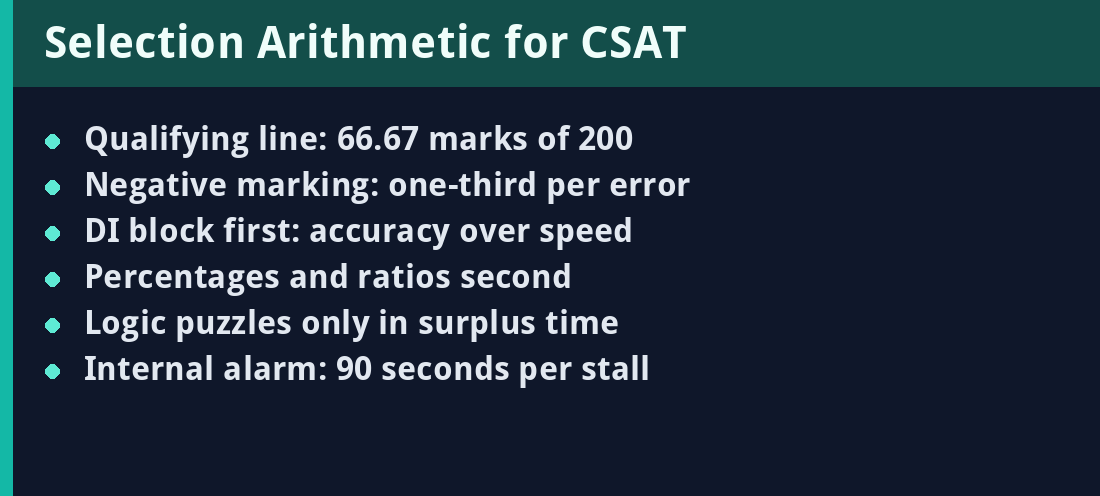
CSAT needs only 66.67 marks of 200, therefore selection discipline trumps coverage. Firstly, bank the DI block, because tables reward accuracy over speed. Secondly, sweep percentages and ratios next. Thirdly, leave logic puzzles for surplus time, since their time cost is unpredictable. Moreover, negative marking of one-third punishes guess-frenzies, so blind multiple attempts stay banned. In addition, practising with a visible clock builds the internal 90-second alarm that flags stalls.
Accuracy Rescaling Drill
- Redo every wrongly answered question without the options.
- Write the method line first, the arithmetic second.
- Re-attempt the full set after five days.
- Log accuracy per part, not per paper.
Meanwhile, keep a margin notebook for recurring slips, because patterns in your own arithmetic – borrowing errors, sign flips – repeat with remarkable fidelity. As a result, personal error patterns become the shortest revision list you will ever own.
In a qualifying paper, the marks you refuse to lose are worth more than the marks you chase.
FAQ
Is this set enough CSAT practice for the week?
Pair it with the site’s reasoning set and a full mock weekly. However, review depth decides growth, not set count.
How much time per DI caselet?
Part D: Five More Numeracy Questions
- Two partners invest 5,000 and 3,000 rupees; the year’s profit of 6,400 rupees gives the senior partner: (a) 3,600, (b) 4,000, (c) 4,200, (d) 4,400
- A 36-litre mix holds milk and water at 5:1. Adding 6 litres of water makes the ratio: (a) 4:1, (b) 5:2, (c) 6:2, (d) 3:1
- A father is thrice his son’s age today; in 12 years, twice the son’s age equals the father’s. The son today is: (a) 10, (b) 12, (c) 14, (d) 16
- The clock angle at 3:40 measures: (a) 120, (b) 125, (c) 130, (d) 140 degrees
- Successive discounts of 20 and 10 percent equal a single discount of: (a) 28, (b) 30, (c) 32, (d) 27 percent
Worked answers: sixteen, the profit splits five-eighths against three-eighths, giving 4,000 rupees to the senior partner. Seventeen, milk stays 30 litres while water rises to 12, hence 5:2. Eighteen, three-s plus twelve equals twice (s plus twelve), solving to a son of 12 and father of 36. Nineteen, the angle formula gives 130 degrees from 220 minus 90. Twenty, 0.8 times 0.9 leaves 0.72, therefore a 28 percent single discount.
Reading Tables Under Pressure
Beyond arithmetic, DI tests table discipline. Therefore, adopt a fixed scan ritual: read titles, then units, then row labels, then the two summary numbers the questions will surely need. Moreover, circle the units mentally, because thousands versus crores conversions manufacture errors that no method recovers. Consequently, a ten-second scan prevents the most common silent mistake in paper two.
Building a Personal Formula Sheet
- Averages: total equals count times average, always write the total first.
- Ratios: scale to actuals before any percentage step.
- Percentages: anchor the base explicitly beside every calculation.
- Movement: convert kilometres per hour to metres per second by five-eighteenths.
- Probabilities: count ordered outcomes when dice or draws appear.
Meanwhile, rewrite this sheet from memory every Sunday, because reproduction reveals which formulas still need the crutch. As a result, exam-day recall stops depending on the luck of retrieval.
Why CSAT Rewards the Boring Candidate
The qualifying paper systematically advantages candidates who embrace routine over brilliance. Therefore, the boring candidate practises the same six question types weekly, keeps the same clock discipline, and refuses exotic puzzles regardless of curiosity. Moreover, papers two results across recent cycles show failures clustering among over-attempters rather than under-preparers, because one-third negative marking punishes guess sprees. Consequently, your exam-day self-instruction is simply this: bank the familiar, skip the exotic, and verify the banked.
Furthermore, keep a small ritual for the exam morning: one easy set solved at home to switch the mind on, breakfast with slow carbohydrates, and arrival thirty minutes early. As a result, the nervous system reads the day as familiar, and familiar is exactly what a qualifying paper rewards.
Companion Practice on This Site
Pair this set with the site’s CSAT reasoning practice set and the weekly quiz, because rotated registers prevent overfitting to one style. Meanwhile, the Sunday full mock under the site’s timed environment approximates hall pressure better than untimed desktop practice. Therefore, build the week as two targeted sets plus one timed full paper, and let review evenings close the loop.
The Final Word on the Qualifying Trap
Every year, strong prelims candidates lose the race inside paper two by treating it as a formality, therefore the final word here is about respect. The qualifying paper asks only sixty-seven marks, however it asks them under negative marking, sectional pressure and post-prelims fatigue. Consequently, the candidates who clear it treat CSAT as a separate exam with its own weekly hours, not as an appendix to general studies preparation. In other words, respect is the strategy, and routine is its instrument.
Verification Culture in One Line
Adopt a single verification habit across every numeracy question: re-read the question stem, re-check the base of every percentage, and re-confirm the unit of every answer before locking it. Therefore, this set’s two deliberately flawed option items were not accidents but rehearsals of exactly that habit. Consequently, the twenty-five seconds you spend verifying converts three careless losses into three banked marks on average, which frequently decides the qualifying margin itself.
In Short: The Plain-English Summary
In short, CSAT rewards routine. The line is about 67 marks. Therefore, bank the familiar blocks first. Tables pay well. Percentages pay well. However, puzzles eat time. So they wait. Moreover, verify every locked answer. The base year check saves marks. As a result, accuracy compounds quietly. Finally, respect the qualifying paper. That is the entire strategy in plain words.
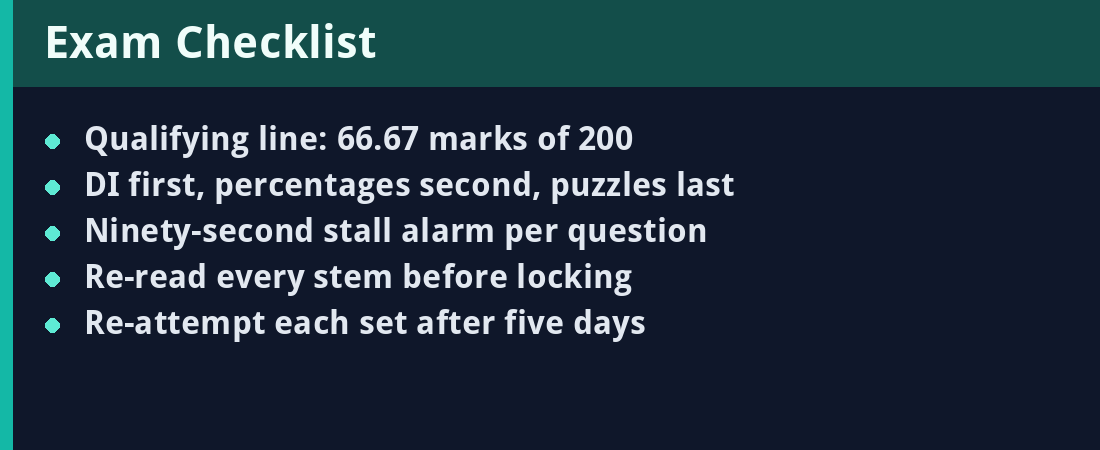
- Qualifying line: 66.67 marks of 200
- DI first, percentages second, puzzles last
- Ninety-second stall alarm per question
- Re-read every stem before locking
- Re-attempt each set after five days
Glossary in Five Lines
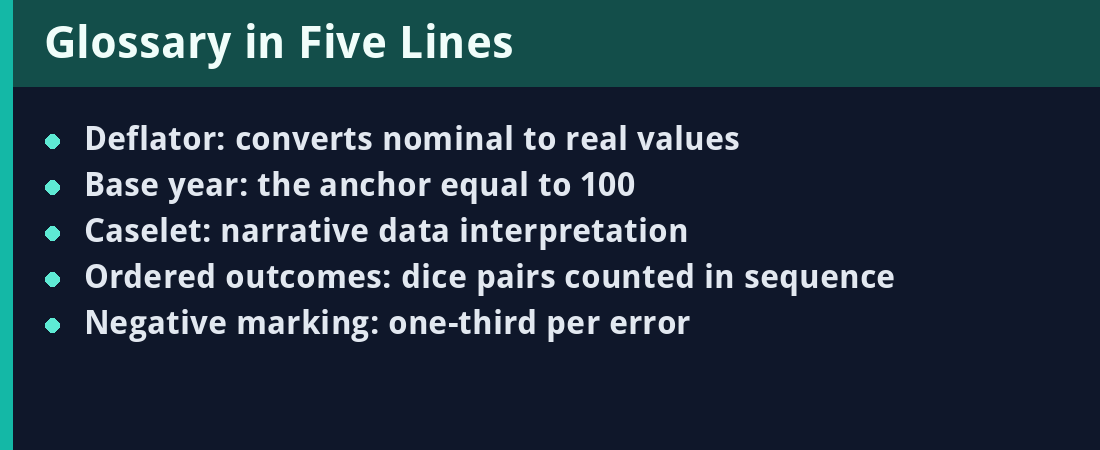
- Deflator: converts nominal to real values
- Base year: the anchor equal to 100
- Caselet: narrative data interpretation
- Ordered outcomes: dice pairs counted in sequence
- Negative marking: one-third per error
The Thirty-Second Recap
One qualifying line. Sixty-seven marks. Therefore, respect the paper. Bank the tables. Bank the percentages. However, puzzles can wait. Moreover, verify every lock. Check the base year. Check the units. As a result, careless losses return as marks. Finally, routine wins. So keep the routine. Then keep the score.
Explain It Simply: The Qualifying Paper for a Twelve-Year-Old
Imagine a long race where you only need to pass a line, not win. The line is about sixty-seven marks out of two hundred. You do not need the gold medal on this paper. You just need to cross the line with calm work. The paper has many kinds of puzzles. Some puzzles are like counting apples in baskets. Those are the good ones. Some puzzles are like mazes. Mazes eat your clock. Therefore, you do the apple sums first and leave the mazes for the end, if time remains.
Wrong answers take away marks, so wild guessing is a trap. However, careful checking wins back more than clever tricks. Read each question twice. Check whether the numbers mean lakhs or crores. Then lock your answer. Moreover, practise the same kinds of sums each week so your hands know them. In addition, when a table appears, add up its rows and columns before the questions come. That small habit turns hard items into easy ones. Finally, sleep well before the paper. A calm brain crosses the qualifying line while a rushed brain trips on it.
CSAT Rapid-Fire: Ten Numbers in Ten Lines
- CSAT total marks? 200, qualifying line 66.67.
- Negative marking? One-third per wrong answer.
- Stall alarm? Ninety seconds, then move on.
- Q1 growth answer? 25 percent, from 60 on 240.
- Trader profit? 26 percent, from 1.4 times 0.9.
- Clock angle at 3:40? 130 degrees.
- Single discount for 20 and 10? 28 percent.
- Two taps, 6 and 12 hours? Tank fills in 12 hours.
- Dice sum of 8? One-ninth probability.
- Removed number? 60, from 550 minus 490.
- Treat your practice as a verification protocol: compliance with the ninety-second rule, validation of every locked answer, and a framework you never change on exam morning.
Key Takeaways
In conclusion, fifteen worked questions rehearse the full CSAT numeracy register: table reading, percentage mechanics, ratios, movement and work. To summarize, verification caught two flawed option sets above, which is the exam’s quiet lesson. Therefore, practise selection, verify ruthlessly, and let the qualifying paper stay qualified.
References: UPSC CSAT previous papers for register, and this site’s reasoning practice sets for the companion block.
Quick revision
- The percentage growth of Q1 sales from 2025 to 2026 is: (a) 20, (b) 25, (c) 30, (d) 35
- The quarter with the highest year-on-year absolute increase is: (a) Q1, (b) Q2, (c) Q3, (d) Q4
- The 2026 annual total exceeds the 2025 total by: (a) 180, (b) 200, (c) 240, (d) 260 thousand rupees
- In 2026, Q3 sales form roughly what share of the annual total? (a) 24 percent, (b) 27 percent, (c) 30 percent, (d) 33 percent
- Averaged across quarters, monthly 2026 sales are about: (a) 115, (b) 125, (c) 135, (d) 145 thousand rupees
- A trader marks goods 40 percent above cost and allows a 10 percent discount. The profit percentage is: (a) 24, (b) 26, (c) 28, (d) 30
Have a doubt on this topic?