

RBI Monetary Policy Tools Explained: Repo, SDF, MSF, OMO, CRR, SLR
Every rate decision you revise for exams flows from one toolkit: the RBI’s monetary policy instruments. This page assembles the full set – repo, reverse repo, the SDF, MSF, bank rate, OMOs and the CRR-SLR pair – with corridor arithmetic, transmission logic and the exam questions each instrument attracts. Therefore, read the table first, then the working notes, then the drill.
- The Policy Corridor in One Table
- Instrument Notes That Matter
- Repo and the SDF
- MSF, Bank Rate and OMOs
- CRR Against SLR: The Classic Pair
- The Transmission Chain Examiners Test
- Five-Question Drill
- FAQ
- Why did the SDF replace reverse repo?
- Do OMOs change the policy rate?
- The Thirty-Second Recap
- Explain It Simply: The RBI Toolkit for a Twelve-Year-Old
- Rapid-Fire: Ten Anchors in Ten Lines
- Abbreviations for the Toolkit
- Durable Against Frictional Liquidity
- The LAF in One Paragraph
- When the Corridor Widens or Narrows
- Mains Framing in Four Sentences
- Where to Watch the Toolkit Operate
- Following One Decision End to End
- One Last Picture to Carry
- Toolkit’s Last Word
- One Line of Compliance Vocabulary
- Key Takeaways
Contents: the policy corridor, instrument-by-instrument notes, CRR against SLR, transmission chain, a five-question drill and mains framing.
The Policy Corridor in One Table
| Instrument | Rate Now | Function |
|---|---|---|
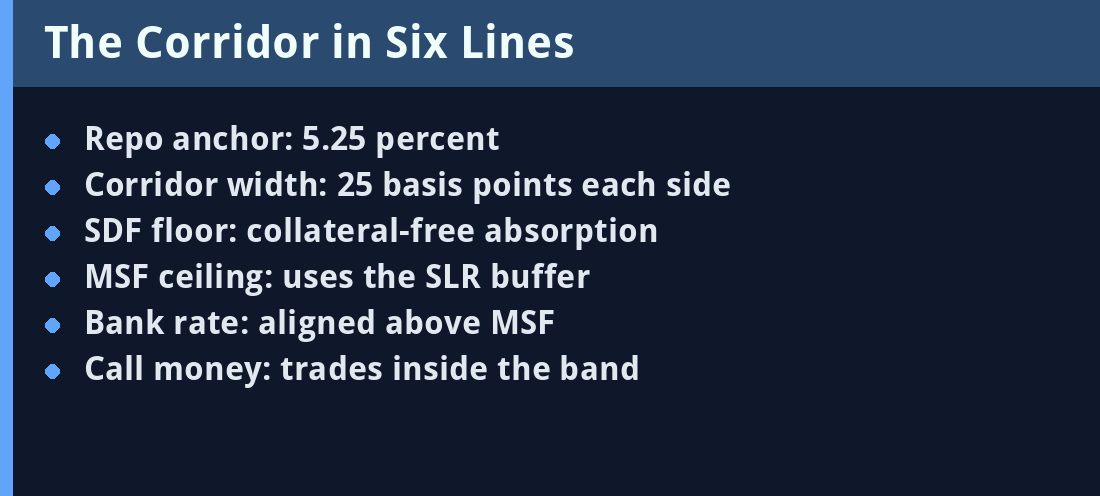
| SDF (standing deposit facility) | Corridor floor | Absorbs liquidity without collateral |
| Repo | 5.25 percent | Policy anchor, collateralised lending |
| MSF (marginal standing facility) | Corridor ceiling | Emergency overnight borrowing |
| Bank rate | Aligned above MSF | Penal refinance signal |
Moreover, the corridor is symmetric around the repo, typically twenty-five basis points on each side, therefore the SDF sits at 5.00 percent and the MSF at 5.50 percent in the current calibration. Consequently, call money trades inside the corridor, and that single sentence answers a recurring prelims question.
Instrument Notes That Matter
Repo and the SDF
- Repo: banks borrow overnight from the RBI against government securities.
- Reverse repo historically absorbed surplus funds, however the SDF replaced its role from April 2022.
- The SDF needs no collateral, therefore it absorbs liquidity even when securities run short.
- The policy repo anchors the framework under the RBI Act’s Section 45ZA.
MSF, Bank Rate and OMOs
- MSF: banks dip into the statutory liquidity ratio buffer under this penal window.
- Bank rate: aligned above the MSF, it prices refinance and signals stance.
- Open market operations: outright purchases or sales of government paper.
- OMOs manage durable liquidity, while repo windows manage overnight friction.
CRR Against SLR: The Classic Pair
| Feature | CRR | SLR |
|---|---|---|
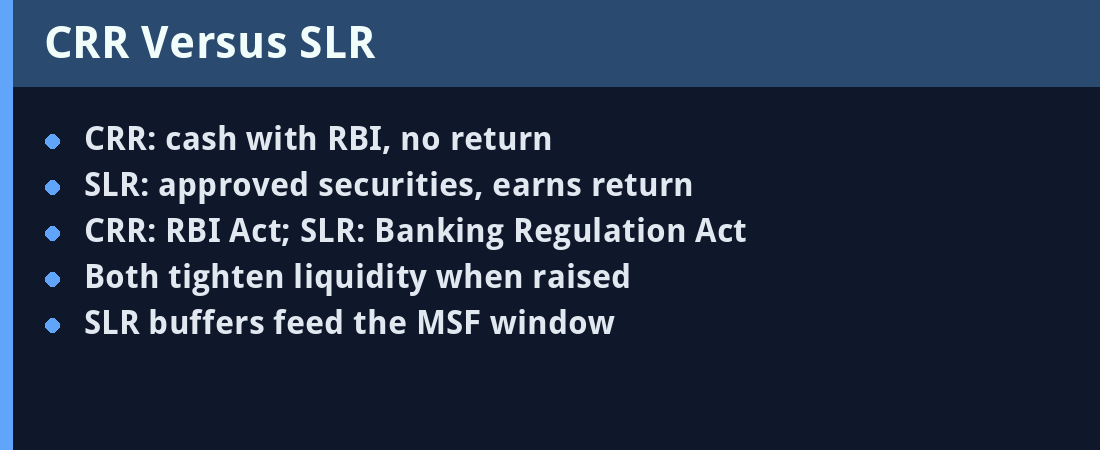
| Form | Cash with the RBI | Approved securities, cash, gold |
| Returns | None | Earns interest |
| Control | RBI, under the RBI Act | RBI, under the Banking Regulation Act |
| Primary aim | Liquidity control | Solvent, invested balance sheets |
However, both squeeze lendable resources when raised, therefore examiners frame hikes as tightening through either instrument. Meanwhile, remember that CRR carries no return while SLR holdings do, a distinction that decides at least one statement question every cycle.
The Transmission Chain Examiners Test
A repo cut lowers the policy anchor, consequently call money follows, lending rates linked to external benchmarks reprice quickly, and deposit rates trail with a lag. Moreover, transmission weakens when deposits stick, which is why the committee watches pass-through data. Therefore, mains answers score when they narrate this chain with a lag caveat, rather than asserting instant transmission.
The corridor is the RBI’s day-to-day lane; the CRR-SLR pair is its structural highway.
Five-Question Drill
- The current policy repo rate is: Answer: 5.25 percent, with a neutral stance.
- The collateral-free absorption facility is: Answer: the SDF, introduced April 2022.
- The corridor ceiling instrument is: Answer: the MSF.
- Which instrument earns no return for banks? Answer: the CRR.
- The inflation target band is: Answer: 2 to 6 percent around 4 percent.
FAQ
Why did the SDF replace reverse repo?
Absorption without collateral, therefore unconstrained by securities supply during surplus liquidity episodes.
Do OMOs change the policy rate?
The Thirty-Second Recap
One anchor. Two walls. Therefore, repo at the centre. SDF below. MSF above. Twenty-five points each side. Moreover, bank rate follows MSF. OMOs move quantities. CRR holds no return. SLR earns interest. However, both tighten when raised. Finally, transmission lags on deposits. Say the chain. Score the marks.
Explain It Simply: The RBI Toolkit for a Twelve-Year-Old
Imagine the central bank as the school’s money shop. It lends pocket money to banks at one price, the repo. It also accepts extra pocket money from banks, paying a small fee, through the SDF. If a bank is desperate at midnight, it pays a penalty price, the MSF. These three prices form a band, and everyone trades inside the band. Moreover, the school can also buy or sell bonds in the market, which adds or drains the total pocket money in the system. Finally, the school keeps two safety rules: banks must park some cash for free, the CRR, and some in safe papers, the SLR. That is the whole toolkit in one paragraph.
Rapid-Fire: Ten Anchors in Ten Lines
- Policy repo: 5.25 percent, neutral stance.
- Corridor: 25 basis points each side.
- SDF: floor, collateral-free, from April 2022.
- MSF: ceiling, uses the SLR buffer.
- Bank rate: aligned above the MSF.
- CRR: no return, RBI Act control.
- SLR: earns return, Banking Regulation Act.
- OMOs: durable liquidity, quantity tool.
- Target: 4 percent CPI, band 2-6.
- Committee: six members, Section 45ZA.
Abbreviations for the Toolkit
- RBI: the Reserve Bank of India.
- SDF: standing deposit facility.
- MSF: marginal standing facility.
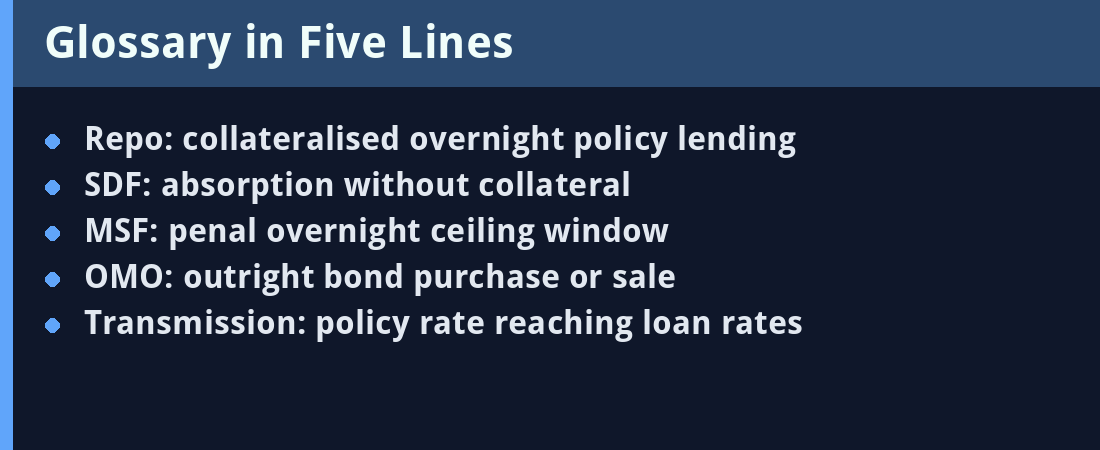
- OMO: open market operation.
- CRR: cash reserve ratio.
- SLR: statutory liquidity ratio.
- MPC: monetary policy committee.
- EBLR: external benchmark lending rate.
Durable Against Frictional Liquidity
The toolkit divides liquidity work into two horizons. Frictional, overnight imbalances live inside the corridor through repo, SDF and MSF. However, durable, multi-month surpluses or deficits need OMOs and the G-SAP-style planned purchases the RBI used during pandemic episodes. Therefore, when a mains question asks why both tool sets exist, answer with horizon separation, and cite that quantity tools move the level while price tools set the cost.
The LAF in One Paragraph
The liquidity adjustment facility is the umbrella over repo and reverse-side windows, operated through daily auctions and fine-tuning operations. Moreover, variable rate auctions now carry most of the signalling load, with fixed-rate windows reserved for stress. Consequently, the exam framing is simple: LAF is the delivery mechanism, the corridor is the architecture, and the repo is the anchor inside it.
When the Corridor Widens or Narrows
- Stress episodes: the ceiling gains importance as banks lean on the MSF.
- Surplus episodes: the floor does the work, therefore the SDF dominates volumes.
- Normal times: symmetric twenty-five point bands keep call money centred.
- Stance shifts move the anchor, not the width, under current practice.
Mains Framing in Four Sentences
Firstly, define the corridor with its three prices. Secondly, separate quantity tools from price tools with one example each. Thirdly, narrate transmission with the deposit-lag caveat. Finally, close with the target framework binding the committee’s hands. Consequently, a 150-word answer carrying this spine reads complete and current, whatever the year’s rates.
Where to Watch the Toolkit Operate
Reading the actual releases builds comfort no summary matches. Therefore, spend ten minutes on three pages each month: the policy statement, the monetary policy report, and the daily liquidity bulletin. Moreover, trace one full cycle – stance change, variable rate operations, liquidity numbers – and the textbook corridor becomes an observed machine. Consequently, both prelims statements and interview follow-ups lose their sting, because you will describe the toolkit from evidence rather than memory. In addition, the MPC minutes reveal dissent language that mains answers can cite for balance, which evaluators reward as analytical maturity.
Following One Decision End to End
The toolkit becomes memorable when you trace one decision through its full anatomy. Take a hypothetical hold: the committee meets for three days, reviews staff projections of CPI paths and growth prints, and votes six to zero or five to one. The statement lands at ten in the morning, naming the repo at 5.25 percent and the stance neutral. Within the hour, the corridor prices reprice, and external-benchmark loans follow within a quarter, while deposit rates trail by two or three quarters. Meanwhile, the liquidity bulletin over the following weeks shows the SDF absorbing surplus or the MSF lending at the margin, and open market purchases or sales adjust the durable stock of money. Therefore, one traced decision teaches the whole framework better than a month of isolated definitions, and interview boards consistently reward candidates who narrate this anatomy fluently.
Furthermore, keep a one-page scrapbook of each bi-monthly statement’s first paragraph for a year. Consequently, you will notice language shifts – accommodation to neutrality, withdrawal to accommodation – and those phrases become quote-ready evidence in mains answers, which is exactly the maturity evaluators describe in top-band scripts.
One Last Picture to Carry
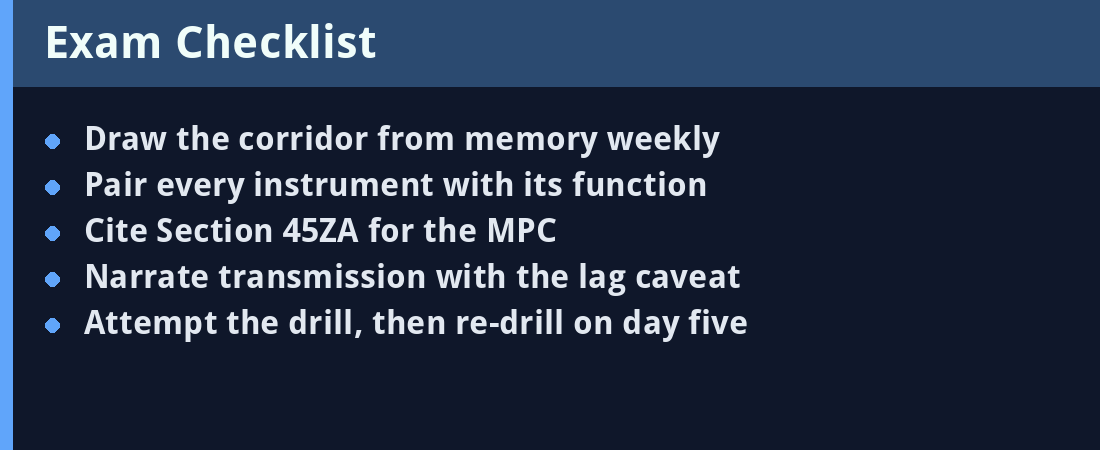
Finally, draw the corridor once from memory each Sunday: floor, anchor, ceiling, twenty-five points apart, with quantity tools standing outside the band. Therefore, the picture stays fresh while rates move, and any surprise in a statement question resolves against a structure you own rather than a number you memorised, which is the entire point of learning the toolkit rather than the tariff.
Toolkit’s Last Word
Finally, when in doubt inside the exam hall, sort any instrument question into price or quantity; the answer follows in one step. Therefore, the two-bin test is your seatbelt, and corridors, corridors everywhere, become the friendliest paragraph in the paper.
One Line of Compliance Vocabulary
- The corridor works as a protocol: overnight validation through windows, compliance with the band as the rule, and authorization for quantity moves through committee and government frames.
- Every instrument above passes the same test: does it set a price, move a quantity, or bind a framework rule?
Key Takeaways
In conclusion, hold the corridor as one picture – SDF floor, repo anchor, MSF ceiling – then attach CRR against SLR and the transmission chain with its lag caveat. To summarize, instruments price money or move quantities, and every exam question sorts into one of those two bins. Therefore, revise the tables twice this week and the drill once, and the toolkit yields its marks without drama.
References: rbi.org.in policy statements, the monetary policy report, and the RBI Act for Section 45ZA authority.
Quick revision
- Repo: banks borrow overnight from the RBI against government securities.
- Reverse repo historically absorbed surplus funds, however the SDF replaced its role from April 2022.
- The SDF needs no collateral, therefore it absorbs liquidity even when securities run short.
- The policy repo anchors the framework under the RBI Act’s Section 45ZA.
- MSF: banks dip into the statutory liquidity ratio buffer under this penal window.
- Bank rate: aligned above the MSF, it prices refinance and signals stance.
Have a doubt on this topic?