

SSC CGL Tier-2 English Preparation: Start the Highest-Weight Module This Week
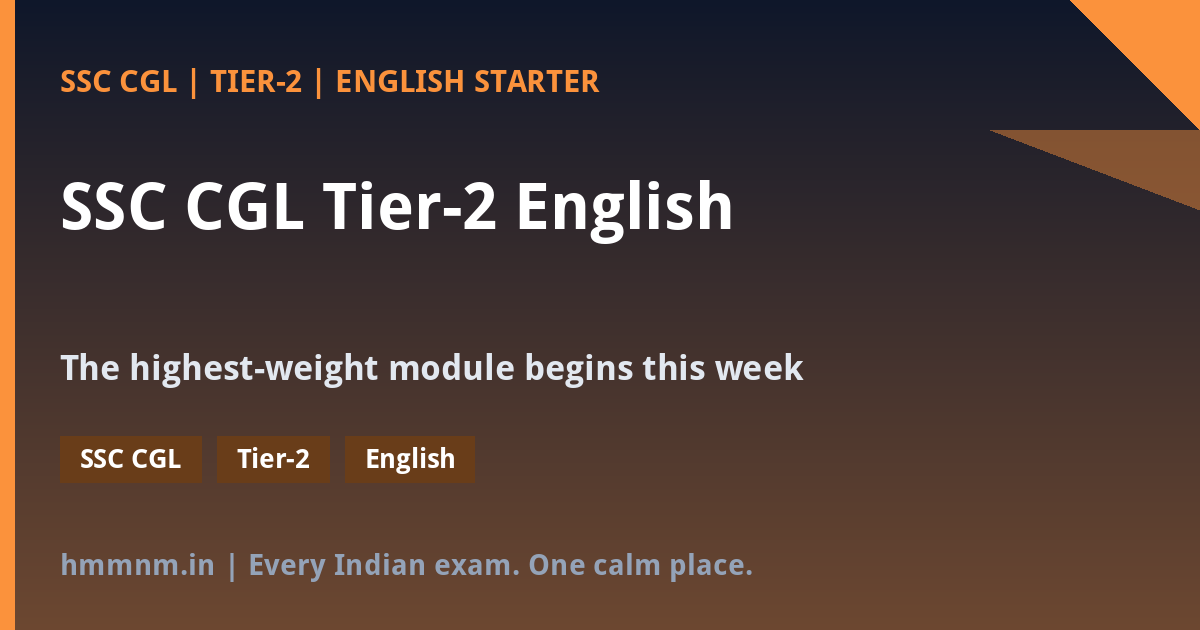
Of every Tier-2 module, English carries the most marks per preparation hour, because its syllabus is finite, its patterns repeat, and its scoring is less volatile than mathematics. This page is the starter kit for the week after Tier-1: the module map, the topic weights, a six-week progression and the resources that matter. Therefore, begin tonight, not after the answer key.
- Module Arithmetic
- The Vocabulary System
- Grammar Traps That Repeat
- The Six-Week Progression
- Five-Question Drill
- FAQ
- Is one editorial daily enough reading?
- When should mocks begin?
- The Thirty-Second Recap
- Explain It Simply: Tier-2 English for a Twelve-Year-Old
- Rapid-Fire: Ten Anchors in Ten Lines
- Abbreviations for the Module
- Paragraph Errors: The Mains-Only Discipline
- The Phrasal Verb Starter Twenty
- The Weekly Consolidation Ritual
- The Editor’s Eye: Reading Like a Paper-Setter
- Two Minutes on the Day-Before Ritual
- A Last Note on Compounding
- The Module by Numbers
- Weights and Windows in Ten Lines
- Ten Abbreviations, One Breath
- Key Takeaways
- Related reading
Contents: module arithmetic, topic weightage table, the vocabulary system, grammar traps, a six-week plan, drill and FAQ.
Module Arithmetic
The English module sits inside paper one’s second session, testing range, idiom and error-spotting at mains depth. Moreover, its marks arrive faster than mathematics marks, therefore early weeks invested here pay visible dividends quickly. Meanwhile, the typing module rides the same session day, which makes English-plus-typing the natural evening pair for the corridor months.
| Topic Family | Expected Share | Preparation Lever |
|---|---|---|
| Spotting errors and sentence improvement | Large | Rule buckets plus paragraph drills |
| Cloze and fillers | Steady | Collocation reading habit |
| Reading comprehension | Steady | Editorial pacing |
| Vocabulary and idioms | Wide | Daily word bank with usage |
| Narration and voice | Predictable | Formula practice |
The Vocabulary System
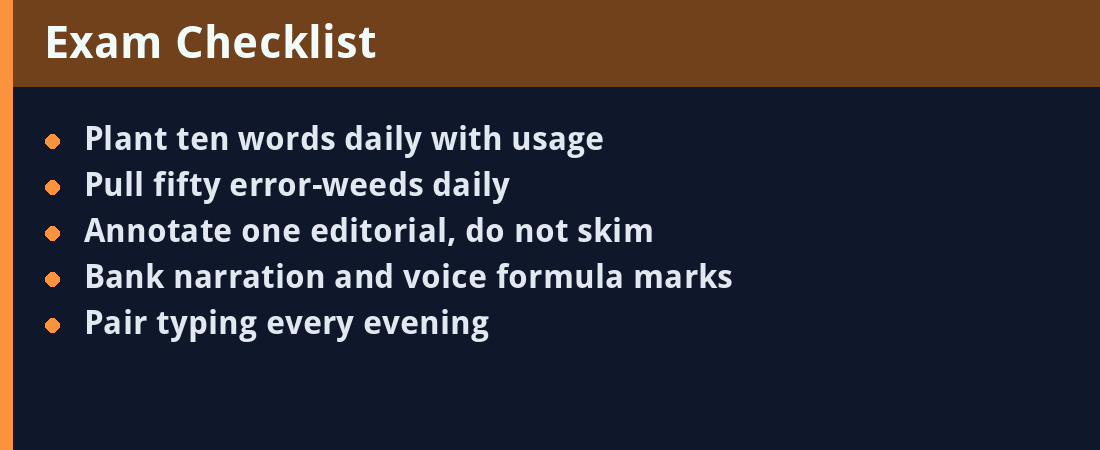
- Ten words daily, each with one usage sentence in your own voice.
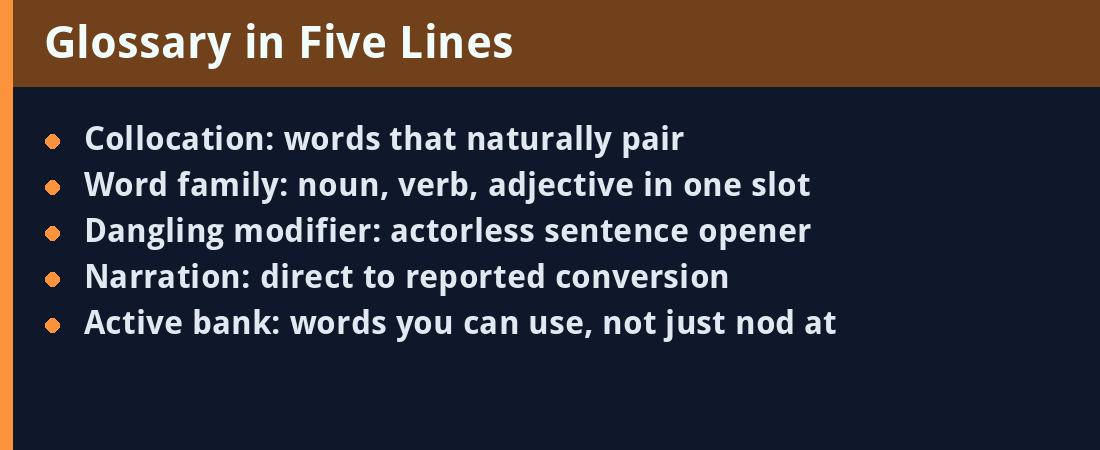
- Word families: prudent, prudence, prudently in one slot.
- Idiom pairs: learn meaning plus one exam-style sentence.
- Revise yesterday’s bank before today’s additions, always.
- Weekly consolidation: speak the week’s bank aloud in five minutes.
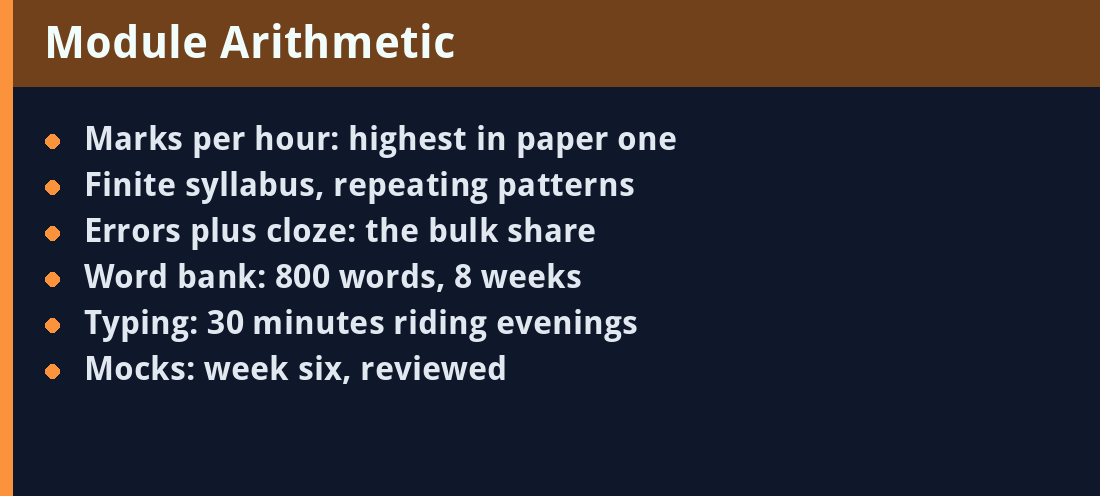
Consequently, an active bank of eight hundred words covers the module’s needs, built in eight quiet weeks. Moreover, the same bank feeds the interview stage later, therefore the investment compounds across the entire examination cycle.
Grammar Traps That Repeat
- Subject-verb agreement: collectives singular, neither of singular always.
- Tense shifts in reported speech: one step back, without exception.
- Preposition pairs: comply with, prefer to, accused of, charged with.
- Parallel structure breaks in long sentences, a mains-only trap.
- Dangling modifiers, which the module loves to hide in improvements.
The Six-Week Progression
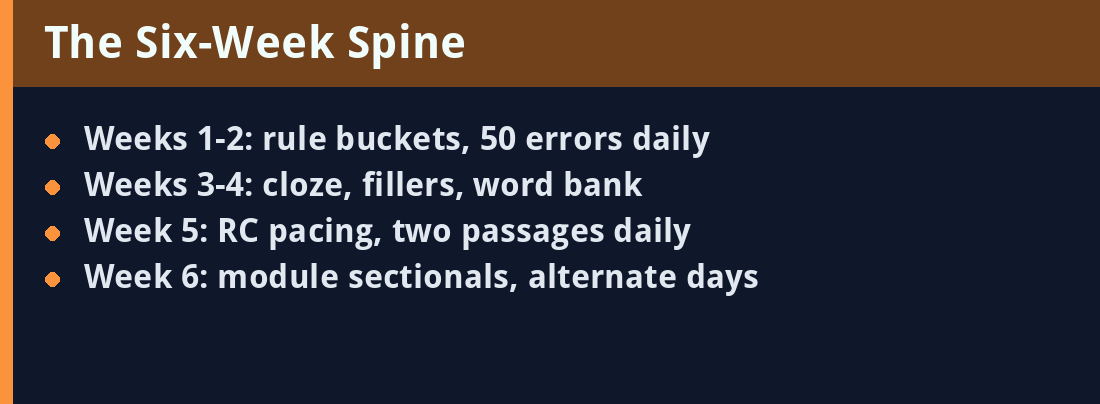
- Weeks 1-2: rule buckets and daily error-spotting sets, fifty questions each.
- Weeks 3-4: cloze and fillers plus the daily word bank, with paragraph errors.
- Week 5: reading comprehension pacing, two passages daily at eight minutes.
- Week 6: full module sectionals, alternate days, reviewed the same evening.
Furthermore, thirty typing minutes ride alongside every evening block, because the session-day pairing builds stamina for the real schedule. As a result, six disciplined weeks convert English from a lottery into the steadiest scorer on your merit sheet.
English at mains depth is not talent; it is a word bank with a calendar attached.
Five-Question Drill
- Choose the correct sentence. Answer: “The committee has forwarded its recommendation.” Collective noun, singular verb.
- Fill the blank: The scheme was ___ by litigation. Answer: rolled back, standard collocation.
- Spot the error: “Neither of the drafts were clean.” Answer: replace were with was.
- Convert to passive: “The bench announced the verdict.” Answer: “The verdict was announced by the bench.”
- Idiom: to bell the cat means: Answer: to take a risky lead.
FAQ
Is one editorial daily enough reading?
One with active notes beats three passive reads, therefore annotate, not just read.
When should mocks begin?
The Thirty-Second Recap
One module. Finite syllabus. Therefore, start this week. Ten words daily. Fifty errors daily. Moreover, collocations win cloze. Families beat lists. However, narration and voice are formula marks. Bank them. Finally, pair typing every evening. Six weeks. One steady scorer.
Explain It Simply: Tier-2 English for a Twelve-Year-Old
Think of this module as a garden you water daily, not a wall you build in a week. Every day you plant ten new word-seeds and pull fifty error-weeds. Some weeds look alike, so you learn their families: the tense weeds, the preposition weeds, the agreement weeds. Moreover, you read one newspaper page slowly, the way a gardener studies leaves. In six weeks the garden fills, and marks grow like tomatoes – quietly, then all at once. Finally, your fingers also train on the keyboard each evening, because the exam day asks both your head and your hands to work together.
Rapid-Fire: Ten Anchors in Ten Lines
- Daily word bank: ten words with usage.
- Daily error set: fifty questions.
- Active bank target: eight hundred words.
- Editorial habit: one, annotated.
- Narration and voice: formula marks, bank early.
- Cloze lever: collocations over grammar.
- Typing: thirty minutes every evening.
- Mocks: week six, not week one.
- Review: same evening, every set.
- Session pairing: English plus typing builds stamina.
Abbreviations for the Module
- SSC: the Staff Selection Commission.
- CGL: the Combined Graduate Level exam.
- RC: reading comprehension.
- DEST: the data entry speed test riding the same session.
- PYQ: previous year questions, the pattern bible.
- IBPS: the banking cousin whose cloze sets double as drills.
Paragraph Errors: The Mains-Only Discipline
Single-line error spotting fades at mains level, replaced by paragraph frames where errors hide across clauses. Therefore, train with a fixed scan order: read once for the verb chain, once for pronoun references, once for parallel structure. Moreover, underline subjects mentally before touching the options, because agreement errors between distant subject and verb carry most marks in this family. Consequently, a three-scan protocol converts the paragraph task from intuition into procedure, which holds under the clock.
The Phrasal Verb Starter Twenty
- Back out: withdraw from a commitment.
- Carry on: continue despite difficulty.
- Come across: find by chance.
- Drop in: visit casually.
- Figure out: solve or understand.
- Get away with: escape consequences.
- Hold up: delay.
- Look into: investigate.
- Put off: postpone.
- Run into: meet unexpectedly.
- Set up: establish.
- Take over: assume control.
- Turn down: reject.
- Wind up: conclude.
- Bear out: confirm.
- Break down: stop functioning.
- Call off: cancel.
- Do away with: abolish.
- Give in: yield.
- Keep up: maintain pace.
Notably, this list is a starting bank, not the syllabus, therefore add five verbs weekly with one exam-style sentence each. Moreover, cloze passages recycle exactly this register, so the bank feeds two question families at once.
The Weekly Consolidation Ritual
Every Sunday, close the week in fifteen minutes. Firstly, speak the week’s word bank aloud without notes. Secondly, rewrite any five error-log sentences in corrected form. Thirdly, read one previous-year paragraph-error set cold. Consequently, the week’s learning moves into durable memory, and the next week builds on rock rather than sand. Furthermore, the ritual doubles as progress evidence: the bank you can speak is the bank you own, and ownership is what the module measures.
The Editor’s Eye: Reading Like a Paper-Setter
Paper-setters for this module build questions from a narrow set of editorial habits, therefore reading like one converts the module into a predictable code. Firstly, notice how often opinion columns rely on concessive pairs – however, although, despite – because filler questions test whether you register the pivot. Secondly, count the abstract nouns policy prose loves, such as framework, implementation and accountability, since vocabulary-in-context items harvest exactly this register. Thirdly, watch paragraph openers and closers, because para-jumble logic lives there. Consequently, ten minutes of deliberate reading per day, done with these three lenses, quietly trains every question family the module contains.
Furthermore, keep a one-page editor’s log: five concessive pivots met, five abstract nouns decoded, one paragraph-logic note. Therefore, your editorial habit leaves evidence, and evidence becomes the error-log’s vocabulary wing. As a result, when the six-week plan reaches its sectional weeks, the reading foundation is already load-bearing.
Two Minutes on the Day-Before Ritual
Finally, the module rewards a settled eve routine. Read only your word bank and error log, attempt one light set for warmth, and sleep at exam-hour discipline, because recall arrives rested rather than crammed. Moreover, lay out the admit card and identity the night before, which removes morning decisions the memory does not need. Consequently, the steadiest module on your merit sheet begins with the steadiest evening of your corridor month, and that symmetry is worth engineering deliberately.
A Last Note on Compounding
Finally, remember that the word bank, the error log and the typing minutes all compound silently, and the module that felt endless in week one feels automatic by week six, which is simply how compounding feels from the inside.
The Module by Numbers
- Word bank: 10 words daily, 800 words in 8 weeks.
- Error sets: 50 questions daily through weeks 1 and 2.
- Reading: 2 passages daily in week 5 at 8 minutes each.
- Typing: 30 minutes every evening beside the module.
- Mocks: from week 6, alternate days, reviewed same evening.
- Session day pairs English with the DEST typing window.
Weights and Windows in Ten Lines
- Paper one spans multiple sessions; English shares its session with the skill window.
- Error families split across 5 rule buckets, each worth consistent marks.
- Cloze passages run 10 blanks; fillers run 5 double-blank items.
- RC passages hold 8 to 10 questions across 2 sets.
- Idioms appear in clusters of 4 to 5 per paper.
- Narration and voice contribute roughly 6 to 8 formula marks.
- Typing thresholds ask near 2,000 key depressions in 15 minutes.
- Week 6 schedule: 3 full sectionals plus 3 review evenings.
- The SSC and IBPS patterns share 70 percent of this register.
- PYQ sets from 5 recent years cover the whole topic map.
Ten Abbreviations, One Breath
- SSC: Staff Selection Commission; CGL: Combined Graduate Level.
- DEST: data entry speed test; OMR: the response sheet.
- RC: reading comprehension; PYQ: previous year questions.
- IBPS and SBI: banking cousins sharing this register.
- RBI: the central bank whose editorials feed cloze passages.
- NCERT and CBSE: school frames for grammar grounding.
- DoPT: the appointment ministry at the corridor’s end.
Key Takeaways
In conclusion, the module rewards a calendar: daily words, daily errors, annotated reading and week-six mocks, with typing riding alongside. To summarize, treat English as the corridor’s steadiest scorer and start it before the answer key arrives. Therefore, tonight’s thirty minutes already separate you from the crowd that waits for result news to begin.
References: ssc.gov.in syllabus documents and previous-year papers for pattern authority.
Related reading
- SSC CGL Tier-1 Exam Over: The Honest Review, Cutoff Arithmetic and Week-One Tier-2 Plan
- SSC CGL Tier-1 is Over: Answer Key, Normalization and the Tier-2 Roadmap
Quick revision
- Ten words daily, each with one usage sentence in your own voice.
- Word families: prudent, prudence, prudently in one slot.
- Idiom pairs: learn meaning plus one exam-style sentence.
- Revise yesterday’s bank before today’s additions, always.
- Weekly consolidation: speak the week’s bank aloud in five minutes.
- Subject-verb agreement: collectives singular, neither of singular always.
Have a doubt on this topic?