
World Ozone Day 2026: Current Affairs One-Liners for September 16
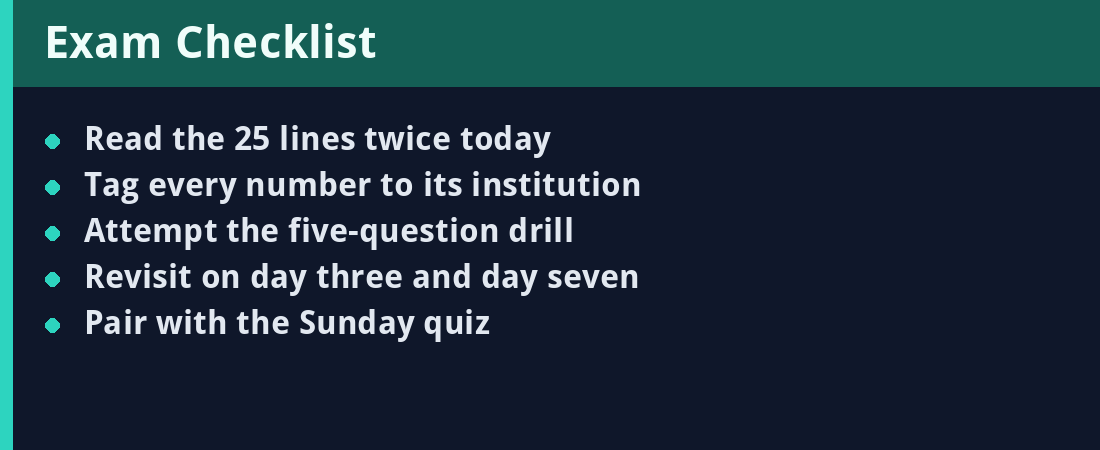
Good morning, and welcome to the 16 September capsule: twenty-five one-liners covering the week that matters, led by today’s own observance – World Ozone Day. Every line below is exam-ready, institution-tagged and short enough to revise outside any exam centre. Therefore, read the table twice, attempt the drill, and return on day three and day seven.
- Today on the Calendar: 16 September
- National Headlines in One Line Each
- International Desk
- Economy Numbers Table
- Science, Environment and Miscellaneous
- Five-Question Drill
- FAQ
- How current are these lines for a December exam?
- Which exams use these directly?
- The Thirty-Second Recap
- Explain It Simply: Today’s News for a Twelve-Year-Old
- Rapid-Fire: Ten Anchors in Ten Lines
- Abbreviations That Recur
- States and Schemes in News
- Sports Desk in One Line Each
- Dates Worth This Fortnight
- How Static GK Wears Current Clothing
- The Weekly Anchor Plan
- The Capsule as a Spoken Drill
- One Last Habit for the Capsule
- The Capsule’s Last Word
- Final Word
- A Last Note on Trust
- Key Takeaways
- Related reading
Contents: today’s observances, national and international headlines, economy numbers, science and environment lines, a five-question drill and the weekly anchor plan.
Today on the Calendar: 16 September
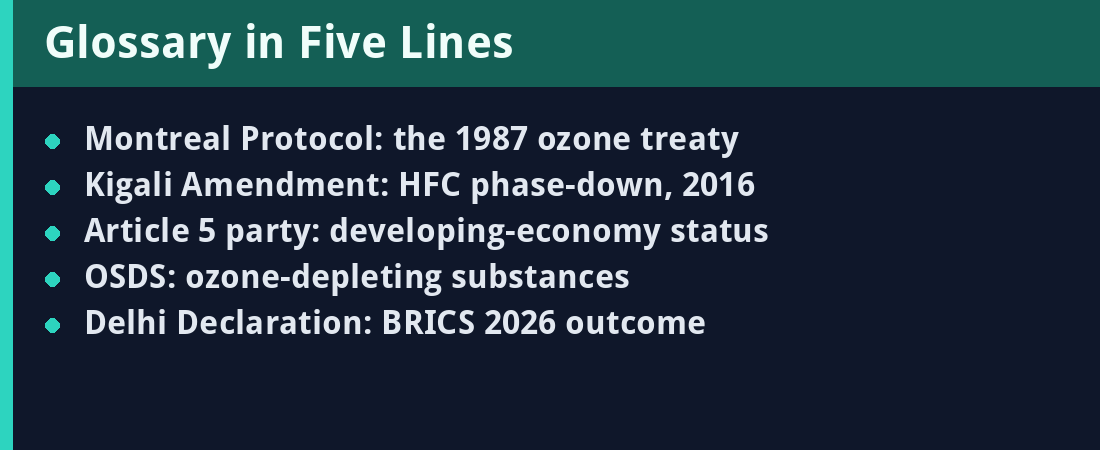
- World Ozone Day marks the 1987 signing of the Montreal Protocol on substances that deplete the ozone layer.
- The protocol is the only treaty ratified by every United Nations member state.
- The WMO-UNEP assessments project recovery to 1980 ozone levels by around mid-century.
- The Kigali Amendment of 2016 added the HFC phase-down as a climate measure.
- India participates as an Article 5 party with a delayed HFC schedule.
National Headlines in One Line Each
- India hosted the 18th BRICS Summit in New Delhi on 12-13 September, adopting the Delhi Declaration.
- Q1 FY27 GDP growth printed at 7.8 percent, the strongest first quarter in five years.
- The RBI’s monetary policy committee held the repo rate at 5.25 percent with a neutral stance.
- GST 2.0 completed one year of the rationalised slab structure with record collections.
- The monsoon withdrawal commenced from northwest India on schedule, the IMD confirmed.

International Desk
- The UNGA’s 81st session opened with India pressing Security Council reform.
- The Indus Waters Treaty remained in abeyance amid arbitration proceedings.
- Nepal’s flash floods drew Indian relief assistance under the Neighbourhood First framework.
- The India-China reset advanced on border management and trade tracks.
- India-Iran and India-UAE tracks moved on connectivity and CEPA implementation.
Economy Numbers Table
| Indicator | Reading | Institution |
|---|---|---|
| GDP growth, Q1 FY27 | 7.8 percent | NSO, MoSPI |
| Repo rate | 5.25 percent | Six-member MPC |
| Inflation target | 4 percent, 2-6 band | RBI Act framework |
| GST year-one | Record collections | CBIC, finance ministry |
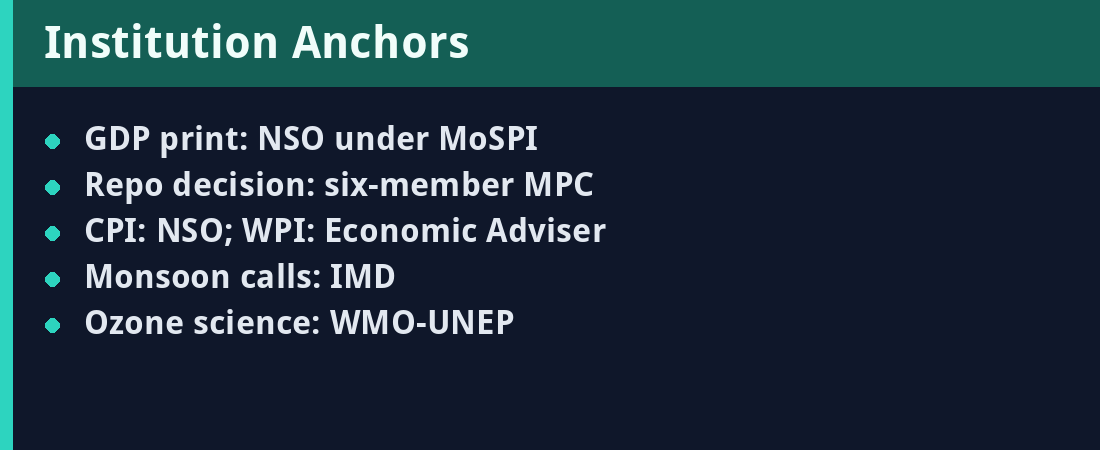
Moreover, examiners pair numbers with publishers, therefore the third column carries the marks. Similarly, WPI belongs to the Office of the Economic Adviser while CPI belongs to the NSO, and that single distinction answers two recurring questions.
Science, Environment and Miscellaneous
- World Ozone Day: 16 September; Engineer’s Day and Democracy Day: 15 September.
- The Great Indian Bustard remains critically endangered with under 150 adults in the wild.
- Gaganyaan’s uncrewed test series progressed toward human spaceflight certification.
- The Bharatiya Antariksh Station targets completion by 2035.
- India’s chess Olympiad double-gold defence entered its final boards.
Five-Question Drill
- World Ozone Day is observed on: Answer: 16 September, marking the 1987 protocol.
- Which treaty has universal UN ratification? Answer: the Montreal Protocol.
- The Kigali Amendment targets: Answer: HFCs, a climate measure under the protocol.
- India’s Q1 FY27 GDP growth stands at: Answer: 7.8 percent, released by the NSO.
- The repo rate after the September review: Answer: 5.25 percent, neutral stance.
One observance, one institution, one number: that is how a one-liner earns its mark.
FAQ
How current are these lines for a December exam?
The spine stays valid; however, refresh numbers monthly through the site’s digests, because rates and prints move.
Which exams use these directly?
The Thirty-Second Recap
Twenty-five lines. One observance today. Therefore, ozone takes the lead. The protocol has universal ratification. Kigali handles HFCs. Moreover, growth prints at 7.8. The repo holds at 5.25. GST celebrates year one. However, pair each number with its office. NSO for prices of consumers. Adviser for wholesale. Finally, revise on day three. Revise on day seven. Recall locks in.
Explain It Simply: Today’s News for a Twelve-Year-Old
Today the world thanks a thin shield of gas high in the sky. Long ago, fridges and sprays made holes in that shield. Therefore, every country signed a promise in 1987 to stop making the hole-making chemicals. The promise worked, and the shield is healing. Moreover, the same promise now fights warming gases called HFCs. Meanwhile, at home, the economy grew fast this quarter, and the rate team kept loan costs steady. So remember the pattern: a problem, a promise, a healing result. That pattern answers most exam questions about today.
Rapid-Fire: Ten Anchors in Ten Lines
- World Ozone Day: 16 September, from 1987.
- Montreal Protocol: universal ratification.
- Kigali Amendment: 2016, HFC phase-down.
- Ozone recovery: 1980 levels by mid-century.
- BRICS 18th summit: New Delhi, Delhi Declaration.
- Q1 FY27 GDP: 7.8 percent growth.
- Repo rate: 5.25 percent, neutral stance.
- Inflation target: 4 percent, 2-6 band.
- CPI publisher: NSO; WPI: Economic Adviser.
- GST 2.0: one year, record collections.
Abbreviations That Recur
- WMO: the World Meteorological Organization, ozone assessor.
- UNEP: the UN environment programme, co-assessor.
- HFC: hydrofluorocarbon, the Kigali target gas.
- MPC: the six-member rate committee.
- NSO: the National Statistics Office.
- IMD: the India Meteorological Department.
- UNGA: the UN General Assembly, 81st session.
States and Schemes in News
- Bihar’s caste survey findings kept reservation arithmetic in national debate.
- Maharashtra cleared electronics incentives under its semiconductor policy.
- Tamil Nadu’s green hydrogen park drew central co-financing interest.
- Kerala moved on tribal land assignment rules through its revenue board.
- Gujarat advanced a wetland proposal on the Ramsar track.
Sports Desk in One Line Each
- India’s chess Olympiad double-gold defence reached its final boards.
- The Asian Games torch relay began at Aichi ahead of the 2026 edition.
- Neeraj Chopra’s season-best kept the Diamond League race open.
- BCCI central contracts retained the Grade A-plus four.
- The Santosh Trophy drew record entries for its next edition.
Dates Worth This Fortnight
| Date | Observance | One-Line Anchor |
|---|---|---|
| 14 September | Hindi Diwas | Devanagari adoption by the Assembly, 1949 |
| 15 September | Engineer’s Day, Democracy Day | Visvesvaraya birth anniversary |
| 16 September | World Ozone Day | Montreal Protocol signing, 1987 |
| 17 September | World Patient Safety Day | WHO campaign with a rotating theme |
Moreover, memory hooks beat rote: link each date to its story, and one recall drags the whole anchor chain. In addition, examiners increasingly wrap observances in statement questions, therefore learn the year alongside the day.
How Static GK Wears Current Clothing
A Nepal flood question may actually test disaster institutions, while a BRICS line may test grouping basics. Therefore, after reading each one-liner, ask which static anchor it hangs from. Consequently, the capsule doubles as a static-revision trigger, and the Sunday quiz rehearses exactly this disguise on this site.
The Weekly Anchor Plan
Pair this capsule with the site’s companion pieces for full coverage. Firstly, the economy digest explains the numbers behind today’s table. Secondly, the RBI toolkit page expands every instrument named above. Thirdly, the Sunday quiz converts all twenty-five lines into timed questions. Therefore, one capsule plus three companions closes the reading-to-recall loop. Meanwhile, log quiz scores across four Sundays, because trend lines reveal weak zones that single scores hide. In addition, aspirants facing interviews should rehearse one-liners aloud, since spoken recall survives stage pressure better than silent reading.
The Capsule as a Spoken Drill
Candidates preparing interviews or descriptive papers gain an extra layer from this capsule by converting it to speech. Therefore, take any five lines and deliver them aloud as a sixty-second news brief, without notes, in front of a mirror or a recorder. Moreover, listen once and note where you stumble, because stumbles mark the lines you recognise but do not own. Consequently, three rounds of spoken delivery move the capsule from reading memory into recall memory, which is the layer that survives examination halls and interview boards alike.
Furthermore, pair the spoken drill with the pairing habit: every number must name its institution aloud, and every institution must name its headquarter city. For example, seven point eight percent belongs to the statistics office in New Delhi, while the repo belongs to the monetary policy committee of the central bank in Mumbai. As a result, each line doubles as a geography and polity anchor, and one revision pass quietly serves three syllabus areas at once.
One Last Habit for the Capsule
Finally, keep the capsule visible: print it or pin it to your phone’s first screen, because friction decides whether revision happens on tired evenings. Therefore, the page you see is the page you reread, and the lines you reread are the marks you bank when the quiz or the exam finally asks for them. Moreover, aspirants who maintain this visibility habit report the capsule finishing its loop in under eight minutes by week’s end, which leaves no excuse on even the busiest study day.
The Capsule’s Last Word
Finally, remember why the format exists: exams reward compression, and twenty-five compressed lines are the smallest complete unit of a fortnight. Therefore, guard the habit for sixty days, and the current affairs section stops being the syllabus’s scarecrow and becomes its gift.
Final Word
Finally, pair this morning’s capsule with tonight’s spoken drill, and the loop closes on the same day it opens, which is how habits outlive motivation.
A Last Note on Trust
Finally, trust only primary releases for every line here, because ministry pages settle what forums confuse, and the capsule names its sources so your revision stands on documents rather than on chatter.
Key Takeaways
In conclusion, this capsule leads with World Ozone Day and locks the fortnight’s spine: summits, rates, reforms and recoveries, each tagged to its institution. To summarize, read twice today, quiz tonight, revisit twice this week. Therefore, walk into any September exam with the observance calendar and the number table fully loaded.
References: pib.gov.in, rbi.org.in, mospi.gov.in, wmo.int and un.org – primary releases behind every line.
Related reading
- The NEET 2026 Storm: Paper Leak, Article 142 and the Aftermath, Exam-Ready Notes
- WPI vs CPI: The Two Thermometers of Inflation Every Exam Tests
Quick revision
- World Ozone Day marks the 1987 signing of the Montreal Protocol on substances that deplete the ozone layer.
- The protocol is the only treaty ratified by every United Nations member state.
- The WMO-UNEP assessments project recovery to 1980 ozone levels by around mid-century.
- The Kigali Amendment of 2016 added the HFC phase-down as a climate measure.
- India participates as an Article 5 party with a delayed HFC schedule.
- India hosted the 18th BRICS Summit in New Delhi on 12-13 September, adopting the Delhi Declaration.
Have a doubt on this topic?