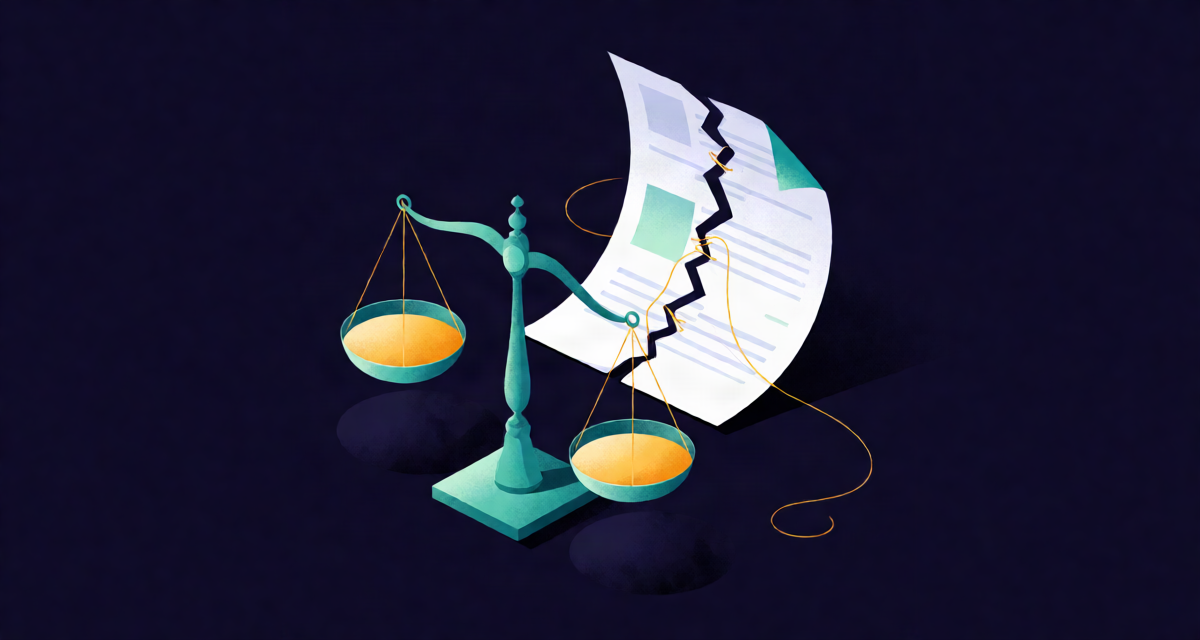
NEET 2026 Paper Leak: Article 142 and Complete Exam-Ready Notes
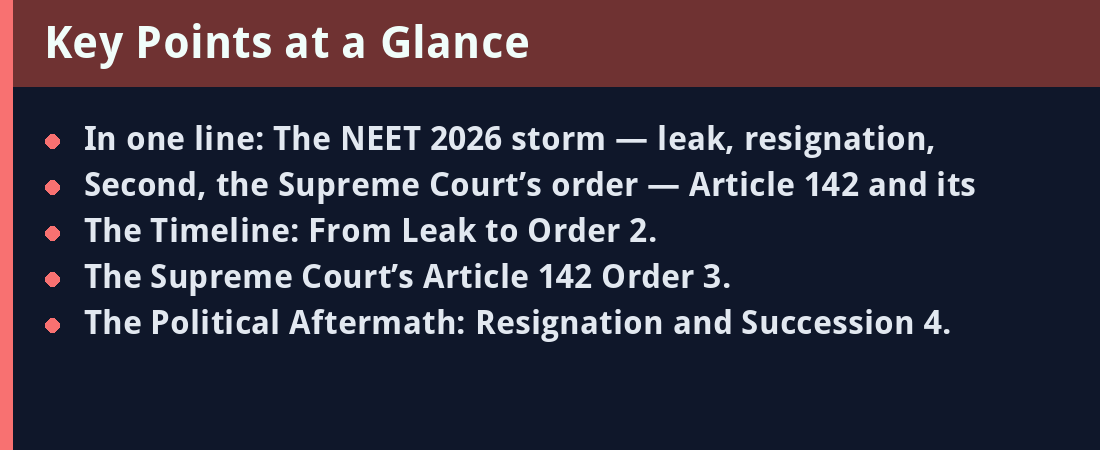
In one line: The NEET 2026 storm — leak, resignation, Article 142, decoded.
- 1. The Timeline: From Leak to Order
- 2. The Supreme Court’s Article 142 Order
- 3. The Political Aftermath: Resignation and Succession
- 4. The Legal Frame: The Anti-Paper-Leak Act and FIR Law
- 5. The Reform Debate: Exam Integrity’s Next Steps
- 6. How Exams Probe This Topic
- 7. Quick Revision: One-Glance Facts
- The Timeline in One Table
- Practice Corner: Five Definition Checks (with Answers)
- The Case Lens: The Balance Question
- The Three Classic Traps (Where Beginners Slip)
- Frequently Asked Questions
- What did the Supreme Court order on 1 September 2026?
- Why did the Education Minister resign?
- What is Article 142?
- How does the Anti-Paper-Leak Act fit in?
- What reforms does the episode force?
- Exam Checklist
- FAQ
- How much of this page is exam-relevant?
- When should I revisit?
- The Thirty-Second Recap
- Explain It Simply
- Abbreviations That Recur Here
In one line: The 2026 NEET UG controversy’s full arc: the paper leak, the July 20–25 student protests and the police cases, Education Minister Pradhan’s resignation and Joshi’s succession, the Supreme Court’s 1 September Article 142 order quashing the students’ FIRs with compensation for the injured — and the exam-integrity debate (the Anti-Paper-Leak Act, the reform options) the storm has forced to the top of the policy table.
The NEET storm stands on four counts. First, the timeline — from leak to order. Second, the Supreme Court’s order — Article 142 and its logic. Third, the accountability layer — the political aftermath. Fourth, the reform debate — what changes now.
Contents
1. The Timeline: From Leak to Order
2. The Supreme Court’s Article 142 Order
3. The Political Aftermath: Resignation and Succession
4. The Legal Frame: The Anti-Paper-Leak Act and FIR Law
5. The Reform Debate: Exam Integrity’s Next Steps
6. How Exams Probe This Topic
7. Quick Revision: One-Glance Facts
– Practice Corner: Five Definition Checks (with Answers)
– The Case Lens: The Balance Question
Quick Answer: The NEET UG 2026 cycle was convulsed by a paper-leak controversy: student protests erupted 20–25 July 2026, police registered FIRs against participating students, and the unrest forced Education Minister Dharmendra Pradhan’s resignation in July 2026, with Pralhad Joshi succeeding him. On 1 September 2026 the Supreme Court, invoking its plenary power under Article 142, quashed the FIRs filed against the student protesters and ordered compensation for students injured in the police action; the opposition, in response, called off its planned 5 September Delhi march. The episode joins the 2024 NEET controversy’s lineage (this site’s Anti-Paper-Leak Act post covers the statute) and throws up the standing exam questions: Article 142’s scope, the FIR law’s safeguards, the leak-economy’s anatomy, and the reform menu — from the Public Examinations (Prevention of Unfair Means) Act’s enforcement to multi-shift-and-normalisation redesigns and the accountability of testing agencies.
1. The Timeline: From Leak to Order
- The leak and the exam. The NEET UG 2026 paper-leak allegations — the newest storm in the cycle that began with the 2024 controversy (the cancelled-and-re-conducted episode this site’s archives track) — ignited the year’s biggest student agitation. Read this as the trigger event; every later step in the timeline flows from it.
- The protest week. 20–25 July 2026: the arc ran from mobilisation to confrontation to police response — the injuries the Supreme Court’s compensation order would later formally acknowledge. Memorise the dates; examiners love anchoring the compensation clause to this week.
- The FIRs. First Information Reports were filed against students — the criminalisation of protest that the Court’s order squarely targeted. The cases became the reason the bench called the prosecutions “the wrong message to the young.” Hold this causal link firmly.
- The order and the aftermath. 1 September 2026: the Article 142 quashing-and-compensation order landed; by 5 September the opposition’s Delhi march was called off — the de-escalation the order achieved, explicitly noted in the coverage. This is the resolution pair examiners pair with the leak date.
2. The Supreme Court’s Article 142 Order
- The Article. Article 142: the Supreme Court’s power to pass any decree or order “necessary for doing complete justice in any cause or matter pending before it” — the plenary power the Court has deployed from Union Carbide (1989) through the Ayodhya verdict (2019) — the constitutional provision every prelims paper recycles. Read the wording once; examiners lift it verbatim as an MCQ stem.
- The order’s content. Two deliverables: the FIRs against the student protesters quashed, and compensation awarded to students injured in the police action — the Court separating the students’ genuine grievance (the leak itself) from any violence, and choosing restorative over punitive closure.
- The Court’s logic. The students were the leak’s victims, not its villains — prosecuting them for protesting maladministration inverts accountability; the exam system’s failure, not the examinees’ anger, is the root cause — the reasoning the editorial pages read into the order. This is your quotable mains line; memorise the “victims, not villains” framing.
- The Article 142 debate. The evergreen contest over judicial reach: “complete justice” versus legislative territory — the critics’ standing charge of judicial overreach; the counter: the power exists precisely for the cases ordinary law cannot close humanely. Learn both sides — this is the balanced mains paragraph.
3. The Political Aftermath: Resignation and Succession
- The resignation. Dharmendra Pradhan resigned as Education Minister in July 2026 — the ministry owns NEET conduct through the NTA, so the paper leak landed on his desk; the scale of the protests converted administrative failure into political accountability. Read the date carefully: examiners love a “who resigned when” match-the-following row.
- The succession. Pralhad Joshi took over the Education Ministry — his name is a fresh prelims fact, and fresh facts are exactly what UPSC and SSC probes prefer. Note his inherited brief in two words: restore the exam cycle, carry the integrity agenda forward.
- The opposition’s calibration. The march was called off after the Supreme Court’s order — the agitation’s core demand (withdrawal of the FIRs) was substantially met. Call this a pause in the political theatre, not the end of the accountability debate; that distinction is how examiners phrase the trap.
- The NTA question. The testing agency sat at the controversy’s centre — reform calls covered its leadership, its security protocols, and the multi-city, multi-shift logistics. These are the files the successor minister inherits: the administrative layer beneath the political one, and a favourite “structural reform” question for Mains.
4. The Legal Frame: The Anti-Paper-Leak Act and FIR Law
- The Public Examinations (Prevention of Unfair Means) Act, 2024. The dedicated anti-cheating statute — it criminalises paper leaks, solver-gangs and organised cheating (our dedicated post gives it the full treatment). The 2026 storm is the Act’s first real enforcement test, and the prosecutions that follow will answer whether it has teeth. Read this as the Act’s examination, not just the students’.
- The FIR law’s safeguards. The First Information Report now operates under the BNSS, the CrPC’s successor: what a valid FIR requires, when protest crosses into cognisable territory, and the quashing jurisdiction (Section 482 CrPC’s heritage, now Section 528 BNSS) that the Supreme Court exercised through the broader door of Article 142. This is the procedural layer examiners probe in law papers — expect a question on it.
- The proportionality doctrine. The state’s response to protest must pass the constitutional test of necessity and proportionality — the Puttaswamy-line jurisprudence. The student-FIR cases are the doctrine’s live application: whether filing FIRs against protesting examinees survives scrutiny.
- The victim-or-accused inversion. The leak’s true beneficiaries are the organised rackets, not the students — the examinees are the harmed party. The Act targets that accountability gap, and the Court’s order drawing this distinction echoes the doctrine: punish the racket, protect the examinee.
5. The Reform Debate: Exam Integrity’s Next Steps
- The enforcement track. Full deployment of the Anti-Paper-Leak Act — prosecuting every link in the leak chain, from the printers to the takers. Read it this way: the 2026 cycle is the statute’s credibility test. If prosecutions stall, the deterrent collapses; if they convict, the Act becomes the template for every leaked exam in India.
- The process track. The exam-design fixes the Education Ministry’s committees now carry on their plate: multi-shift normalisation and its fairness debate (the direct inheritance of the 2024 controversy), digital-delivery security to choke leaks at the source, and centre-empanelment audits to clean the ground-level apparatus.
- The empathy track. The compensation principle the Court has seeded — redress for injured students, remedial options for affected candidates, including re-tests where warranted. This is the restorative layer the order adds to the integrity kit: enforcement punishes the guilty, but only compensation repairs the wronged.
- The trust deficit. NEET’s own scale — lakhs of candidates, an entire career staked on a single exam — is the root stress. The long-term debate therefore centres on structural reform: multiple attempts per year and a wider exam window. For the UPSC mains, frame the policy essay directly: “Reform the examination system to restore trust — suggest a framework.” Structure your answer along all four tracks above; that is the framework.
6. How Exams Probe This Topic
- Prelims MCQs: Article 142’s text-and-purpose; the order’s date (1 September 2026) and content (FIRs quashed, compensation); the ministerial change (Joshi for Pradhan); the Anti-Paper-Leak Act’s year (2024) and its target (organised unfair means); the NTA’s mandate.
- Mains questions: “The Supreme Court’s Article 142 order in the NEET FIRs case balances empathy and accountability — discuss”; “Paper leaks are a governance failure, not merely a law-enforcement one — examine with the 2024–26 NEET episodes”; “Evaluate the Public Examinations Act’s design against the leak economy’s anatomy”.
- The interview layer: the fairness-to-all dilemma (the affected-and-unaffected candidates), judicial power’s reach, protest-and-policing’s proportionality — the three depth-probes.
7. Quick Revision: One-Glance Facts
- Timeline. Leak → protests 20–25 July 2026 → FIRs → Pradhan resigns (July), Joshi in → SC order 1 September (Article 142) → 5 September march called off.
- The order. FIRs quashed + compensation for the injured; the students the victims-not-villains logic.
- Article 142. “Complete justice” plenary power — Union Carbide-to-2026 the lineage.
- The Act. Public Examinations (Prevention of Unfair Means) Act, 2024 — the organised-racket target.
- The layer below. NTA’s reform, the multi-shift debate, the restorative compensation the new layer.
Conclusion. The 2026 NEET storm closes its legal chapter with a restorative order — the students cleared, the injured compensated, the accountability pushed upward to the system and its ministers. The exam layer: Article 142’s scope, the timeline’s dates, the Act’s frame, and the reform essay’s balance — learn the four, and every dressing of this episode pays.
The Timeline in One Table
| Date | Event |
|---|---|
| Jul 2026 | Protests nationwide; Education Minister resigns (25 Jul); Joshi takes charge |
| Aug 2026 | SIT and committee processes; reform debate |
| 1 Sep 2026 | Supreme Court Article 142 order: FIRs quashed, compensation |
Practice Corner: Five Definition Checks (with Answers)
- The order’s date and power — 1 September 2026; Article 142 (complete justice).
- The Education Ministry’s July 2026 change — Pradhan resigned; Pralhad Joshi succeeded.
- The dedicated leak statute — The Public Examinations (Prevention of Unfair Means) Act, 2024.
- The Court’s compensation targeted — Students injured in the police action during the July 2026 protests.
- The march called off — The opposition’s 5 September 2026 Delhi march, withdrawn after the order.
The Case Lens: The Balance Question
Any framing of this episode — mains or interview — runs the balance walk: the students’ grievance legitimate (the leak the state’s failure) while the vandalism-condemnation the Court itself maintained; the FIRs’ quashing the proportionality correction while the leak-rackets’ prosecution the Act’s real business; the reform the long answer (enforcement + process + restoration) while the trust-deficit the structural root. The balanced verdict — empathy for the examinees, severity for the racket, reform for the system — the full-mark shape.
The Three Classic Traps (Where Beginners Slip)
Article 143 confused with 142. 142 is the complete-justice decree power; 143 the advisory-jurisdiction reference — the adjacent-number trap the MCQ sets every cycle.
“The Court acquitted the students.” It quashed the FIRs — an executive-process correction under plenary power, not a criminal trial’s acquittal: the distinction the law-paper probes.
The leak conflated with the protest. The leak (the Act’s target) and the protest (the order’s subject) are two facts — the answer that merges them loses the episode’s whole analytical structure.
Frequently Asked Questions
What did the Supreme Court order on 1 September 2026?
Invoking Article 142, it quashed the FIRs registered against students who protested the NEET 2026 paper leak (20–25 July) and awarded compensation to students injured in the police action — prompting the opposition to call off its 5 September Delhi march.
Why did the Education Minister resign?
Dharmendra Pradhan resigned in July 2026 amid the leak-and-protest storm — the ministry owning NEET’s conduct; Pralhad Joshi succeeded him with the exam-integrity brief.
What is Article 142?
The Supreme Court’s plenary power to pass any decree or order necessary for “complete justice” in a pending matter — used from Union Carbide onward; here, to correct the punitive overreach against protesting students.
How does the Anti-Paper-Leak Act fit in?
The Public Examinations (Prevention of Unfair Means) Act, 2024 criminalises organised leak-rackets — the statute whose enforcement against the 2026 leak’s perpetrators is the episode’s unfinished half (this site’s dedicated post carries the full law).
What reforms does the episode force?
The three-track menu: enforcement (the Act’s prosecutions), process (NTA protocols, multi-shift fairness, centre audits) and restoration (compensation-and-remedies) — with the single-high-stakes-exam design the structural debate.
Related on hmmnm.in: Census 2027 and the Caste Count, Exam-Ready Notes · India AI Impact Summit 2026, Exam-Ready Notes · India’s BRICS Chairship 2026, Exam-Ready Notes
Read next: Anti-Paper Leak Act 2026 and the NEET Storm (series archive)
Exam Checklist
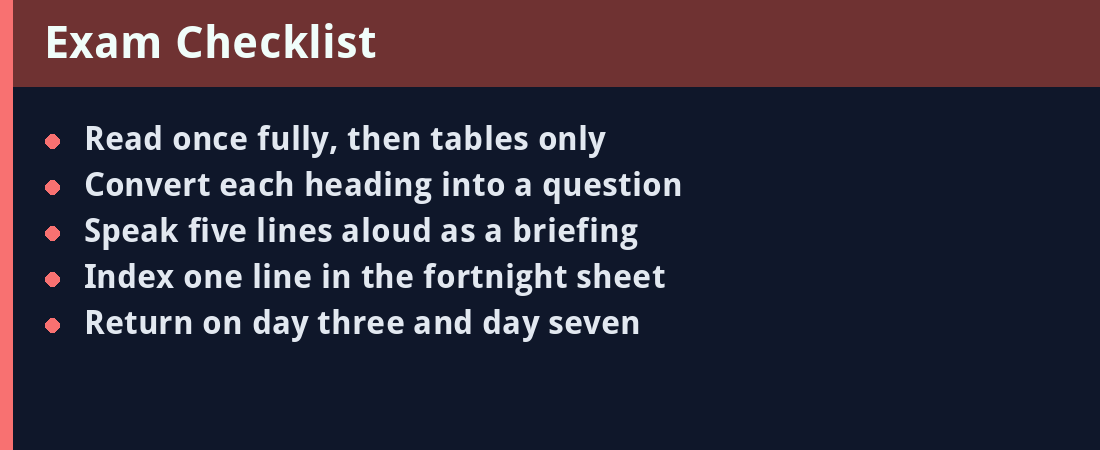
- Read once fully, then tables only
- Convert each heading into a question
- Speak five lines aloud as a briefing
- Index one line in the fortnight sheet
- Return on day three and day seven
FAQ
How much of this page is exam-relevant?
Nearly all of it, because the tables and worked items follow the standard question register for this subject.
When should I revisit?
Day three and day seven after the first read, with the drill spoken aloud once.
The Thirty-Second Recap
One page. One topic. Therefore, read the tables twice. Speak the recap once. Moreover, the numbers carry the marks. The names carry the traps. However, revisits beat rereads. Finally, day three and day seven. That is all.
Explain It Simply
Think of this page as a map of one neighbourhood. The big streets are the tables. The landmarks are the numbers. The street names are the terms in bold. However big the city feels, this one neighbourhood fits in a pocket, and a pocket map is what exam week needs. Therefore, walk it once fully, then walk only the streets you forget, and by the second walk the neighbourhood feels like home.
Pocket the map, not the whole city: exams reward the walkable version of every topic.
Abbreviations That Recur Here
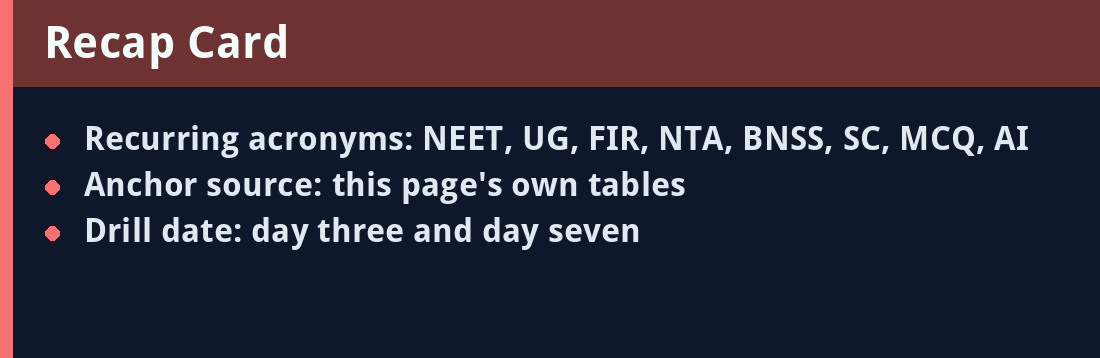
- NEET.
- UG.
- FIR.
- NTA.
- BNSS.
- SC.
- MCQ.
- AI.
Quick revision
- The leak and the exam.: The NEET UG 2026 paper-leak allegations — the newest storm in the cycle that began with the 2024 controversy (the cancelled-and-re-conducted episode…
- The protest week.: 20–25 July 2026: the arc ran from mobilisation to confrontation to police response — the injuries the Supreme Court’s compensation order…
- The FIRs.: First Information Reports were filed against students — the criminalisation of protest that the Court’s order squarely targeted.
- The order and the aftermath.: 1 September 2026: the Article 142 quashing-and-compensation order landed; by 5 September the opposition’s Delhi march was called off — the…
- The Article.: Article 142: the Supreme Court’s power to pass any decree or order “necessary for doing complete justice in any cause or matter pending…
- The order’s content.: Two deliverables: the FIRs against the student protesters quashed, and compensation awarded to students injured in the police action — the Court…
Have a doubt on this topic?