JEE/NEET Physics · Current Electricity series · Part 4 of 8 · All parts →
- EMF ε = the battery’s ideal push (open-circuit voltage); unit volt
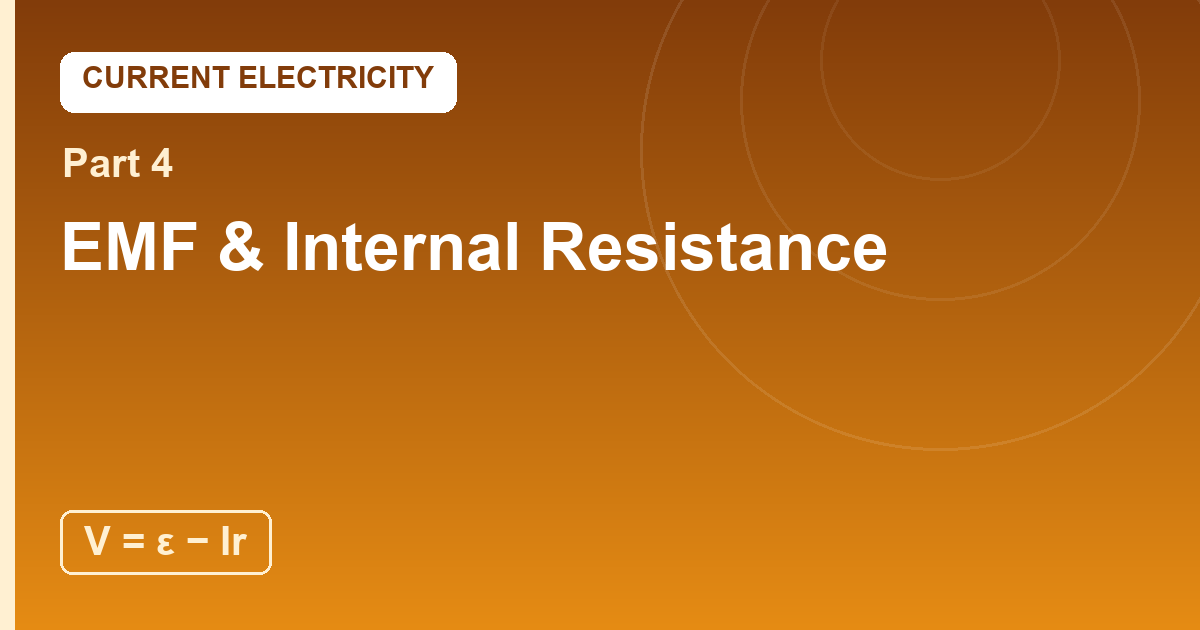
- Real batteries have internal resistance r: terminal V = ε − Ir
- Max current (short circuit) = ε/r — brief and violent
- Series cells: ε adds; parallel equal cells: same ε, shared r
- Maximum power transfer: R = r (but 50% efficiency inside the battery!)
A battery promises 1.5 V on the label and delivers slightly less the moment you use it. The difference isn’t lying — it’s the battery’s own internal resistance eating its share. Meet the battery’s honest resume. Part 4 of the Current Electricity series.
- EMF: the promise
- Terminal voltage: the reality
- Short circuit and max current
- Cell combinations
- Maximum power transfer
- Solved examples
- Common mistakes
- This physics in your daily life
- Practice set
- Recap
EMF: The Promise
EMF (electromotive force — a misleading old name: it’s energy per charge, not a force) is the total push the chemicals can deliver: measured with nothing connected, the ideal open-circuit voltage.
Terminal Voltage: The Reality
| Letter | What it means (plain words) | Value / unit |
|---|---|---|
| ε | EMF — chemical energy per coulomb | V |
| r | internal resistance | Ω; grows as batteries age |
| V | terminal voltage under load | V = ε only when I = 0 |
Short Circuit and Max Current
Connect the terminals directly (R = 0): I_max = ε/r — limited only by the battery’s own guts. A car battery (r ~ 0.01 Ω) can source thousands of amps: why dropping a wrench across terminals is a welding demonstration.
Cell Combinations
| Arrangement | EMF | Internal resistance | Use |
|---|---|---|---|
| n in series | nε | nr | high voltage |
| n parallel (equal) | ε | r/n | long life, high current |
| mixed (m rows × n) | nε | nr/m | both |
Maximum Power Transfer
External power peaks when R = r — but half the energy burns inside the battery. Audio amplifiers and RF circuits match for power; power grids deliberately mismatch for efficiency.
Solved Examples
I = 12/6 = 2 A; V = 12 − 2(0.5) = 11 V.
✔
Answer: 11 V
ε = 9; I = 7.2/4 = 1.8 A; r = (9−7.2)/1.8 = 1 Ω.
Two measurements, complete diagnosis — how battery testers work.
✔
Answer: ε = 9 V, r = 1 Ω
R = r = 2 Ω; I = 2.5 A; P = I²R = 6.25 W (with 6.25 W wasted inside — the 50% tax).
✔
Answer: R = 2 Ω, P = 6.25 W
- EMF = terminal voltage always. Only at zero current; every load makes V < ε.
- Adding EMFs in parallel. Parallel equal cells keep ONE ε — parallel adds current capability, not voltage.
- Internal r imaginary. It’s real resistance, obeying all the same laws — just living inside the casing.
- Matching for max power ≠ best efficiency. At R = r, efficiency is only 50%: exams love asking both numbers.
This Physics in Your Daily Life
- Phone batteries ‘die’ progressively — aging raises r: full charge (same ε) delivers sagging voltage under load until shutdown: retirement by internal resistance.
- Car batteries fail in winter dramatically — cold raises r while the starter demands hundreds of amps: V collapses, the groan you hear is ε − Ir in audio form.
- Jump-starting a car — a healthy donor battery’s low r carries the starter current: roadside assistance as internal-resistance engineering.
- Why cheap batteries fade fast in digital cameras — high pulsed currents punish any r: devices are essentially internal-resistance testers.
- Power tools’ lithium packs — cells in series (voltage) with parallel strings (current): your drill’s torque is cell topology made mechanical.
A water pump with narrow inlet pipes: the promise is full pressure, but every litre drawn fights the inlet’s own friction — the tap sees pressure drop the moment flow begins. The battery’s electrolyte and contacts are those narrow pipes: current through them costs voltage before the outside world gets any.
12 V battery, r = 0.1 Ω: at 2 A load, V = 11.8 (fine); at 50 A, V = 7 V (straining); at 120 A short, V = 0. The same healthy battery looks three ways at three loads — load testing IS measuring r.
Redraw the battery as an ideal push (ε) in series with a small resistor (r): every circuit then treats the pair as one honest source. The terminal arrow’s length visibly shrinks as I grows — the diagram is the equation.
Practice set (answers hidden — try first)
(NEET-level) ε = 6 V, r = 0.5, R = 5.5: terminal V =
(JEE Main-level) Open 9 V, loaded 8 V at 2 A: r =
(NEET-level) Short-circuit current of ε = 12, r = 0.1:
(Concept) Four 1.5 V cells in series give
(JEE Main-level) Max external power needs
- EMF = open-circuit promise
- V = ε − Ir under load
- I_max = ε/r (short circuit)
- series adds ε; parallel shares load
- max power at R = r (50% tax)
- 🔁 EMF vs terminal voltage
- 🔁 internal resistance model
- 🔁 cell combination table
- 🧠 Chant: ‘promise minus toll’.
- 🧠 Match rule: ‘R = r for power, efficiency cries’.
- 🏠 Daily: winter car groan = ε − Ir audible.
- 🏠 Daily: phone aging = rising r, dying voltage.
Quick revision
- EMF ε = the battery’s ideal push (open-circuit voltage); unit volt
- Real batteries have internal resistance r: terminal V = ε − Ir
- Max current (short circuit) = ε/r — brief and violent
- Series cells: ε adds; parallel equal cells: same ε, shared r
- Maximum power transfer: R = r (but 50% efficiency inside the battery!)
- Terminal voltage: the reality
Have a doubt on this topic?