

Banking Awareness: NPAs, the 90-Day Clock and SARFAESI to IBC Recovery
Banking stress questions run through every IBPS and mains cycle: NPAs, their classification clock, the recovery arsenal from SARFAESI to IBC, and the recent write-down era. This page fixes the ladder, the laws and the acronyms in one revision pass. Therefore, read the classification table first, then the recovery notes, then the drill.
- The NPA Ladder
- The Recovery Toolkit
- Why IBC Changed the Game
- Provisioning and Prudential Basics
- Five-Question Drill
- FAQ
- Is SARFAESI open to all lenders?
- Do IBC timelines hold?
- The Thirty-Second Recap
- Explain It Simply
- Rapid-Fire
- Abbreviations
- The Era Arc: From Twin Balance Sheet to Clean-Up
- The Vocabulary That Came With the Era
- How a Mock Frames This Block
- The One-Line Legalese
- The Numbers That Frame the Block
- A Closing Frame: Stress as a System Test
- Statement Practice, Self-Written
- The Page’s Closing Habit
- The Last Two-Minute Frame
- The Recovery Stat Sheet
- Key Takeaways
- Related reading
Contents: the NPA ladder, provisioning basics, the recovery toolkit table, ARCs and IBC logic, drill and mains framing.
The NPA Ladder
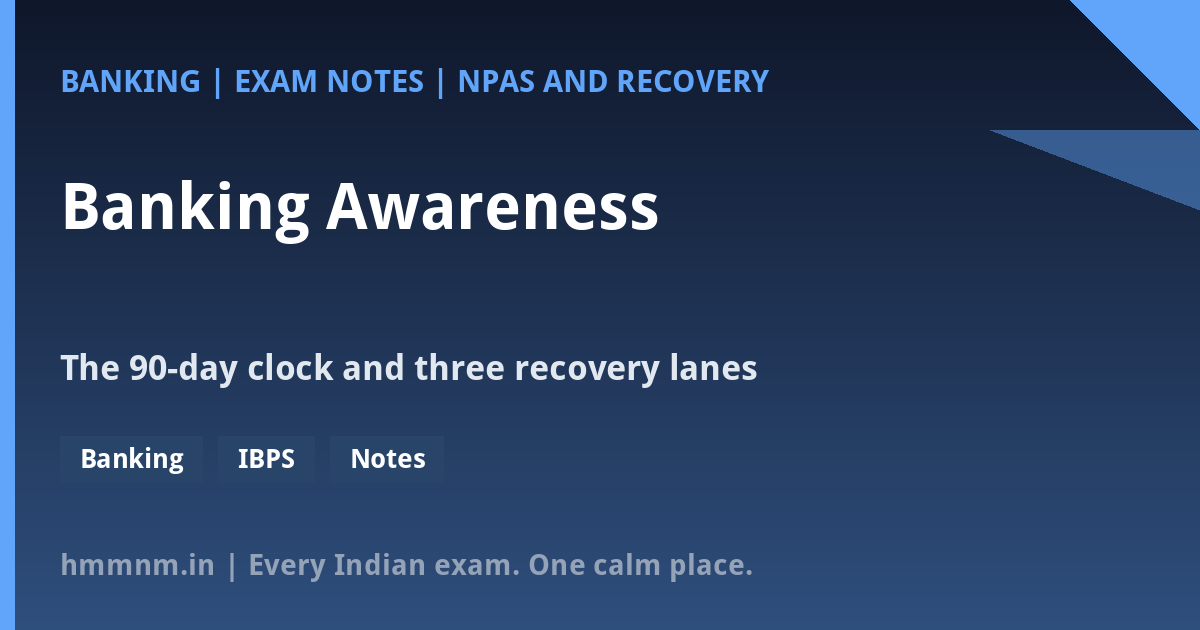
| Bucket | Overdue Period | Exam Hook |
|---|---|---|
| Sub-standard | Up to 12 months past due | First stress rung |
| Doubtful | Sub-standard thereafter | Security reliance fades |
| Loss asset | Identified by audit or bank | Write-down territory |
Moreover, the ninety-day trigger defines the NPA birth itself: interest or principal overdue beyond ninety days. Consequently, statement questions hang on that single number, therefore anchor ninety, twelve, and the loss classification together.
The Recovery Toolkit
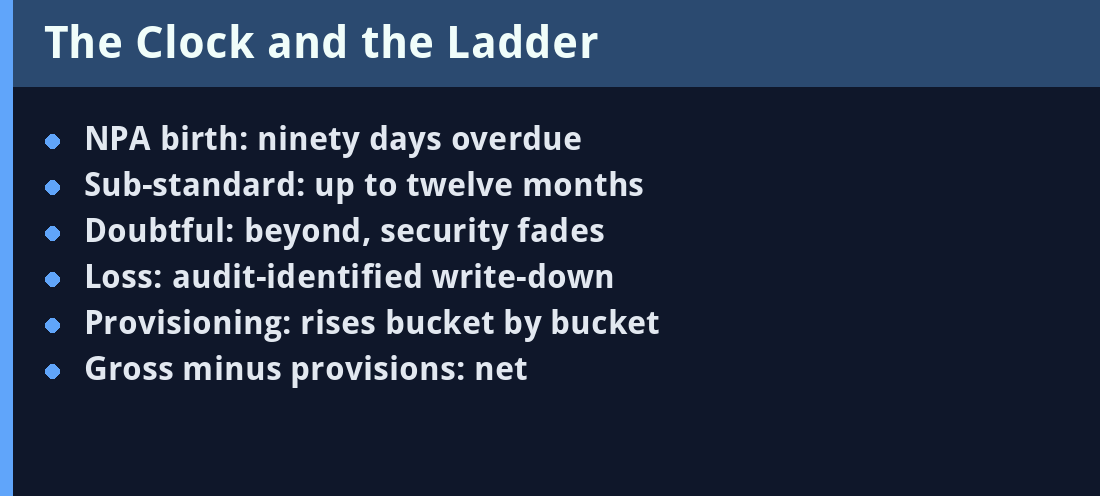
- SARFAESI, 2002: seize and sell secured assets without court, for secured creditors above thresholds.
- Debt Recovery Tribunals under RDDBFI, 1993: the adjudication route.
- Lok Adalats and compromise settlements ride the informal lane.
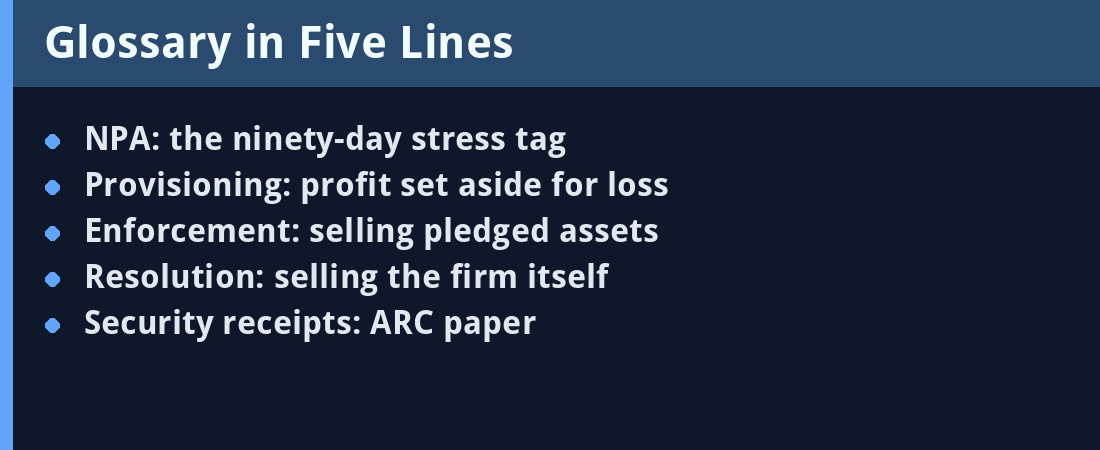
- ARCs buy stressed pools under the SARFAESI frame with security receipts.
- IBC, 2016: the resolution highway with timeline discipline.
Why IBC Changed the Game
The code inverts power: default pushes control to a committee of creditors, and timelines discipline everyone. Moreover, the resolution versus liquidation fork prices survival, therefore recovery percentages became market facts rather than negotiable moods. Consequently, mains answers cite the timeline discipline and the creditor-in-control doctrine as the two structural shifts.
Provisioning and Prudential Basics
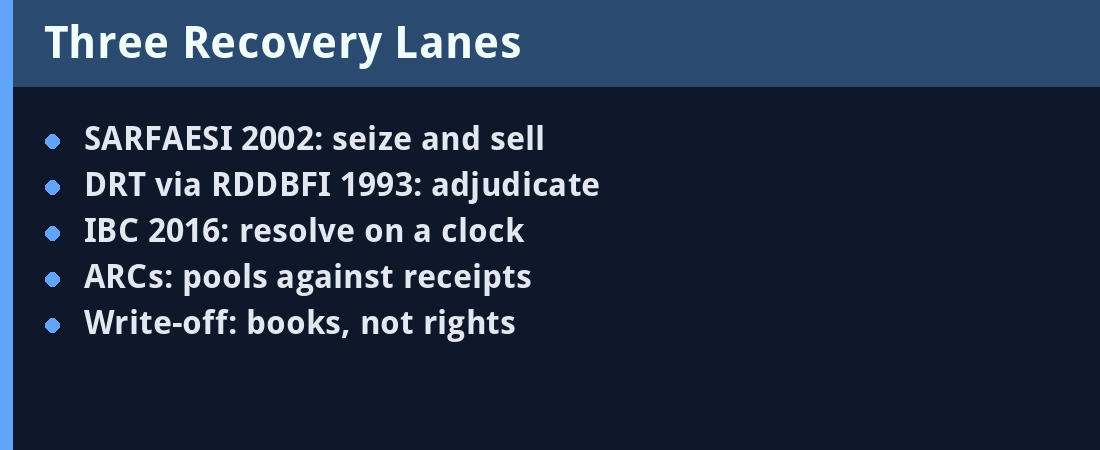
- Provisioning rises bucket by bucket as asset quality falls.
- Capital buffers absorb the provisioning shocks under Basel-aligned rules.
- Gross NPA counts total stressed stock; net NPA nets out provisions.
- Write-offs remove books, not recovery rights.
- The ARCs hold pools against security receipts, not cash guarantees.
A write-off is accounting’s mercy, not the debtor’s freedom – recovery rights survive the ledger.
Five-Question Drill
- An asset turns NPA when overdue beyond: Answer: ninety days.
- SARFAESI empowers: Answer: secured creditors to enforce without court.
- DRTs flow from: Answer: the RDDBFI Act, 1993.
- IBC resolution control rests with: Answer: the committee of creditors.
- Net NPA equals: Answer: gross NPA minus provisions.

FAQ
Is SARFAESI open to all lenders?
Secured creditors above the notified threshold, therefore fintech lenders ride via partners or courts.
Do IBC timelines hold?
The Thirty-Second Recap
One clock. Ninety days. Therefore, stress begins there. Buckets follow. Twelve months to doubtful. Loss ends the ladder. Moreover, recovery rides three lanes. SARFAESI seizes. DRT adjudicates. IBC resolves. However, write-offs keep rights alive. Finally, gross counts stock. Net nets provisions. Say both.
Explain It Simply
A bank lends like a gardener plants seeds. Most seeds grow. Some dry up. When a seed misses its water for ninety days, it is officially sick. The gardener watches it for a year, then calls it worse, then finally writes it off the map – but keeps the right to chase the seed’s owner. Recovery has three doors: grab the pledged pot and sell it, take the owner to a special court, or gather all lenders and sell the whole garden to a new owner on a clock. That is NPAs and recovery, told in a garden.
Rapid-Fire
- NPA trigger: ninety days overdue.
- Sub-standard rung: up to twelve months.
- SARFAESI year: 2002.
- DRT parent act: 1993.
- IBC year: 2016, creditor in control.
- Gross minus provisions: net NPA.
- ARC paper: security receipts.
- Write-off: books close, rights live.
Abbreviations
- NPA: non-performing asset.
- SARFAESI: secured asset enforcement law.
- DRT: debt recovery tribunal.
- IBC: insolvency and bankruptcy code.
- ARC: asset reconstruction company.
- RBI: the prudential regulator.
- CoC: committee of creditors.
- PSB: public sector bank.
The Era Arc: From Twin Balance Sheet to Clean-Up
Banking stress has an era arc examiners love. The 2013-16 years wore the twin balance sheet label: stressed corporate books facing stressed bank books. The 2016-19 clean-up combined recognition discipline with the IBC’s new stick, and recognition plus resolution pulled headline ratios down. Then the pandemic pause and its post-pandemic normalisation followed, with corporates deleveraged and bank capital buffers rebuilt. Consequently, mains answers that narrate recognition, resolution and recapitalisation as three moves of one strategy read like policy literature, and prelims keeps testing the vocabulary that arc produced.
The Vocabulary That Came With the Era
- Twin balance sheet: stressed firms and banks together.
- Recognition: honest classification of stress.
- Resolution: selling or restructuring the borrower firm.
- Recapitalisation: capital infusions into public banks.
- Bankruptcy code: the IBC’s formal name in statutes.
How a Mock Frames This Block
In bank mains GA sections, the block arrives as statement sets: the ninety-day rule paired with the SARFAESI threshold, or the CoC doctrine paired with the DRT route. Therefore, practise converting each line of this page into a true-false pair, because writing your own statements is the drill setters use. Moreover, interview boards ask one predictive question – where does stress build next – and the honest frame is unsecured retail bubbles and climate-stressed portfolios, both citable from recent RBI speeches, which turns a static page into a current-affairs answer.
The One-Line Legalese
Finally, memorise one statutory sentence: secured creditors may enforce security interests without the intervention of court, subject to the SARFAESI threshold. Therefore, when options paraphrase this power wrongly – courts involved, all lenders included – the sentence flags the trap instantly, and banking law questions become reading comprehension.
The Numbers That Frame the Block
Banking stress answers gain weight from a few anchored magnitudes. Gross NPA ratios, which once ran double-digit for public banks in the stress era, now sit near multi-year lows after the clean-up arc. Moreover, recovery through the IBC has returned substantial sums to creditors across cycles, though haircuts remain the sore point that interview boards probe. Therefore, carry three numbers loosely – the peak stress ratio, the current low band, and the scale of IBC recoveries – and update them quarterly from the RBI’s trend and progress report. Consequently, static law plus live numbers is the combination that distinguishes a prepared candidate from a memorised one.
Furthermore, the provisioning coverage ratio deserves one sentence: higher coverage means future shocks hurt profits less, which is why regulators cheer rising coverage even as it dents today’s bottom line. As a result, a single ratio connects law, accounting and policy in one line, which is exactly the kind of sentence mains evaluators circle.
A Closing Frame: Stress as a System Test
Close with the frame that makes this block memorable. Every stress episode tests three systems at once: the classification system that recognises truth, the legal system that prices it, and the capital system that survives it. Therefore, NPAs are never just bad borrowers; they are the economy asking whether its institutions can be honest together. Moreover, India’s arc – from denial, through recognition, to resolution – is exactly what development finance literature prescribes, which mains papers reward as applied understanding. Consequently, carry the three-system frame and every individual fact on this page finds its shelf, and shelves are what examination memories are actually made of.
Statement Practice, Self-Written
- Statement: SARFAESI applies to unsecured creditors first. Answer: false – secured creditors above thresholds.
- Statement: the CoC controls resolution under the IBC. Answer: true.
- Statement: loss assets must await court identification. Answer: false – banks and auditors identify them.
- Statement: provisioning falls as buckets worsen. Answer: false – it rises.
- Statement: security receipts guarantee ARC returns. Answer: false – they pass through recoveries.
The Page’s Closing Habit
Finally, end each banking-law revision by reciting the three dates and the one statutory sentence, because law papers reward exactness over eloquence. Therefore, ninety seconds of recitation keeps the lanes and the ladder sharp, and sharpness is the entire difference between a near-mark and a banked-mark in this section.
Moreover, the RBI’s quarterly trend and progress report keeps every number on this page current, and one table per quarter is all the maintenance this block ever needs.
The Last Two-Minute Frame
Therefore, when the paper asks about bad loans, give it the clock, the ladder and the three lanes in that order, and close with the three-system sentence about honesty, price and survival. That frame, more than any single act, is what this page was built to put in your pocket.
The Recovery Stat Sheet
| Lane | Law Year | Power |
|---|---|---|
| Enforcement | 2002 | Seize and sell |
| Adjudication | 1993 | Tribunal decree |
| Resolution | 2016 | CoC sale on clock |
Moreover, the three lanes together returned thousands of crores across recent cycles, with the IBC alone accounting for recoveries above 3 lakh crore rupees cumulatively, and peak gross NPA ratios above 11 percent for state banks in the stress era now resting below 3 percent system-wide. Therefore, the arc from 2016 to 2026 is a policy story with numbers attached, and mains answers quoting 2 or 3 of them read like research rather than recall.
Key Takeaways
In conclusion, hold the ninety-day clock, the bucket ladder, and the three recovery lanes with their founding years. To summarize, classification first, provisioning second, recovery third. Therefore, revise the table and drill once this week, and the banking-stress block banks itself.
References: the RBI’s master directions on IRAC norms, and the SARFAESI and IBC statutes.
Related reading
- IBPS PO Prelims Mock Test (September 16, 2026): 100 Questions in the Real Exam Pattern, Fully Explained — Day 7, 19 Days to Exam
- RBI's Monetary Policy Toolkit: Repo, SDF, MSF, OMO and the CRR-SLR Pair Explained
Quick revision
- SARFAESI, 2002: seize and sell secured assets without court, for secured creditors above thresholds.
- Debt Recovery Tribunals under RDDBFI, 1993: the adjudication route.
- Lok Adalats and compromise settlements ride the informal lane.
- ARCs buy stressed pools under the SARFAESI frame with security receipts.
- IBC, 2016: the resolution highway with timeline discipline.
- Provisioning rises bucket by bucket as asset quality falls.
Have a doubt on this topic?