Pulleys and Connected Bodies: Mastering Teams of Masses in Physics
JEE/NEET Physics · Laws of Motion series · Part 3 of 8 · All parts →
- One rope = one tension (ideal, massless) — masses tied together share the driver
- Bodies connected by a taut rope share the same speed magnitude (rope length is fixed)
- Method: FBD for EACH body → equations → solve together
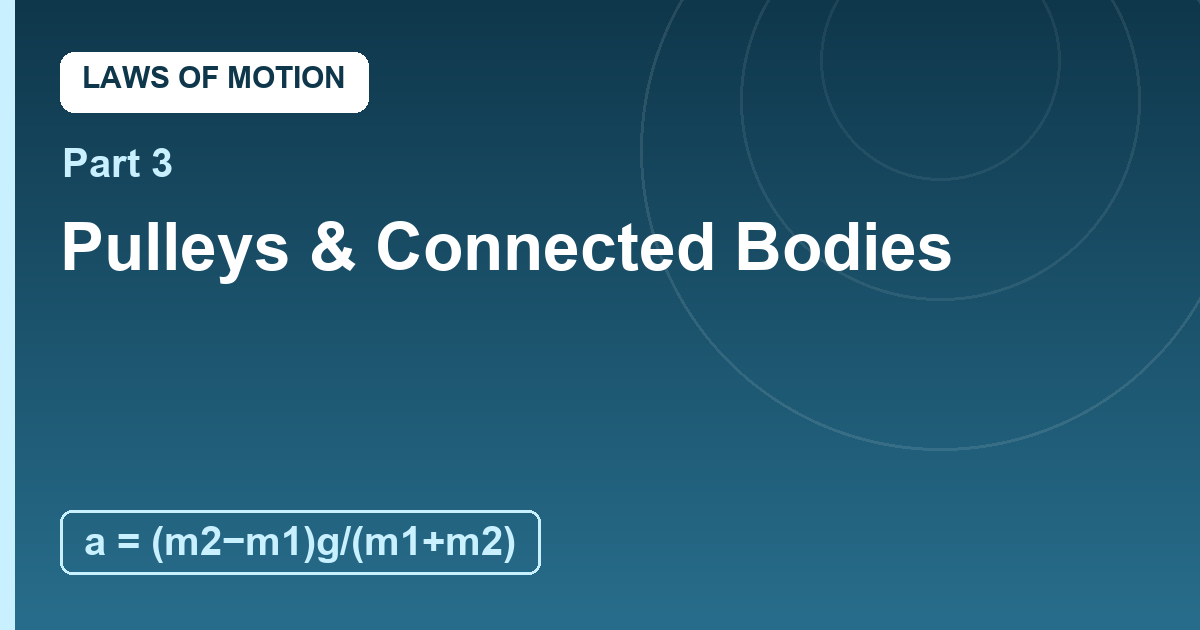
- Classic Atwood machine: a = (m₂ − m₁)g/(m₁ + m₂)
- Wedges and inclined planes: resolve gravity into mg sinθ (along) and mg cosθ (into surface)
Hitch two masses to one rope over a pulley and they become a single team: one acceleration, one shared fate. Pulley problems look like puzzles — they’re actually bookkeeping. Once you accept two simple rules and apply the free-body-diagram method from Part 2 to each body in turn, every connected-body problem collapses into routine algebra. This is Part 3 of the Laws of Motion series, and it covers the machinery behind half the mechanics questions you’ll meet in JEE and NEET.
- The rules of connected teams
- The Atwood machine
- The inclined plane split
- Combining: slope + pulley
- Solved examples
- Common mistakes
- This physics in your daily life
- Practice set
- Recap
The Rules of Connected Teams
Two rules govern every connected system, and both come straight from what an ideal rope is. (1) One ideal rope = one tension everywhere. An ideal rope is massless and frictionless through its pulleys, so the tension it transmits is identical at every point along its length. If you ever calculate two different tensions for the same rope, you’ve made a slip — differing values belong to different ropes or to real pulleys with mass. (2) A taut, inextensible rope makes all attached bodies move with the same speed. The rope cannot stretch or slacken, so if one end moves a metre, the other end must move exactly a metre too. One speeding up exactly as much as the other slows means their acceleration magnitudes are equal.
Combine these two constraints with the standard method — a separate FBD for each body, Newton’s second law written for each, then solve the equations together — and the system effectively solves itself. The rope’s rules supply the extra equations (“same T, same |a|”) that turn two unknowns-per-body into a solvable set.
The Atwood Machine
The classic setup: two masses hanging from a single rope over a frictionless, massless pulley. The heavier one sinks, the lighter one rises, and both share the same acceleration magnitude. Draw the FBDs — for m₁ the tension pulls up and weight pulls down; for m₂ it’s the same story — and write:
m₂g − T = m₂a (the heavier mass accelerates downward) and T − m₁g = m₁a (the lighter mass accelerates upward). Add the two equations and T vanishes, leaving:
Read the tension formula with intuition: T always sits between m₁g and m₂g. The heavier mass’s weight exceeds T (so it accelerates down) and the lighter mass’s weight falls short of T (so it accelerates up). If m₁ = m₂, then a = 0 and T = mg exactly — a perfectly balanced rope, static despite two forces fighting.
A useful one-line summary: the difference in weights pushes the total mass. The net driving force is (m₂ − m₁)g and the inertia being moved is (m₁ + m₂). That’s the entire Atwood machine in a sentence.
The Inclined Plane Split
On a slope at angle θ, gravity still points straight down — but the motion (or the tendency of motion) runs along the surface. So we resolve gravity into two perpendicular components:
- mg sin θ along the slope — the pulling part, the only piece that accelerates the block downhill;
- mg cos θ into the surface — the pressing part, which the surface must balance: N = mg cos θ.
Why these components? Because the block never leaves the surface, there’s no acceleration perpendicular to it — the surface’s normal force must exactly cancel mg cos θ. Everything left over, mg sin θ, is free to accelerate along the slope. For a frictionless slide:
Notice what’s missing: mass. Slope acceleration is mass-blind, exactly like free fall — the angle decides everything. Galileo’s insight about falling bodies applies just as well to sliding ones.
Combining: Slope + Pulley
The exam favourite: a block on a frictionless incline, connected by a rope over a pulley at the top to a hanging mass. Which way does the system move? Compare the drivers — the hanger’s weight mg against the slider’s down-slope component mg sinθ.
The method is the same three moves every time:
- FBD the slider: tension pulls up-slope; mg sinθ pulls down-slope; mg cosθ is cancelled by N.
- FBD the hanger: tension pulls up; weight mg pulls down.
- Add the equations to eliminate T — the rope’s tension is internal to the team and cancels in the sum.
You can even shortcut the addition: the net external driving force is the difference of the two “engines” (here mg − mg sinθ), and the total inertia is the sum of all masses. One division later, you have a.
Solved Examples
Difference pushes the total: (5−3)(10)/(8) = 2.5 m/s².
T = 2(3)(5)(10)/8 = 37.5 N.
Check: T must lie between the weights, 30 N and 50 N — 37.5 N sits exactly in between. ✔
Answer: a = 2.5 m/s²; T = 37.5 N
Only the along-slope component drives motion: a = g sin30° = 5 m/s² (g = 10).
Note: mass never entered the calculation — slope acceleration is mass-blind, like free fall. A feather and an elephant slide together. ✔
Answer: 5 m/s²
Slider’s down-slope engine: 4 × 10 × sin30° = 20 N; hanger’s engine: 3 × 10 = 30 N.
Since 30 N > 20 N, the hanger wins. Net external force on the 7 kg team: 30 − 20 = 10 N → a = 10/7 ≈ 1.43 m/s², hanger descending. ✔
Answer: ≈1.43 m/s², hanger down
- Different tensions on one rope. One ideal rope = one tension; differing values belong to different ropes or to massive pulleys, which need their own torque equations.
- Using g for the slide acceleration. Slope acceleration is g sinθ — only the along-slope gravity component drives it. Full g happens only at θ = 90°.
- Forgetting the team shares |a|. If the rope is taut, both bodies have equal acceleration magnitudes — that’s precisely what connects the two FBD equations into one solvable system.
- Writing N = mg on an incline. The surface feels only mg cos θ; the sin part is busy pulling the block downhill and never presses on the surface.
- Sign chaos when the direction reverses. Decide the direction of motion first (compare the engines), then write equations consistently with that choice. If a comes out negative, your guess was backwards — the magnitude is still right.
This Physics in Your Daily Life
- Construction cranes and hoists — hanging loads on cables are Atwood machines with an engine: cable tension is sized by m(g+a), never just mg, with safety factors of 5–10 built on top.
- Curtains and flag hoists — pulley systems let a small force lift awkward loads by trading distance for force: Atwood’s bargain, household edition.
- Wheelchair ramps and moving-truck ramps — gentle slopes reduce the effective pull from mg to mg sinθ: accessibility engineering is incline physics. A 10° ramp needs less than a fifth of the force of a vertical lift.
- Treadmills with incline settings — the machine tilts your run so gravity’s sinθ-component adds difficulty without extra speed: gym equipment doing resolved vectors on you.
- Rock-climbing belay devices — rope tension and friction manage a falling partner: connected-body physics with lives attached.
- Childhood see-saws and well pulleys — the village well pulley is a one-rope, one-tension system in daily service for centuries.
A tug-of-war team and its rope are one linked creature: no point of the rope can stretch, so when one end moves a metre, the other end moves a metre — maybe in another direction, but by the same amount. Same distance each second means same speed, and the same speed-change each second means the same acceleration. The rope enforces democracy.
Atwood with 3 and 5 kg: the weight difference (20 N) pushes the total inertia (8 kg): a = 20/8 = 2.5 m/s². Both masses read exactly this — the 5 kg down, the 3 kg up. Make it 3 and 3: difference zero, a = 0 — perfect balance, the rope a statue.
Draw both FBDs side by side with the rope connecting the tension arrows: T pulls the heavy mass UP (it loses the tug) and the light mass UP too (it wins the ride). Down-arrows are the weights. Slide the equations together and T cancels in the sum — the system’s equation only cares about external pulls.
Practice set (answers hidden — try first)
(NEET-level) 2 kg and 4 kg Atwood (g=10): a =
(JEE Main-level) Frictionless 45° incline: a =
(NEET-level) N on a 30° incline for a 10 kg block:
(Concept) Atwood with equal masses: acceleration =
(JEE Main-level) 3 kg slides freely down 37° (sin37°≈0.6): a =
- one rope, one tension; taut rope, one |a|
- Atwood: a = (m₂−m₁)g/(m₁+m₂) — “difference pushes the total”
- incline: a = g sinθ, N = mg cosθ
- FBD each body, then combine
- internal tensions cancel in the sum
- 🔁 connected-team rules
- 🔁 Atwood formulas
- 🔁 incline resolution
- 🧠 Chant: ‘difference pushes the total’.
- 🧠 Slope split: ‘sin slides, cos clings’.
- 🧠 Sanity check: T always sits between the two weights; a always between 0 and g.
- 🏠 Daily: ramps make loads mg sinθ-light.
- 🏠 Daily: crane cables sized by m(g+a), not mg.
Quick revision
- One rope = one tension (ideal, massless) — masses tied together share the driver
- Bodies connected by a taut rope share the same speed magnitude (rope length is fixed)
- Method: FBD for EACH body → equations → solve together
- Classic Atwood machine: a = (m₂ − m₁)g/(m₁ + m₂)
- Wedges and inclined planes: resolve gravity into mg sinθ (along) and mg cosθ (into surface)
- The rules of connected teams
Have a doubt on this topic?