


IBPS PO Prelims Quant: Master Simplification to Data Interpretation
Quantitative Aptitude decides IBPS PO Prelims destinies more than any other section, because it carries 35 questions inside a 20-minute window. Therefore, selection – not coverage – is the real skill. This page ranks the scoring topics, sets an 18-day speed plan, and works through the calculation habits that separate a 14-mark stumble from a 22-mark clearance.
- The Section in Numbers
- The High-Yield Ranked List
- Speed-Math Foundations Worth 40 Hours
- The 18-Day Schedule
- The Review Protocol That Compounds
- Five-Question Drill with Answers
- Exam-Day Attempt Order
- FAQ
- How many mocks are enough?
- Should arithmetic be attempted in prelims at all?
- A Worked Data Interpretation Caselet
- Calculation Techniques That Compound
- The Arithmetic Question Selection Filter
- The Week Structure That Survives Jobs and College
- What to Do When Scores Plateau
- One Honest Paragraph on Fear
- The Night-Before Protocol
- In Short: The Plain-English Summary
- Glossary in Five Lines
- The Thirty-Second Recap
- Explain It Simply: The Quant Clock for a Twelve-Year-Old
- Key Takeaways
IBPS PO Prelims 2026: The English 30-Marks Scoring Plan in 18 Days
Banking Awareness for IBPS and RRB: Account Types and KYC Basics Explained
Contents: section arithmetic, topic weightage table, the high-yield ranked list, speed-math foundations, an 18-day schedule, a five-question drill and exam-day attempt order.

The Section in Numbers
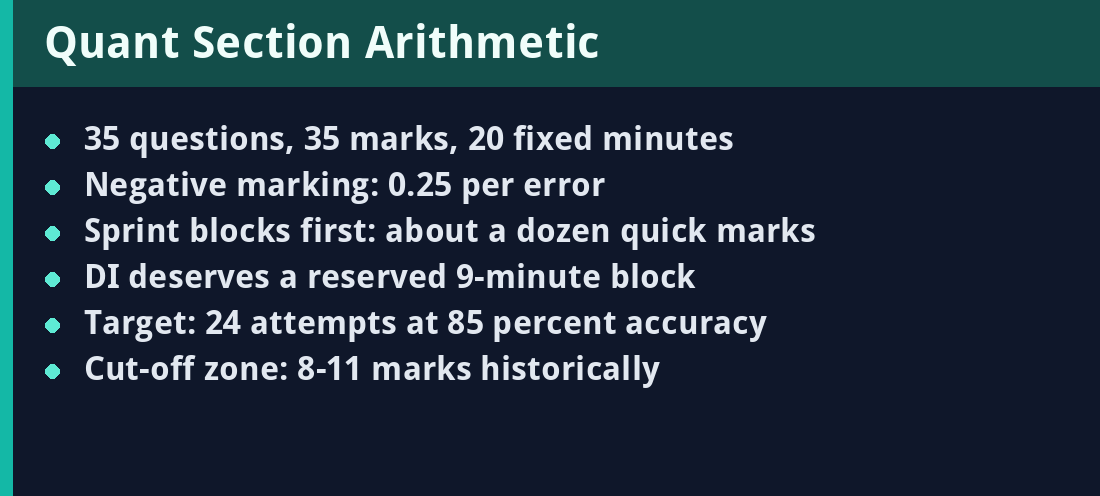
The prelims paper places 35 quant questions for 35 marks in a fixed 20-minute sectional window, with 0.25 negative marking per error. Consequently, roughly 34 seconds exist per question if you attempt everything, which no topper does. Meanwhile, sectional cut-offs for quant typically sit near 8-11 marks, while serious contenders target 18-plus. Therefore, the arithmetic of selection follows: about 24 attempts at 85 percent accuracy yield roughly 19-20 marks after penalties.
| Topic Block | Expected Share | Preparation Payoff |
|---|---|---|
| Simplification and approximation | 8-10 questions | Highest marks per minute |
| Data interpretation | 10-12 questions | Decides the section |
| Arithmetic word problems | 8-10 questions | Deep but slow |
| Number series | 4-5 questions | Pattern practice pays |
| Quadratic comparisons | 3-5 questions | Formula-fixed and quick |
Moreover, the two sprint blocks – simplification and quadratic – together offer about a dozen fetchable marks in under seven minutes. Therefore, they open every attempt plan on this page.
The High-Yield Ranked List
- Simplification and approximation: percentage equivalents, root-square fluency, BODMAS discipline.
- Quadratic comparisons: root comparison without solving fully when signs permit.
- Number series: wrong-number and missing-number patterns from previous papers.
- Data interpretation: tables, caselets, and ratio-heavy charts.
- Arithmetic: ratio, percentage, profit-loss, time-work, and averages in that order.
Speed-Math Foundations Worth 40 Hours
- Tables to thirty, squares to forty, cubes to twenty – non-negotiable memory work.
- Fraction-percentage equivalents: one-eighth is 12.5 percent, one-twelfth is 8.33 percent, and so on to one-twentieth.
- Successive percentage change: plus 20 then minus 10 compounds to plus 8, not plus 10.
- Ratio scaling: a 3:5 split of 96 means 36 and 60 – practise seeing products, not variables.
- Approximation guardrails: round early, but never both operands in the same direction on subtraction.
Consequently, twenty focused hours on these five habits typically add five marks, because calculation time converts directly into attempted questions. Meanwhile, error logging keeps the speed honest: every silly mistake enters a notebook with its cause circled.
The 18-Day Schedule
- Days 1-4: speed-math foundations plus 30 simplification questions daily.
- Days 5-8: two DI sets daily plus quadratic comparisons every alternate day.
- Days 9-13: arithmetic blocks, one topic daily with previous-year sets.
- Days 14-16: full 20-minute sectionals, two daily, with review evenings.
- Days 17-18: error-log reading plus one light sectional at exam timing.
The Review Protocol That Compounds
Every sectional earns a 30-minute autopsy: classify each miss as concept, calculation, or misreading. Therefore, concept gaps route back to topic days, calculation slips route to speed drills, and misreadings route to a slower question-stem ritual. Moreover, track the three counts on paper across the fortnight, because watching misreadings fall is the morale needle that matters. Consequently, review time is never lost practice time; it is the practice that pays interest.
Quant prelims is not a maths exam; it is a selection exam conducted in maths.
Five-Question Drill with Answers
- Simplify: 144 multiplied by what gives 20,736? Answer: 144, since 144 squared is 20,736.
- Series: 2, 6, 12, 20, 30, ? Answer: 42. Differences run 4, 6, 8, 10, then 12.
- Quadratic: x-squared minus 7x plus 12 equals zero; y-squared minus 5y plus 6 equals zero. Answer: x is greater than or equal to y. Roots are 3,4 against 2,3.
- Simple interest: 12,000 rupees at 8 percent for 3 years. Answer: 2,880 rupees, from principal times rate times time over hundred.
- Average: eleven numbers average 50; removing one leaves 49. Answer: 60, because 550 minus 490 is 60.
Exam-Day Attempt Order
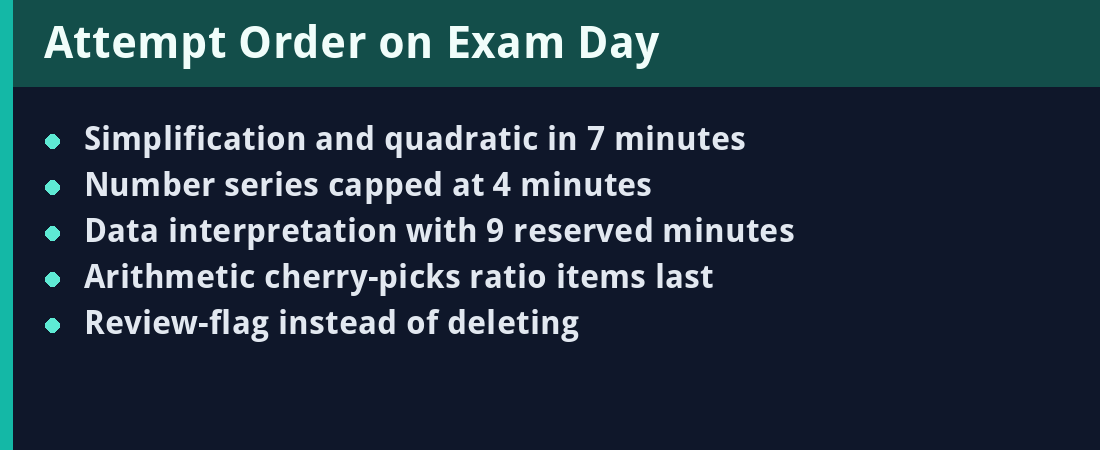
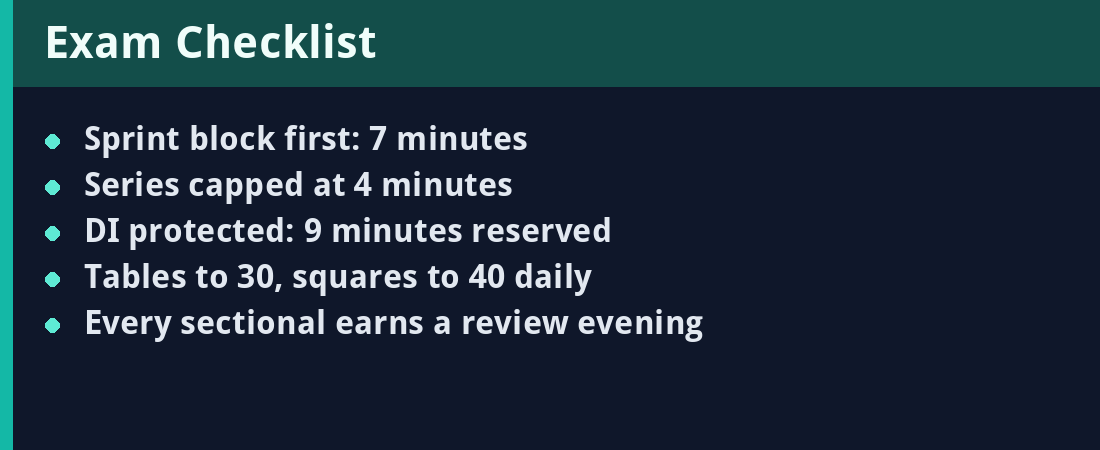
Firstly, clear simplification and quadratic in the opening seven minutes. Secondly, take series next at a hard four-minute cap. Thirdly, walk into data interpretation with nine minutes reserved. Finally, arithmetic gets whatever remains, choosing ratio and percentage items first. However, honour the caps without negotiation, because the sectional clock does not renegotiate. In addition, mark for review rather than deleting, since review-flagged items earn a second look if minutes remain.
FAQ
How many mocks are enough?
Ten reviewed sectionals beat thirty unreviewed ones. Therefore, review depth sets the ceiling, not mock count.
Should arithmetic be attempted in prelims at all?
Cherry-pick only ratio and percentage items. Meanwhile, full arithmetic coverage belongs to mains preparation.
A Worked Data Interpretation Caselet
Consider a table every prelims pattern loves: branch sales of a bank across four quarters, in crores. Branch Alpha posts 40, 50, 60 and 70; Branch Beta posts 50, 50, 55 and 65. Total annual sales stand at 130, 155, 175 and 195 across the four quarters. Now watch the question types that follow, because the arithmetic is always percentage, ratio or average in costume.
- Alpha’s Q2-to-Q4 growth: 70 on 50 is 40 percent, computed as two-fifths of the base.
- Beta’s annual total is 220 against Alpha’s 220, therefore the annual ratio is exactly one to one despite different shapes.
- The Q1 share of the annual 655-crore total is 130 on 655, roughly one-fifth.
- Quarterly growth of the combined figure: 155 on 130 is about 19 percent, then 175 on 155 near 13, then 195 on 175 under 12 – note the decelerating sequence exams love to test.
Consequently, one two-row table generated four distinct skills in under three minutes. Therefore, practice DI by predicting the question before reading it: growth, share, ratio, average, trend. Moreover, write the totals before the questions arrive, because pre-computed row and column sums convert two-step questions into one-step recall.
Calculation Techniques That Compound
- Convert percentages to fractions: 37.5 is three-eighths, 16.67 is one-sixth, 83.33 is five-sixths.
- Chain multiplications through factors: 24 percent of 250 equals a quarter of 250 minus one percent of 250.
- Use options as bounds: when answers spread widely, approximate aggressively and select.
- Divide by doubling: 720 by 45 equals 1440 by 90, therefore sixteen.
- Anchor squares: knowing 37 squared is 1369 solves many series and root questions instantly.
The Arithmetic Question Selection Filter
Inside the exam, apply a three-second filter to every word problem. Firstly, is the topic ratio, percentage, or average? Attempt immediately. Secondly, is it time-work or profit-loss with clean numbers? Attempt second. Thirdly, anything involving multi-stage journeys, mixtures with unknowns, or combined pipes goes to the last pass or the bin. Consequently, the filter converts a 35-question mountain into a scripted route of about 24 stops.
The Week Structure That Survives Jobs and College
Candidates preparing alongside jobs or classes need a weekly template rather than a daily fantasy. Therefore, structure the week as four engine days of ninety quant minutes, two skill days of sixty minutes each, and one review day where no fresh topic opens. Moreover, front-load mornings with speed drills when the mind is clean, and reserve evenings for error-log reading when energy dips. Consequently, the plan bends without breaking, because the structure lives in the week, not in any single heroic day.
Furthermore, protect the Sunday full-length sectional as a fixed appointment, since calibration under fatigue separates exam readiness from practice comfort. As a result, eighteen such Sundays produce both skill and temperament, which is precisely what the twenty-minute window tests.
What to Do When Scores Plateau
Every serious candidate hits a two-week plateau where scores refuse to climb. Therefore, diagnose before doubling effort: usually the cause is either stale practice material or unreviewed error patterns. Firstly, swap at least half your material for previous-year papers, because register familiarity matters. Secondly, reread the entire error log in one sitting and mark the three recurring causes. However, resist the urge to add more mock hours, because plateaus signal processing debt, not effort debt. Consequently, the climb resumes within a week for nearly every candidate who reviews instead of repeating.
One Honest Paragraph on Fear
Quant anxiety is the quiet tax most candidates pay daily, therefore address it directly rather than performing confidence. Fear shrinks when procedure replaces improvisation: the fixed attempt order, the fixed caps, the fixed review ritual all convert an open-ended threat into a closed checklist. Moreover, candidates who write their plan on paper and read it before every sectional report measurably lower their pulse on exam day, because the brain trusts rehearsal over optimism. Consequently, the final strategy is not a secret technique but a written, rehearsed routine that survives contact with the clock.
The Night-Before Protocol
Sleep, not study, is the final revision tool, therefore the night-before protocol closes the books at nine. Pack the admit card, identity document, photographs and water bottle against a checklist, because routine packing removes morning decisions. Moreover, rehearse the attempt order one final time by reading the written plan, and then hand the day over to preparation already completed. Consequently, the morning self arrives rested, equipped and scripted, which is the entire point of eighteen disciplined days.
Finally, remember what the sectional window actually certifies: composure under arithmetic pressure, nothing more and nothing less. Therefore, every drill on this page was really composure training wearing a mathematics costume, and eighteen days of it reliably shows up as steady hands on the mouse during the real twenty minutes.
In Short: The Plain-English Summary
In short, quant rewards selection. The window is 20 minutes. Therefore, sprint items open the paper. Series follows. Data interpretation gets nine protected minutes. However, arithmetic comes last, by choice. Moreover, memory work buys speed. As a result, tables and squares pay rent daily. In addition, the review protocol turns misses into marks. Finally, write the plan down. Trust the script on exam day. That is the whole framework.
- Sprint block first: 7 minutes
- Series capped at 4 minutes
- DI protected: 9 minutes reserved
- Tables to 30, squares to 40 daily
- Every sectional earns a review evening
Glossary in Five Lines
- Sprint block: simplification plus quadratic
- Fraction equivalents: one-eighth is 12.5 percent
- Caselet: a story-wrapped data set
- Person-days: workers times days equals work
- Review protocol: classify, rewrite, re-attempt
The Thirty-Second Recap
Thirty-five marks. Twenty minutes. Therefore, selection beats coverage. Sprint first. Series second. Data third. However, protect nine minutes for tables. Moreover, tables pay rent daily. Squares pay rent daily. Log every miss. Review every log. As a result, speed turns into attempts. Finally, write the plan. Read the plan. Run the plan.
Explain It Simply: The Quant Clock for a Twelve-Year-Old
The maths part of the bank exam is a race, not a test of deep maths. You get thirty-five marks worth of questions and twenty minutes on the clock. That is about half a minute for each try. Therefore, you must pick your fights. Some sums take ten seconds. A good example is two times two. Some sums take two minutes. A hard puzzle is like that. The smart runner does the fast sums first. Then, with time left, the runner tries one or two long ones.
Think of a fair with many stalls. Each stall gives one ticket for a right answer and takes a quarter ticket for a wrong one. You would not guess at random, since wrong guesses cost you. So you play the stalls you know. Moreover, you learn your times tables by heart, just like a cricketer learns to catch. Tables up to thirty. Squares up to forty. These are your gloves and bat. In addition, the data tables in the paper are like scoreboards: read them once, write the totals, and half the questions answer themselves. Finally, keep one page with your plan. On the big day, you do not think. You just run the plan.
Key Takeaways
In conclusion, quant prelims rewards a fixed selection order, sprint-first, with data interpretation protected by a reserved nine-minute block. To summarize, memory work on tables and equivalents buys speed, error logs buy accuracy, and caps buy attempts. Therefore, run the 18-day plan exactly as written, and walk in with a selection strategy instead of a syllabus.
References: ibps.in for pattern, previous-year papers for weightage, and rbi.org.in data pages for DI-grade number sense.
Quick revision
- Simplification and approximation: percentage equivalents, root-square fluency, BODMAS discipline.
- Quadratic comparisons: root comparison without solving fully when signs permit.
- Number series: wrong-number and missing-number patterns from previous papers.
- Data interpretation: tables, caselets, and ratio-heavy charts.
- Arithmetic: ratio, percentage, profit-loss, time-work, and averages in that order.
- Tables to thirty, squares to forty, cubes to twenty – non-negotiable memory work.
Have a doubt on this topic?