Uniform Circular Motion: Why Constant Speed Doesn’t Mean Constant Velocity
JEE/NEET Physics · Motion in a Plane series · Part 5 of 6 · All parts →
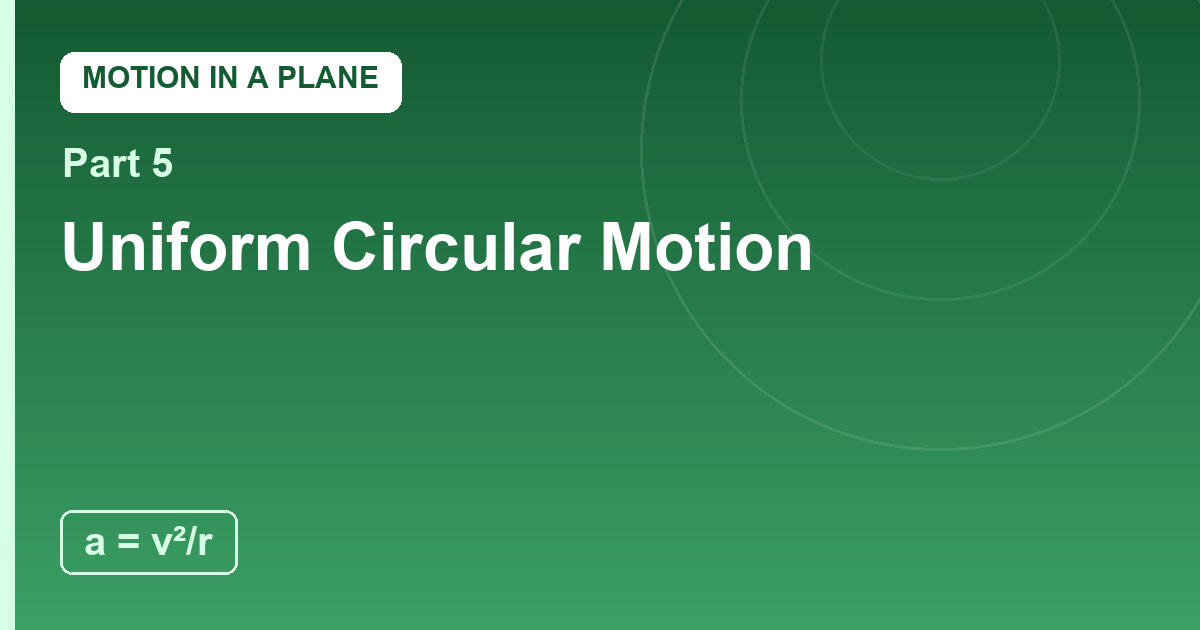
- Uniform circular motion (UCM): constant SPEED, continuously changing VELOCITY — because the direction of motion keeps turning
- Because velocity changes, there IS acceleration — centripetal acceleration, a_c = v²/r, always pointing toward the centre
- It is NOT constant acceleration in the Part 2 sense: the magnitude is constant, but the direction of a keeps rotating
- Period, frequency and speed link up neatly: v = 2πr/T
- “Centripetal force” is a ROLE, not a new force: gravity, tension, friction, or normal forces supply it in different situations
A car rounding a bend at a steady 60 km/h is accelerating — its speedometer hasn’t moved, but its velocity is turning, and turning velocity is acceleration. There’s nowhere to hide from a = change-in-velocity. This card unpacks that paradox, derives centripetal acceleration, and shows you exactly which real force plays the centre-seeking role in every scene — from car tyres to the Moon. It’s Part 5 of the Motion in a Plane series.
- Speed constant, velocity not
- Centripetal acceleration
- The v²/r surprise
- Deriving v²/r from geometry
- Period, frequency, speed
- Who plays the centripetal role?
- Solved examples
- Common mistakes
- This physics in your daily life
- Practice set
- Recap
Speed Constant, Velocity Not
Drive around a circle at exactly 20 m/s. After a quarter turn, your velocity is 20 m/s north instead of 20 m/s east: same speed, different direction — so the velocity CHANGED, and changed velocity means accelerated motion. Uniform circular motion is acceleration in its purest disguise.
Why does this trip up so many students? Because everyday language uses “accelerating” to mean “speeding up.” Physics is stricter: acceleration is any change in the velocity vector — its magnitude, its direction, or both. In straight-line motion (Parts 1–3), direction stayed fixed, so acceleration meant speed change. Now the speed is fixed, and direction change alone carries the entire burden. One vector, two ways to change it — circular motion exercises the way you’ve never practised.
So when we say “uniform” circular motion, “uniform” refers only to the speed — the motion is anything but uniform in the vector sense. The velocity vector sweeps around like the second hand of a clock: constant length, ceaselessly rotating.
Centripetal Acceleration
Since velocity changes, Newton’s second law demands an acceleration. For circular motion at constant speed, that acceleration has a name and a strict job description: it must be centripetal — literally “centre-seeking.” It acts at every instant along the radius, pointing from the particle toward the centre of the circle, perpendicular to the velocity.
Why perpendicular? Consider what would happen if the acceleration had any component along the velocity. A forward component would increase the speed; a backward component would decrease it. But uniform circular motion requires the speed to stay constant — so the acceleration must have zero component along v. The only direction perpendicular to the velocity at any point on a circle is along the radius. Hence: acceleration points to the centre, always and exactly. It turns the velocity without ever touching its length.
| Letter | What it means (plain words) | Value / unit |
|---|---|---|
| a_c | centripetal acceleration (magnitude) | m/s², aimed at the centre |
| v | constant speed along the circle | m/s |
| r | radius of the circle | m |
| ω | angular speed — radians swept per second (ω = v/r) | rad/s |
| T | period — time for one full lap | s |
The v²/r Surprise
The formula hides two dramatic behaviours. Read it as a physics story:
Double your speed → FOUR times the required acceleration (v appears squared). Halve the radius (a tighter turn) → double the acceleration (r sits in the denominator). Fast and tight is the worst combination on the road — each factor compounds the other.
This is exactly why tight bends carry low advisory speed limits, and why the second before a crash punishes speed so brutally: the v² grows violently. A car at 80 km/h doesn’t need twice the sideways grip of the same car at 40 km/h — it needs four times. When the available friction runs out, the car simply continues straight, off the road: the tyres could no longer supply the demanded a_c.
Deriving v²/r from Geometry (Why It’s v²/r and Not Something Else)
You don’t have to take the formula on faith. Here’s the classic geometric argument, which examiners love:
At two nearby moments, the particle is at points P and Q on the circle, with velocity vectors v and v′ of equal length, each tangent to the circle. Place them tip-to-tail: the change in velocity, Δv = v′ − v, is a small vector pointing roughly toward the centre. The angle between the two velocity vectors equals the angle Δθ swept at the centre (tangents rotate by the same angle as the radii).
For small Δθ: the arc length PQ ≈ v Δt, and the chord Δv ≈ v Δθ. Dividing: Δv/Δt ≈ v (Δθ/Δt) = vω. Since ω = v/r, we get a_c = vω = v²/r. Two speeds and a radius — pure geometry, no new physics needed. The same result in angular language: a_c = ω²r.
Period, Frequency, Speed
One full lap covers a distance of 2πr in time T, so the speed is simply distance over time: v = 2πr/T. The frequency f (laps per second) is the reciprocal of the period, f = 1/T, giving the handy family of equivalent forms: v = 2πrf and a_c = 4π²f²r. Exams frequently hand you rpm (revolutions per minute) — convert first: divide by 60 to get revolutions per second.
For a sense of scale: the Earth’s orbit sweeps 2π × 1.5×10¹¹ m over one year (≈ 3.15×10⁷ s) → about 30 km/s. The same formula that times a fan blade times a planet — that’s the power of a good equation.
Who Plays the Centripetal Role?
Newton’s second law says F = ma_c for circular motion. But notice: there is no separate “centripetal force” in nature. The phrase is a job description — whatever real force points toward the centre and has the right magnitude fills the role. Identifying the actor is the central skill in every circular-motion problem:
| Scene | Force providing the centripetal pull |
|---|---|
| Ball on a string | tension |
| Car on a flat bend | friction (tyres) |
| Moon around Earth | gravity |
| Electron around nucleus (classic picture) | electrostatic attraction |
| Clothes in a spin dryer | the drum’s normal push |
| Car at the top of a convex hill / bottom of a dip | the combination of gravity and normal force |
| Banked road (frictionless) | the horizontal component of the normal force |
A quick worked sketch of the flat-bend case: friction supplies the centre-seeking force, so μmg ≥ mv²/r, which rearranges to v ≤ √(μgr). This single inequality answers an entire family of exam questions about safe cornering speeds.
Solved Examples
a_c = v²/r = 5²/25 = 25/25 = 1 m/s². Then F = ma_c = 60 × 1 = 60 N, directed toward the centre. (In practice, it’s friction from the track that supplies this.)
✔
Answer: 1 m/s²; 60 N toward the centre
Friction must supply the full centripetal force: mg·μ = mv²/r → μ = v²/(gr) = 400/(50 × 10) = 0.8.
Sanity check at 28 m/s: μ = 784/500 ≈ 1.57 — impossible on dry asphalt (μ rarely exceeds ~1). The v² has spoken: the car slides. ✔
Answer: μ = 0.8
Same ω → use a_c = ω²r: B has 4× the radius → a_B = 4 a_A.
But watch the trap: if instead B moved at the same LINEAR speed as A, we’d use a_c = v²/r, and B’s larger radius would give a QUARTER of A’s acceleration. Same letter pair, opposite outcomes — the question’s phrasing (same ω vs same v) decides which form to use. Always read carefully. ✔
Answer: a_B = 4a_A (same ω); a_B = a_A/4 (same v)
- ‘Constant speed means no acceleration.’ Only in straight lines; on any curve, direction-change alone is acceleration. Check the velocity vector, not the speedometer.
- Centrifugal fantasy. In the ground frame there is no outward force — the outward ‘shove’ you feel in a turning car is your body’s inertia obeying Newton’s first law while the car turns inward around you. “Centrifugal force” is a bookkeeping device for rotating frames, never a real force in an inertial frame.
- Treating a_c as constant acceleration. Its magnitude is constant, but its direction rotates every instant — the Part 2 kinematic equations (v = u + at, s = ut + ½at², etc.) do NOT apply to circular motion.
- Inventing a new force. ‘Centripetal force’ is a job description: tension, friction, gravity or a normal force must already exist to take the job. Never draw a free-body diagram with an extra arrow labelled ‘centripetal force’.
- Forgetting to convert rpm or km/h. rpm → revolutions per second (÷60); km/h → m/s (÷3.6). Half the numerical errors in this chapter are unit slips.
This Physics in Your Daily Life
- Seatbelts exist because of v²/r — in a bend, the car turns (friction supplies a_c) while your body tries to continue straight: the belt plays the centripetal role your seat refuses to.
- Clothes dryers fling water outwards-through-the-holes — the drum turns the clothes; the water, lacking a centripetal supplier once the drum wall ends, continues straight and escapes through the holes: ‘spin dry’ is Newton’s first law doing laundry.
- Cemetery bends, hairpin mountain roads — engineers reduce r only as much as friction allows: every advisory speed sign is a_c = v²/r solved for v.
- Satellites and the ISS — gravity IS the centripetal force: astronauts at 8 km/s fall around the planet forever (the Gravitation series told this story).
- Cyclists and bikers lean into turns — leaning lines up the resultant of gravity and the normal force through the centre of the curve: your body angle is chosen so that resultant supplies exactly ma_c.
- Banked highway curves — the road tilts so the normal force’s horizontal component provides part of the centripetal force, reducing the burden on friction. The optimum banking angle satisfies tan θ = v²/(gr).
A passenger with closed eyes in a steadily turning car can’t see the turn — but feels it: something keeps nudging them sideways. The speedometer says nothing changed; the body says everything did. What changed is direction, and the body, unlike the speedometer, tracks velocity — a full vector.
At 10 m/s on a 20 m circle: a_c = 100/20 = 5 m/s² — half a g, felt clearly. Double the speed to 20: 20 m/s² — two g, bone-shaking. Same bend, same car: the acceleration quadrupled because only the direction-turning rate demanded it. Tighten to r = 10: doubles again.
Draw the velocity arrows at successive moments around the circle: all the same length, each aimed along a new tangent. Copy them tip-to-tail: their differences are tiny arrows all pointing INWARD — the vector change in velocity per second is a centripetal arrow. The picture literally derives v²/r.
Practice set (answers hidden — try first)
(NEET-level) v = 6, r = 1.8: a_c =
(JEE Main-level) a_c = 8 m/s², r = 2: v =
(NEET-level) Direction of a_c in UCM:
(Concept) Speed doubles on the same circle: a_c becomes
(JEE Main-level) r = 0.5 m, 120 rpm: v =
(Concept) A particle in UCM covers a quarter circle. What is the magnitude of its change in velocity?
- constant speed, changing velocity = acceleration
- a_c = v²/r, centre-pointing, ⊥ velocity
- double speed → 4× a_c; halve radius → 2× a_c
- v = 2πr/T links period and speed
- centripetal force is a role played by real forces — never draw it as an extra force
- 🔁 UCM: |v| constant, direction rotates
- 🔁 a_c = v²/r = ω²r = 4π²r/T²
- 🔁 centripetal ⊥ velocity, never changes speed
- 🧠 Chant: ‘turning is acceleration; sideways, not faster’.
- 🧠 v²/r: ‘speed squared over radius — the violence of fast, tight turns’.
- 🧠 Frame choice: same ω → compare with ω²r; same v → compare with v²/r.
- 🏠 Daily: seatbelts play the centripetal role in bends.
- 🏠 Daily: spin dryers = water obeying Newton’s first law.
Quick revision
- Uniform circular motion (UCM): constant SPEED, continuously changing VELOCITY — because the direction of motion keeps turning
- Because velocity changes, there IS acceleration — centripetal acceleration, a_c = v²/r, always pointing toward the centre
- It is NOT constant acceleration in the Part 2 sense: the magnitude is constant, but the direction of a keeps rotating
- Period, frequency and speed link up neatly: v = 2πr/T
- “Centripetal force” is a ROLE, not a new force: gravity, tension, friction, or normal forces supply it in different situations
- Speed constant, velocity not
Have a doubt on this topic?