In one line: JEE/NEET Physics · Electrostatics series · Part 1 of 8 · All parts →✪ Key points — the 30-second versionCharge comes in two kinds: positive and negative —.
JEE/NEET Physics · Electrostatics series · Part 1 of 8 · All parts →
- Charge comes in two kinds: positive and negative — like charges push apart, unlike charges pull together
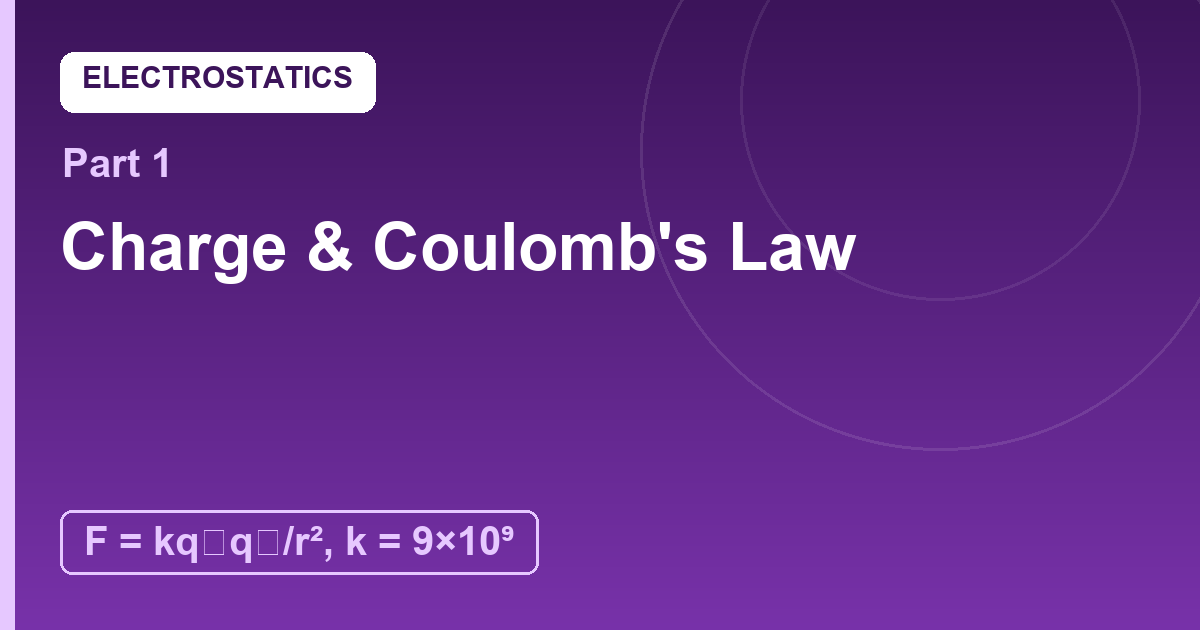
- Coulomb’s law: F = kq₁q₂/r² — looks exactly like gravity, but with a k that is ENORMOUS
- k = 9×10⁹ — electric force is ~10³⁶ times stronger than gravity between two protons
- Charge is quantised (comes in whole electrons) and conserved (never created or destroyed)
- Quantising the charge: q = ne (n whole electrons, e = 1.6×10⁻¹⁹ C)
Rub a balloon on your hair and it sticks to a wall. Lightning tears the sky apart. Both are the same thing: charge — one of the universe’s two great forces, cousin of gravity but a million-trillion-trillion times stronger. Part 1 of the Electrostatics series — the opening card of the Class 12 high-weightage block.
- Two kinds of charge, one simple rule
- Coulomb’s law: gravity’s twin
- What each letter means
- The k surprise: why electricity rules
- Quantisation and conservation
- Solved examples
- Common mistakes
- This physics in your daily life
- Practice set
- Recap
Two Kinds of Charge, One Simple Rule
Charge comes in exactly two flavours: positive (+) and negative (−). The behaviour rule is one line: like charges repel (push apart), unlike charges attract (pull together). Protons carry +e, electrons carry −e, and almost everything around you is neutral only because the two precisely cancel.
Coulomb’s Law: Gravity’s Twin
Place two charges a distance apart — they push or pull with a force given by Coulomb’s law. Compare it with Newton’s gravity and the family resemblance is unmistakable:
| Letter | What it means (plain words) | Value / unit |
|---|---|---|
| F | the push/pull force between the two charges | newtons (N) |
| k | Coulomb’s constant — electricity’s strength number | 9 × 10⁹ N·m²/C² |
| q₁, q₂ | the two charges | coulombs (C); e = 1.6×10⁻¹⁹ C |
| r | distance between the charge CENTRES | metres — always squared |
The k Surprise: Why Electricity Rules
Gravity’s G is 6.67×10⁻¹¹; electricity’s k is 9×10⁹. Between two protons, the electric repulsion beats gravitational attraction by a factor of about 10³⁶ — a billion trillion trillion. Why doesn’t electricity crush the universe then? Because ordinary matter is neutral: the positives and negatives cancel almost perfectly, leaving gravity (which never cancels) to run the cosmos at large scales.
Quantisation and Conservation
Quantised: charge comes in whole-electron packets. You can have 1e, 2e, 100e — never half an electron. q = ne. Conserved: the total charge of an isolated system never changes; rubbing a balloon doesn’t create charge, it TRANSFERS electrons (hair → balloon, leaving hair + and balloon −).
Solved Examples
Direct: F = 9×10⁹ × (2×10⁻⁶)² / (0.1)² = 9×10⁹ × 4×10⁻¹² / 0.01.
= 3.6 N — a tangible push between two specks. That’s k’s enormity at work.
Same charges a metre apart would be: 0.036 N (100× distance → 10⁻⁴× force, the inverse square). ✔
Answer: 3.6 N (repulsive, both positive)
Work in ratios: numerator ×2 (charge), denominator ÷4 (distance halved → r² quartered).
New F = 2 × 4 = 8F.
Check each factor separately — the multiplicative bookkeeping of 1/r² laws. ✔
Answer: 8F
q = ne: n = q/e = 1 / 1.6×10⁻¹⁹.
n = 6.25×10¹⁸ electrons — six billion billion in a single coulomb. Now feel why ‘charging’ objects barely dents their electron count: a rubbed balloon shifts maybe a billionth of them.
✔
Answer: n ≈ 6.25 × 10¹⁸ electrons
- Forgetting to square r. The eternal inverse-square trap — square the distance before dividing.
- Using cm with k. k demands metres and coulombs; a μC is 10⁻⁶ C, a cm is 10⁻² m. Convert everything first.
- Sign errors with force direction. The formula gives magnitude; LIKE repels, UNLIKE attracts — set directions by inspection, not by plugging signs blindly.
- ‘Rubbing creates charge.’ No — it transfers electrons. Total charge is conserved; the balloon gains exactly what the hair loses.
This Physics in Your Daily Life
- The balloon-and-hair trick is this entire card: rubbing transfers electrons, the charged balloon polarises the wall’s molecules, and unlike-charge attraction sticks it there.
- Lightning is charge separation gone extreme — clouds rub against air (essentially), build kilomillion-volt charge differences, and the 10³⁶-strong force discharges in a flash.
- Laundry static and crackling sweaters in dry winter air: electron transfer between fabrics, with no humid air to leak it away.
- Photocopiers and laser printers guide toner powder with charged drums — Coulomb’s law, printing your documents.
- Fuel trucks drag earth-chains because transferred charge during fuelling could spark — safety engineering built on charge conservation.
Practice set (answers hidden — try first)
(NEET-level) Two 3 μC charges, 30 cm apart. Force:
(JEE Main-level) One charge doubled, distance doubled. Force becomes:
(NEET-level) Charge on 5×10¹⁴ electrons:
(Concept) A glass rod rubbed with silk becomes positive because:
(JEE Main-level) Two charges attract at F. Both are doubled, distance unchanged:
- F = kq₁q₂/r²; k = 9×10⁹ N·m²/C²
- inverse square: distance ×10 → force ÷100
- quantised q = ne, e = 1.6×10⁻¹⁹ C
- 🔣 like repels, unlike attracts — set direction by inspection
- 🔣 F = kq₁q₂/r², k = 9×10⁹ (vs gravity’s 10⁻¹¹ G)
- 🔣 electric force is ~10³⁶ × gravity between protons
- 🔣 charge quantised: q = ne; conserved: rubbing transfers, never creates
- 🔣 ratio method for combined changes (charge ×2, distance ÷2 → 8F)
- 🔁 like repel, unlike attract
- 🔁 F = kq₁q₂/r², k = 9×10⁹
- 🔁 charge quantised (q = ne) and conserved
- 🧠 Chant: ‘like flees, unlike clings’.
- 🧠 k vs G: ‘electricity is 10³⁶ times the bully’.
- 🧠 One coulomb: ‘six billion billion electrons’.
- 🏠 Daily: balloon-on-wall, winter crackle, lightning — all Part 1.
- 🏠 Daily: photocopiers print with Coulomb’s law.
Quick revision
- Charge comes in two kinds: positive and negative — like charges push apart, unlike charges pull together
- Coulomb’s law: F = kq₁q₂/r² — looks exactly like gravity, but with a k that is ENORMOUS
- k = 9×10⁹ — electric force is ~10³⁶ times stronger than gravity between two protons
- Charge is quantised (comes in whole electrons) and conserved (never created or destroyed)
- Quantising the charge: q = ne (n whole electrons, e = 1.6×10⁻¹⁹ C)
- Two kinds of charge, one simple rule
Have a doubt on this topic?