
JEE/NEET Physics · Thermodynamics series · Part 4 of 6 · All parts →
- Heat engine: draw Q_h from a hot source, dump Q_c to a cold sink, keep the difference as work
- Efficiency η = W/Q_h = 1 − Q_c/Q_h — always less than 1
- Carnot’s theorem: NO engine between two temperatures beats the Carnot engine
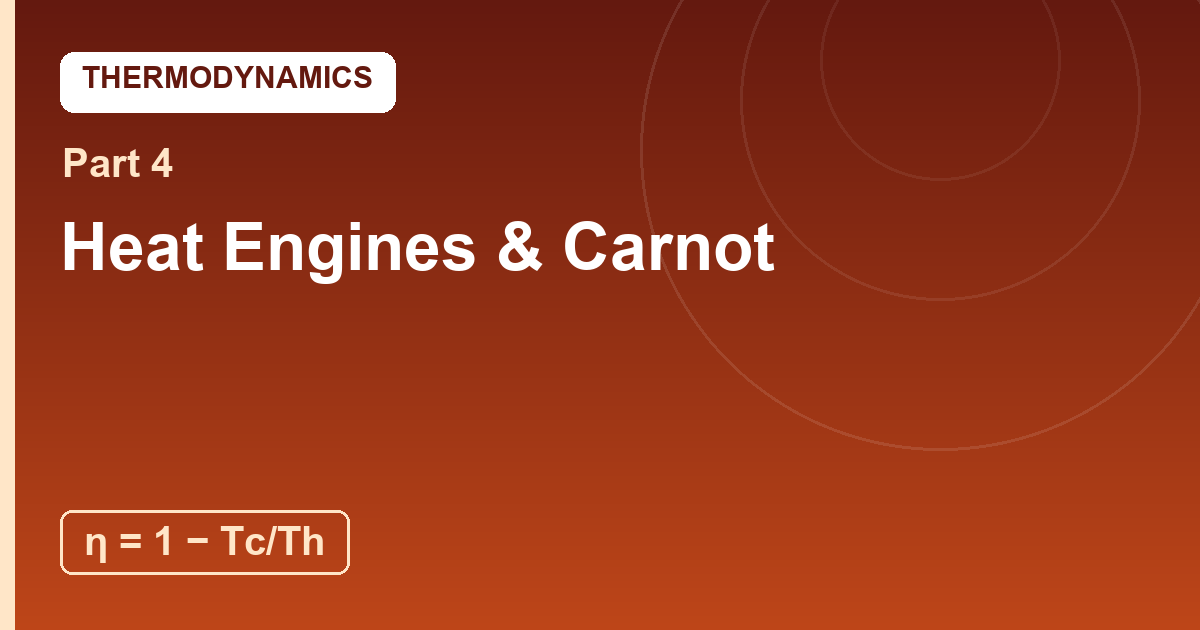
- Carnot efficiency: η = 1 − T_c/T_h (kelvins!) — the absolute ceiling
- The four Carnot strokes: isothermal expansion → adiabatic expansion → isothermal compression → adiabatic compression
Every engine ever built — steam, petrol, jet, or the power plant lighting your room — plays the same game: steal heat from something hot, sell some as work, and bribe the cold with the rest. The laws of physics set the house rules. Part 4 of the Thermodynamics series.
- The three-player game
- Efficiency: the scoreboard
- Carnot’s perfect cycle
- Why Carnot can’t be beaten
- Solved examples
- Common mistakes
- This physics in your daily life
- Practice set
- Recap
The Three-Player Game
A heat engine sits between a hot reservoir (flame, boiler, Sun) and a cold reservoir (air, river, exhaust). Each cycle it absorbs Q_h, converts some to work W, and must dump Q_c = Q_h − W into the cold. The dumping isn’t a design flaw — it’s a law (next part).
Efficiency: The Scoreboard
Carnot’s Perfect Cycle
Sadi Carnot (1824) designed the thought-experiment engine: four reversible strokes between two temperatures. Its efficiency depends on nothing but the two temperatures:
| Letter | What it means (plain words) | Value / unit |
|---|---|---|
| T_h, T_c | hot and cold reservoir temperatures | kelvin (always!) |
| Q_h, Q_c | heat absorbed / rejected per cycle | J |
| η | efficiency | fraction or % |
Why Carnot Can’t Be Beaten
Suppose a better engine existed between the same temperatures: run it backwards (as a fridge) coupled to Carnot forward, and the pair would move heat from cold to hot with no net work — violating the second law. Contradiction → no such engine. The ceiling is logical, not technological.
Solved Examples
η = 1 − 300/500 = 40% — no engine between these baths can do better, whatever the marketing says.
✔
Answer: 40%
η = 1 − 600/900 = 33%.
Carnot: 1 − 300/400 = 25% — the claimed engine BEATS the ceiling: impossible, the numbers must be wrong.
✔
Answer: 33% claimed but violates Carnot’s 25%
η_Carnot = 1 − 275/300 ≈ 8% — legal but puny, and huge, cold-plate engineering makes it impractical.
Infinite energy at tiny ΔT is a treasure vault with a tiny door. ✔
Answer: Only ~8% ceiling; impractical
- Celsius in Carnot’s formula. T’s must be kelvin: 1 − 27/127 is meaningless. Convert first, every time.
- Adding W to Q_h. η = W/Q_h with W = Q_h − Q_c; mixing numerator definitions scrambles the fraction.
- Believing 100% is possible. Only if T_c = 0 K (unreachable) or Q_c = 0 (second law forbids) — efficiency 1 is nature’s locked door.
- Carnot as a real machine. It’s an idealization — real engines add friction, finite-time losses, and always fall short.
This Physics in Your Daily Life
- Power plant siting — coal plants run ~800 K steam vs ~300 K cooling: ~60% Carnot ceiling, ~40% real: the cooling tower you see is the ‘bribe’ being paid to the cold.
- Car engines waste ~60–70% of fuel energy — mostly the mandatory Q_c through the radiator and exhaust: the second law’s tax, not bad engineering.
- GE / Rolls-Royce turbine race — higher T_h materials (ceramic blades, better alloys) directly buy efficiency: metallurgy chasing Carnot.
- Ocean thermal energy (OTEC) pilot plants — harvesting the sea’s surface-deep ΔT at ~3% real efficiency: the tiny-door vault in real life.
- Combined-cycle plants — a gas turbine’s exhaust becomes a steam turbine’s hot source: stacking two Carnot ladders to ~60%: the smartest cheat within the law.
A heat engine is a middleman between rich and poor: it takes energy from the hot, sells some as work, and must pay the cold its cut. Why can’t it keep everything? Because energy taken FROM a hot bath and fully converted to work would leave the universe’s disorder books unbalanced — the transaction needs a waste receipt.
Steam at 500 K → 300 K sink: ceiling 40%. At 900 K: 67%. The engine doesn’t improve by cleverness — the TEMPERATURE LADDER does. This is why better materials (higher T_h) have always been the real engine race, from Watt to jet turbines.
Picture energy as water and the engine as a waterwheel: it only turns while water FALLS from the hot level to the cold level. The fall (T_h − T_c) is the resource; Carnot’s fraction (1 − T_c/T_h) is how much of the fall you can catch. No fall, no work — a single-temperature ocean can’t turn any wheel.
Practice set (answers hidden — try first)
(NEET-level) T_h = 600 K, T_c = 300 K: Carnot η =
(JEE Main-level) Q_h = 1000 J, Q_c = 700 J: η =
(NEET-level) 100% efficiency would require:
(Concept) A real engine claiming η > η_Carnot between the same baths:
(JEE Main-level) 27 °C and 227 °C reservoirs: η_Carnot =
- engine = heat in, work out, heat dumped
- η = 1 − Q_c/Q_h
- Carnot: η = 1 − T_c/T_h (kelvin)
- Carnot unbeatable — by contradiction
- four reversible strokes
- 🔁 engine energy flows
- 🔁 efficiency formulas
- 🔁 Carnot theorem logic
- 🧠 Chant: ‘sell the fall, bribe the cold’.
- 🧠 Kelvins! ‘Celsius in Carnot = instant wrong’.
- 🏠 Daily: car radiator = the mandatory bribe.
- 🏠 Daily: turbine metallurgy = chasing higher T_h.
Quick revision
- Heat engine: draw Q_h from a hot source, dump Q_c to a cold sink, keep the difference as work
- Efficiency η = W/Q_h = 1 − Q_c/Q_h — always less than 1
- Carnot’s theorem: NO engine between two temperatures beats the Carnot engine
- Carnot efficiency: η = 1 − T_c/T_h (kelvins!) — the absolute ceiling
- The four Carnot strokes: isothermal expansion → adiabatic expansion → isothermal compression → adiabatic compression
- Efficiency: the scoreboard
Have a doubt on this topic?