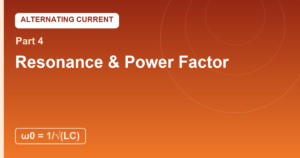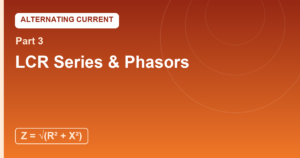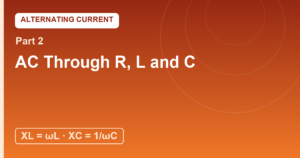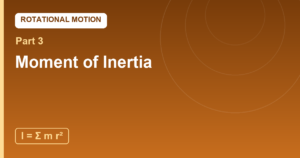
JEE/NEET Physics · Alternating Current series · Part 5 of 5 · All parts →
- Transformer: mutual inductance between coils on a shared core — Vs/Vp = Ns/Np
- Step-up raises voltage (fewer losses in transmission); step-down makes it safe
- Energy conserving (ideal): Ip/Is = Np/Ns — voltage up, current down
- LC oscillations: charge sloshes between C and L at ω₀ — electrical SHM
- The whole series on one card — RMS, reactances, LCR, resonance, power, transformers
The transformer is the quiet machine that made the electrical age possible — trading voltage for current without creating or destroying energy. And an LC circuit alone oscillates forever (ideally): the electrical twin of a mass on a spring. This finale card closes the AC story. Part 5 of the Alternating Current series.
- The voltage trader
- Why transmission loves high voltage
- Transformer losses
- LC oscillations: electrical SHM
- The master formula card
- Final practice set
- Recap
The Voltage Trader
| Letter | What it means (plain words) | Value / unit |
|---|---|---|
| N_p, N_s | primary and secondary turns | — |
| V_p, V_s | primary and secondary (RMS) voltages | V |
| efficiency | power out / power in | ~95–99% real transformers |
Why Transmission Loves High Voltage
Line loss = I²R: halve the current and quarter the loss. For the same delivered power, stepping voltage up 10× cuts current 10× and losses 100×. That’s why the grid runs at 400 kV and steps down to 230 V at your door — the Joule-heating card’s lesson, executed by mutual inductance.
Transformer Losses
| Loss | Cause | Fix |
|---|---|---|
| Copper | winding resistance I²R | thicker conductors |
| Eddy | core swirls | laminations |
| Hysteresis | domain flipping | soft-iron core |
| Flux leakage | imperfect coupling | closed core design |
LC Oscillations: Electrical SHM
Charge a capacitor and connect it to an inductor: charge sloshes C → L → C → L forever (ideally), trading ½q²/C for ½LI² — the exact electrical twin of the mass-spring’s ½kx² ↔ ½mv². Frequency: ω₀ = 1/√(LC) — the same resonance frequency, now seen as a natural rhythm.
Solved Examples
V_s = 230 × 500/100 = 1150 V (step-up).
✔
Answer: 1150 V
I_s = 2000/1150 ≈ 1.74 A; I_p = I_s×(Ns/Np) = 8.7 A at 230 V.
Power conserved: 230×8.7 ≈ 2000 W ✔.
✔
Answer: 8.7 A
ω₀ = 1/√(10⁻¹⁰) = 10⁵ rad/s → f = 10⁵/2π ≈ 15.9 kHz.
Radio-frequency sloshing: tune L or C and you’ve built a station’s oscillator.
✔
Answer: ≈15.9 kHz
- Transformers on DC. No changing flux, no induction, just winding resistance (and smoke): transformers are AC-only machines.
- Creating energy in step-ups. Voltage ×5 means current ×⅕ (ideal): power is traded, never made.
- Transformer ‘amplifiers’. An amplifier adds power from a supply; a transformer only converts form — the difference matters conceptually.
- LC oscillations as resonance-only language. The SAME ω₀, but here seen as free oscillation — two views of one frequency.
This Physics in Your Daily Life
- Every pole-mounted box and adapter brick — transformers stepping 11 kV to 230 V and 230 V to 5 V: the voltage staircase of modern life.
- The grid’s 400 kV towers — step-up at plants, step-down at cities: I²R-loss economics deciding the skyline.
- Wireless chargers and RFID — loosely coupled transformers at close range: flux conversations without cords.
- Doorbell chimes and soldering guns — humble step-downs stepping down for safety.
- Radio transmitters’ LC tanks — oscillating charge as pure tone: every broadcast born from an LC rhythm.
Electricity’s cruel economics: delivering power at low voltage means huge currents and I²R losses that eat the product. The transformer breaks the curse — voltage and current are freely tradable, so ship power at tiny current and convert at both ends. It’s the arbitrage desk of the electrical economy.
100 MW at 230 V would need 435,000 A — cables thick as rooms. At 400 kV: 250 A — practical wires. Same power, million-fold friendlier currents: the entire grid architecture hangs on Vs/Vp = Ns/Np.
Two coils on a shared iron ring: primary’s AC flux circulates the core and threads the secondary turn by turn — each secondary turn harvesting the same dΦ/dt. More turns, more harvest: the turns-ratio IS the voltage ratio, drawn.
Practice set (answers hidden — try first)
(NEET-level) Ns/Np = 20, Vp = 20 V: Vs =
(JEE Main-level) Ideal transformer: Vs > Vp means Is
(NEET-level) Transformers require
(Concept) LC oscillation frequency:
(JEE Main-level) L=1 mH, C=1 μF: f ≈
- Vs/Vp = Ns/Np; power conserved
- high-V transmission starves I²R losses
- four loss types and fixes
- LC: electrical SHM at 1/√(LC)
- transformers are AC-only
- 🔁 turns-ratio relations
- 🔁 transmission economics
- 🔁 loss catalogue
- 🧠 Chant: ‘turns trade voltage; power stays’.
- 🧠 Grid logic: ‘ship it high, use it low’.
- 🏠 Daily: adapter bricks are tiny transformers.
- 🏠 Daily: LC tanks broadcast every radio tone.
Quick revision
- Transformer: mutual inductance between coils on a shared core — Vs/Vp = Ns/Np
- Step-up raises voltage (fewer losses in transmission); step-down makes it safe
- Energy conserving (ideal): Ip/Is = Np/Ns — voltage up, current down
- LC oscillations: charge sloshes between C and L at ω₀ — electrical SHM
- The whole series on one card — RMS, reactances, LCR, resonance, power, transformers
- Why transmission loves high voltage
Have a doubt on this topic?