JEE/NEET Physics · Alternating Current series · Part 4 of 5 · All parts →
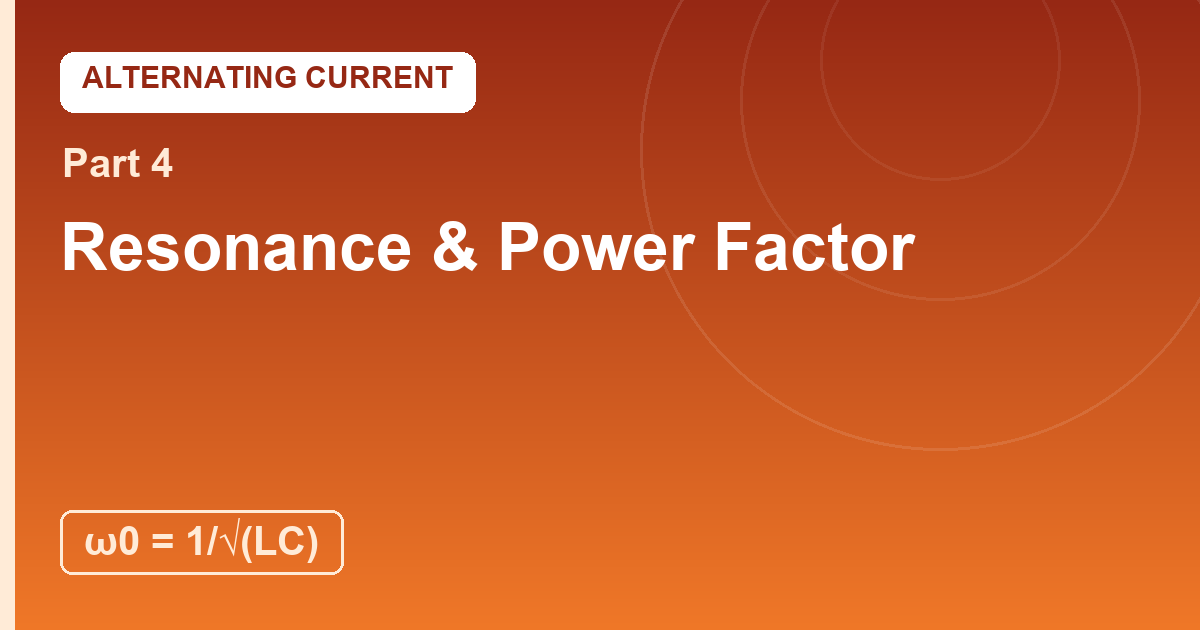
- Resonance: X_L = X_C at ω₀ = 1/√(LC) — impedance collapses to R alone
- At resonance: maximum current, circuit behaves purely resistive, φ = 0
- Sharpness measured by Q = ω₀L/R — high Q = narrow, selective tuning
- Average power: P = V_rms I_rms cosφ — only the in-step component works
- cosφ = power factor: R/Z — why utilities love factor-1 customers
Tune an old radio and you’re sliding a circuit toward resonance — the one frequency where coil and capacitor cancel each other perfectly and current pours through. Meanwhile the power factor decides how much of the current you’re billed for actually does work. Part 4 of the Alternating Current series.
- Resonance: the great cancellation
- The resonance formulas
- Q: sharpness of the selectivity
- Power factor: the honest fraction
- Solved examples
- Common mistakes
- This physics in your daily life
- Practice set
- Recap
Resonance: The Great Cancellation
At ω₀ = 1/√(LC), X_L = X_C exactly: the net reactance vanishes and Z falls to bare R. Current peaks (I_max = V/R), voltage and current realign (φ = 0), and L and C exchange energy between themselves like a pendulum — the source only feeds the resistor’s losses.
Q: Sharpness of the Selectivity
High Q (small R): a needle-narrow peak — the circuit responds to ONE frequency and ignores neighbours: radio selectivity. Low Q: a broad hill, many frequencies pass: crude but tolerant. Bandwidth = ω₀/Q.
Power Factor: The Honest Fraction
Reactive components draw current that swings back and forth uselessly (they return it next quarter-cycle). cosφ counts the productive fraction: 1 = all work; 0.5 = half the current’s capacity wasted on circulating energy.
Solved Examples
ω₀ = 1/√(25×10⁻⁶) = 200 rad/s; f₀ = 200/2π ≈ 31.8 Hz.
✔
Answer: 200 rad/s; 31.8 Hz
I = 20/4 = 5 A; V_C = 5 × 500 = 2500 V — voltage magnification (Q = 125!).
✔
Answer: 5 A; 2500 V across C
P = 230×10×0.8 = 1840 W; reactive component = 10×sin(cos⁻¹0.8) = 6 A sloshing uselessly.
Capacitor banks at factories cancel exactly this: power-factor correction, industry-style.
✔
Answer: 1840 W real; 6 A reactive
- Resonance minimizing impedance in PARALLEL. Series: Z minimum, current maximum. Parallel LCR: Z maximum — the mirror case; read the circuit first.
- Q as quality of power. Here Q = selectivity sharpness (ω₀L/R) — unrelated to charge n or heat Q of other cards: context is everything.
- Power factor in DC thinking. P = VI only when φ = 0: always carry cosφ in AC power.
- Resonant voltage magnification ignored. Component ratings must withstand Q×V_source: real capacitors die of exam-ignored voltages.
This Physics in Your Daily Life
- Every radio, TV and phone tuner — resonance selecting one carrier from thousands: your channel choice is an LC value.
- Factory capacitor banks — correcting lagging power factors to avoid utility penalties: accountants balancing phasors.
- Induction cooktops and wireless chargers — resonant coupling maximising transfer: efficiency by cancellation.
- Electric grid voltage stability — resonance considerations in long lines (Ferranti effects): planners minding the sweet spots.
- MRI and metal detectors — resonance (radio-frequency and nuclear too) as measurement: physics repeating its favourite trick.
Push a swing at exactly its own rhythm: each small push lands in step, and the amplitude soars. The LCR at ω₀ is that swing: L and C trade energy back and forth at their natural rate, and the source’s every volt lands in phase. Off-rhythm pushes fight the motion — off-resonance currents die in reactance.
L = 1 H, C = 25 μF: resonance at 32 Hz. At 32 Hz: Z = R (say 4 Ω) — current floods. At 320 Hz: X_L ≈ 2000, X_C ≈ 20 → Z ≈ 1980 Ω — current starved hundredfold. One frequency welcomed, neighbours turned away: the tuner’s entire personality in two divisions.
Plot current against frequency: a peaked hill centred on ω₀, height V/R, width ω₀/Q. Raise Q: same height, narrower waist — the selectivity needle. Overlay power factor: it rises to 1 exactly at the peak and falls away on both flanks: two curves telling one story.
Practice set (answers hidden — try first)
(NEET-level) L=2 H, C=0.5 F… wait, 2 H and 0.5 μF: ω₀ =
(JEE Main-level) At resonance, phase difference between V and I:
(NEET-level) cosφ =
(Concept) Higher Q means
(JEE Main-level) 100 V, 5 A, cosφ = 0.6: P =
- ω₀ = 1/√(LC): X_L = X_C
- series resonance: Z = R, I max, φ = 0
- Q = ω₀L/R: sharpness/selectivity
- P = V_rmsI_rms cosφ
- cosφ = R/Z: the productive fraction
- 🔁 resonance condition and formulas
- 🔁 Q meaning
- 🔁 power factor logic
- 🧠 Chant: ‘one over root LC’.
- 🧠 Swing rule: ‘push in rhythm, amplitude soars’.
- 🏠 Daily: tuning a radio is choosing ω₀.
- 🏠 Daily: factories install capacitors to fix cosφ.
Quick revision
- Resonance: X_L = X_C at ω₀ = 1/√(LC) — impedance collapses to R alone
- At resonance: maximum current, circuit behaves purely resistive, φ = 0
- Sharpness measured by Q = ω₀L/R — high Q = narrow, selective tuning
- Average power: P = V_rms I_rms cosφ — only the in-step component works
- cosφ = power factor: R/Z — why utilities love factor-1 customers
- Resonance: the great cancellation
Have a doubt on this topic?