JEE/NEET Physics · Moving Charges & Magnetism series · Part 5 of 8 · All parts →
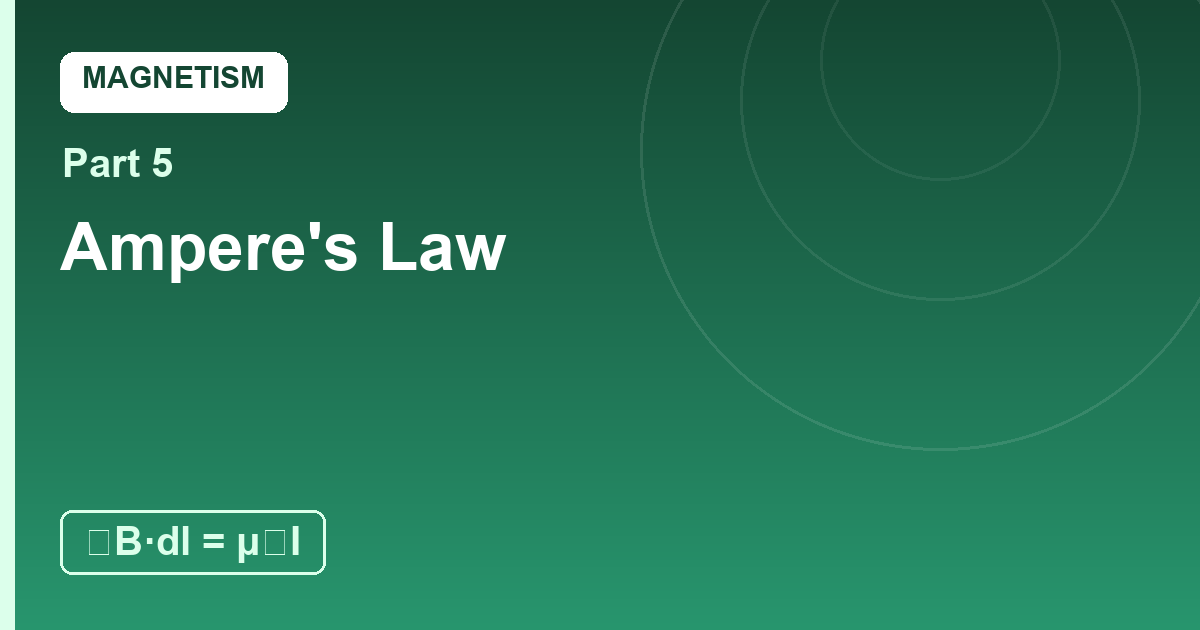
- Ampere’s law: ∮B·dl = μ₀I_enclosed — the magnetic analogue of Gauss’s law
- Field’s ‘circulation’ around any loop = μ₀ × (currents piercing it)
- Useful when symmetry makes B constant along the loop (wires, solenoids, toroids)
- Re-derives wire and solenoid formulas in three lines each
- Currents OUTSIDE the loop contribute zero net circulation
Gauss’s law counted enclosed charge by watching field lines pierce a surface. Ampere’s law counts enclosed current by watching the field circulate around a loop — the same elegant bookkeeping, rotated ninety degrees. Part 5 of the Moving Charges & Magnetism series.
- Circulation: the new bookkeeping
- The law
- Symmetry’s gift
- Toroids and odd paths
- Solved examples
- Common mistakes
- This physics in your daily life
- Practice set
- Recap
Circulation: The New Bookkeeping
Walk a closed loop in a magnetic field, multiplying field-strength-along-your-path by step length, and sum: that’s the circulation. Ampere says it equals μ₀ times the current piercing any surface your loop bounds — nothing else matters.
The Law
Symmetry’s Gift
| Symmetric case | Loop choice | Result |
|---|---|---|
| Long straight wire | concentric circle | B = μ₀I/2πr in one line |
| Solenoid (long) | rectangle threading turns | B = μ₀nI inside |
| Toroid | circle inside the ring | B = μ₀NI/2πr — fully contained |
| Thick wire (inside) | circle within the metal | B grows linearly with r |
Toroids and Odd Paths
A toroid (donut solenoid) confines its field entirely inside the ring — no stray exterior field, and Ampere’s circle inside delivers the answer instantly. For non-symmetric paths, the law still HOLDS but stops being useful (B varies along the path) — Biot-Savart then grinds it out element by element.
Solved Examples
B(2π×0.05) = μ₀×20 → B = (4π×10⁻⁷×20)/(0.1π) = 8×10⁻⁵ T.
✔
Answer: 8×10⁻⁵ T
I_enc = I(r/R)² = I/4; B = μ₀(I/4)/(2π(R/2)) = μ₀I/(4πR).
At the surface B_s = μ₀I/2πR → interior field = B_s/2.
✔
Answer: Half the surface value
I_enc = 10 − 6 = 4 A → ∮B·dl = μ₀×4 = 5×10⁻⁶ T·m.
Outside currents matter only through their NET piercing — a signed census.
✔
Answer: 5×10⁻⁶ T·m
- Using Ampere’s law for asymmetric geometries. It’s always TRUE but only COMPUTABLE when B is constant on a well-chosen loop.
- Unsigned current counting. Piercing currents carry signs by right-hand orientation: opposite currents subtract.
- Confusing circulation with field strength. The loop integral is μ₀I_enc; extracting B needs the symmetry argument.
- Forgetting the thick-wire interior case. Inside, only the enclosed fraction of current counts: B grows linearly from zero at the centre.
This Physics in Your Daily Life
- Clamp meters (electricians’ tongs) — an Amperian loop you can open: the meter reads circulation and prints current, without touching the wire: this law sold as a tool.
- Toroidal transformers — confined field means no stray hum or interference: clean power conversion by donut geometry.
- Fuse and breaker ratings verified in labs — current measured by field circulation standards: metrology running on Ampere.
- Maglev guideway design — field containment and shaping analysed with Amperean loops: levitation engineered by circulation budgets.
- Ground-fault circuit interrupters (GFCIs) — compare circulation around live and neutral: any imbalance trips in milliseconds: Ampere’s law saving lives in bathrooms.
Wrap a string around a spinning top: the twirl it carries away tells you the top’s spin. Wrap an imaginary loop around a current: the magnetic twirl (circulation) it carries tells you the current. The field is the messenger; the current is the message; the loop integral reads the envelope.
20 A piercing a loop: circulation 4π×10⁻⁶×20/… μ₀I = 2.5×10⁻⁵ T·m. Double loop radius with same current: B halves, path doubles — circulation UNCHANGED. It’s an invariant of the current, not of your choice of loop: the signature of a conservation law.
Draw field circles around a wire, then an Amperian loop riding along a field circle: everywhere the field points along your walk — the product B×(path) accumulates smoothly. Detour the loop outward where B is diagonal, and the diagonal parts contribute less — but the total envelope stays pinned to μ₀I.
Practice set (answers hidden — try first)
(NEET-level) Circulation around 5 A:
(JEE Main-level) Doubling loop radius (same wire): circulation
(NEET-level) Ampere’s law relates B’s circulation to
(Concept) Currents outside the Amperian loop:
(JEE Main-level) Inside a uniform wire at r = R/2: B =
- ∮B·dl = μ₀I_enc
- symmetry → constant B → instant answers
- rebuilds wire/solenoid formulas
- toroids confine field fully
- currents signed by orientation
- 🔁 law statement and meaning
- 🔁 symmetry method
- 🔁 interior wire case
- 🧠 Chant: ‘walk the loop, count the piercings’.
- 🧠 Tool form: ‘clamp meters ARE Ampere’s law’.
- 🏠 Daily: electrician tongs read current non-contact.
- 🏠 Daily: GFCI outlets trip by circulation imbalance.
Quick revision
- Ampere’s law: ∮B·dl = μ₀I_enclosed — the magnetic analogue of Gauss’s law
- Field’s ‘circulation’ around any loop = μ₀ × (currents piercing it)
- Useful when symmetry makes B constant along the loop (wires, solenoids, toroids)
- Re-derives wire and solenoid formulas in three lines each
- Currents OUTSIDE the loop contribute zero net circulation
- Circulation: the new bookkeeping
Have a doubt on this topic?