MAT Data Interpretation Sufficiency Shortcuts: Score More in Less Time
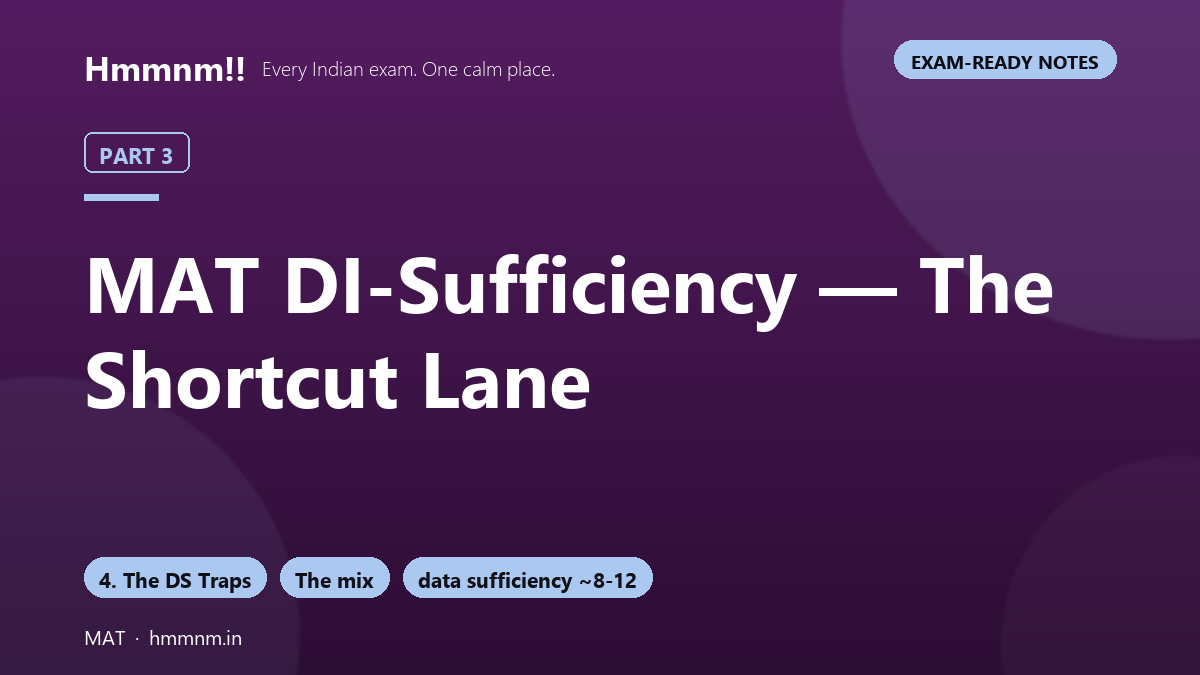
Quick answer: In one line: MAT Part 3: MAT's Data Analysis and Sufficiency section mixes standard DI (tables-charts-graphs) with the data sufficiency question type most aspirants. MAT's Data Analysis and…
- Table of Contents.
- 1. The Section’s Composition.
- 2. The DI at MAT Pace.
- 3. Data Sufficiency: The Method.
- 4. The DS Traps.
- 5. The Allocation-and Elimination Discipline.
- 6. How Exams Probe This Topic.
- 7. Quick Revision: One-Glance Facts.
- Practice Corner: Five DS Checks (with Answers).
- Ten Quick DS Drills (Answers in Brackets).
- The Test-Automation Trap-File (The Deeper-Distractors).
- The Sectional-Week’s Structure (The MAT’s the Micro-Cycle).
- Related exam guides.
- Frequently Asked Questions
- What should you know about 1. The Section's Composition?
- What should you know about 2. The DI at MAT Pace?
- What should you know about 3. Data Sufficiency: The Method?
- What should you know about 4. The DS Traps?
- What should you know about 5. The Allocation-and Elimination Discipline?
- About the Author
- References & authoritative sources
In one line: MAT Part 3: MAT's Data Analysis and Sufficiency section mixes standard DI (tables-charts-graphs) with the data sufficiency question type most aspirants.
MAT’s Data Analysis and Sufficiency section mixes standard DI (tables-charts-graphs) with the data sufficiency question type most aspirants under prepare — the section’s shortcut lane. This note covers both.
Quick Answer: MAT’s Data Analysis and Sufficiency section mixes standard DI (tables-charts-graphs) with the data sufficiency question type most aspirants under prepare — the section’s shortcut lane. This note covers both.
Table of Contents.
- The Section’s Composition
- The DI at MAT Pace
- Data Sufficiency: The Method
- The DS Traps
- The Allocation-and Elimination Discipline
- How Exams Probe This Topic
- Quick Revision: One-Glance Facts
1. The Section’s Composition.
- ~40 questions: data interpretation sets (tables, bar-pie line graphs, caselets) ~20-25 questions , data sufficiency ~8-12. Plus the odd comparison-and quant lite items — the sufficiency block is the section’s distinctive and neglected component.
- Same 45-second doctrine; DI sets reward the fraction and ratio automation (Part 4-of CAT’s toolkit applied at double speed).
2. The DI at MAT Pace.
- The set method (compressed). Read the table’s frame first (titles-units footnotes — 10 seconds), pre mark the maxima minima (the questions cluster there). Then compute with fraction-approximation (MAT’s options are spaced generously — estimate, don’t calculate).
- The standard computations. Percentages (the fraction table automatic), ratios (the unit method), growth rates (the year over year mental math). Averages (the weighted shortcut) — five operations cover ~90% of the questions.
- In fact, the paragraph data sets: convert to a 3-line mini table before answering — the 30-second investment that halves each question’s time.
3. Data Sufficiency: The Method.
- A question + two statements (1 and 2) + five options: (a) 1 alone sufficient, (b) 2 alone. (c) both-together, (d) each alone, (e) together insufficient — the option order is fixed. Memorise it (the options’ wording varies slightly across MAT papers — read the stem’s version once per paper).
- (1) Decide what the question exactly asks (a value? a range?); (2) test Statement 1 alone — solve-or insufficient; (3) cover 1’s result and test 2 alone (the independence discipline — the #1 error is carrying 1’s information into 2’s test); (4) combine only if both alone fail; (5) match to the option.
- The yes-no variant. Therefore, for “is x > 5—-type questions: sufficiency means a definite yes or no — a “sometimes” is insufficiency; the trap logic differs fundamentally from value-questions.
4. The DS Traps.
- Meanwhile, the carry over error — testing Statement 2 with Statement 1’s data (the discipline: physically cover).
- Solving-not deciding — DS needs only sufficiency, not the answer’s value: if you can see x is findable, stop — the full solve wastes 60 seconds.
- As a result, the unique value requirement — a quadratic giving two values is insufficient for “what is x—(the hidden solutions trap).
- In other words, the obvious together jump — choosing (c) without testing each alone (each alone answers are more common than test takers assume).
- Zero and negative forgetting — in number property DS (the “is n positive—family), test the boundary values (0, negatives, fractions) before declaring sufficiency.
5. The Allocation-and Elimination Discipline.
- Notably, the 30-minute plan: the DI sets first (~20-22 min — the reliable bulk) → the DS block (~7-8 min at ~40-45 seconds each — the trained DS question is fast; the untrained is a time-pit) → review.
- The triage rule. Indeed, a DI set with dense irregular data gets skipped wholesale (the 4-question sunk risk). Meanwhile, the DS’s “number properties” family is the quick lane for the prepared — the two extremes of the section’s value.
6. How Exams Probe This Topic.
- Specifically, the practice regime: daily mixed sectionals. Meanwhile, the DS block drilled separately (50-60 questions until the option matching is automatic). Past-MAT papers for the authentic DI style.
- Cross-reference: CAT Part 4’s fraction toolkit, Part 1-of MAT’s pace doctrine, Part 8’s 90-day plan.
7. Quick Revision: One-Glance Facts.
- DI ~20-25 + DS ~8-12.
- Exact question → 1 alone → 2 alone (covered) → combine → match; sufficiency-not solving.
- Carry over, full-solves, unique-value, obvious-together, boundary-values.
- DI 20 min → DS 8 min → review; skip the hostile set wholesale.
Similarly, the section is two lanes: the DI bulk at approximation speed. Meanwhile, the data sufficiency block — the shortcut lane for the prepared (a 40-second question type) and a time-pit for the untrained. Master the independence discipline and the sufficiency not solving habit. Meanwhile, this section delivers the paper’s most efficient minutes.
Practice Corner: Five DS Checks (with Answers).
- Overall, the five DS options’ order (fixed)? — (a) 1 alone, (b) 2 alone, (c) both together, (d) each alone, (e) together insufficient .
- The #1 DS error? — Carrying statement 1’s data into statement 2’s test — cover the first physically .
- Consequently, what does DS require — the answer or sufficiency? — Sufficiency only; stop once findability is established .
- The yes-no variant’s rule? — A definite yes or no is sufficient; “sometimes” is not .
- Which values must be tested before declaring sufficiency? — The boundaries: zero, negatives, fractions .
Ten Quick DS Drills (Answers in Brackets).
- What is x? I: x² = 25 II: x < 0 — [Both together: x = −5, answer c].
- Is n an integer? I: 2n is an integer II: n² is an integer — [I alone insufficient (n = 1.5? no — 2n = 3 integer), II alone sufficient? n² integer forces n integer or irrational — n = √2 gives 2, so insufficient; together: c].
- What is a + b? I: a − b = 4 II: ab = 0 — [Neither sufficient alone; together a or b is 0 — still two possibilities, e].
- Is x > y? I: x² > y² II: x > 0 — [Insufficient even together — negative y with larger absolute value breaks it, e].
- Furthermore, what is the area of the square? I: the diagonal is 10 II: the perimeter is 20√2 — [Each alone: d].
Drill ten such items daily for a week — the option matching becomes automatic, and the section’s fastest marks stop leaking.
The Test-Automation Trap-File (The Deeper-Distractors).
Likewise, the deeper trap layer of MAT reasoning. Reverse syllogisms : the conclusions are given and you choose the statements — the Venn logic runs backward, eliminated by contradiction. Coded inequality’s either-or complement : when ‘A >. B’ and ‘A < B’ are both non-definite, they may form a complementary pair answerable as ‘either’ — the classic miss. Number series’ double pattern : interleaved series (the 1,4,2,5,3,6 type) hide two patterns in one line — identifying both is the trap’s escape. Analogies’ relation naming : classify the relation (degree, part-whole, cause-effect) before mapping — surface similarity like ‘nurse is to hospital’ is the trap. New-pattern coding : Chinese-style sentence-to-word mapping where word order and position form the two-line code to crack. Five traps, the last 5 percent of the section.
The Sectional-Week’s Structure (The MAT’s the Micro-Cycle).
The weekly architecture, MAT-specific. Monday and Thursday : reasoning — 30 items rotating the pattern ladder and puzzle types. Tuesday and Friday : quant — 25 items rotating chapters by weight, arithmetic first. Wednesday : DI and DS — two sets plus 15 DS items as an independence drill. Saturday : one full 40-question section in 30 minutes, rotating through the five sections. Sunday : the error-log review and a GK compilation pass — a light recovery day. In short, the week totals 12-15 hours — a realistic load for both working adults and students, with never a zero day to preserve continuity.
Read next: SNAP Part 8: The 8-Week Plan with CAT Overlap, Exam-Ready Notes
Related exam guides.
- SNAP Part 8: The 8-Week Plan with CAT Overlap, Exam-Ready Notes.
- SNAP Part 7: GE-PI-WAT — The SIBM Interview Loop, Exam-Ready Notes.
- SNAP Part 6: Retakes — The Multi-Attempt Rule and How to Use It, Exam-Ready Notes.
Frequently Asked Questions
What should you know about 1. The Section's Composition?
~40 questions: data interpretation sets (tables, bar-pie line graphs, caselets) ~20-25 questions , data sufficiency ~8-12. Plus the odd comparison-and quant lite items — the sufficiency block is the section’s distinctive and neglected component. Same 45-second doctrine; DI sets reward the fraction and ratio automation (Part 4-of CAT’s toolkit applied at double speed).
What should you know about 2. The DI at MAT Pace?
The set method (compressed). Read the table’s frame first (titles-units footnotes — 10 seconds), pre mark the maxima minima (the questions cluster there). Then compute with fraction-approximation (MAT’s options are spaced generously — estimate, don’t calculate). The standard computations. Percentages (the fraction table automatic), ratios (the unit method), growth rates (the year over year mental math). Averages (the weighted shortcut) — five operations cover ~90% of the questions.
What should you know about 3. Data Sufficiency: The Method?
Subsequently, a question + two statements (1 and 2) + five options: (a) 1 alone sufficient, (b) 2 alone. (c) both-together, (d) each alone, (e) together insufficient — the option order is fixed. Memorise it (the options’ wording varies slightly across MAT papers — read the stem’s version once per paper).
What should you know about 4. The DS Traps?
In fact, the carry over error — testing Statement 2 with Statement 1’s data (the discipline: physically cover). Solving-not deciding — DS needs only sufficiency, not the answer’s value: if you can see x is findable, stop — the full solve wastes 60 seconds. As a result, the unique value requirement — a quadratic giving two values is insufficient for “what is x—(the hidden solutions trap).
What should you know about 5. The Allocation-and Elimination Discipline?
Moreover, the 30-minute plan: the DI sets first (~20-22 min — the reliable bulk) → the DS block (~7-8 min at ~40-45 seconds each — the trained DS question is fast; the untrained is a time-pit) → review. The triage rule. In other words, a DI set with dense irregular data gets skipped wholesale (the 4-question sunk risk). Meanwhile, the DS’s “number properties” family is the quick lane for the prepared — the two extremes of the section’s value.
References & authoritative sources
Source: compiled from official notifications, standard textbooks and our own mock-test analytics; last reviewed September 2026.
Quick revision
- The Section’s Composition
- Data Sufficiency: The Method
- The Allocation-and Elimination Discipline
- How Exams Probe This Topic
- Quick Revision: One-Glance Facts
- ~40 questions: data interpretation sets (tables, bar-pie line graphs, caselets) ~20-25 questions , data sufficiency ~8-12.
Have a doubt on this topic?
Sources & official references
External references for fact-checking and further reading.