JEE/NEET Physics · Current Electricity series · Part 7 of 8 · All parts →
- Potentiometer: a wire as a programmable voltage tap — compares EMFs without drawing current
- Balance condition: ε_x/ε_s = ℓ_x/ℓ_s (lengths at null)
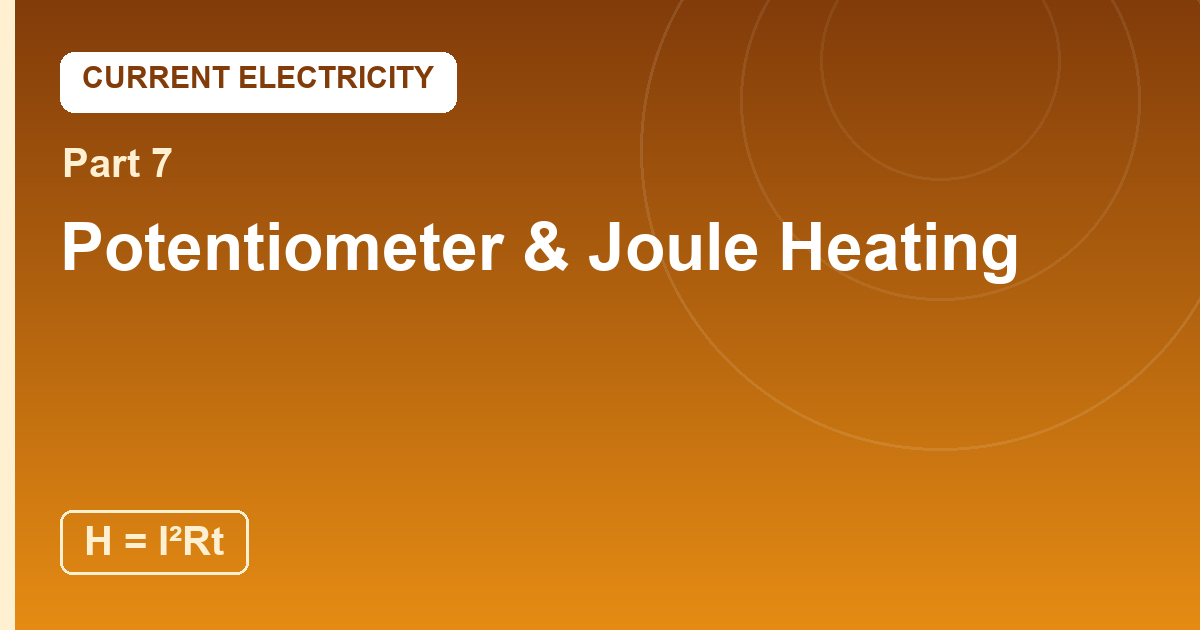
- Joule’s law of heating: H = I²Rt — heat grows with current SQUARED
- Kilowatt-hour: 1 unit = 3.6×10⁶ J (the electricity bill’s unit)
- Heaters use high-resistance elements deliberately; transmission lines use low R and high V to cut I²R losses
The same physics that runs your geyser (I²Rt heating) also runs the precision lab’s best voltmeter (the potentiometer’s null method). One cooks your breakfast, the other measures to six decimals — both are current electricity’s proudest children. Part 7 of the Current Electricity series.
- The potentiometer: a measuring ruler
- The null comparison
- Joule heating: why I²
- The kilowatt-hour and your bill
- Transmission at high voltage
- Solved examples
- Common mistakes
- This physics in your daily life
- Practice set
- Recap
The Potentiometer: A Measuring Ruler
A long uniform wire fed by a driver cell has a smooth voltage drop along its length — every point is a tap at a known fraction of the total. Slide a contact until a test cell’s EMF exactly cancels the local tap: null. The test cell delivers no current, so its internal resistance never biases the reading.
Joule Heating: Why I²
Drifting electrons collide with the lattice, surrendering field-gained energy as heat — at a rate VI = I²R. The square is vicious: double the current, quadruple the heat. That’s why overloads melt wires and why current ratings matter.
The Kilowatt-Hour and Your Bill
P = VI = I²R; the meter counts kW×h: 1 unit = 3.6 MJ. A 1 kW iron for an hour = 1 unit. The Units & Measurements series met this unit; here it earns its keep.
Transmission at High Voltage
Line loss = I²R_line. For the same delivered power (P = VI), raising V a hundredfold cuts I a hundredfold and losses ten-thousandfold: the entire logic of the grid’s 400 kV towers.
Solved Examples
P = V²/R = 230²/10 ≈ 5.3 kW — a typical geyser rating.
✔
Answer: ≈5.3 kW
ε_x = 1.5 × 75/60 = 1.875 V.
✔
Answer: 1.875 V
(a) I = 100 A → loss = I²R = 100 kW (all of it!). (b) I = 10 A → loss = 1 kW — a hundredfold voltage, ten-thousandfold saving.
✔
Answer: 100 kW vs 1 kW
- Using V = IR for the potentiometer’s test cell. At null, the test cell drives nothing — its terminal voltage EQUALS its EMF, which is the whole point.
- Heating ∝ I instead of I². The square is the exam’s most retested single fact: fuses, ratings, and losses all ride on it.
- Mixing energy units. kWh is energy (3.6 MJ); kW is power: the bill counts the former.
- High voltage ‘to reduce R’. Lines stay the same R — high V reduces I, and I² does the rest: say it correctly.
This Physics in Your Daily Life
- Every appliance’s wattage sticker is P = VI = I²R computed at design current: your kitchen is a Joule-heating catalogue.
- Electricity bills in ‘units’ — kWh counted by the meter: 3.6 MJ per unit, priced at the tariff: physics invoiced monthly.
- Transmission towers and transformers — step up to hundreds of kV to starve the I²R losses: the grid’s entire architecture from one square.
- Incandescent bulbs and toasters — deliberate high-R elements glowing white-hot: light and breakfast by Joule heating.
- Laptop chargers and phone fast-charge negotiation — manage I²R heating in cables: why thick short cables charge faster and cool plugs matter.
Electrons gain energy from the field between collisions — twice the field, twice the gain per collision AND (Ohm) twice the collisions per second per electron passing. Power ∝ I × V, and both scale with I: hence I²R. Friction that scales with flow-rate squared — familiar from air drag.
1 A through 10 Ω: 10 W. 2 A: 40 W. 10 A: 1000 W — one kettle’s worth from the same resistor. Transmission at 1 kV vs 10 kV for 100 kW: 100 kW lost vs 1 kW — the grid’s whole story in two numbers born of one square.
Draw energy as a waterfall per coulomb: batteries lift, resistors drop, and at the resistor the drop converts entirely to heat (Joule). For the potentiometer, draw the wire’s linear voltage ramp and the test cell as a wall of exact height: slide until wall height matches ramp height — no flow, perfect comparison.
Practice set (answers hidden — try first)
(NEET-level) H for 2 A, 5 Ω, 10 s:
(JEE Main-level) Null at 45 cm vs standard 1.2 V at 60 cm: ε_x =
(NEET-level) 1 unit (kWh) in joules:
(Concept) Transmission uses high voltage to reduce
(JEE Main-level) P for 230 V across 46 Ω:
- potentiometer: EMF comparison by length ratio
- null = no current drawn from the test cell
- H = I²Rt — the square rules
- 1 kWh = 3.6 MJ = 1 bill unit
- high V transmission starves I²R losses
- 🔁 potentiometer principle
- 🔁 Joule’s law and its square
- 🔁 kWh energy accounting
- 🧠 Chant: ‘double the current, quadruple the heat’.
- 🧠 Grid logic: ‘raise V, shrink I, starve the square’.
- 🏠 Daily: the meter counts kWh = 3.6 MJ each.
- 🏠 Daily: toasters glow by Joule heating on purpose.
Quick revision
- Potentiometer: a wire as a programmable voltage tap — compares EMFs without drawing current
- Balance condition: ε_x/ε_s = ℓ_x/ℓ_s (lengths at null)
- Joule’s law of heating: H = I²Rt — heat grows with current SQUARED
- Kilowatt-hour: 1 unit = 3.6×10⁶ J (the electricity bill’s unit)
- Heaters use high-resistance elements deliberately; transmission lines use low R and high V to cut I²R losses
- The potentiometer: a measuring ruler
Have a doubt on this topic?