JEE/NEET Physics · Current Electricity series · Part 6 of 8 · All parts →
- Wheatstone bridge: four resistors in a diamond; balanced when no current crosses the middle
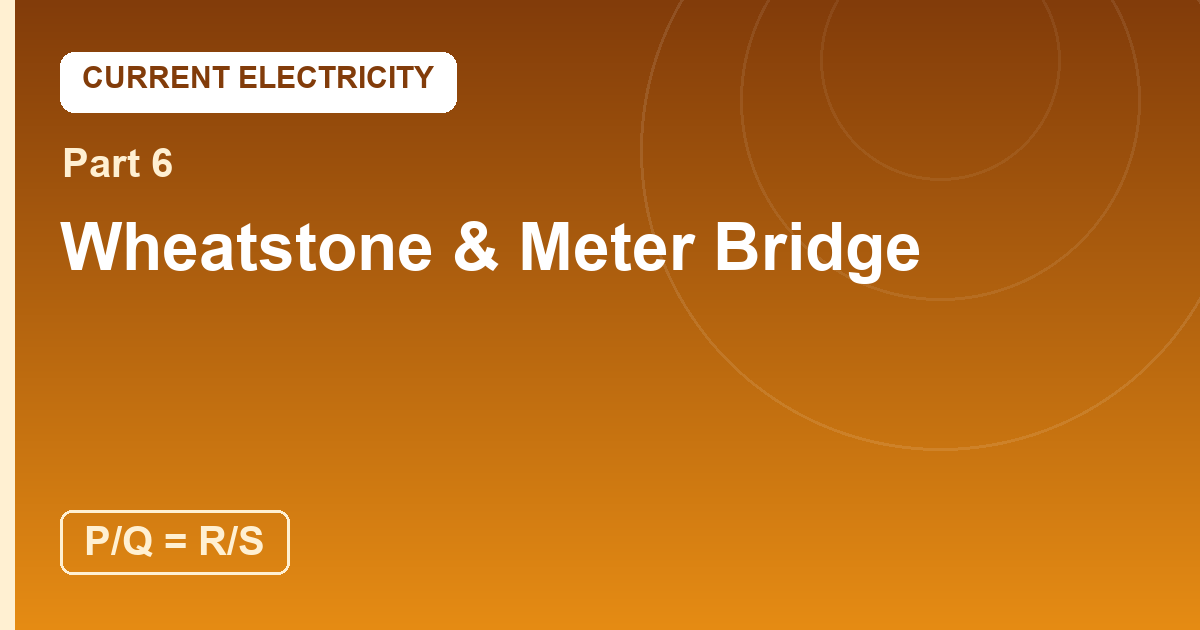
- Balance condition: P/Q = R/S — the unknown compares, nothing absolute needed
- Meter bridge: a 1 m wire as two of the arms; balance point gives ratios
- Balanced bridges are INDEPENDENT of the cell’s EMF — drift-proof measurement
- Applications: strain gauges, load cells, temperature sensors (thermistors)
Measure a resistance without ever knowing the battery’s voltage — by balancing four resistors until a needle sits exactly at zero. The Wheatstone bridge is comparison measurement at its most elegant, and it still runs your bathroom scale and car’s airbag sensor. Part 6 of the Current Electricity series.
- The diamond and its middle wire
- The balance condition
- Why EMF doesn’t matter
- The meter bridge
- Solved examples
- Common mistakes
- This physics in your daily life
- Practice set
- Recap
The Diamond and Its Middle Wire
Four resistors P, Q, R, S form a diamond; a galvanometer bridges the middle. Feed the top and bottom points from a cell. Currents split… and at one special ratio, the two mid-points sit at EXACTLY the same potential: no current crosses the middle — the needle rests at zero. That’s balance.
The Balance Condition
Why EMF Doesn’t Matter
The balance is a RATIO condition: any cell voltage (fresh or dying) produces proportionally scaled currents, and the null persists. This independence is why balanced bridges stay accurate for decades — nothing about the source can bias the reading.
The Meter Bridge
A practical Wheatstone: a uniform 1-metre wire forms two arms (resistance ∝ length). Unknown X and known R complete the diamond:
Solved Examples
S = RQ/P = 15×20/10 = 30 Ω.
✔
Answer: 30 Ω
X = 6×40/60 = 4 Ω.
✔
Answer: 4 Ω
First: X = R(40/60). Second: R = X(50/50) = X → contradiction unless… solving: X² = R²·(2/3) → X/R = √(2/3) ≈ 0.816; with R standardized, X ≈ 0.82 R — the swap technique removes wire-end errors, a real lab refinement.
✔
Answer: X ≈ 0.82 R (swap method)
- Using the bridge unbalanced. All bridge formulas hold ONLY at null; off-balance, the galvanometer current needs full Kirchhoff treatment.
- Reciprocal errors. P/Q = R/S is the pattern — cross-multiply carefully; the exam’s most common slip.
- Length mix-ups in meter bridges. The two arms are ℓ and (100 − ℓ): match each to the correct gap resistor.
- Expecting EMF sensitivity. The method is immune to EMF, but NOT to a non-uniform wire or warm contacts — real error sources live elsewhere.
This Physics in Your Daily Life
- Digital bathroom scales — strain gauges in a Wheatstone bridge: your weight bends strips, unbalancing the bridge by microvolts: balance as a weighing technology.
- Car airbag crash sensors — acceleration deforms bridge elements; the imbalance fires the deploy circuit in milliseconds: life saved by a null-method descendant.
- Biomedical sensors (glucose, temperature) — resistive transducers read by bridges: hospitals run on balanced diamonds.
- Pipeline corrosion monitoring and structural health sensors — bridges track tiny resistance drifts in embedded gauges: bridges watching bridges.
- Calibration labs’ standard resistances — measured by bridge comparison to this day: the null method remains the precision gold standard.
Instead of measuring a flow (always perturbed by the meter), wait for NO flow: a null. Nothing crosses the detector, so the detector disturbs nothing — measurement without contact. Precision comes from detecting ZERO, which human instruments do far more sensitively than any absolute value.
Balance at P/Q = R/S: put a 0.1% standard beside an unknown and the ratio transfers 0.1% accuracy without ever knowing the battery’s EMF — its drift, its internal resistance, its temperature: all cancelled by the null.
Trace current from the battery: it splits at the top, rejoins at the bottom — two parallel voltage dividers. Mark each divider’s midpoint potential: slide one resistor until the midpoints meet — the two ladder-pictures agree, the middle wire goes silent, and the ratio equality is read straight off the geometry.
Practice set (answers hidden — try first)
(NEET-level) Balance with P=2, Q=4, R=6: S =
(JEE Main-level) Meter bridge null at 25 cm, R = 9 Ω: X =
(NEET-level) At balance, galvanometer current =
(Concept) Bridge readings don’t depend on EMF because
(JEE Main-level) Balanced bridge middle wire removed: outer currents change?
- balance: no current in the middle wire
- P/Q = R/S
- independent of EMF — ratio magic
- meter bridge: X = Rℓ/(100−ℓ)
- null methods = precision methods
- 🔁 bridge topology
- 🔁 balance equation
- 🔁 EMF immunity
- 🧠 Chant: ‘equal ratios, silent middle’.
- 🧠 Null power: ‘zero beats any number’.
- 🏠 Daily: bathroom scales = bridge + strain gauges.
- 🏠 Daily: airbag sensors fire from bridge imbalance.
Quick revision
- Wheatstone bridge: four resistors in a diamond; balanced when no current crosses the middle
- Balance condition: P/Q = R/S — the unknown compares, nothing absolute needed
- Meter bridge: a 1 m wire as two of the arms; balance point gives ratios
- Balanced bridges are INDEPENDENT of the cell’s EMF — drift-proof measurement
- Applications: strain gauges, load cells, temperature sensors (thermistors)
- The diamond and its middle wire
Have a doubt on this topic?