JEE/NEET Physics · Mechanical Properties of Fluids series · Part 6 of 7 · All parts →
- Surface molecules are pulled INWARD — the surface behaves like a stretched membrane
- Surface tension T = force/length (N/m); water ≈ 0.072 N/m, mercury ≈ 0.47
- Energy view: surface tension = energy per unit area — surfaces cost energy
- Excess pressure inside drops/bubbles: ΔP = 2T/r (drop), 4T/r (soap bubble — two surfaces)
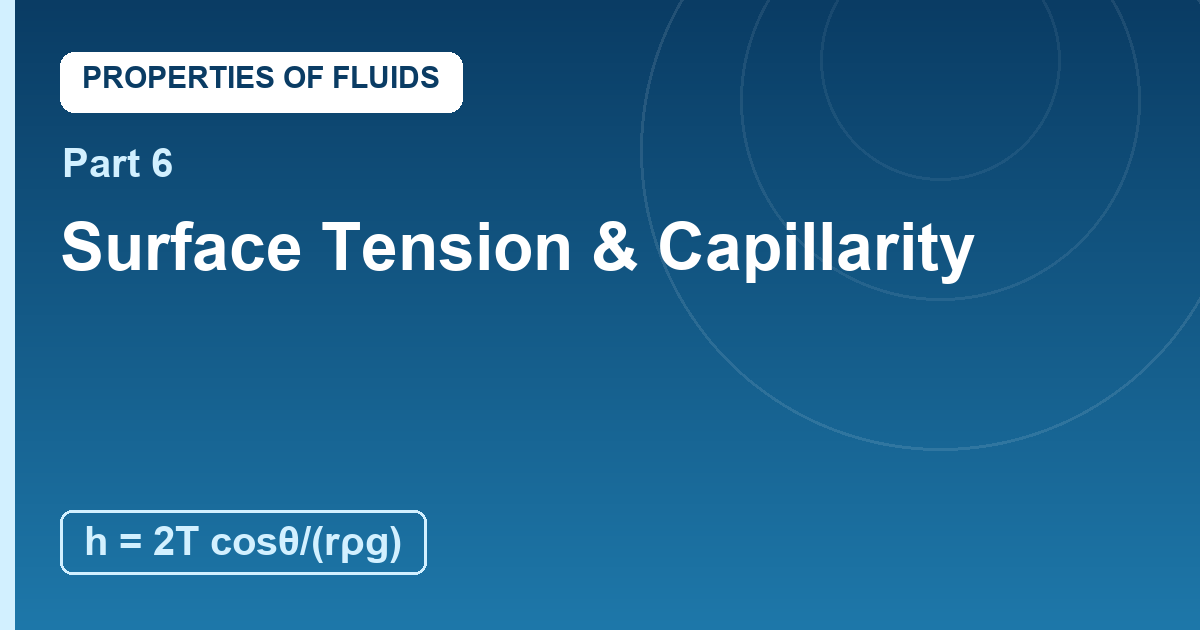
- Capillary rise: h = 2T cosθ/(rρg) — water climbs narrow tubes; mercury depresses
Water striders walk on ponds. Dew forms beads on leaves. Your capillary blood test works with a dot of blood. All from one fact: water’s surface is under tension, like a stretched balloon skin. Part 6 of the Mechanical Properties of Fluids series.
- Why surfaces tense up
- Tension as force, tension as energy
- Drops and bubbles: the inside push
- Capillarity: climbing tubes
- Angle of contact
- Solved examples
- Common mistakes
- This physics in your daily life
- Practice set
- Recap
Why Surfaces Tense Up
A molecule inside water is pulled equally in all directions by neighbours. A molecule at the SURFACE has neighbours only below and beside — the missing upward pull leaves a net inward tug. Crowded by this, the surface shrinks to minimum area: beads, drops, films.
Tension as Force, Tension as Energy
| Letter | What it means (plain words) | Value / unit |
|---|---|---|
| T | surface tension of the liquid | N/m; water 0.072, soap ~0.025, mercury 0.47 |
| θ | angle of contact with a surface | water-glass ≈ 0°, mercury-glass ≈ 140° |
| r | radius of tube or drop | m |
Drops and Bubbles: The Inside Push
| Object | Excess pressure | Why |
|---|---|---|
| Liquid drop | ΔP = 2T/r | one surface |
| Soap bubble (air inside) | ΔP = 4T/r | two surfaces (inner + outer) |
| Air bubble in liquid | ΔP = 2T/r | one liquid surface |
Capillarity: Climbing Tubes
Water wets glass (θ ≈ 0): the surface’s stretch pulls the column up until weight balances: h = 2T cosθ/(rρg). Narrower tube → higher climb. Mercury (non-wetting, θ > 90°) is pushed DOWN instead.
Angle of Contact
Where liquid meets solid, the meniscus shape tells the story: concave (water in glass — adhesive pull wins) or convex (mercury — cohesive pull wins). Capillarity’s sign lives inside cosθ.
Solved Examples
h ∝ 1/r → doubles to 6 cm.
✔
Answer: 6 cm
ΔP = 2T/r = 2×0.072/0.001 = 144 Pa.
✔
Answer: 144 Pa
Drop: 2T/r; bubble: 4T/r — the bubble’s is double, having two surfaces.
Combine two such bubbles and the smaller one (higher internal pressure) empties into the bigger — the classic result. ✔
Answer: Bubble = 2× drop
- Using 2T/r for soap bubbles. Bubbles have two surfaces: 4T/r. Air bubbles in liquid are single-surfaced (2T/r).
- Capillary height in cm-vs-m mix-ups. Keep r in metres; h comes out in metres.
- Sign of capillarity. Mercury’s cosθ is negative — capillary DEPRESSION; water in glass rises.
- Detergent ‘removes’ tension wrongly stated. It LOWERS T (~1/3 for soapy water) — that’s why it spreads and cleans, not because tension vanished.
This Physics in Your Daily Life
- Water striders and floating razor blades — light things resting on the tension ‘skin’: ponds’ weight-bearing film.
- Towels, sponges, and wick lamps — capillary action drags water through millions of microscopic channels: drying and lighting by surface tension.
- Detergents and soaps — lower water’s T so it wets grease and spreads into corners: cleaning is surface-tension engineering.
- Ink in fountain pens and plant water transport — trees lift water metres through xylem capillaries plus osmosis: forests run on this card.
- Dew beading on leaves and waxed cars — non-wetting surfaces minimize area: beads; unwaxed wetting surfaces spread films.
Everyone at a crowded party is comfortable — pushed from all sides, net force zero. The people at the WALL, though, feel the crowd only inward: they’re squeezed toward the room. Water molecules at the surface are wall-people — net inward pull, forever. Crowded from below, they make the boundary as small as possible.
Water’s T = 0.072 N/m: a 1 cm surface line pulls with 0.00072 N — tiny, but enough for insects and dew. Cut a 1 cm² new surface and it costs 7.2×10⁻⁵ J: minute per patch, decisive at insect scale. Small forces rule small worlds.
Draw a surface molecule with attraction arrows from neighbours: below — many; above — none. The arrow-sum points inward. Now picture every surface molecule so armed: the whole layer pulled inward, contracting like a stretched elastic sheet over the liquid.
Practice set (answers hidden — try first)
(NEET-level) Soap bubble vs drop (same r, T): bubble’s ΔP =
(JEE Main-level) Capillary radius halves: rise
(NEET-level) Water on glass has θ ≈ 0° — it
(Concept) Detergent cleaning works by:
(JEE Main-level) ΔP = 2T/r with T = 0.05, r = 1 mm:
- surface molecules pulled inward → film-like surface
- T = force/length = energy/area
- drop: ΔP = 2T/r; soap bubble: 4T/r
- capillary: h = 2T cosθ/(rρg)
- wetting (concave, rises) vs non-wetting (convex, depresses)
- 🔁 origin of surface tension
- 🔁 two formulas for T
- 🔁 excess pressure trio
- 🧠 Chant: ‘drop two-T, bubble four-T’.
- 🧠 Capillary: ‘narrower tube, higher climb’.
- 🏠 Daily: towels dry by capillarity.
- 🏠 Daily: soap works by lowering T.
Quick revision
- Surface molecules are pulled INWARD — the surface behaves like a stretched membrane
- Surface tension T = force/length (N/m); water ≈ 0.072 N/m, mercury ≈ 0.47
- Energy view: surface tension = energy per unit area — surfaces cost energy
- Excess pressure inside drops/bubbles: ΔP = 2T/r (drop), 4T/r (soap bubble — two surfaces)
- Capillary rise: h = 2T cosθ/(rρg) — water climbs narrow tubes; mercury depresses
- Tension as force, tension as energy
Have a doubt on this topic?