JEE/NEET Physics · Laws of Motion series · Part 3 of 8 · All parts →
- One rope = one tension (ideal, massless) — masses tied together share the driver
- Bodies connected by a taut rope share the same speed magnitude (rope length is fixed)
- Method: FBD for EACH body → equations → solve together
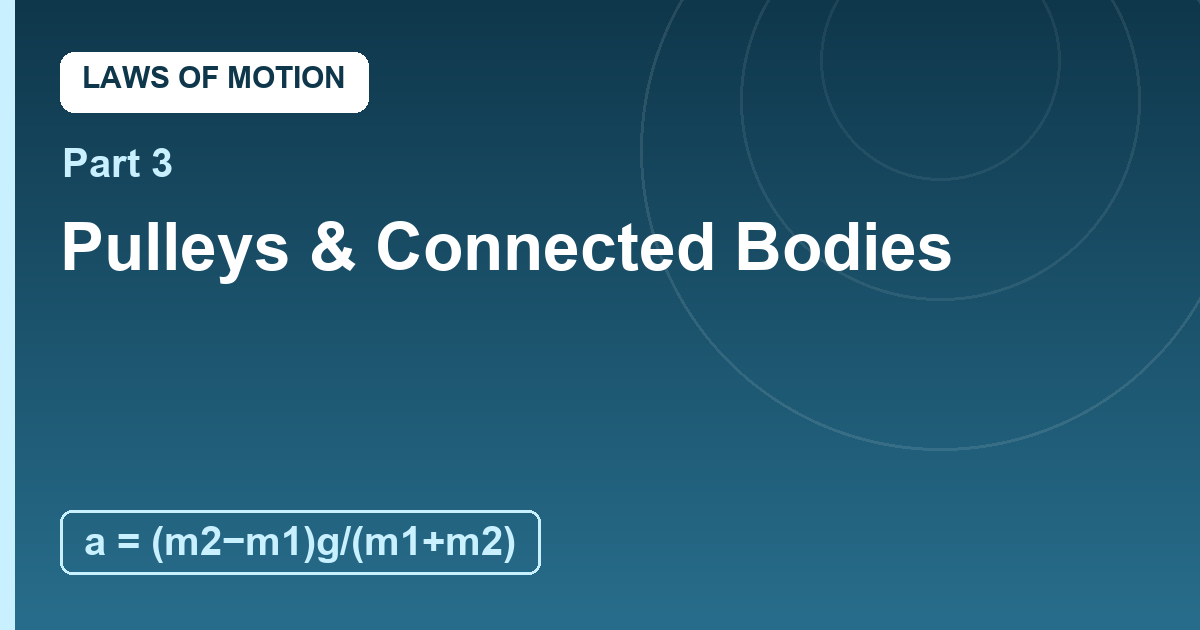
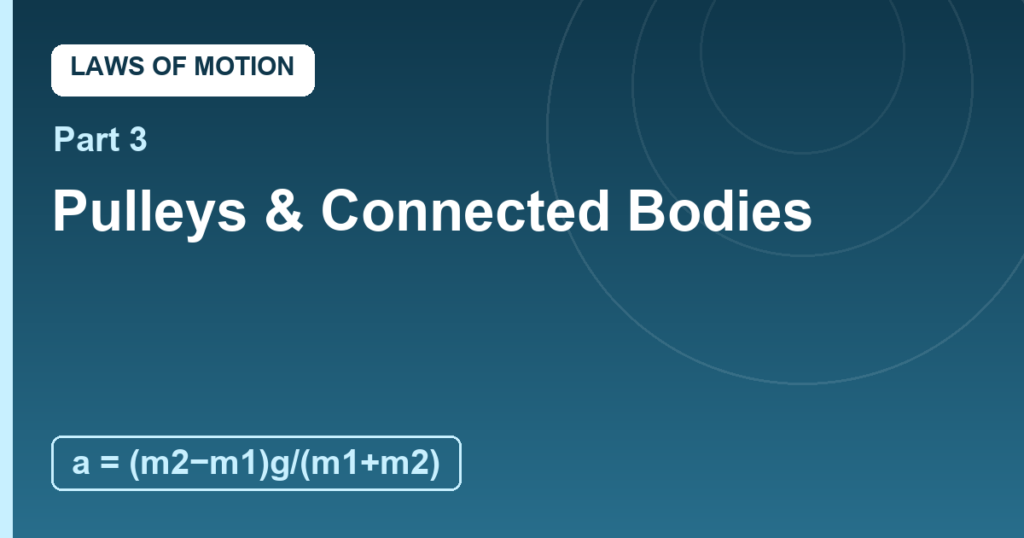
- Classic Atwood machine: a = (m₂ − m₁)g/(m₁ + m₂)
- Wedges and inclined planes: resolve gravity into mg sinθ (along) and mg cosθ (into surface)
Hitch two masses to one rope over a pulley and they become a single team: one acceleration, one shared fate. Pulley problems look like puzzles — they’re actually bookkeeping. Part 3 of the Laws of Motion series.
- The rules of connected teams
- The Atwood machine
- The inclined plane split
- Combining: slope + pulley
- Solved examples
- Common mistakes
- This physics in your daily life
- Practice set
- Recap
The Rules of Connected Teams
Two rules govern every connected system. (1) One ideal rope = one tension everywhere. (2) A taut, inextensible rope makes all attached bodies move with the same speed — one speeds up exactly as much as the other. Combine with per-body FBDs and the system solves itself.
The Atwood Machine
Two masses over a frictionless pulley: the heavier sinks, the lighter rises. Both share acceleration
The Inclined Plane Split
On a slope at angle θ, gravity resolves into mg sin θ along the slope (the pulling part) and mg cos θ into the surface (the pressing part, which sets the normal: N = mg cos θ). Frictionless slide: a = g sin θ — the angle decides everything.
Combining: Slope + Pulley
A mass on a frictionless slope connected over a pulley to a hanging mass: FBD the slider (mg sinθ up-slope vs tension down-slope), FBD the hanger (mg vs T), add the equations to eliminate T. Same three moves, every time.
Solved Examples
a = (5−3)(10)/(8) = 2.5 m/s².
T = 2(3)(5)(10)/8 = 37.5 N.
Check: between the masses’ weights 30 and 50 N — exactly as it must be. ✔
Answer: a = 2.5 m/s²; T = 37.5 N
a = g sin30° = 5 m/s² (g = 10).
Note: mass never entered — slope acceleration is mass-blind, like free fall. ✔
Answer: 5 m/s²
Slider pull along slope: 4 × 10 × sin30° = 20 N (down-slope); hanger pull: 30 N (down).
Net on the 7 kg team: 30 − 20 = 10 N → a = 10/7 ≈ 1.43 m/s², hanger descends.
✔
Answer: ≈1.43 m/s², hanger down
- Different tensions on one rope. One ideal rope = one tension; differing values belong to different ropes or massive pulleys.
- Using g for the slide acceleration. Slope acceleration is g sinθ — only the along-slope gravity component drives it.
- Forgetting the team shares |a|. If the rope is taut, both bodies have equal acceleration magnitudes — that’s what connects the equations.
- N = mg on an incline. The surface feels only mg cos θ; the sin part is busy pulling the block downhill.
This Physics in Your Daily Life
- Construction cranes and hoists — hanging loads on cables are Atwood machines with an engine: cable tension is sized by m(g+a) with safety factors of 5–10.
- Curtains and flag hoists — pulley systems let a small force lift awkward loads by trading distance for force: Atwood’s bargain, household edition.
- Wheelchair ramps and moving-truck ramps — gentle slopes reduce the effective pull from mg to mg sinθ: accessibility engineering is incline physics.
- Treadmills with incline settings — the machine tilts your run so gravity’s sinθ-component adds difficulty without extra speed: gym equipment doing resolved vectors.
- Rock-climbing belay devices — rope tension and friction manage a falling partner: connected-body physics with lives attached.
A tug of war team and the rope are one linked creature: no point of the rope can stretch, so when one end moves a metre, the other end moves a metre — maybe in another direction, but by the same amount. Same distance each second means same speed, and same speed-change means same acceleration. The rope enforces democracy.
Atwood with 3 and 5 kg: the weight difference (20 N) pushes the total inertia (8 kg): a = 2.5 m/s². Both masses read exactly this — the 5 kg down, the 3 kg up. Make it 3 and 3: difference zero, a = 0 — perfect balance, the rope a statue.
Draw both FBDs side by side with the rope connecting the tension arrows: T pulls the heavy mass UP (it loses the tug) and the light mass UP too (it wins the ride). Down-arrows are the weights. Slide the equations together and T cancels in the sum — the system’s equation only cares about external pulls.
Practice set (answers hidden — try first)
(NEET-level) 2 kg and 4 kg Atwood (g=10): a =
(JEE Main-level) Frictionless 45° incline: a =
(NEET-level) N on a 30° incline for a 10 kg block:
(Concept) Atwood with equal masses: acceleration =
(JEE Main-level) 3 kg slides freely down 37° (sin37°≈0.6): a =
- one rope, one tension; taut rope, one |a|
- Atwood: a = (m₂−m₁)g/(m₁+m₂)
- incline: a = g sinθ, N = mg cosθ
- FBD each body, then combine
- internal tensions cancel in the sum
- 🔁 connected-team rules
- 🔁 Atwood formulas
- 🔁 incline resolution
- 🧠 Chant: ‘difference pushes the total’.
- 🧠 Slope split: ‘sin slides, cos clings’.
- 🏠 Daily: ramps make loads mg sinθ-light.
- 🏠 Daily: crane cables sized by m(g+a).
Quick revision
- One rope = one tension (ideal, massless) — masses tied together share the driver
- Bodies connected by a taut rope share the same speed magnitude (rope length is fixed)
- Method: FBD for EACH body → equations → solve together
- Classic Atwood machine: a = (m₂ − m₁)g/(m₁ + m₂)
- Wedges and inclined planes: resolve gravity into mg sinθ (along) and mg cosθ (into surface)
- The rules of connected teams
Have a doubt on this topic?